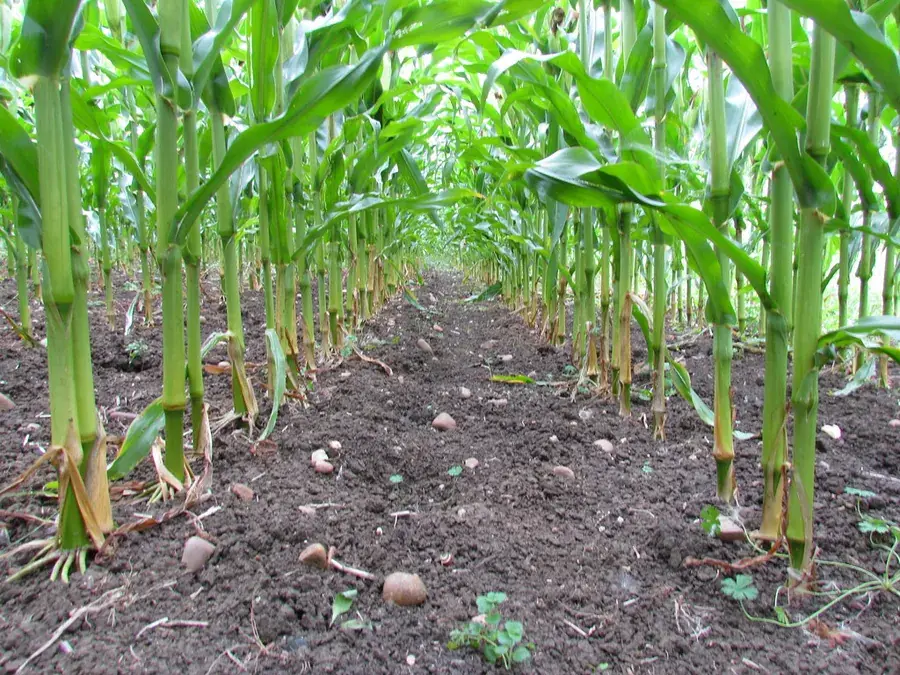
Sweet corn
Zea mays
Twenty minutes from stalk to pot is the rule — and the freezer is the only way to keep August.
- Ready when
- About 18–24 days after the silks first show, when the silks are brown and dry and the ear feels full and rounded to the tip through the husk. Then the milk test: peel back a strip of husk and press a thumbnail into a kernel near the top. Milky white juice means pick it; clear, watery juice means wait two days; thick and doughy means it is past and should be fed to the chickens or cut for soup. Check the ears every day once the silks brown.
- How to pick
- In the cool of the morning, if you can. Hold the stalk with one hand, grip the ear with the other, bend it down sharply and twist — it snaps off clean. Get it into the shade and the kitchen fast: in standard (‘su’) varieties the sugar starts turning to starch the moment the ear leaves the plant, and half of it is gone within a day at room temperature. Supersweet (‘sh2’) and sugary-enhanced (‘se’) types hold longer. Raccoons will know the night before you do — electric fence with two wires at 12 and 25 cm off the ground, or pick a day early.
- On a frost night
- Bring it in. Corn is killed at 0 °C: the leaves go limp and straw-coloured and the ears stop filling that night. The evening a frost is forecast, pick every ear that passes the milk test and freeze or eat it within the day; ears that are not yet filled will not finish on a frosted plant and can go to the chickens or the compost. Nothing covers a corn patch, so a late sowing in a short-season garden is a bet on the weather.
Where it keeps
Storing sweet corn
| Where | Temperature | Humidity | Keeps | How |
|---|---|---|---|---|
| Fridge, in the husk | 0–4 °C32–39 °F | high | 1–2 days for standard types; up to a week for supersweets | Husks on, in a bag, in the coldest part of the fridge, picked that morning. Every hour warm costs sweetness. |
| Kitchen counter | 15–21 °C59–70 °F | moderate | Hours | Only on the way to the pot. Standard sweet corn loses much of its sugar in a day at room temperature. |
Putting it up
What to do with too many sweet corn
Freezing within hours of picking is the only way to keep sweet corn tasting like August. For kernels, husk and silk, blanch whole ears 4 minutes, chill in ice water, cut the kernels off at about two-thirds of their depth without scraping the cob, and bag flat — this is the cut corn that goes into every winter chowder. For corn on the cob, blanch by ear size — 7 minutes for small ears under 3 cm across, 9 for medium, 11 for large — and chill thoroughly, or the cob tastes woody; frozen cobs are good but never quite fresh. Canning corn is pressure-canner only, 55 minutes for 500 ml jars and 85 for litres of whole kernels at 10 lb (weighted gauge, 0–300 m), and cream-style corn in 500 ml jars only for 85 minutes; corn is a low-acid vegetable and there is no safe water-bath time. Supersweet varieties can brown in the jar, so can a small test batch first. Blanched kernels also dry well for soup.
The fastest route and the one that keeps flavour best.
Jars heated above boiling under pressure — the only safe way to can plain vegetables.
A dehydrator or a low oven; light, keeps for a year.
- Freezing
Frozen sweet corn, on the cob and whole kernel
Blanched the same day it was picked, August corn tastes like August in February. Kernels for chowder, a few cobs for a treat.
About 1 kg of kernels from a dozen average ears; a dozen cobs fills a 4 L freezer bag · 45 minutes active
The recipe →
Saving seed
Most garden varieties are hybrids
Nearly every sweet corn sold is an F1 hybrid, and seed saved from it grows a ragged, uneven patch — so for most gardens the answer is simply to buy sweet corn seed every year. Corn is wind-pollinated and crosses with any corn within hundreds of metres, including the neighbour’s field; seed savers keep at least 250 m (800 ft) between varieties and prefer 800 m, or stagger sowings so that two patches silk at least two weeks apart. Even a supersweet eaten fresh goes starchy if a field-corn patch pollinates it, so 100 m (300 ft) or two weeks of separation matters for the table too. Where saving corn seed does make sense is with an open-pollinated flour, flint or dent corn — the old ‘Gaspé’ flint, the ‘Painted Mountain’ flours, the eight-row flints — or an open-pollinated sweet corn like ‘Golden Bantam’: leave the best ears on the stalks until the husks are dry and brown, pick, pull back the husks and hang the ears to finish drying for a month, then shell by hand. Save from dozens of plants at least — corn inbreeds badly from a handful — and from the whole patch rather than one favourite.
Keeps: 1–3 years; sow fresh seed when you can.
The seed-saving guide →Next year
Planning sweet corn for next season
Rotate: corn is a heavy feeder, so follow it with beans or peas and put it where last year’s legumes or a manured bed were; not after corn two years running, to break corn borer and rootworm. Full sun, rich soil with compost or manure, and water when the tassels and silks come. Sow in a block of at least four short rows, never one long row — the pollen falls from the tassels onto the silks and a single row sets half-filled ears — 25–30 cm (10–12 in) apart in the row, rows 75 cm apart. Direct sow 1–2 weeks after the last frost when the soil is 16 °C (60 °F), 3–4 cm deep; supersweets want 18 °C and rot in cold soil. In zones 3–4 pick a 65–70 day variety, warm the soil under black plastic, and start a few in pots indoors three weeks before planting out if you must.
Sweet corn at a glance
- Botanical name
- Zea mays
- Group
- Corn
- Picked
- July, August, September
- Frost
- Tender: finished by the first frost.
- Best put up as
- freezing, pressure canning, drying
- Seed
- Most garden varieties are hybrids
Questions people ask about sweet corn
How do I know when sweet corn is ready?
The silks have turned brown and dry, about three weeks after they first showed, and the ear feels full to the tip. Then peel back a strip of husk and press a kernel with your thumbnail: milky juice means pick it now, clear juice means wait two days, and thick doughy juice means it is past. Check every day once the silks brown — the window is only a few days.
How long does sweet corn keep after picking?
Standard varieties lose much of their sugar within a day, so eat them the day they are picked — the old rule is to have the water boiling before you go out to the patch. Supersweet and sugary-enhanced types hold several days in the husk in a cold fridge. For anything you will not eat in two days, freeze it the day it is picked.
Can you freeze corn on the cob?
Yes. Husk and silk, blanch by ear size — 7 minutes for small ears, 9 for medium, 11 for large — chill thoroughly in ice water so the cob does not go woody, dry, and bag. For better quality and less freezer space, blanch whole ears 4 minutes, chill, cut the kernels off at two-thirds depth without scraping the cob, and freeze them flat.
Can I can sweet corn?
Only in a pressure canner. Corn is a low-acid vegetable, so sealed jars must be heated above boiling: whole kernels process 55 minutes for 500 ml jars and 85 for litres at 10 lb (weighted gauge, 0–300 m); cream-style corn goes in 500 ml jars only, for 85 minutes. There is no water-bath method. Some supersweet varieties brown in the jar, so test a small batch.
Can I save seed from my sweet corn?
Almost certainly not usefully — nearly all sweet corn is an F1 hybrid and the saved seed grows an uneven patch. If you want to save corn seed, grow an open-pollinated flint, flour or dent corn, or an old open-pollinated sweet corn, with 250 m or two weeks of silking between it and any other corn, let the ears dry on the stalk, and shell them after a month hanging indoors. Save from the whole patch; the seed keeps only 1–3 years.
How do I keep raccoons out of the corn?
An electric fence is the only thing that reliably works: two wires, at about 12 and 25 cm off the ground, switched on from the day the silks show. Raccoons arrive the night the corn is ready, which is a good reason to walk the patch with the children each evening doing the milk test and picking anything close. A radio in the patch buys a night or two at most.
Your own frost dates
When does this come in where you are?
Enter a town, postal code or ZIP and the garden year, the frost watch and this week’s guide are built from your own weather.
Checked against these sources ·
- NCHFP: Corn — on or off the cob (freezing)
- NCHFP: Canning whole-kernel corn
- NCHFP: Canning cream-style corn
- University of Minnesota Extension: Growing sweet corn
- University of Illinois Extension: How to save seeds (isolation table)
Harvest months are typical for zones 4–6 and move by weeks north and south. Storage figures are for the ideal; a house without a cold room will get the shorter end of each range.