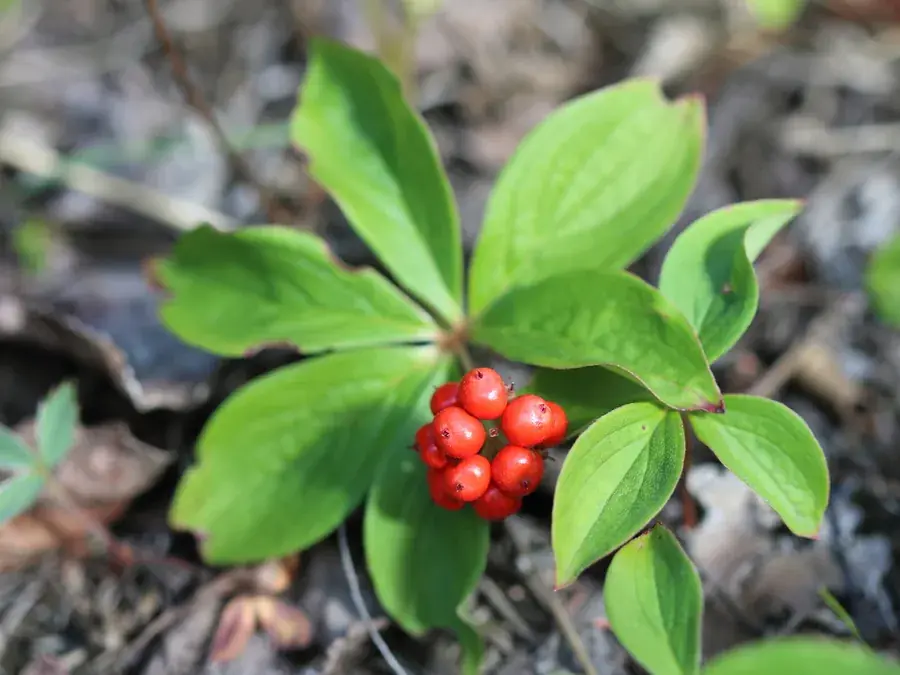
Photo by Public domain (iNaturalist) on iNaturalist · CC0 (public domain)
BerrySeason: August – September
Bunchberry
Cornus canadensis
- When
- Typically August – September — August, September. Earlier in the south, later in the north.
- Where it grows
- Cool, acidic conifer and mixed woods, mossy logs, bog edges and subalpine slopes, in carpets across the forest floor.
- How to know it
- A 10–20 cm (4–8 in) plant with a single whorl of four to six oval leaves whose veins arch toward the tip like a dogwood’s; in June the four white ‘petals’ are bracts around a knot of tiny flowers, and by August a tight bunch of bright red berries sits in the middle of the whorl.
- Look-alikes
- Red baneberry (Actaea rubra) is the poisonous red berry of the same woods: a bushy herb to 60 cm (2 ft) with large compound, toothed leaves and glossy berries, each with a black dot, in a cluster held on a stalk above the leaves. Bunchberry’s berries sit directly in a whorl of simple leaves on an ankle-high plant; the whole shape rules baneberry out.
- Harvest and use
- Edible once identified, but bland and mealy with a hard seed — a trail nibble and a safe first berry for children to learn on, better in a mixed jam than alone. Take a few berries from a carpet; the plant spreads by rhizome and is in no danger.
- Caution
- Teach children the whorl-of-leaves rule before the berry rule. Baneberry’s berries can slow the heart; a few are enough to send a child to hospital.
Bunchberry at a glance
- Also called
- Dwarf dogwood, Canadian dwarf cornel, crackerberry, pigeonberry, quatre-temps (Quebec), ch’entq’ena (Dena’ina). Western bunchberry (Cornus unalaschkensis) of the Pacific coast and Alaska is nearly identical and used the same way.
- Family
- Cornaceae, the dogwood family — bunchberry is a dogwood the size of a hand.
- Where it grows
- Native across Canada and Alaska from the treeline south: all of the boreal forest, the Maritimes, Quebec and Ontario, and in the US through New England, the Adirondacks and the upper Great Lakes, down the Appalachians at elevation to West Virginia and Virginia, and through the Rockies, Cascades and coast ranges, where it climbs to subalpine forest. One of the commonest forest-floor plants of the north.
- When to pick
- August into September in the middle of its range — late July in warm lowlands, September at altitude and in the far north. The berries turn from green to a bright, glossy scarlet and stay on the plant for weeks; a ripe one is soft enough to squash between finger and thumb. Flowering is May–July, and a patch often shows flowers and fruit a few weeks apart.
- Parts used
- The red berries, raw as a trail nibble or cooked into mixed jams, sauces and puddings, where their pectin helps other fruit set. Each holds one hard two-chambered stone, which is spat out or strained. Leaves, stems and roots are not food.
- Is any of it poisonous?
- Nothing poisonous. The berries are bland, mealy and seedy rather than harmful, and a child who eats a handful comes to no harm beyond a crunchy mouthful.
- More look-alikes to know
- White baneberry or doll’s eyes (Actaea pachypoda) is the other poisonous one: white berries with a black dot on thick red stalks, above the same bushy compound leaves as red baneberry. Lingonberry and wintergreen are harmless evergreen neighbours with red berries on glossy leathery leaves. Canada mayflower (Maianthemum canadense) has speckled red berries on a stalk above one or two heart-shaped leaves; mildly purgative, not a food. Nothing else carries a bunch of berries inside a whorl of simple leaves.
Questions people ask about bunchberry
Are bunchberries edible?
Yes — once identified by the whorl of four to six leaves with the berry cluster sitting in the middle, bunchberries are edible raw or cooked. They are bland and mealy with a hard stone, so most people treat them as a trail nibble or add them to other fruit in jam. Nothing about the plant is poisonous.
How do you identify bunchberry?
A plant 10–20 cm (4–8 in) tall with a single whorl of four to six oval, pointed leaves whose veins curve toward the tip the way a dogwood’s do. In early summer there are four white petal-like bracts around a knot of tiny flowers; by late summer a tight bunch of bright red berries sits in the centre of the leaf whorl. It grows in carpets in cool conifer woods.
What poisonous berry looks like bunchberry?
Red baneberry (Actaea rubra), which fruits in the same woods at the same time. It is a bushy plant to 60 cm (2 ft) with large, divided, toothed leaves and a loose cluster of glossy red berries held on a stalk above the foliage, each berry with a black dot; a few can slow the heart and send a child to hospital. Bunchberry is ankle-high with simple leaves in a whorl and the berries sitting in that whorl, so the shape of the plant settles it.
What should kids know about bunchberry?
That the plant is the rule, not the berry. A good game is to find the whorl of leaves first and only then look for the berries in the middle; if the berries are on a stalk above a leafy bush, walk away. Bunchberries are one of the safest wild berries for a child to learn on, because the plant is so distinctive and the fruit, though dull, is harmless.
When do bunchberries ripen?
August and September across most of Canada and the northern US, a little earlier in warm lowland woods and later in the mountains and far north. The berries go from green to shiny red and hold on the plant for several weeks. The white ‘flowers’ you see in June are bracts; the fruit forms from the tiny true flowers in the centre.
Do Indigenous peoples eat bunchberry?
Across the north the berries were eaten but rarely prized: the Dena’ina name means ‘crunchy’ and the Alutiiq name ‘gristly’, which tells you how they are regarded. Alutiiq cooks add them to berry dishes and jam, and elsewhere they were mixed with better fruit or stored with grease. They matter more to grouse, hares and bears.
Found in these regions
- Boreal North & Taiga
- Boreal Forest & Shield
- Acadian Forest & Atlantic Coast
- Great Lakes & St. Lawrence Lowlands
- Western Mountains & Interior Plateaus
- Pacific Maritime
Hardiness zones 1–6.
Is it ready near you?
Get this week's foraging guide for your area
Enter a town, postal code or ZIP and we'll tell you what's in season right there this week — from your local climate, this week's weather and your ecological region.
Also ready in October
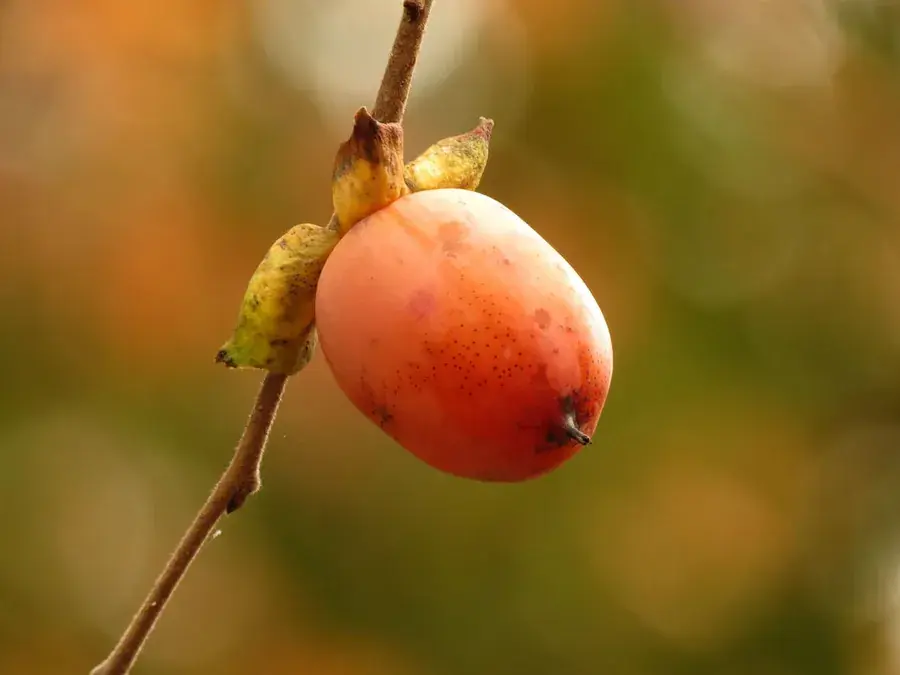 FruitOctober – November
American persimmon
Diospyros virginiana
Blocky alligator-hide bark; orange fruit the size of a plum, only ripe when it is wrinkled, squishy and usually on the ground.
How to know it & its look-alikes →Photo: Katja Schulz · CC BY 4.0
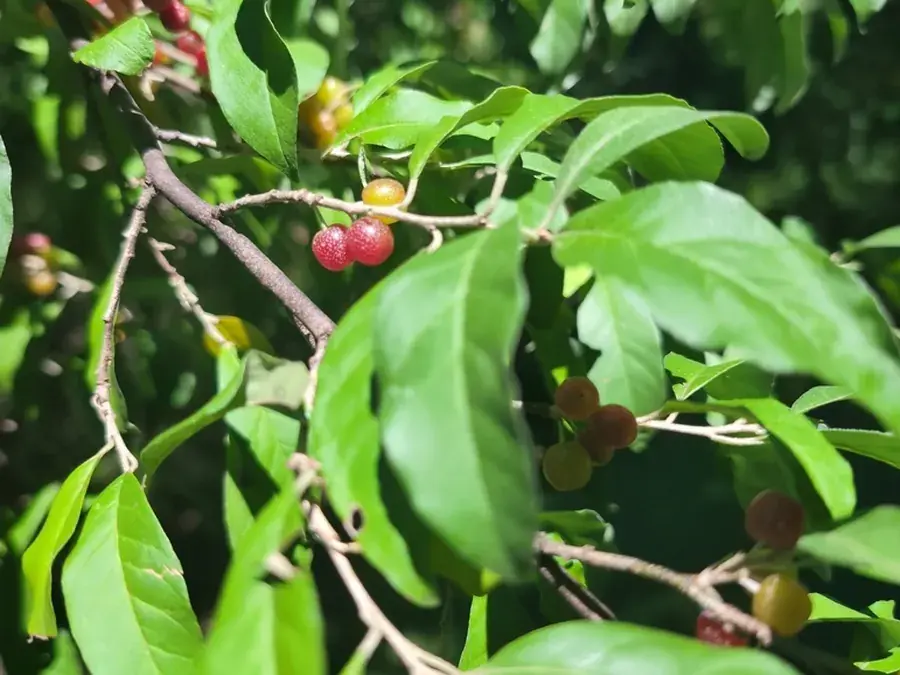 BerrySeptember – October
Autumn olive
Elaeagnus umbellata
A sprawling thorny shrub whose leaves flash silver underneath; in autumn it is weighed down with small red berries finely speckled with silver and brown scales, each with one soft seed.
How to know it & its look-alikes →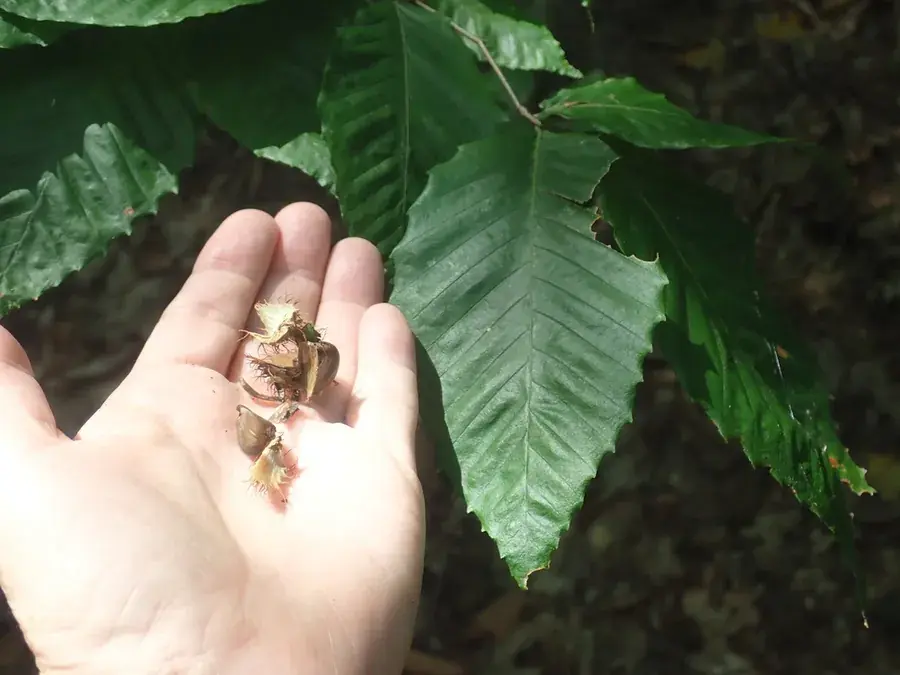 NutSeptember – October
Beechnuts
Fagus grandifolia
Smooth, pale grey bark on a tall tree; long, sharp, cigar-shaped buds; oval leaves with coarse teeth and straight parallel veins, many held, bleached, through winter. The nuts are small, three-sided and come two to a soft-bristled husk that splits into four.
How to know it & its look-alikes →
Checked against these sources ·
- Minnesota Wildflowers — Bunchberry (Cornus canadensis)
- USDA Forest Service Fire Effects Information System — Cornus canadensis
- Kenai National Wildlife Refuge Notebook (Peninsula Clarion) — A common little plant with uncommon traits
- University of Wisconsin Horticulture Extension — Baneberry (Actaea spp.)
Seasons are typical for the middle of the range and move by weeks north and south, and up and down hills.
Educational information only. Never eat a wild plant or mushroom identified from a single photograph or description — confirm with a regional field guide or an experienced forager, and know the poisonous species in your area first.