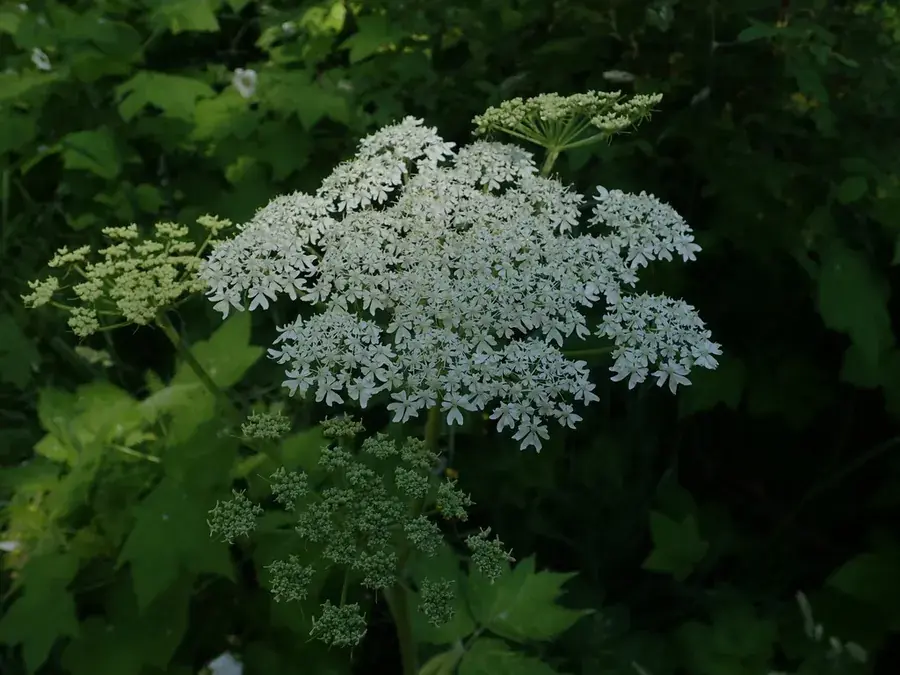
Photo by Public domain (iNaturalist) on iNaturalist · CC0 (public domain)
GreenSeason: April – June
Cow parsnip
Heracleum maximum
This one has a dangerous look-alike
Giant hogweed is the dangerous twin: 3–5 m (10–16 ft), a stem 5–10 cm (2–4 in) thick with purple blotches and coarse white bristles, leaves to 1.5 m (5 ft) across, and sap that causes severe blistering burns. Water hemlock and poison hemlock share its ground and are deadly — both are hairless, with finely divided leaves rather than huge maple-like ones, and purple-streaked or blotched stems.
- When
- Typically April – June — April, May, June. Earlier in the south, later in the north.
- Where it grows
- Moist meadows, streambanks, ditches, avalanche tracks and open woods from the coast to the subalpine; native across Canada and most of the US outside the Deep South.
- How to know it
- A huge native umbel plant, 1–3 m (3–10 ft), with a hollow, deeply ridged stem covered in soft hairs and no purple blotches; the leaves are enormous, three-parted and maple-like, up to 50 cm (20 in) across. Flat white flower heads 15–30 cm (6–12 in) wide in May–July.
- Harvest and use
- Young leaf stalks and flower-bud stalks picked before the flowers open, peeled of every bit of outer skin, then eaten raw like celery or cooked. A long-standing Indigenous food across the Northwest, where it is called Indian celery. Wear gloves and long sleeves to pick and peel it.
- Caution
- The sap causes phytophotodermatitis: on skin exposed to sunlight it raises painful blisters within 24–48 hours and dark marks that last months. Keep sap off skin and out of eyes, wash immediately, and stay out of the sun for two days after contact. Not a plant for children to handle.
Cow parsnip at a glance
- Also called
- Indian celery, Indian rhubarb, pushki (Alaska), berce laineuse (Quebec). Older books call it Heracleum lanatum.
- Family
- Apiaceae, the carrot family (which also includes giant hogweed, wild parsnip and the hemlocks).
- Where it grows
- Native across Canada from Newfoundland to British Columbia and north into the Yukon and Alaska, and through the northern and western United States — the Great Lakes, New England, the Appalachians, the Rockies and the whole Pacific coast down through California. Absent from the Deep South: Texas, Louisiana, Mississippi, Alabama, Florida, Arkansas, Oklahoma and South Carolina.
- When to pick
- Spring, before the flowers open: roughly April in the Pacific Northwest and the mid-Atlantic, May into June in Quebec, Ontario and the mountains, later still in Alaska and at altitude. Pick leaf stalks while the leaf is still unfolding and bud stalks while the flower head is a tight green knob in its sheath. Once the umbel opens, the stalks turn fibrous and strong-tasting.
- Parts used
- Young leaf stalks and the budding flower stalks, peeled of every bit of outer skin and strings, eaten raw or cooked; Indigenous cooks ate them with seal oil or oolichan grease and also roasted or boiled them. The leaves, flowers, mature stems, seeds and roots are not eaten. Peeling is not optional — the skin carries the burning compounds.
- Is any of it poisonous?
- The sap of every above-ground part contains furanocoumarins. On skin that then meets sunlight it causes phytophotodermatitis: redness, then painful blisters within 24–48 hours, and brown marks that can last for months. Unpeeled stalks blister the mouth. Giant hogweed does the same thing far worse. Wash with soap and cold water at once if sap touches skin, keep the area covered for 48 hours, and never let sap near the eyes.
- More look-alikes to know
- Wild parsnip (Pastinaca sativa): yellow flowers, a grooved hairless stem, 1–1.5 m (3–5 ft), and sap that burns as badly as cow parsnip’s; an introduced weed of roadsides. Angelica (Angelica atropurpurea): smooth purple stem with no hairs, round ball-shaped flower heads, and leaves divided into many separate leaflets rather than three big maple-like lobes. Poison hemlock: see the entry — hairless, purple-blotched, fern-leaved, musty. Water hemlock: hairless, purple-streaked, leaflets with veins ending in the notches, chambered root, always in wet ground. Both hemlocks are deadly; cow parsnip’s huge three-part leaves and hairy, blotch-free stem rule them out.
Questions people ask about cow parsnip
How do you tell cow parsnip from giant hogweed?
Size, blotches and bristles. Cow parsnip is 1–3 m (3–10 ft) with a stem 2.5–5 cm (1–2 in) thick, soft-hairy, ridged and green with no purple spots, and flower heads up to 30 cm (12 in) across with 15–30 rays. Giant hogweed is 3–5 m (10–16 ft), its stem 5–10 cm (2–4 in) thick with purple blotches and coarse white bristles, leaves up to 1.5 m (5 ft) across and flower heads up to 75 cm (2.5 ft) with 50 or more rays. Giant hogweed is established mainly in southern Ontario, parts of Quebec and Atlantic Canada, BC’s south coast, and in New York, Pennsylvania, Michigan, Maine, New England, Washington and Oregon.
Is cow parsnip poisonous to touch?
The sap is. Handle it in gloves and long sleeves, especially on sunny days: sap on skin plus sunlight causes blisters within a day or two and dark marks that last months. The reaction is milder than giant hogweed’s but real, and children with bare arms should not be cutting it.
Can you eat cow parsnip?
Yes — the young leaf stalks and flower-bud stalks, picked before flowering and peeled completely, are a traditional spring food across the Northwest, eaten raw like celery or cooked. Everything depends on the peeling and on being certain it is cow parsnip rather than a hemlock. Leaves, mature stems, seeds and roots are not eaten.
Which Indigenous peoples eat cow parsnip?
Many. Kuhnlein and Turner documented its use by more than thirty nations of northwestern North America, including the Tlingit, Haida, Tsimshian, Kwakwaka’wakw, Nuu-chah-nulth, Coast Salish and interior peoples such as the Nlaka’pamux and Blackfoot. Leaf stalks and bud stalks were peeled and eaten fresh in spring, often with oolichan grease, and traditional knowledge was explicit that all the outer skin had to come off to avoid a burned mouth.
When is cow parsnip season?
Spring, for a few weeks while the stalks are young and the flower head is still a closed green knob — April on the Pacific coast and in the mid-Atlantic, May to June in Quebec, Ontario and the Rockies, June into July in Alaska. After the white umbel opens the stalks are fibrous and strong.
What should kids know about cow parsnip?
That the big-leaved plant in the ditch can burn, and that nothing in the carrot family is picked without an adult. Sap on skin on a sunny day blisters like a bad burn. If a child gets sap on them, wash with soap and cold water right away and keep that skin covered from the sun for two days.
Found in these regions
- Boreal North & Taiga
- Boreal Forest & Shield
- Acadian Forest & Atlantic Coast
- Great Lakes & St. Lawrence Lowlands
- Northeast Atlantic Coast & Piedmont
- Appalachian Highlands
- Central Hardwoods & Interior Plateaus
- Prairies & Great Plains
- Western Mountains & Interior Plateaus
- Pacific Maritime
- Mediterranean California
Hardiness zones 2–9.
Is it ready near you?
Get this week's foraging guide for your area
Enter a town, postal code or ZIP and we'll tell you what's in season right there this week — from your local climate, this week's weather and your ecological region.
Also ready in October
 FruitOctober – November
American persimmon
Diospyros virginiana
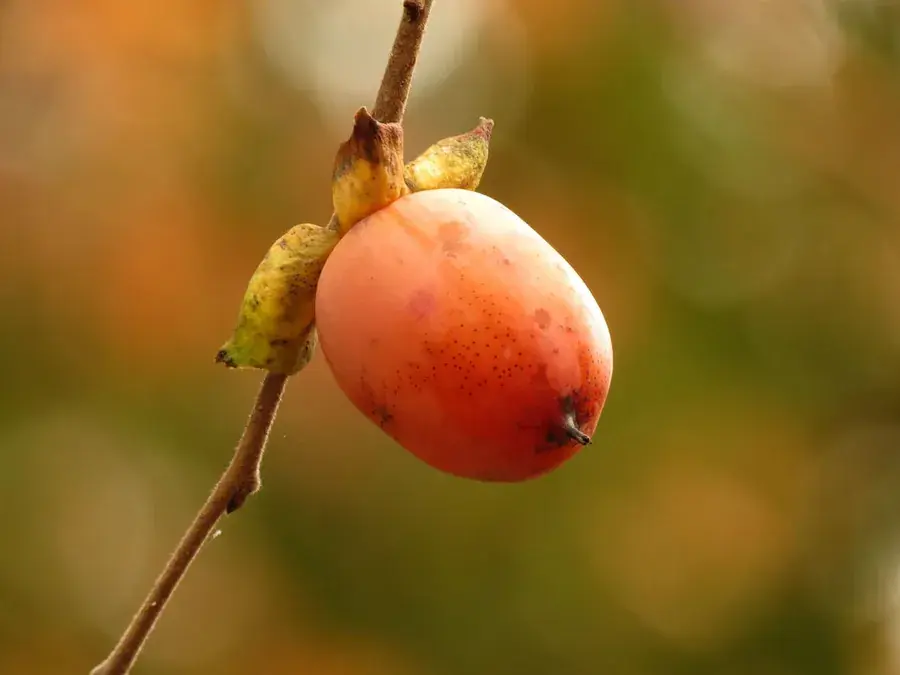
Blocky alligator-hide bark; orange fruit the size of a plum, only ripe when it is wrinkled, squishy and usually on the ground.
How to know it & its look-alikes →Photo: Katja Schulz · CC BY 4.0
 BerrySeptember – October
Autumn olive
Elaeagnus umbellata
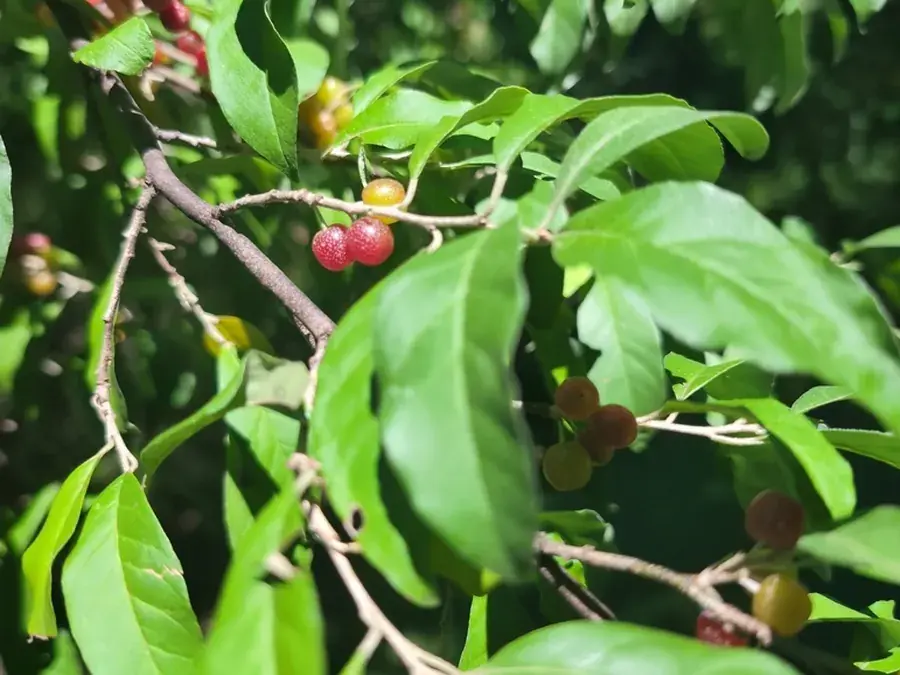
A sprawling thorny shrub whose leaves flash silver underneath; in autumn it is weighed down with small red berries finely speckled with silver and brown scales, each with one soft seed.
How to know it & its look-alikes →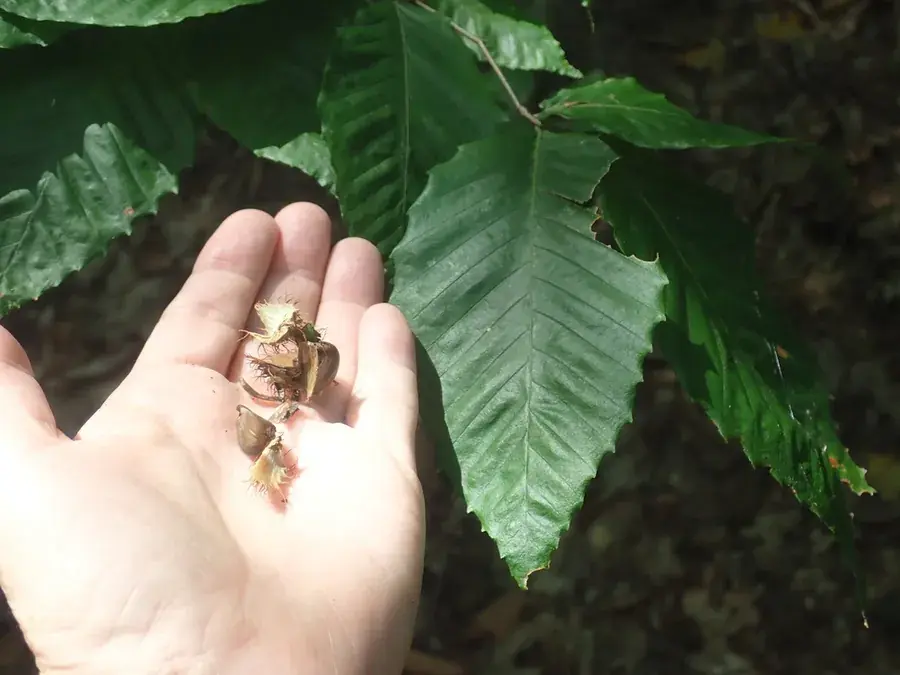 NutSeptember – October
Beechnuts
Fagus grandifolia
Smooth, pale grey bark on a tall tree; long, sharp, cigar-shaped buds; oval leaves with coarse teeth and straight parallel veins, many held, bleached, through winter. The nuts are small, three-sided and come two to a soft-bristled husk that splits into four.
How to know it & its look-alikes →
Checked against these sources ·
- USDA NRCS Plant Guide: Cow parsnip (Heracleum maximum)
- Cornell Weed ID: Cow parsnip
- New York DEC: Giant hogweed and its look-alikes
- Invasive Species Centre (Canada): Giant hogweed
- Minnesota Department of Agriculture: Giant hogweed
- Kuhnlein & Turner (1986), Cow-parsnip: an Indigenous vegetable of northwestern North America — Journal of Ethnobiology
Seasons are typical for the middle of the range and move by weeks north and south, and up and down hills.
Educational information only. Never eat a wild plant or mushroom identified from a single photograph or description — confirm with a regional field guide or an experienced forager, and know the poisonous species in your area first.