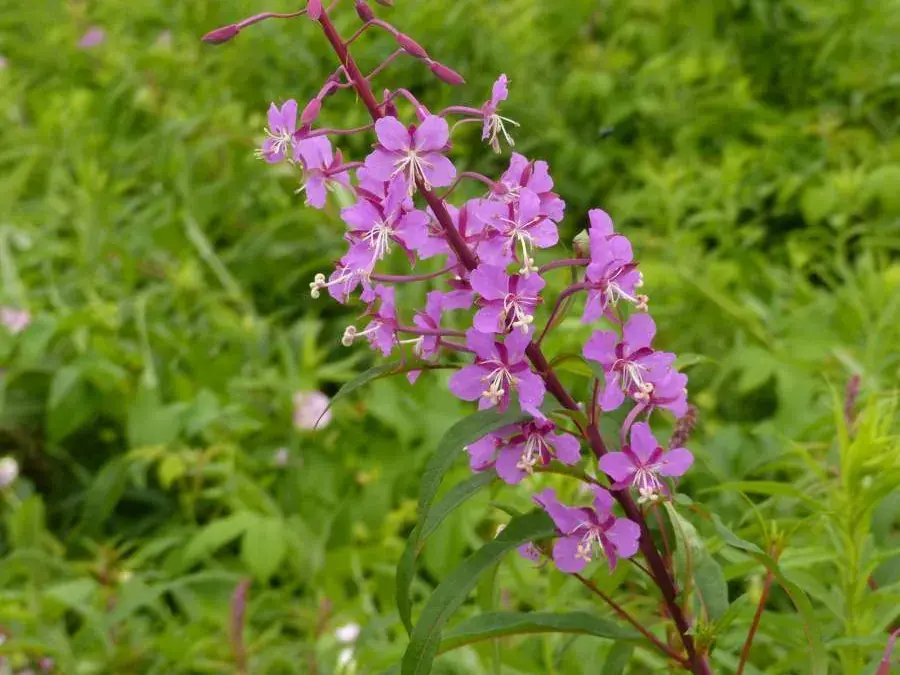
Photo by christine123 on iNaturalist · CC BY 4.0
GreenSeason: April – August
Fireweed
Chamaenerion angustifolium
- When
- Typically April – August — April, May, June, July, August. Earlier in the south, later in the north.
- Where it grows
- Burns, clear-cuts, roadsides, avalanche tracks and river gravels — any open, disturbed ground in the north and the mountains, often in sheets that turn a hillside magenta.
- How to know it
- A tall unbranched spire, 1–2 m (3–6 ft), of four-petalled magenta flowers opening from the bottom up; narrow alternate leaves on a round, often reddish stem. Hold a leaf to the light: the side veins curve and join into a line running just inside the edge, which no look-alike shares.
- Look-alikes
- Purple loosestrife is the summer double: an invasive wetland plant with a square stem, opposite leaves and five- to seven-petalled flowers packed in a tighter, darker spike. It is not poisonous but it is not food. In spring the shoots can be confused with dogbane and milkweed shoots, which bleed milky sap when snapped — fireweed’s sap is clear.
- Harvest and use
- Young shoots in spring, snapped where they break cleanly and steamed like asparagus; flowers and buds in July–August for jelly, syrup and a floral honey. Take shoots from a big patch and leave most standing — the plant feeds the whole clearing.
- Caution
- Mature leaves and strong tea can be mildly laxative; start with a little. Fireweed is the floral emblem of Yukon and is protected in parks like everything else, but it is abundant and picking a few shoots on a roadside harms nothing.
Fireweed at a glance
- Also called
- Rosebay willowherb (Britain), great willow-herb in some older North American books, épilobe à feuilles étroites (Quebec). Botanists have shuffled it between Epilobium angustifolium and Chamerion angustifolium; Chamaenerion is the current name and all three refer to the same plant.
- Family
- Onagraceae, the evening-primrose family (which also includes the other willowherbs and fuchsia).
- Where it grows
- Native and abundant across the whole boreal belt from Alaska and Yukon to Labrador and Newfoundland, south through the Rockies, Cascades and coast ranges, and around the Great Lakes and St. Lawrence. In the east it thins out south of the Adirondacks and northern New England and is mostly a plant of high ground in the Appalachians. It is famous for carpeting burns and clear-cuts in the first few summers after a fire.
- When to pick
- Two short seasons. Shoots: April–May in southern Ontario and Quebec, late May to June across the boreal north and in the mountains, while they are 15–30 cm (6–12 in) tall, still tender and snap cleanly; once the stem turns fibrous, stop. Flowers and buds: July into August in the middle of the range, with the spike opening from the bottom up, so a patch gives flowers for several weeks. Leaves for tea are best before flowering.
- Parts used
- Young shoots, steamed or sautéed like asparagus (peel older ones). Young leaves, raw in small amounts or dried for tea. Flower buds and open flowers, raw in salads, or infused for jelly, syrup and a pale ‘fireweed honey’ made with sugar. The pith of mature stems is sweet and can be scraped out. The seed fluff and tough old stems are not used.
- Is any of it poisonous?
- Nothing poisonous, but mature leaves and strong tea are mildly laxative in quantity, and the raw leaves are bitter later in the season. Start small.
- More look-alikes to know
- Dogbane (Apocynum) and common milkweed (Asclepias syriaca) are the spring risk, when all three come up as leafy shoots on disturbed ground. Both bleed white milky sap the moment a stem or leaf is snapped; fireweed’s sap is clear. Dogbane is poisonous and bitter; milkweed shoots are eaten by some foragers after boiling but should not be mistaken for fireweed. Later in the year the big-leaved willowherbs (Epilobium) are harmless relatives with smaller flowers, and purple loosestrife is covered in the main entry.
Questions people ask about fireweed
Is fireweed edible?
Yes — once identified by its four-petalled magenta flowers, alternate leaves and the vein that loops along the leaf edge, every green part of fireweed has been eaten: shoots, young leaves, buds and flowers. It is a traditional spring vegetable across Alaska and the north. Nothing about it is poisonous, though strong tea is mildly laxative.
How do you tell fireweed from purple loosestrife?
Count petals and feel the stem. Fireweed flowers have four broad petals on a round, often reddish stem with alternate leaves; purple loosestrife has five to seven narrow petals crowded into a tighter, darker spike on a square stem with opposite or whorled leaves. Loosestrife is an invasive wetland weed, not poisonous but not food, and worth reporting.
When do you pick fireweed shoots?
In spring while the shoots are 15–30 cm (6–12 in) tall and snap cleanly — April or May in the south of its range, late May to June in the boreal north and the mountains. Once the stem is woody and the leaves have toughened the season is over. Flowers follow in July and August.
What is fireweed jelly?
A rose-coloured jelly made by steeping the flowers in hot water, straining, and setting the infusion with sugar and pectin; it is a Yukon and Alaska staple sold at summer markets. Pick open, undamaged flowers from the lower half of the spike in July–August and leave the buds above to keep opening. The same infusion sweetened and reduced is sold as fireweed ‘honey’ or syrup.
What looks like fireweed shoots in spring?
Dogbane and milkweed shoots, which come up on the same roadsides and disturbed ground. Snap one: dogbane and milkweed ooze milky white sap, and dogbane is poisonous. Fireweed shoots have clear sap, a reddish tinge, and narrow leaves with a pale midrib.
Is fireweed safe for children to pick?
Yes, with the milky-sap rule. Fireweed is a good plant for children to learn: the summer flowers are unmistakable and a nibbled petal does no harm. For spring shoots, teach them to snap a stem and look for sap — milky white means put it down.
Found in these regions
- Boreal North & Taiga
- Boreal Forest & Shield
- Acadian Forest & Atlantic Coast
- Great Lakes & St. Lawrence Lowlands
- Appalachian Highlands
- Prairies & Great Plains
- Western Mountains & Interior Plateaus
- Pacific Maritime
Hardiness zones 1–7.
Is it ready near you?
Get this week's foraging guide for your area
Enter a town, postal code or ZIP and we'll tell you what's in season right there this week — from your local climate, this week's weather and your ecological region.
Also ready in October
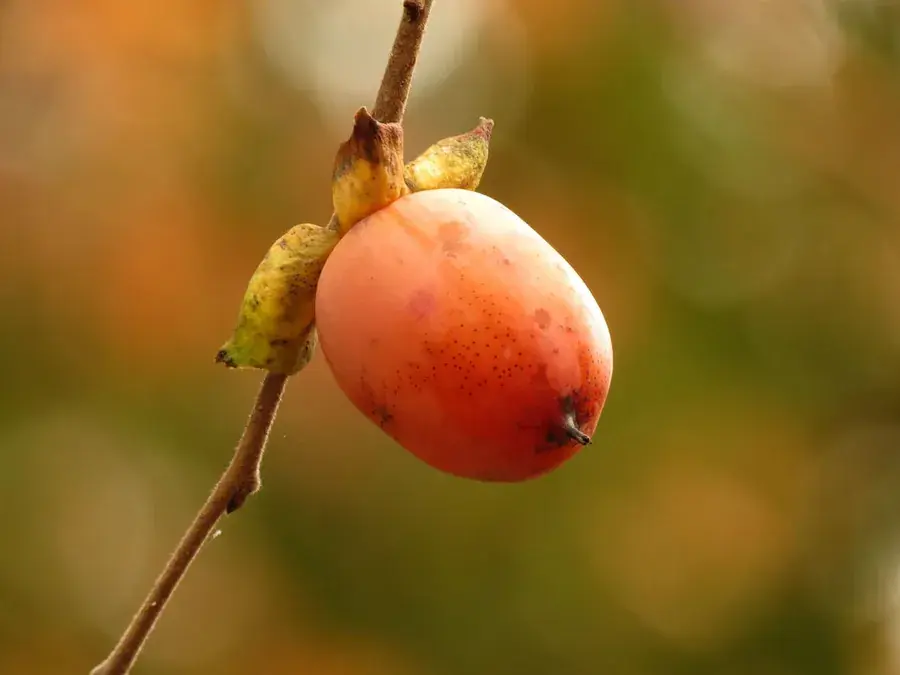 FruitOctober – November
American persimmon
Diospyros virginiana
Blocky alligator-hide bark; orange fruit the size of a plum, only ripe when it is wrinkled, squishy and usually on the ground.
How to know it & its look-alikes →Photo: Katja Schulz · CC BY 4.0
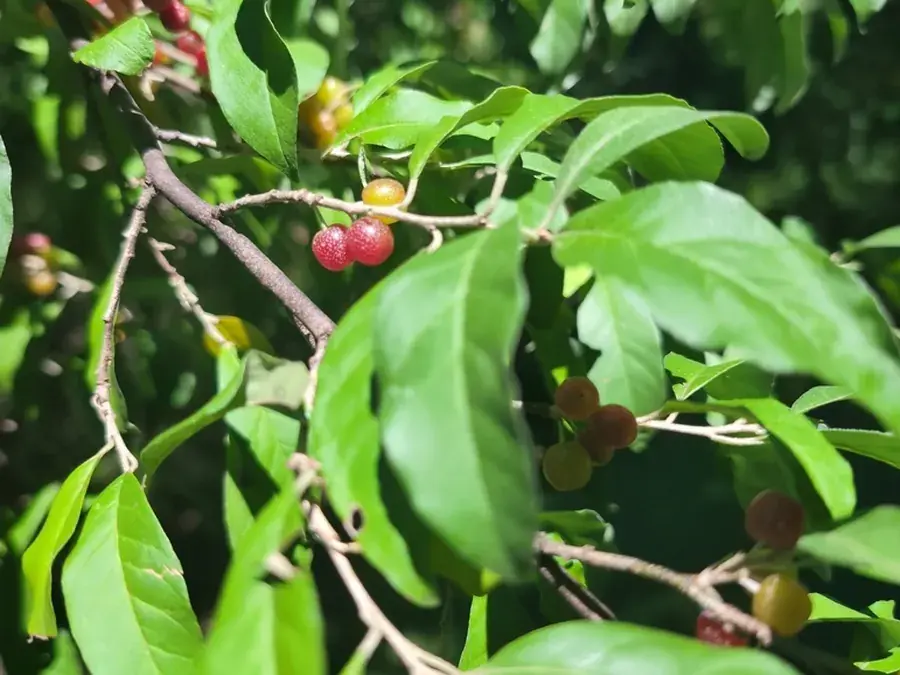 BerrySeptember – October
Autumn olive
Elaeagnus umbellata
A sprawling thorny shrub whose leaves flash silver underneath; in autumn it is weighed down with small red berries finely speckled with silver and brown scales, each with one soft seed.
How to know it & its look-alikes →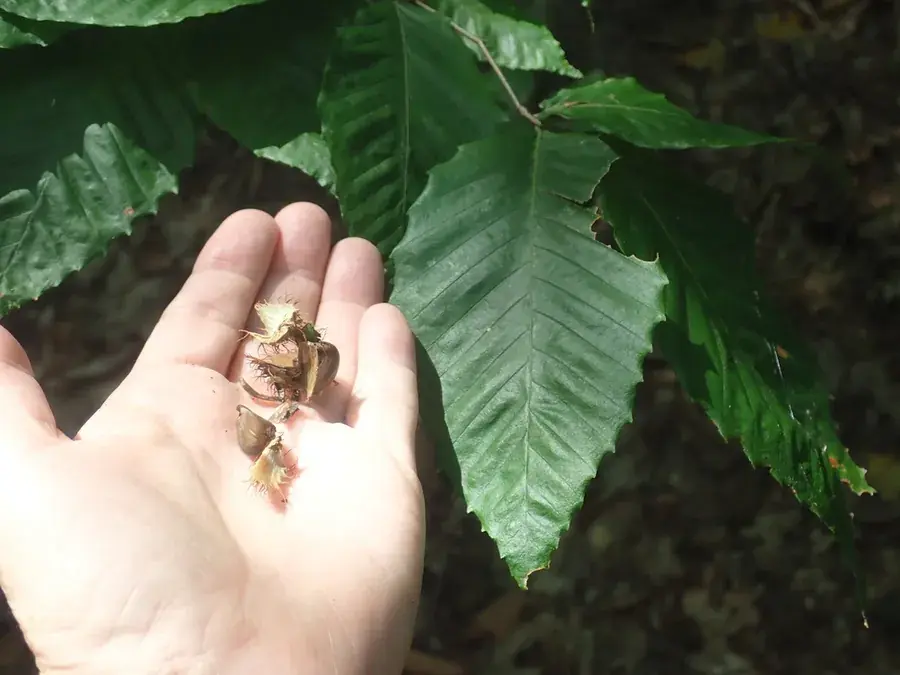 NutSeptember – October
Beechnuts
Fagus grandifolia
Smooth, pale grey bark on a tall tree; long, sharp, cigar-shaped buds; oval leaves with coarse teeth and straight parallel veins, many held, bleached, through winter. The nuts are small, three-sided and come two to a soft-bristled husk that splits into four.
How to know it & its look-alikes →
Checked against these sources ·
- University of Alaska Fairbanks Cooperative Extension — Fireweed (FNH-00106)
- South Dakota State University Extension — What’s the difference between fireweed and purple loosestrife?
- PEI Untamed — Fireweed
- Wikipedia — Chamaenerion angustifolium
Seasons are typical for the middle of the range and move by weeks north and south, and up and down hills.
Educational information only. Never eat a wild plant or mushroom identified from a single photograph or description — confirm with a regional field guide or an experienced forager, and know the poisonous species in your area first.