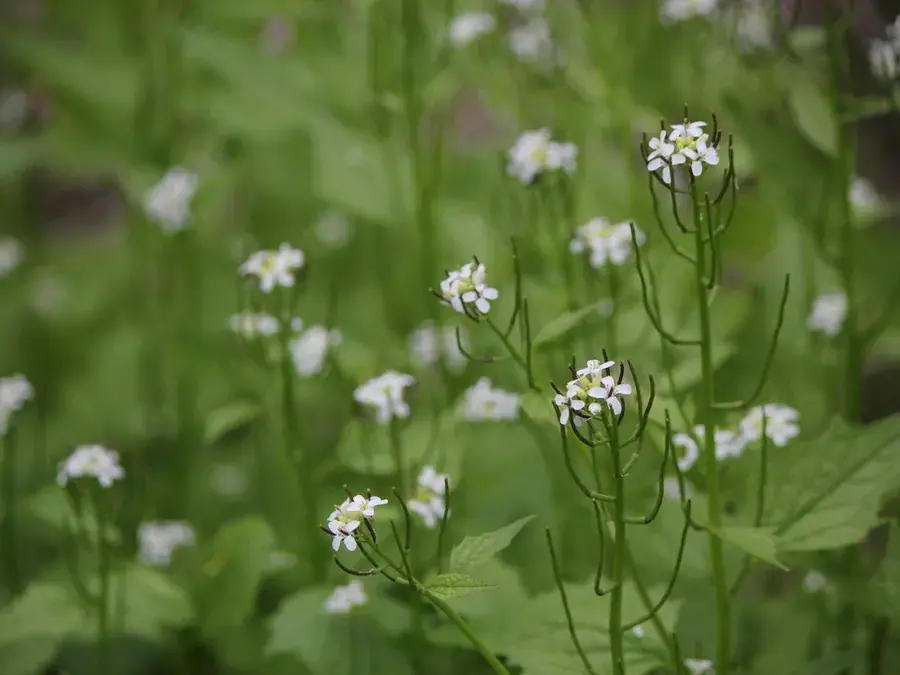
Photo by Quinten Wiegersma on iNaturalist · CC BY 4.0
GreenIn season now (October)
Garlic mustard
Alliaria petiolata
- When
- Typically March – June, October – November — March, April, May, June, October, November. Earlier in the south, later in the north.
- Where it grows
- Shaded and half-shaded ground: woodland edges, trail sides, floodplain forest, fence lines and the back of the yard, usually in dense carpets.
- How to know it
- Crush a leaf — it smells of garlic, and nothing that resembles it does. First-year rosettes have kidney-shaped, scallop-edged leaves; second-year stalks 30–100 cm (1–3 ft) carry triangular toothed leaves, small four-petalled white flowers and thin upright seed pods, over a white S-curved taproot.
- Look-alikes
- Violets, ground ivy (creeping Charlie), henbit and young nettle all share the rounded or heart-shaped leaf of a first-year rosette. None smells of garlic. Ground ivy and henbit have square stems and opposite leaves; violet leaves come to a point with finer teeth; nettle stings.
- Harvest and use
- Young leaves, flower buds and tender stalks, raw in small amounts or chopped and cooked: pesto, sautés, soup. Chop and let it sit a few minutes, or cook it, to drive off the cyanide-releasing compounds. Pull the whole plant, root and all — it is one of the worst woodland invaders on the continent, so take as much as you like and bag any flowering stalks.
- Caution
- Raw garlic mustard contains cyanide precursors, so eat it raw only in small amounts and only occasionally. Pulled plants can still set seed — bag flowering stalks for the trash rather than composting them. Restricted or prohibited as a noxious weed in several states and provinces, which means do not move or plant it, not that you cannot pick it.
Garlic mustard at a glance
- Also called
- Jack-by-the-hedge, hedge garlic, poor man’s mustard, alliaire officinale (Quebec).
- Family
- Brassicaceae, the mustard family (which also includes cabbage, horseradish, watercress and the toothworts).
- Where it grows
- A European biennial brought over in the 1800s as a kitchen herb, now the dominant woodland invader from Nova Scotia and New Brunswick through southern Quebec and Ontario, New England, the Great Lakes states and the Ohio valley, south through the Appalachians to Georgia and west to the eastern Plains, with established outposts around Edmonton, Denver, Salt Lake City, Portland, Seattle and Vancouver and a small population at Juneau. It is not recorded in Florida, the Gulf coast, the desert Southwest or Hawaii.
- When to pick
- Spring is the main season: the second-year stalks shoot up in April and May in southern Ontario and Quebec (a month earlier in Virginia, later toward Thunder Bay), and leaves, buds and tender stems are best just before and as the flowers open. First-year rosettes are green and pickable from October until snow and again as soon as it melts, and they are the mildest. By June the stalks are tough and bitter and the pods are forming; the ripe black seeds can be gathered in July and August for a mustard.
- Parts used
- Leaves (raw in small amounts, better cooked), flower buds and flowering tops (like a bitter broccoli raab), tender stems, the white taproot (grated raw like a mild horseradish) and the ripe seeds (ground as mustard). Chop the greens and let them sit a few minutes, or blanch them, before eating in quantity. Older leaves turn very bitter.
- Is any of it poisonous?
- Garlic mustard releases hydrogen cyanide when its cells are crushed, the same defence found in cassava and lima beans, though at lower levels. Chopping lets most of it escape within minutes, and soaking or cooking brings it down to negligible amounts. Raw garlic mustard is for a leaf or two in a salad now and then, not a daily raw pesto.
- More look-alikes to know
- Toothworts (Cardamine) and sweet cicely bloom in the same woods in the same weeks with white flowers; toothwort leaves are deeply divided or three-parted and sweet cicely’s are ferny, and neither smells of garlic (sweet cicely smells of anise). White avens has three-parted basal leaves and hooked seed heads. Young stinging nettle is sometimes mistaken for a leafy garlic mustard stalk — nettle has opposite leaves and stinging hairs, garlic mustard has alternate leaves and no hairs to speak of. The garlic smell when a leaf is crushed settles every one of these.
Questions people ask about garlic mustard
Is garlic mustard edible?
Yes, once you have confirmed the garlic smell. The young leaves, flower buds, stems, roots and seeds are all eaten, and it was carried to North America as a food plant. It is strongest and bitterest raw, so most people chop it and cook it, which also drives off the cyanide-releasing compounds it carries. Because it is a damaging invader, pulling and eating as much as you can is a kindness to the woods.
How do you identify garlic mustard?
Crush a leaf: it smells of garlic, and no look-alike does. First-year plants are a low rosette of kidney-shaped leaves with scalloped edges; second-year plants send up a stalk 30–100 cm (1–3 ft) tall with triangular, coarsely toothed leaves, clusters of small white four-petalled flowers in spring and thin upright seed pods afterwards. Pull one and the taproot is white with a distinct S-bend at the top.
Can you eat garlic mustard raw?
In small amounts, occasionally. Raw garlic mustard releases hydrogen cyanide when chewed — less than cassava or lima beans, but real. Chopping it and letting it sit a few minutes releases most of the gas; blanching or cooking takes care of the rest. A few leaves in a salad are fine; a big raw pesto every day is not.
When is the best time to pick garlic mustard?
Early spring, as the flower stalks rise and before they open — April and May in the Great Lakes and St. Lawrence country — and the first-year rosettes in late fall and very early spring, when they are mildest. The plant turns bitter and stringy once it is in full flower and seed in June.
What looks like garlic mustard?
Violets, ground ivy (creeping Charlie), henbit and young nettle can all pass for a first-year rosette, and toothwort and sweet cicely share its white spring flowers. None of them smells of garlic. Ground ivy and henbit have square stems and opposite leaves; violet leaves are pointed with finer teeth; nettle stings; toothwort and sweet cicely have divided leaves.
Is garlic mustard safe for kids to pick?
It is one of the better plants for children to learn, because the test is a smell, not a judgement call, and pulling it does the forest a favour. Teach them to crush and sniff every plant before it goes in the bag, and to eat it cooked at home rather than raw by the handful. Keep small children away from sprayed trail edges and have everyone wash their hands — the roots carry soil.
Why should I bag garlic mustard instead of composting it?
Because a pulled plant in flower can still ripen its seeds, and each plant makes hundreds that stay viable in the soil for at least seven years. State and provincial agencies ask that flowering or seeding plants go in sealed bags for the trash or be burned, never into the compost or the brush pile. Rosettes and pre-flowering plants can simply be eaten or left to dry on bare pavement.
Found in these regions
- Acadian Forest & Atlantic Coast
- Great Lakes & St. Lawrence Lowlands
- Northeast Atlantic Coast & Piedmont
- Appalachian Highlands
- Central Hardwoods & Interior Plateaus
- Prairies & Great Plains
- Western Mountains & Interior Plateaus
- Pacific Maritime
Hardiness zones 3–8.
Is it ready near you?
Get this week's foraging guide for your area
Enter a town, postal code or ZIP and we'll tell you what's in season right there this week — from your local climate, this week's weather and your ecological region.
Also ready in October
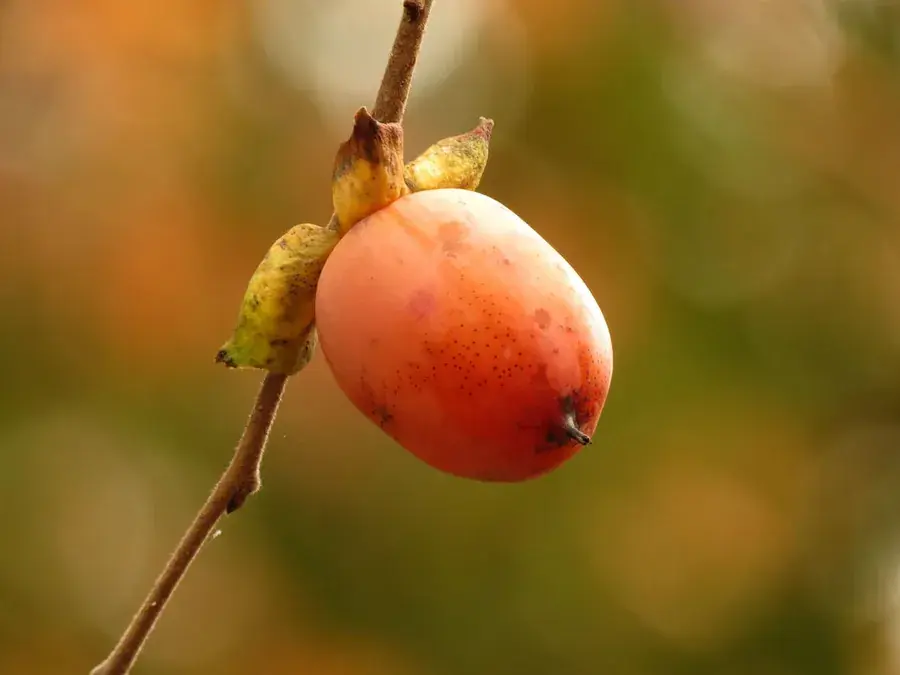 FruitOctober – November
American persimmon
Diospyros virginiana
Blocky alligator-hide bark; orange fruit the size of a plum, only ripe when it is wrinkled, squishy and usually on the ground.
How to know it & its look-alikes →Photo: Katja Schulz · CC BY 4.0
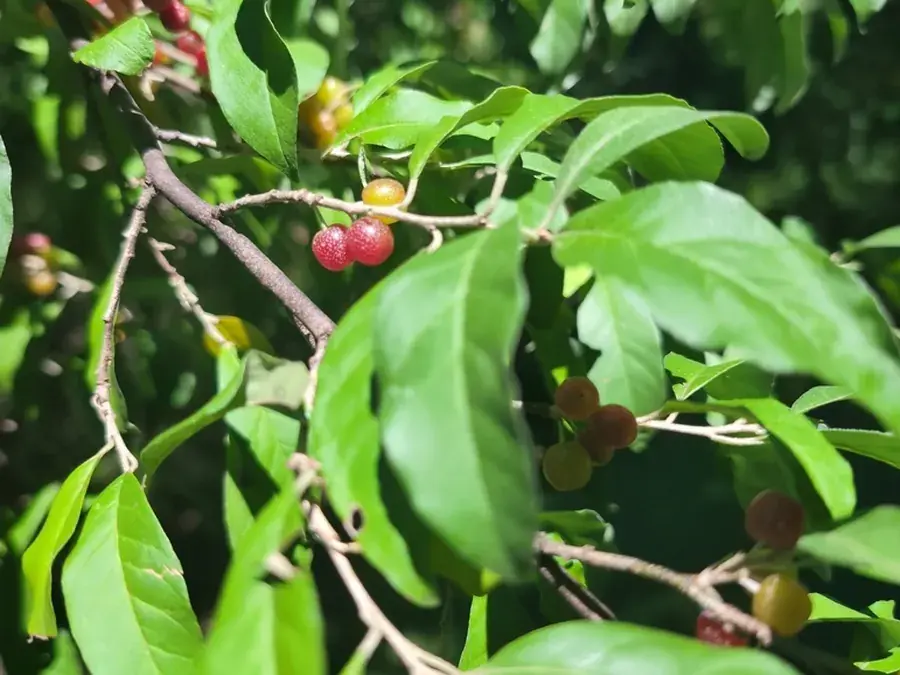 BerrySeptember – October
Autumn olive
Elaeagnus umbellata
A sprawling thorny shrub whose leaves flash silver underneath; in autumn it is weighed down with small red berries finely speckled with silver and brown scales, each with one soft seed.
How to know it & its look-alikes →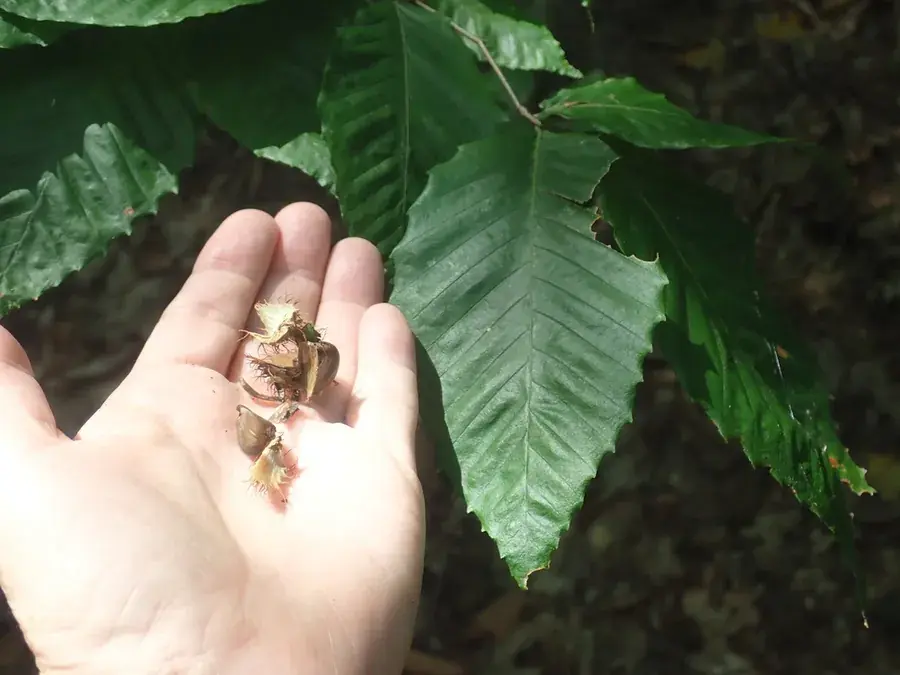 NutSeptember – October
Beechnuts
Fagus grandifolia
Smooth, pale grey bark on a tall tree; long, sharp, cigar-shaped buds; oval leaves with coarse teeth and straight parallel veins, many held, bleached, through winter. The nuts are small, three-sided and come two to a soft-bristled husk that splits into four.
How to know it & its look-alikes →
Checked against these sources ·
- Minnesota Wildflowers: Garlic mustard
- Wisconsin DNR: Garlic mustard (Alliaria petiolata)
- University of Minnesota Extension: Garlic mustard (identification and look-alikes)
- USDA Forest Service Fire Effects Information System: Alliaria petiolata
- National Geographic: Invasive garlic mustard hurts native species (cyanide and edibility)
- VASCAN (Database of Vascular Plants of Canada): Alliaria petiolata
Seasons are typical for the middle of the range and move by weeks north and south, and up and down hills.
Educational information only. Never eat a wild plant or mushroom identified from a single photograph or description — confirm with a regional field guide or an experienced forager, and know the poisonous species in your area first.