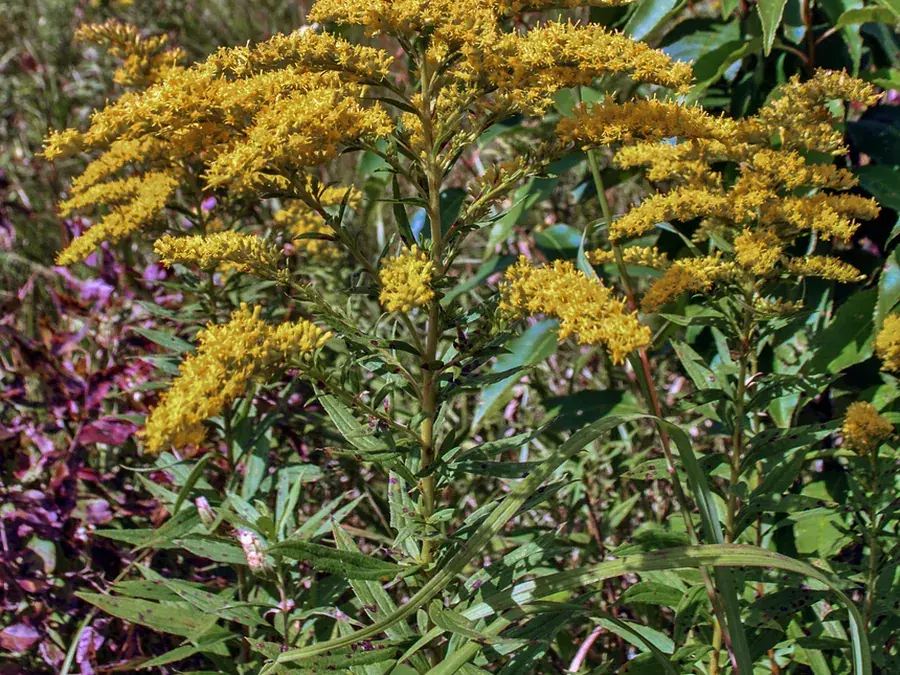
Photo by aarongunnar on iNaturalist · CC BY 4.0
GreenIn season now (October)
Goldenrod (Canada goldenrod)
Solidago canadensis
- When
- Typically July – October — July, August, September, October. Earlier in the south, later in the north.
- Where it grows
- Old fields, ditches, road edges, railway banks and clearings in full sun, in dense colonies that turn whole fields yellow in late summer.
- How to know it
- Stiff unbranched stems 1–1.5 m (3–5 ft) packed with alternate, lance-shaped, three-veined, toothed leaves and no basal rosette at flowering; a pyramidal plume of hundreds of tiny yellow flowers along the upper sides of arching branches. Insect-pollinated — its pollen is heavy and sticky and does not blow.
- Look-alikes
- Ragweed, which blooms at the same time and causes the hay fever goldenrod is blamed for, has green, inconspicuous flower spikes and deeply divided ferny leaves. Tansy ragwort and other ragworts and groundsels (Senecio, Jacobaea) carry yellow daisy-like flowers with distinct petals over ragged lobed leaves, and they contain liver-damaging pyrrolizidine alkaloids — goldenrod flowers are tiny and petal-less to the eye, and its leaves are simple and lance-shaped.
- Harvest and use
- Flowering tops, fresh or dried, for a mild honey-and-hay flavoured tea; young leaves in spring as a cooked green; flowers in fritters and vinegar. Snip the top third of a few stems from a big stand.
- Caution
- In the daisy family: anyone allergic to ragweed, chamomile or chrysanthemums can react. Keep it to a tea. Do not confuse it with ragwort, whose alkaloids accumulate in the liver.
Goldenrod (Canada goldenrod) at a glance
- Also called
- Canada goldenrod, common goldenrod, verge d’or du Canada (Quebec). Tall goldenrod (Solidago altissima), which takes over in the South, and western Canada goldenrod (S. lepida) of the Rockies and Pacific Northwest are so close that many botanists have treated them as one species, and all three are used the same way.
- Family
- Asteraceae, the daisy family (which also includes ragweed, chamomile, chicory and the toxic ragworts).
- Where it grows
- Native and abundant across the continent’s open country: from Newfoundland and Labrador west through Quebec, Ontario and the Prairies, in the boreal forest around Thunder Bay and Prince George, and through New England, the Great Lakes, the Appalachians, the Midwest and the Great Plains. South of the Ohio valley and along the Gulf coast the plant in the ditches is usually tall goldenrod; in the Rockies, interior BC, the Pacific Northwest and the Alaska panhandle it is western Canada goldenrod. Canada goldenrod itself is scarce in California, the low deserts and the Florida peninsula and absent from Hawaii.
- When to pick
- Flowers from late July into October, peaking in late August and September in southern Canada and the northern US — a couple of weeks earlier in the Ohio valley, later on the Gulf coast. Pick the plumes when about half the flowers are open and the colour is bright; once they fade to tan and fluff they are done. Young leaves for cooking come from the new shoots in April and May.
- Parts used
- The flowering tops, fresh or dried, steeped as tea; the flowers stripped from the stems for fritters, vinegar, cordial and infused honey; and the young spring leaves and shoot tips, cooked briefly as a green. The woody stems and roots are not used. Goldenrod honey, made by bees on these fields in September, is a harvest of its own.
- Is any of it poisonous?
- Nothing poisonous in goldenrod itself. It is a daisy-family plant, so people allergic to ragweed, chamomile, chrysanthemums or marigolds can react to the tea or the flowers on their skin. The serious danger is misidentification: tansy ragwort and the other ragworts and groundsels (Jacobaea, Senecio) bloom yellow at the same time and contain pyrrolizidine alkaloids that damage the liver cumulatively — a little at a time over weeks is as harmful as a lot at once. Keep goldenrod to a tea, and never brew anything with yellow daisy-like flowers and ragged lobed leaves.
- More look-alikes to know
- Common ragweed (Ambrosia artemisiifolia) and giant ragweed grow in the same ditches and bloom in the same weeks, with spikes of small green flowers that nobody notices and leaves that are deeply divided and ferny (common) or three-lobed like a maple (giant); they shed the wind-borne pollen that causes late-summer hay fever, and they are not eaten. Tansy ragwort (Jacobaea vulgaris), a noxious weed of the Pacific Northwest and the Maritimes, stands 30–120 cm (1–4 ft) with ragged, deeply lobed leaves and flat-topped clusters of yellow daisies, each with about 13 distinct petals; every part is toxic and the flowers hold the most alkaloid. Common groundsel (Senecio vulgaris) is a small weed with petal-less yellow heads and lobed leaves, also toxic. Common tansy (Tanacetum vulgare) has flat clusters of yellow buttons over ferny leaves and a strong camphor smell; it contains thujone and is not a tea plant. Goldenrod’s tells are simple lance-shaped leaves, a plume rather than a flat cluster, and flowers so small no individual petals stand out.
Questions people ask about goldenrod
Is goldenrod edible?
Yes, once identified with certainty: the flowering tops make a mild tea, the flowers go into fritters, vinegar and cordial, and the young spring leaves can be cooked as a green. Keep it to those uses, and learn the toxic yellow look-alikes — tansy ragwort and the groundsels — before you pick, because they bloom in the same weeks.
Does goldenrod cause hay fever?
No. Goldenrod pollen is heavy and sticky and is carried by bees and other insects; it does not blow on the wind in any amount that reaches your nose. The late-summer sneezing comes from ragweed, which flowers at the same time in the same ditches with inconspicuous green spikes and wind-borne pollen. Goldenrod gets the blame because it is the one you can see.
How do you identify Canada goldenrod?
Stiff, unbranched stems 1–1.5 m (3–5 ft) tall in dense colonies, finely hairy in the upper half; alternate, lance-shaped, sharply toothed leaves with three strong veins and no basal rosette at flowering time; and from August a pyramidal plume of hundreds of tiny yellow flowers lined up along the upper side of arching branches. Tall goldenrod and western goldenrod are nearly identical and used the same way.
What looks like goldenrod and is poisonous?
Tansy ragwort and the other ragworts and groundsels. They carry yellow daisy-like flowers with distinct petals — tansy ragwort’s have about 13 each — in flat-topped clusters over ragged, deeply lobed leaves, and they contain pyrrolizidine alkaloids that damage the liver over time. Common tansy, with yellow buttons over ferny leaves and a camphor smell, is not a tea plant either. Goldenrod’s flowers are too small to show petals, its leaves are simple and lance-shaped, and the head is a plume, not a flat cluster.
When do you harvest goldenrod?
From late July to early October, at the peak of bloom in late August and September across southern Canada and the northern US, when about half the florets on a plume are open and the colour is bright. Snip the top third of a few stems from a large stand on a dry day and dry them hanging in the shade. Spring shoots for cooking are picked in April and May.
What are the round lumps on goldenrod stems?
Galls — the plant’s response to an insect laying its egg inside the stem. The round ball gall is made by the goldenrod gall fly; a larva lives inside all winter and chickadees and downy woodpeckers peck them open for it. Cut one open in winter with a child and you will find a small white grub in a woody room. They do no harm to the plant you pick for tea.
Is goldenrod safe for kids?
The plant is harmless to touch and a weak tea is fine for children, with the usual care for anyone with a ragweed or daisy allergy. The worry is the look-alikes: a child cannot be expected to tell goldenrod from ragwort, so an adult should pick, and the rule for small children is that nothing yellow goes in the mouth on a late-summer walk.
Found in these regions
- Boreal Forest & Shield
- Acadian Forest & Atlantic Coast
- Great Lakes & St. Lawrence Lowlands
- Northeast Atlantic Coast & Piedmont
- Appalachian Highlands
- Central Hardwoods & Interior Plateaus
- Southeastern Piedmont & Coastal Plain
- Gulf Coast & Mississippi Lowlands
- Prairies & Great Plains
- Western Mountains & Interior Plateaus
- Pacific Maritime
Hardiness zones 2–9.
Is it ready near you?
Get this week's foraging guide for your area
Enter a town, postal code or ZIP and we'll tell you what's in season right there this week — from your local climate, this week's weather and your ecological region.
Also ready in October
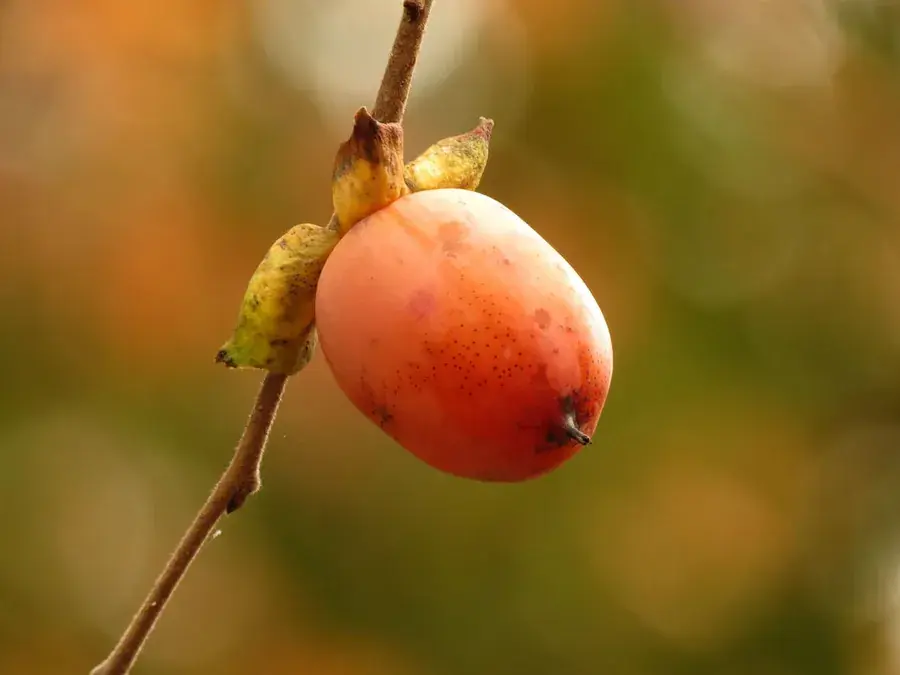 FruitOctober – November
American persimmon
Diospyros virginiana
Blocky alligator-hide bark; orange fruit the size of a plum, only ripe when it is wrinkled, squishy and usually on the ground.
How to know it & its look-alikes →Photo: Katja Schulz · CC BY 4.0
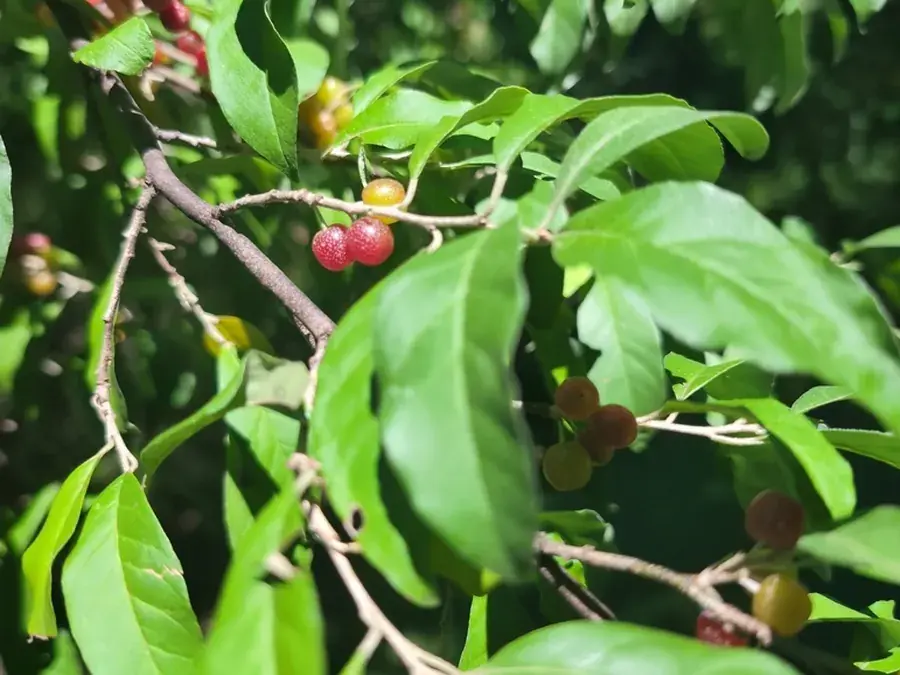 BerrySeptember – October
Autumn olive
Elaeagnus umbellata
A sprawling thorny shrub whose leaves flash silver underneath; in autumn it is weighed down with small red berries finely speckled with silver and brown scales, each with one soft seed.
How to know it & its look-alikes →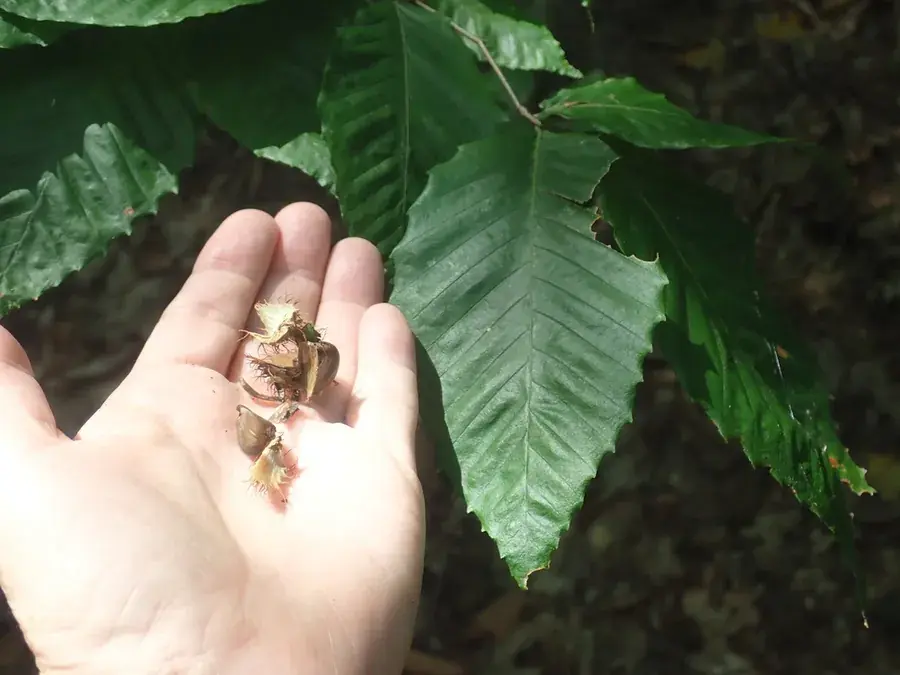 NutSeptember – October
Beechnuts
Fagus grandifolia
Smooth, pale grey bark on a tall tree; long, sharp, cigar-shaped buds; oval leaves with coarse teeth and straight parallel veins, many held, bleached, through winter. The nuts are small, three-sided and come two to a soft-bristled husk that splits into four.
How to know it & its look-alikes →
Checked against these sources ·
- Minnesota Wildflowers: Canada goldenrod
- USDA Forest Service Fire Effects Information System: Solidago canadensis
- University of Vermont Extension: Goldenrod, a useful wildflower
- University of Illinois Extension: Autumn allergies — don’t blame goldenrod
- Washington State Noxious Weed Control Board: Tansy ragwort (Senecio jacobaea) written findings
- Washington State Noxious Weed Control Board: Common groundsel (PNW 466)
Seasons are typical for the middle of the range and move by weeks north and south, and up and down hills.
Educational information only. Never eat a wild plant or mushroom identified from a single photograph or description — confirm with a regional field guide or an experienced forager, and know the poisonous species in your area first.