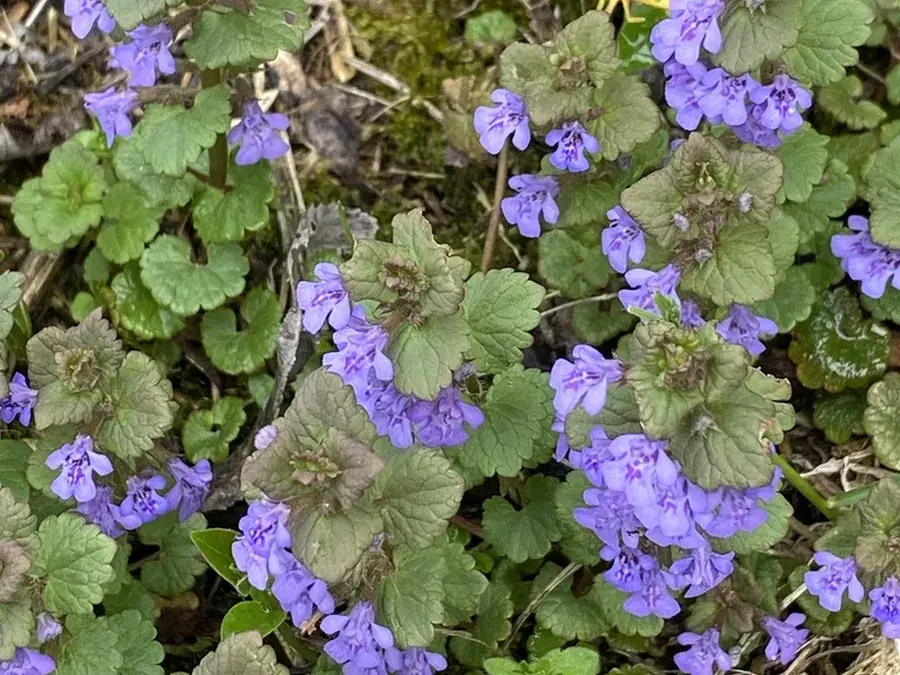
Photo by Sandy Wolkenberg on iNaturalist · CC BY 4.0
GreenIn season now (October)
Ground ivy (creeping Charlie)
Glechoma hederacea
- When
- Typically March – June, September – October — March, April, May, June, September, October. Earlier in the south, later in the north.
- Where it grows
- Shady lawns, the damp side of the house, under hedges and along woodland paths, creeping in mats over anything moist and half-shaded.
- How to know it
- Trailing square stems that root at every node; opposite, round-to-kidney-shaped leaves with scalloped edges on long stalks; small blue-violet two-lipped flowers in the leaf axils in spring; and a sharp minty-skunky smell when crushed.
- Look-alikes
- Henbit and purple dead-nettle (both edible) are upright with leaves clasping the stem; common mallow has round stems and no smell; garlic mustard rosettes smell of garlic and have alternate leaves on round stems. Only ground ivy creeps with square stems and a mint smell.
- Harvest and use
- Young spring leaves and flowering tops, a few at a time: a bitter aromatic pot-herb for soup and stuffing, or dried for tea. It was the English bittering herb for ale before hops. A seasoning quantity, not a salad bowl.
- Caution
- Poisonous to horses in quantity — keep it out of hay and paddocks. For people it contains volatile oils, so eat small amounts and leave it alone in pregnancy. Pick away from sprayed lawns and dog walks.
Ground ivy (creeping Charlie) at a glance
- Also called
- Creeping Charlie, gill-over-the-ground, alehoof, run-away-robin, lierre terrestre (Quebec).
- Family
- Lamiaceae, the mint family (which also includes henbit, dead-nettles, selfheal and wild mint).
- Where it grows
- A European perennial, carried over by settlers as a pot-herb and brewing plant and now one of the commonest lawn weeds of the continent: every province from Newfoundland to British Columbia, every state, and a foothold in Alaska. It is thickest in the moist East — the Maritimes, the St. Lawrence and Great Lakes lowlands, New England, the Ohio valley, the Southeast piedmont — and on the Pacific coast. It thins out on the dry Plains and in the mountain West, and is essentially absent from the Gulf coast, the Florida peninsula, the deserts and Hawaii.
- When to pick
- Early spring, when the new leaves are small, bright and least bitter — March to May in the Great Lakes and St. Lawrence country, February in the mid-Atlantic — and again in September and October after the summer heat. It flowers in April and May; the flowering tops are the traditional tea and brewing harvest. By midsummer the leaves are tough and the smell harsh. It stays green under snow and can be picked in any mild spell of winter.
- Parts used
- Young leaves and flowering tops: a few chopped into soup, stuffing or an omelette as a bitter aromatic herb, or dried for tea. Before hops reached England it bittered and cleared ale, which is where ‘alehoof’ and ‘gill’ (from the French guiller, to ferment) come from. Stems and roots are not used. It is a seasoning quantity, not a salad.
- Is any of it poisonous?
- Ground ivy is poisonous to horses that eat large amounts, fresh or in hay, with sweating, drooling, dilated pupils and laboured breathing; cases are rare because the plant tastes bitter, and rarely fatal. For people it contains volatile oils, including a small amount of pulegone, the compound that makes pennyroyal dangerous — the concentration in ground ivy is a small fraction of pennyroyal’s, but it is a reason to keep servings small and to leave it alone in pregnancy. Not a plant to juice or eat by the bowlful.
- More look-alikes to know
- Henbit (Lamium amplexicaule) and purple dead-nettle (L. purpureum) are upright spring annuals of the same family with pink-purple flowers; henbit’s upper leaves clasp the stem and dead-nettle’s are triangular and purplish at the top, and both are edible. Common mallow has round scalloped leaves of a similar size but round stems, alternate leaves and no smell. First-year garlic mustard rosettes have kidney-shaped leaves too, on round stems, alternate, and smell of garlic. Violets have pointed heart-shaped leaves on round stalks and no smell. Only ground ivy combines creeping square stems that root at the nodes, opposite leaves and that sharp minty-skunky smell.
Questions people ask about ground ivy
Is creeping Charlie edible?
Yes, in small amounts, once identified by its creeping square stems, opposite scalloped leaves and sharp mint smell. The young leaves and flowering tops are a traditional bitter pot-herb and tea and were used to flavour ale before hops. It is not a bulk green: eat it as a seasoning, and skip it in pregnancy because of its volatile oils.
How do you identify ground ivy?
Long trailing stems that are square in cross-section and root wherever a node touches soil; round to kidney-shaped leaves with scalloped edges, in opposite pairs on long stalks; small blue-violet two-lipped flowers in the leaf axils in April and May; and a strong, slightly skunky mint smell when you crush a leaf. Round-stemmed or scentless, it is something else.
Is ground ivy poisonous to horses?
Yes, in quantity. Horses that eat a lot of ground ivy, fresh or in hay, can show sweating, heavy salivation, dilated pupils and laboured breathing. Poisoning is uncommon because the plant is bitter and horses avoid it when they have better forage, and it is rarely fatal, but it should be kept out of paddocks and hay fields.
What looks like ground ivy?
Henbit and purple dead-nettle (both edible mints that stand upright rather than creep), common mallow (round stems, no smell, cheese-wheel fruits), young garlic mustard (round stems, garlic smell) and violets (pointed leaves, no smell). The square creeping stem and the mint smell settle it.
When do you pick ground ivy?
Early spring, from the first thaw to the end of flowering in May, when the leaves are small and least bitter, and again in autumn after the heat breaks. It stays green all winter and can be picked in a mild January. Summer leaves are tough and harsh.
Is creeping Charlie safe for children?
As a plant to find, crush and smell on a lawn walk, yes, and a leaf nibbled will do no harm. It is not something to let children graze on: it is bitter, strongly aromatic and best kept to a seasoning. Pick it from unsprayed ground — ground ivy is one of the most-sprayed lawn weeds in North America — and away from where dogs go.
Found in these regions
- Boreal Forest & Shield
- Acadian Forest & Atlantic Coast
- Great Lakes & St. Lawrence Lowlands
- Northeast Atlantic Coast & Piedmont
- Appalachian Highlands
- Central Hardwoods & Interior Plateaus
- Southeastern Piedmont & Coastal Plain
- Prairies & Great Plains
- Pacific Maritime
Hardiness zones 3–10.
Is it ready near you?
Get this week's foraging guide for your area
Enter a town, postal code or ZIP and we'll tell you what's in season right there this week — from your local climate, this week's weather and your ecological region.
Also ready in October
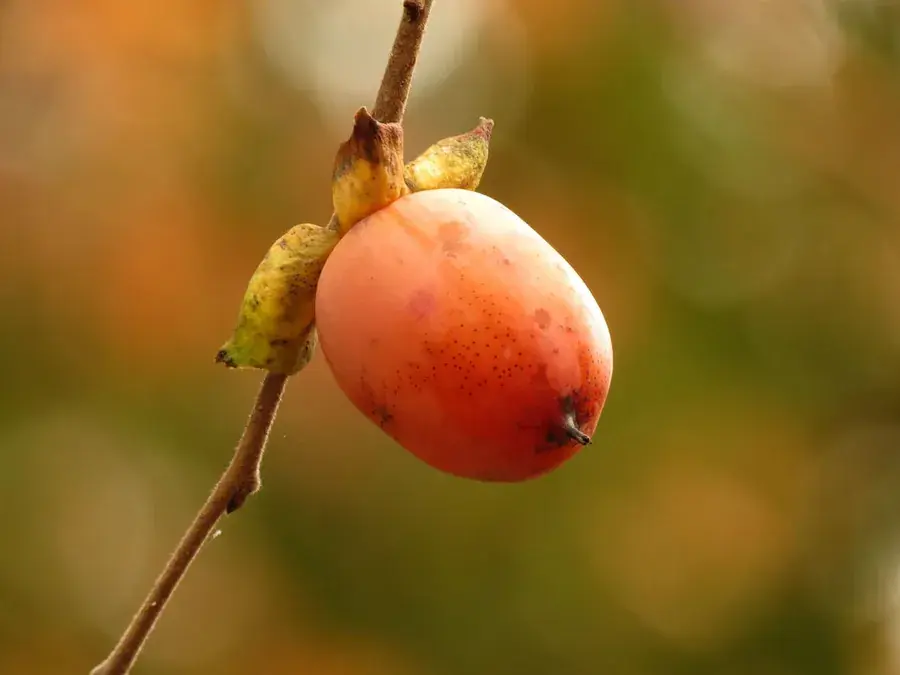 FruitOctober – November
American persimmon
Diospyros virginiana
Blocky alligator-hide bark; orange fruit the size of a plum, only ripe when it is wrinkled, squishy and usually on the ground.
How to know it & its look-alikes →Photo: Katja Schulz · CC BY 4.0
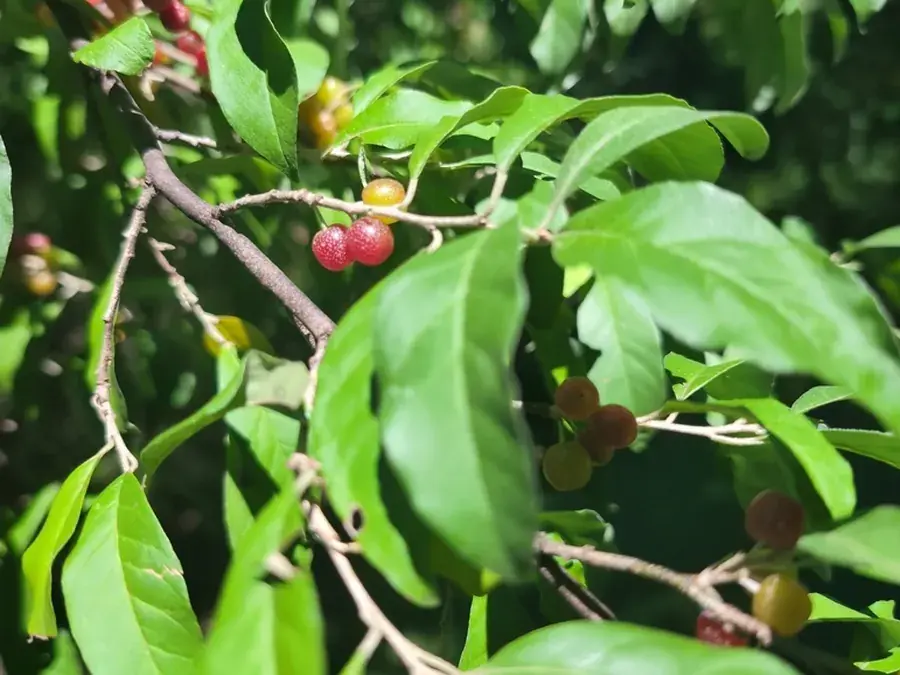 BerrySeptember – October
Autumn olive
Elaeagnus umbellata
A sprawling thorny shrub whose leaves flash silver underneath; in autumn it is weighed down with small red berries finely speckled with silver and brown scales, each with one soft seed.
How to know it & its look-alikes →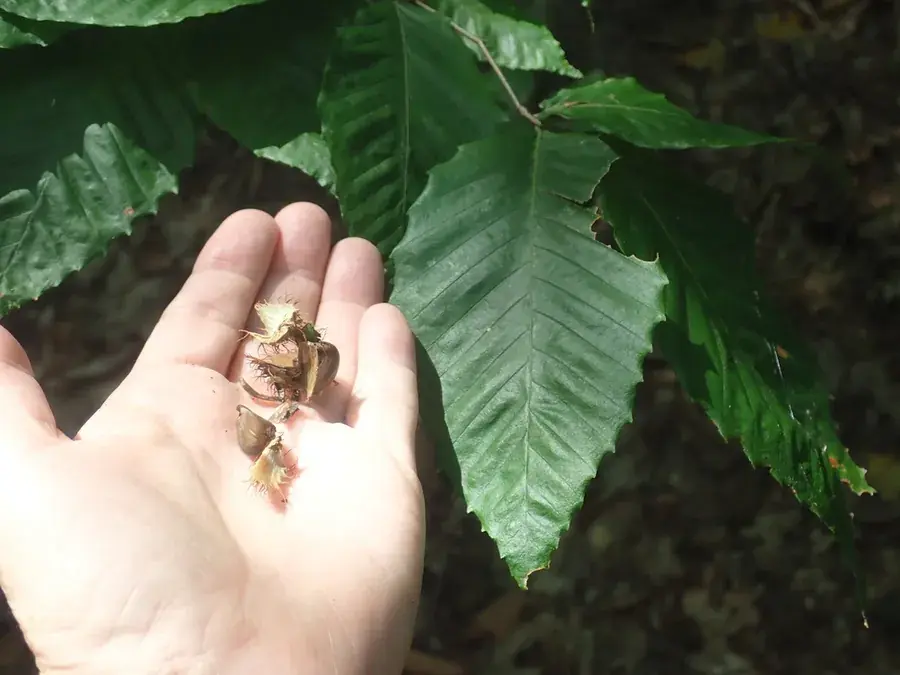 NutSeptember – October
Beechnuts
Fagus grandifolia
Smooth, pale grey bark on a tall tree; long, sharp, cigar-shaped buds; oval leaves with coarse teeth and straight parallel veins, many held, bleached, through winter. The nuts are small, three-sided and come two to a soft-bristled husk that splits into four.
How to know it & its look-alikes →
Checked against these sources ·
- Minnesota Wildflowers: Ground ivy
- USDA NRCS: Ground ivy / creeping Charlie (identification, range, toxicity to horses)
- NC State Extension: Glechoma hederacea
- Wikipedia: Glechoma hederacea (history of use, volatile oils)
- VASCAN: Glechoma hederacea
Seasons are typical for the middle of the range and move by weeks north and south, and up and down hills.
Educational information only. Never eat a wild plant or mushroom identified from a single photograph or description — confirm with a regional field guide or an experienced forager, and know the poisonous species in your area first.