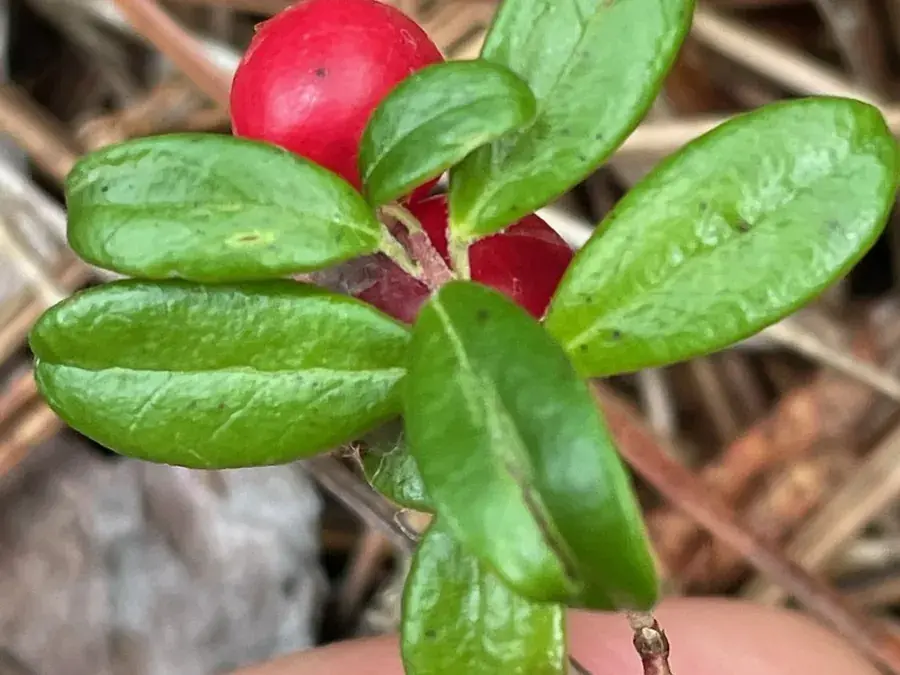
BerryIn season now (October)
Lingonberry (partridgeberry)
Vaccinium vitis-idaea
- When
- Typically September – November — September, October, November. Earlier in the south, later in the north.
- Where it grows
- Acidic, well-drained ground: coastal barrens and headlands in Newfoundland, open spruce and pine woods, rock outcrops, bog hummocks and tundra, usually in a dense ankle-high mat.
- How to know it
- A creeping evergreen 5–20 cm (2–8 in) tall with small, thick, glossy oval leaves whose edges roll under; turn a leaf over and look for scattered dark bristly dots on the pale underside. Firm red berries hang in small clusters at the branch tips, and the tiny bell flowers that preceded them had four fused petals.
- Look-alikes
- Bearberry (kinnikinnick) is the common double: red berries on a trailing evergreen of sandy, rocky ground, with no dots under the leaf and urn-shaped five-petalled flowers; its berries are edible but dry and mealy. Red baneberry is the toxic red berry of the same woods — but it is a soft leafy herb with compound leaves and berries in a stalked cluster, never an evergreen mat.
- Harvest and use
- Tart and firm — sauce, jam, juice and the Newfoundland partridgeberry pie; they keep for months cold. Pick after the first frost, when they sweeten and loosen, and rake with your fingers rather than tearing the mat.
- Caution
- Check the whole plant, not just the berry: a low evergreen mat with dotted leaves, never a leafy herb. Picking is prohibited in most parks and reserves.
Lingonberry (partridgeberry) at a glance
- Also called
- Partridgeberry and redberry (Newfoundland and Labrador), foxberry (Nova Scotia), mountain cranberry, rock cranberry, lowbush cranberry (Alaska), cowberry (Britain), airelle rouge (Quebec). The North American plant is the small-leaved subspecies minus. Not the same plant as the paired-leaf partridgeberry (Mitchella repens) of eastern woods.
- Family
- Ericaceae, the heath family (which also includes blueberries, cranberries, bearberry and Labrador tea).
- Where it grows
- Native across the whole north: Alaska, Yukon and all of boreal Canada east to Newfoundland and Labrador, and south into the Maritimes, northern Maine and New Hampshire, the Adirondacks, the Lake Superior shore of Minnesota, Wisconsin and Michigan, interior British Columbia and the Alberta Rockies. Newfoundland’s coastal barrens carry the biggest wild crop on the continent and a commercial partridgeberry harvest.
- When to pick
- Late August into October, later than blueberries. The berries turn from white to a deep, even red and are at their best after the first hard frost, which softens the skin and takes down the acid — Newfoundlanders pick through October and into early November. Firm red berries hang on the plant through winter and can even be picked from under snow in spring, flavour intact if a little mushy.
- Parts used
- Only the berries. They are too tart to eat by the handful but need no pectin and little cooking: sauce, jam, juice, partridgeberry pie and muffins, or simply mixed with sugar and left in the fridge, where they keep for weeks because of their natural benzoic acid. Leaves are not used for food.
- Is any of it poisonous?
- Nothing poisonous in the plant itself; the only risk is the red-berried look-alikes, above all baneberry.
- More look-alikes to know
- Bunchberry (Cornus canadensis) grows in the same woods with red berries, but they sit in a bunch above a whorl of four to six broad leaves on a soft stem; edible but mealy. Wild cranberries (Vaccinium oxycoccos, V. macrocarpon) are relatives with larger, hollow-feeling berries on thread-thin vines in open bog. Wintergreen (Gaultheria procumbens) has single red berries and leaves that smell of wintergreen when crushed; edible. All three are harmless mistakes — the plant to rule out is baneberry, covered in the main entry.
Questions people ask about lingonberry
When do you pick partridgeberries in Newfoundland?
From mid-September through October and into early November, after the first frost has sweetened them. The province’s own berry guide puts prime picking in October and early November. Earlier berries are hard, pale and very sour; a frosted berry is dark red, slightly soft and comes away with a light pull.
How do you identify lingonberry?
By a creeping evergreen mat 5–20 cm (2–8 in) high with small, thick, glossy leaves whose edges roll under, pale beneath with scattered dark bristly dots; look for the dots with a hand lens if you are unsure. The flowers are tiny white-to-pink bells with four fused petals, and the berries are firm, red and in small clusters at the shoot tips. Bearberry has no dots and five-petalled urn flowers.
Is bearberry the same as lingonberry?
No, though they are often mixed up. Bearberry or kinnikinnick (Arctostaphylos uva-ursi) is a trailing evergreen of sandy and rocky ground with red berries that are edible but dry, mealy and nearly tasteless; its leaves are flat, spoon-shaped and unspotted underneath. Lingonberry grows in a denser upright mat, has rolled leaf edges with dark dots beneath, and its berries are juicy and tart.
Can you eat lingonberries raw?
Yes, once identified — they are simply very tart until frost and most people prefer them cooked or sugared. In Scandinavia and Newfoundland the traditional way is to stir raw berries with sugar and let them stand, which makes a thick spreadable sauce without cooking. The seeds are tiny and eaten.
Are lingonberries safe for children?
Yes, and they are a good berry for children because the plant is low, the berries are firm and the taste is sharp enough that nobody eats too many. The rule to teach is the plant, not the colour: red berries on a glossy evergreen mat, never red berries on a leafy upright plant with divided leaves, which could be baneberry.
Where do lingonberries grow?
Across the boreal forest and tundra of Canada and Alaska and south into northern New England, the Great Lakes shore and the western mountains. Look on acidic, well-drained ground: coastal barrens and headlands, open spruce and jack-pine woods, rock outcrops and the drier hummocks in bogs. They often grow with crowberry, bearberry and reindeer lichen.
Found in these regions
- Boreal North & Taiga
- Boreal Forest & Shield
- Acadian Forest & Atlantic Coast
- Great Lakes & St. Lawrence Lowlands
- Western Mountains & Interior Plateaus
- Pacific Maritime
Hardiness zones 1–6.
Is it ready near you?
Get this week's foraging guide for your area
Enter a town, postal code or ZIP and we'll tell you what's in season right there this week — from your local climate, this week's weather and your ecological region.
Also ready in October
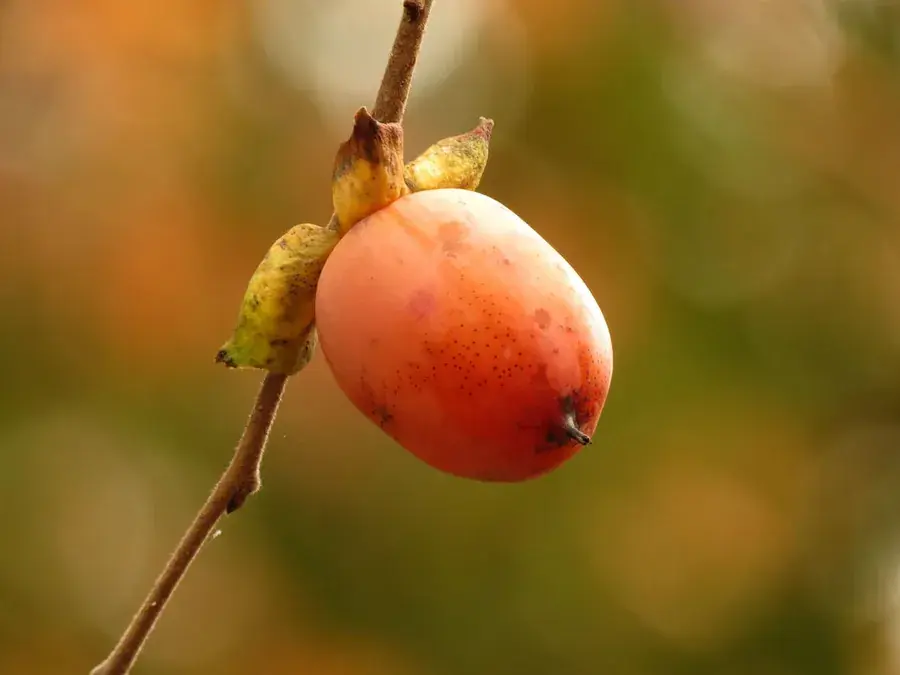 FruitOctober – November
American persimmon
Diospyros virginiana
Blocky alligator-hide bark; orange fruit the size of a plum, only ripe when it is wrinkled, squishy and usually on the ground.
How to know it & its look-alikes →Photo: Katja Schulz · CC BY 4.0
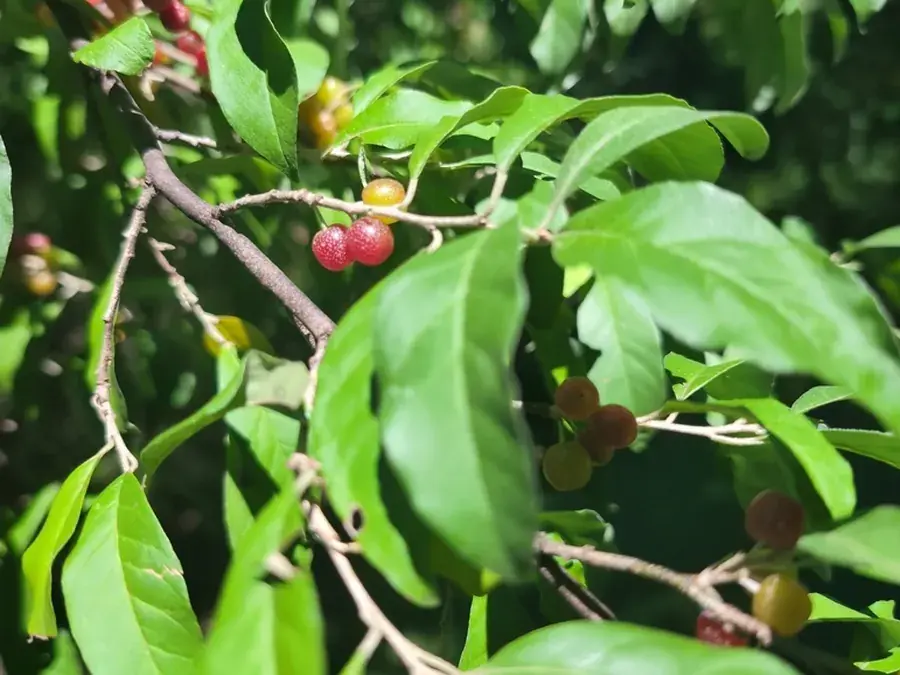 BerrySeptember – October
Autumn olive
Elaeagnus umbellata
A sprawling thorny shrub whose leaves flash silver underneath; in autumn it is weighed down with small red berries finely speckled with silver and brown scales, each with one soft seed.
How to know it & its look-alikes →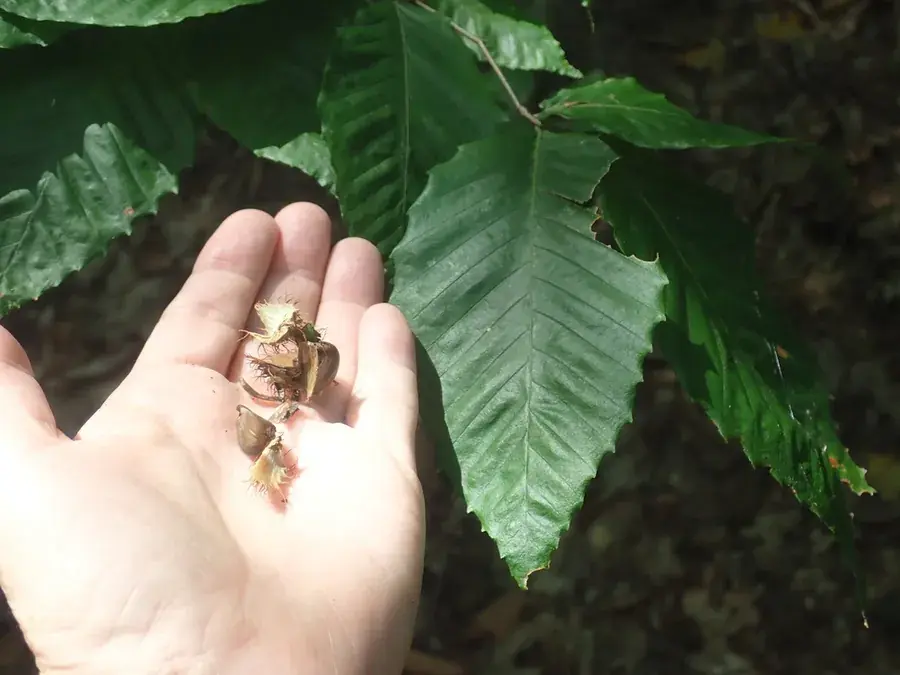 NutSeptember – October
Beechnuts
Fagus grandifolia
Smooth, pale grey bark on a tall tree; long, sharp, cigar-shaped buds; oval leaves with coarse teeth and straight parallel veins, many held, bleached, through winter. The nuts are small, three-sided and come two to a soft-bristled husk that splits into four.
How to know it & its look-alikes →
Checked against these sources ·
- Minnesota Wildflowers — Lingonberry (Vaccinium vitis-idaea)
- USDA Forest Service Fire Effects Information System — Vaccinium vitis-idaea
- Dalhousie University Wild Blueberry Network — Lingonberry (partridgeberry) in Newfoundland and Labrador
- Newfoundland and Labrador Tourism — All about berries
- University of Wisconsin Horticulture Extension — Baneberry (Actaea spp.)
Seasons are typical for the middle of the range and move by weeks north and south, and up and down hills.
Educational information only. Never eat a wild plant or mushroom identified from a single photograph or description — confirm with a regional field guide or an experienced forager, and know the poisonous species in your area first.