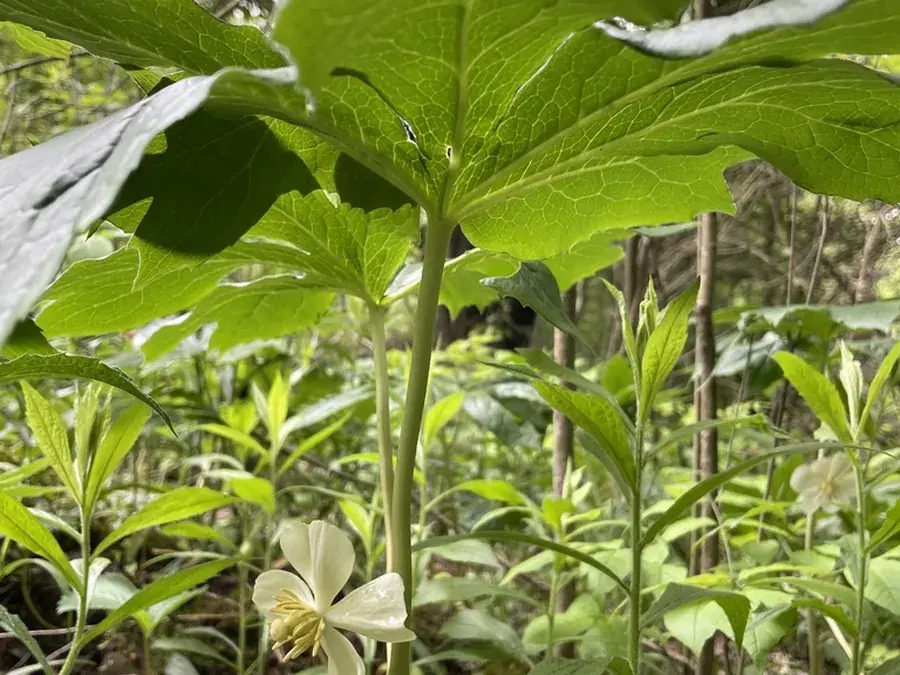
Photo by Public domain (iNaturalist) on iNaturalist · CC0 (public domain)
FruitSeason: July – August
Mayapple
Podophyllum peltatum
This one has a dangerous look-alike
Nothing else in these woods makes an umbrella leaf — the danger is the plant itself. A green, hard fruit, the rind, the seeds, the leaves and the roots all contain podophyllotoxin and are poisonous; so is an unripe fruit a child picks because it looks like a small green apple. Fully ripe means yellow, soft, fragrant, usually fallen.
- When
- Typically July – August — July, August. Earlier in the south, later in the north.
- Where it grows
- Rich, moist deciduous woods, wooded slopes and riverbanks, spreading by rhizome into colonies of hundreds of umbrella leaves.
- How to know it
- Knee-high colonies of one or two deeply lobed umbrella leaves per stalk; the two-leaved plants hold a single nodding white flower in the fork in spring and one egg-shaped fruit in summer. Only a soft, yellow, strongly fragrant fruit that comes away in your hand is ripe.
- Harvest and use
- The ripe flesh only, pressed through a sieve to remove the seeds and skin, for a lemon-and-pineapple juice, jelly or a spoonful eaten fresh. Keep to a few; even the ripe fruit disagrees with some people in quantity.
- Caution
- Every part except the ripe fruit flesh is poisonous and handling the root can inflame the skin. Pick nothing green. Leave most fruit for box turtles, which spread the seed.
Mayapple at a glance
- Also called
- May apple, American mandrake, wild lemon, hog apple, podophylle pelté or pomme de mai (Quebec).
- Family
- Berberidaceae, the barberry family (which also includes blue cohosh and the barberries).
- Where it grows
- Native to the eastern deciduous forest: southern Ontario and south-western Quebec, with an outlying native population in Nova Scotia, and throughout the eastern US from New England to Minnesota, south to Georgia and Louisiana and west into the woodlands of eastern Kansas, Oklahoma and Texas. It is absent from the Florida peninsula and the West. Colonies spread by rhizome and can be decades old and hundreds of leaves wide.
- When to pick
- Late July into August across the Great Lakes region and the mid-Atlantic, from late June in the South and into early September in Minnesota. The flower opens in May under the leaves; the fruit swells green through June and July while the colony’s leaves yellow and collapse around it, and it is ripe only when it has turned soft, yellow and strongly fragrant and comes away at a touch or is already lying on the ground. Colonies fruit sparsely — only the two-leaved plants flower, and only cross-pollinated flowers set — so a good patch may offer a dozen fruit.
- Parts used
- The flesh of the fully ripe fruit only, pressed through a sieve to leave behind the seeds and the skin: a spoonful fresh, or juice, jelly, preserves and a syrup that tastes of lemon, pineapple and guava. Treat it as a flavouring rather than a meal. Leaves, stems, roots, seeds, rind and any fruit that is still green or firm are poisonous and never eaten.
- Is any of it poisonous?
- The whole plant except the ripe fruit flesh — leaves, stems, rhizome and roots, seeds, the rind, and unripe fruit — contains podophyllotoxin, a cell poison that causes vomiting, severe diarrhea and, in serious cases, damage to the liver, kidneys, nerves and blood; NC State rates it a high-severity poison and poisonings have been recorded since the 1800s. Handling the root can inflame the skin. Even ripe fruit eaten in quantity causes diarrhea in some people, so keep to a few, and spit out or strain the seeds.
- More look-alikes to know
- No other eastern wildflower makes a palm-sized umbrella leaf on a single stalk, so the plant is rarely mistaken; the mistakes are about ripeness and about the fruit alone. A green mayapple found on the ground in July looks like a small unripe apple or a lime and is poisonous. Ground cherries (Physalis) ripen to yellow in the same woods but sit inside a papery husk on a bushy plant. Wild cucumber and bur cucumber hang green spiny pods from vines. The twinned leaves of blue cohosh and the umbrella of umbrella-leaf (Diphylleia, in the southern Appalachians) are the nearest leaf shapes; neither has an edible fruit.
Questions people ask about mayapple
Is mayapple fruit edible?
Only when fully ripe — soft, yellow, fragrant and usually fallen — and only the flesh, with the seeds and skin strained out. Ripe mayapple tastes of lemon and tropical fruit and is used for jelly, juice and a spoonful eaten fresh. Every other part of the plant, and any fruit still green or firm, contains podophyllotoxin and is poisonous.
What parts of mayapple are poisonous?
Everything except the flesh of the ripe fruit: the leaves, stems, rhizome and roots, the seeds, the rind, and unripe fruit. The poison is podophyllotoxin, which causes severe vomiting and diarrhea and can injure the liver, kidneys and nerves. Touching the root can also inflame the skin. Eating too many ripe fruit gives some people diarrhea.
When are mayapples ripe?
Late July and August in southern Ontario, Quebec, New York and the Great Lakes states; late June and July from Missouri south; into early September in Minnesota. Do not go by the calendar — a ripe fruit is yellow with no green left, soft enough to dent, smells sweet from a step away, and drops into your hand. If you have to tug, leave it.
How do you identify mayapple?
By colonies of knee-high umbrella leaves, each 20–40 cm (8–16 in) across and cut into five to nine deep lobes, one leaf per stalk on the young plants and two on the mature ones. A single nodding white flower 3–5 cm (1–2 in) across opens in the fork of the two-leaved plants in May, hidden under the leaves, and becomes an egg-shaped fruit 3–5 cm (1½–2 in) long. No other common eastern wildflower makes an umbrella leaf on one stalk; the look-alikes below are the few that come close.
Is mayapple dangerous for children?
Yes, and this is the plant to teach. Mayapple grows in parks, school woodlots and backyards, and its green summer fruit looks like a small apple or lime — a child who eats one unripe, or chews the leaves, can be seriously poisoned. The rule for kids is simple: never a green one, never off the plant, and nothing from this plant at all without an adult who knows it. If a child has eaten any part, call poison control.
Is mayapple poisonous to dogs?
Yes — leaves, roots and unripe fruit poison dogs as they do people, and a dog that digs up and chews a rhizome can become very ill with vomiting and diarrhea. Keep dogs from chewing in a mayapple colony and call a vet if one has.
Who eats mayapple fruit in the wild?
Eastern box turtles above all, which find the fallen fruit by smell and spread the seed through their droppings; raccoons, opossums and some birds take it too. A fallen fruit you leave behind is a turtle’s meal and a colony’s only way of travelling, so take a few and leave most.
Found in these regions
- Great Lakes & St. Lawrence Lowlands
- Northeast Atlantic Coast & Piedmont
- Appalachian Highlands
- Central Hardwoods & Interior Plateaus
- Southeastern Piedmont & Coastal Plain
- Gulf Coast & Mississippi Lowlands
- Prairies & Great Plains
Hardiness zones 3–8.
Is it ready near you?
Get this week's foraging guide for your area
Enter a town, postal code or ZIP and we'll tell you what's in season right there this week — from your local climate, this week's weather and your ecological region.
Also ready in October
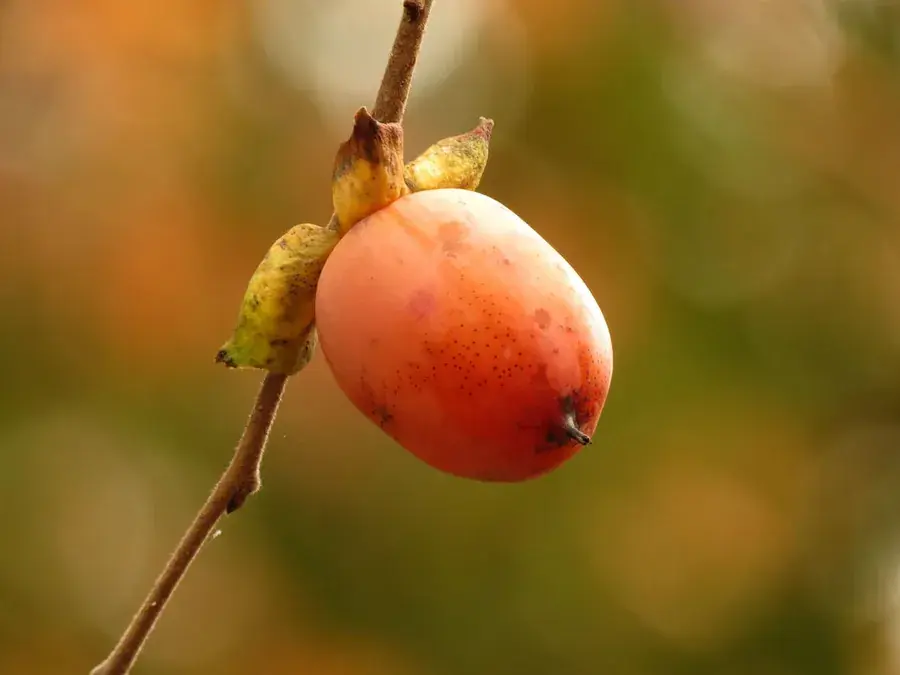 FruitOctober – November
American persimmon
Diospyros virginiana
Blocky alligator-hide bark; orange fruit the size of a plum, only ripe when it is wrinkled, squishy and usually on the ground.
How to know it & its look-alikes →Photo: Katja Schulz · CC BY 4.0
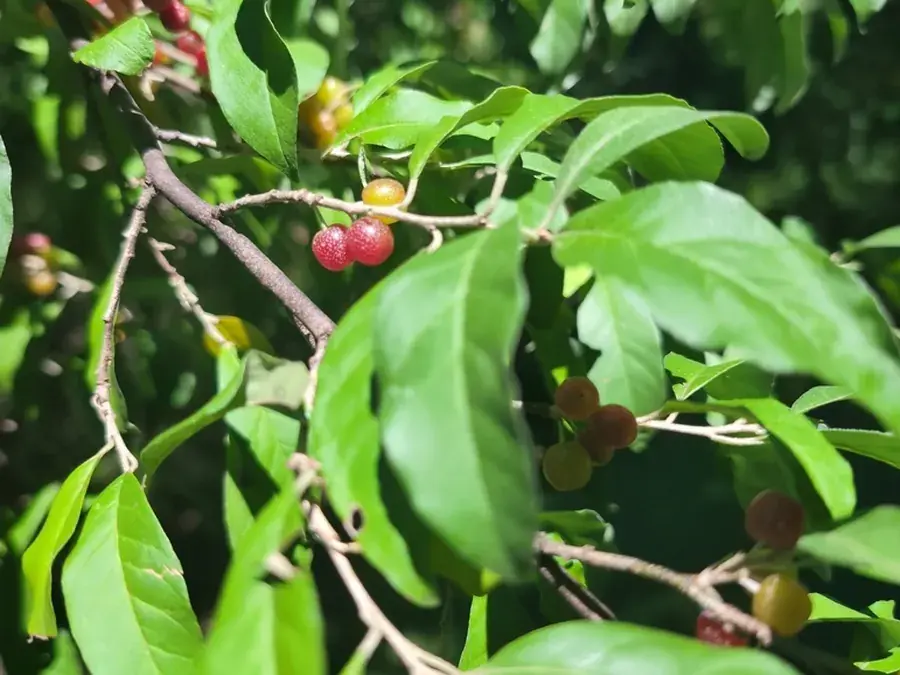 BerrySeptember – October
Autumn olive
Elaeagnus umbellata
A sprawling thorny shrub whose leaves flash silver underneath; in autumn it is weighed down with small red berries finely speckled with silver and brown scales, each with one soft seed.
How to know it & its look-alikes →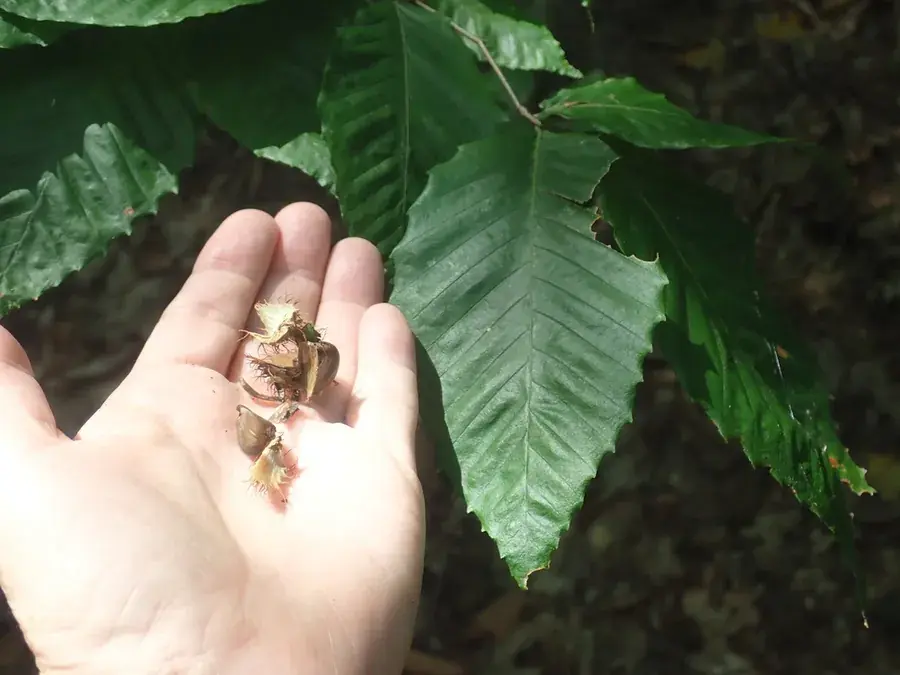 NutSeptember – October
Beechnuts
Fagus grandifolia
Smooth, pale grey bark on a tall tree; long, sharp, cigar-shaped buds; oval leaves with coarse teeth and straight parallel veins, many held, bleached, through winter. The nuts are small, three-sided and come two to a soft-bristled husk that splits into four.
How to know it & its look-alikes →
Checked against these sources ·
- NC State Extension — Podophyllum peltatum
- Missouri Department of Conservation — Mayapple
- Illinois Wildflowers — Mayapple
- Minnesota Wildflowers — Mayapple
- VASCAN (Database of Vascular Plants of Canada) — Podophyllum peltatum
Seasons are typical for the middle of the range and move by weeks north and south, and up and down hills.
Educational information only. Never eat a wild plant or mushroom identified from a single photograph or description — confirm with a regional field guide or an experienced forager, and know the poisonous species in your area first.