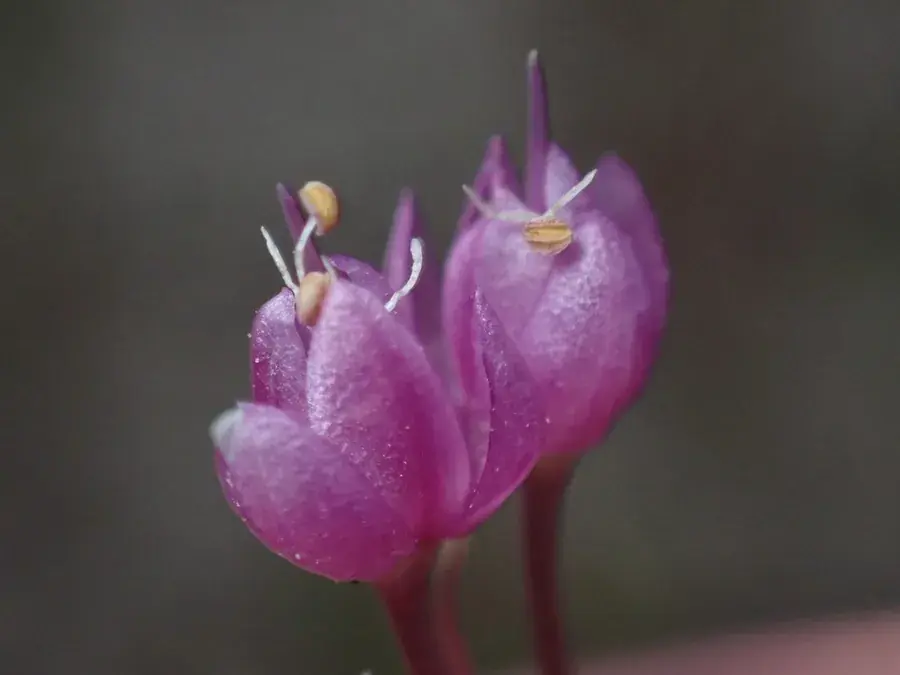
Photo by Jared Shorma on iNaturalist · CC BY 4.0
GreenSeason: May – September
Nodding onion
Allium cernuum
This one has a dangerous look-alike
Death camas (Toxicoscordion venenosum and relatives) grows in the same meadows with the same grass-like leaves and a similar bulb, and it kills. Its flowers are cream-white in an upright spike, not pink and nodding, and no part of it smells of onion. Smell every plant you cut.
- When
- Typically May – September — May, June, July, August, September. Earlier in the south, later in the north.
- Where it grows
- Dry open woods, rocky bluffs, prairie remnants, mountain meadows and Garry oak slopes — sunny, well-drained ground.
- How to know it
- A clump of flat, grass-like leaves from a slender bulb, and in July–August a stem that bends sharply at the top so the pink umbel of bell flowers hangs downward. Crush a leaf: the whole plant smells strongly of onion. No onion smell means it is not an onion, whatever else it looks like.
- Harvest and use
- Leaves and flowers raw or cooked wherever chives go; the small bulbs are strong and sweet when cooked. Snip a few leaves from each clump and leave the bulbs — a dug bulb is a dead plant, and the patches are slow to spread.
- Caution
- Listed as special concern in Minnesota and uncommon across much of the east; take leaves, not plants. Dogs and cats should not be fed any Allium.
Nodding onion at a glance
- Also called
- Nodding wild onion, lady’s leek, qw’uxwi’uc (Island Halkomelem), ail penché (Quebec). Wild chives (Allium schoenoprasum) across the north and prairie onion (A. stellatum) on the Plains are close relatives with the same onion smell and the same uses.
- Family
- Amaryllidaceae, the onion and garlic group (which also includes ramps, chives and daffodils).
- Where it grows
- Native from British Columbia east through Alberta, Saskatchewan, Manitoba and Ontario, and in the US through the Rockies and Cascades, the Black Hills, the Great Lakes states, the Ohio and Tennessee valleys, the Ozarks, and down the Appalachians to Georgia and Alabama. It is absent from the Maritimes, New England, the Atlantic coastal plain, California and Florida, and it is uncommon or listed in several eastern states — special concern in Minnesota.
- When to pick
- Leaves from May through July, before and during flowering, while they are still tender. Flowers in July and August, when the nodding pink umbel makes the plant unmistakable and is itself a garnish. Bulbs, if taken at all, in late summer after the leaves yellow or in early spring — but see the harvest note. Everything moves two to four weeks later in the mountains and the north.
- Parts used
- Leaves, flower stalks and flowers, raw or cooked like chives. Bulbs, small and strong, cooked; Coast Salish households steamed them in pits, and Lewis and Clark ate them. Snip leaves and leave bulbs: a plant takes years to reach flowering size, and cutting half the leaves from a clump leaves it to grow on.
- Is any of it poisonous?
- Nothing poisonous in the plant itself for people. As with all onions, it is toxic to dogs and cats, which should not be fed any part. The danger is entirely in the look-alike.
- More look-alikes to know
- In the east, mountain death camas or white camas (Anticlea elegans, formerly Zigadenus elegans) is the native danger: grass-like leaves, a bulb much like an onion’s, creamy white star flowers in an upright spike, no smell, and alkaloids described as more toxic than strychnine; it grows on prairies, fens and rocky shores from the Great Lakes to the Rockies. Star-of-Bethlehem (Ornithogalum), a garden escape with white six-petalled flowers and grass-like leaves, is also poisonous and smell-less. Blue-eyed grass and sedges are harmless clump-formers that fail the smell test. Prairie onion, wild chives and field garlic all smell of onion and are edible.
Questions people ask about nodding onion
How do you tell nodding onion from death camas?
Smell, then shape. Crush a leaf: nodding onion smells sharply of onion, and death camas (Toxicoscordion venenosum in the west, Anticlea elegans in the east and north) smells of nothing at all. Nodding onion carries pink or white bells in a cluster that hangs from a bent stem; death camas carries cream-white stars in an upright spike. Never dig a bulb you have not smelled the leaves of.
Is nodding onion edible?
Yes — every part is edible once the plant has been identified by its onion smell and its nodding pink umbel, and it has been eaten by Indigenous peoples across its range for thousands of years. Use the leaves and flowers like chives and cook the small bulbs. Without the onion smell it is not an onion and must not be eaten.
When do you harvest nodding onion?
Leaves in late spring and early summer, flowers in July and August, and bulbs — if at all — in autumn after the tops die back or in early spring. The greens are the sustainable harvest: cut a few leaves from each clump and leave the bulbs, since patches are slow to spread and the plant is uncommon across much of the east.
Can death camas poisoning really happen from wild onions?
Yes, and it still does. In 2024 emergency physicians reported seven members of one family poisoned after foraging what they took for wild onions; death camas causes vomiting, a dangerously slow pulse and low blood pressure, and there is no antidote, only hospital support. Indigenous harvesters managed the risk by weeding death camas out of their onion and camas grounds. The onion smell is the whole test.
Is nodding onion safe for children to pick?
Only with the smell test made into a habit: crush, sniff, and only then taste. Children learn it fast and enjoy it, and the pink flowers are a safe first thing to nibble because nothing poisonous has a nodding pink onion-scented umbel. Do not let a child pull up bulbs; that is where the deadly mistake lives.
Is nodding onion poisonous to dogs?
Yes. All onions, garlic and chives, wild or cultivated, damage red blood cells in dogs and cats, and the effect builds with repeated small amounts. Do not feed pets any part of the plant and keep trimmings out of the compost they can reach.
Found in these regions
- Great Lakes & St. Lawrence Lowlands
- Appalachian Highlands
- Central Hardwoods & Interior Plateaus
- Prairies & Great Plains
- Western Mountains & Interior Plateaus
- Pacific Maritime
Hardiness zones 3–8.
Is it ready near you?
Get this week's foraging guide for your area
Enter a town, postal code or ZIP and we'll tell you what's in season right there this week — from your local climate, this week's weather and your ecological region.
Also ready in October
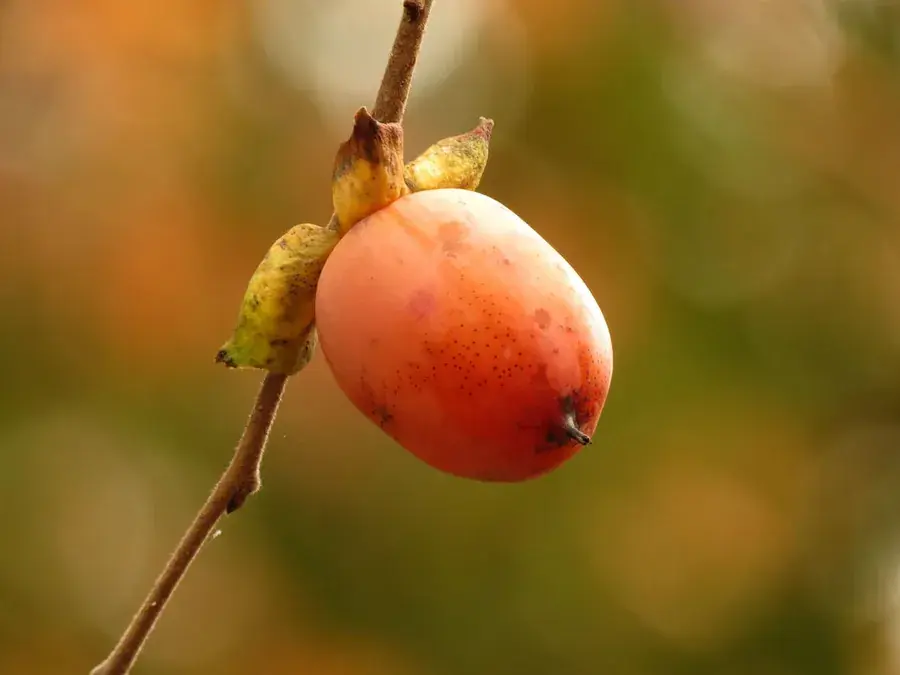 FruitOctober – November
American persimmon
Diospyros virginiana
Blocky alligator-hide bark; orange fruit the size of a plum, only ripe when it is wrinkled, squishy and usually on the ground.
How to know it & its look-alikes →Photo: Katja Schulz · CC BY 4.0
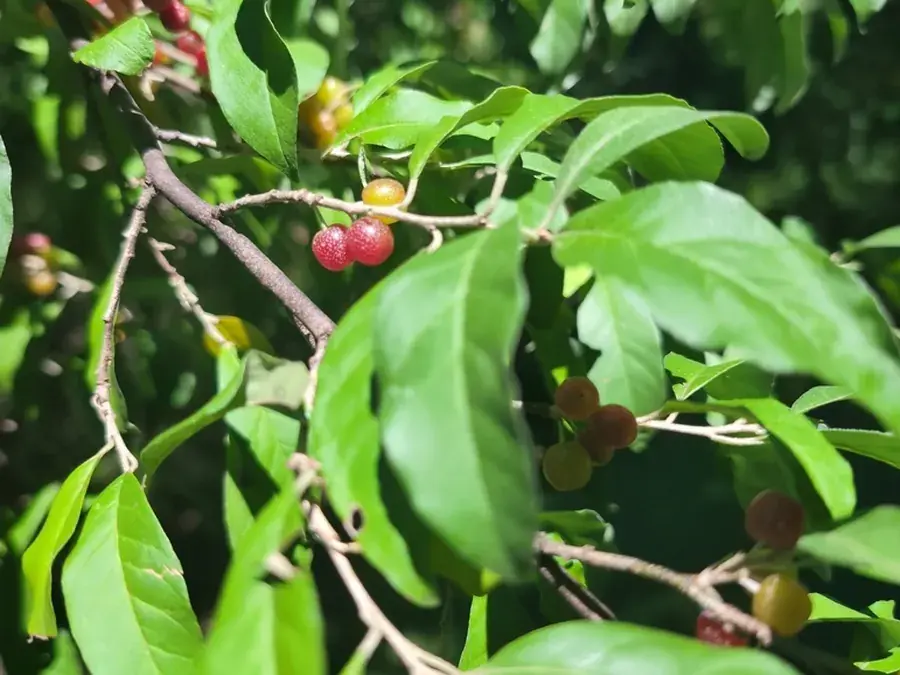 BerrySeptember – October
Autumn olive
Elaeagnus umbellata
A sprawling thorny shrub whose leaves flash silver underneath; in autumn it is weighed down with small red berries finely speckled with silver and brown scales, each with one soft seed.
How to know it & its look-alikes →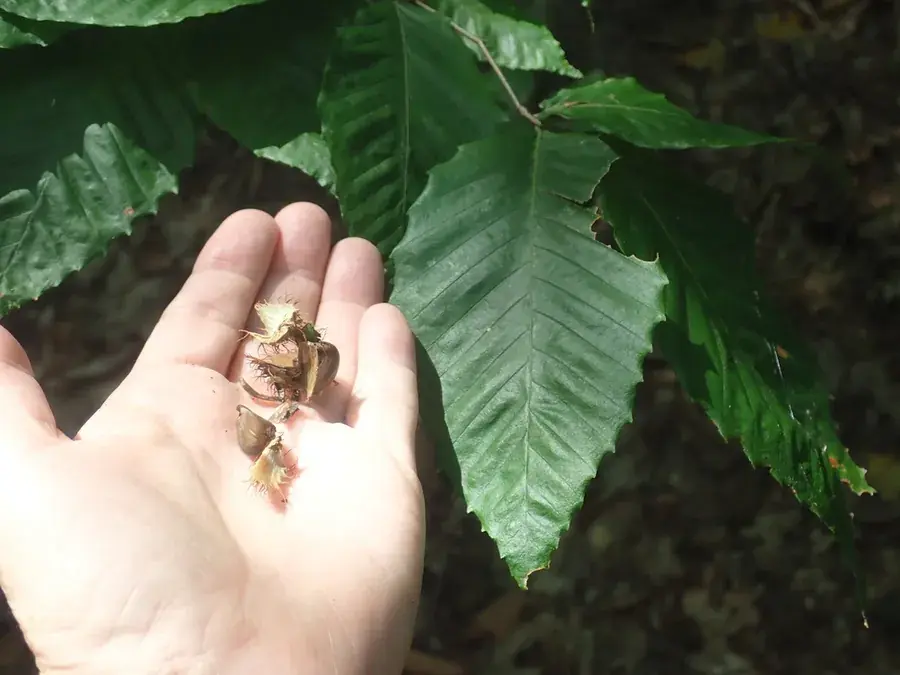 NutSeptember – October
Beechnuts
Fagus grandifolia
Smooth, pale grey bark on a tall tree; long, sharp, cigar-shaped buds; oval leaves with coarse teeth and straight parallel veins, many held, bleached, through winter. The nuts are small, three-sided and come two to a soft-bristled husk that splits into four.
How to know it & its look-alikes →
Checked against these sources ·
- Minnesota Wildflowers — Nodding wild onion (Allium cernuum)
- Minnesota Wildflowers — Mountain death camas (Zigadenus elegans)
- Oregon State University Extension — Meadow deathcamas in the Pacific Northwest (PNW 104)
- Loma Linda University — Acute death camas (Toxicoscordion venenosum) poisoning in seven family members foraging for wild onions (Am J Emerg Med, 2024)
- Garry Oak Ecosystems Recovery Team — Allium cernuum
- Simon Fraser University, Halkomelem ethnobotany — Nodding onion
Seasons are typical for the middle of the range and move by weeks north and south, and up and down hills.
Educational information only. Never eat a wild plant or mushroom identified from a single photograph or description — confirm with a regional field guide or an experienced forager, and know the poisonous species in your area first.