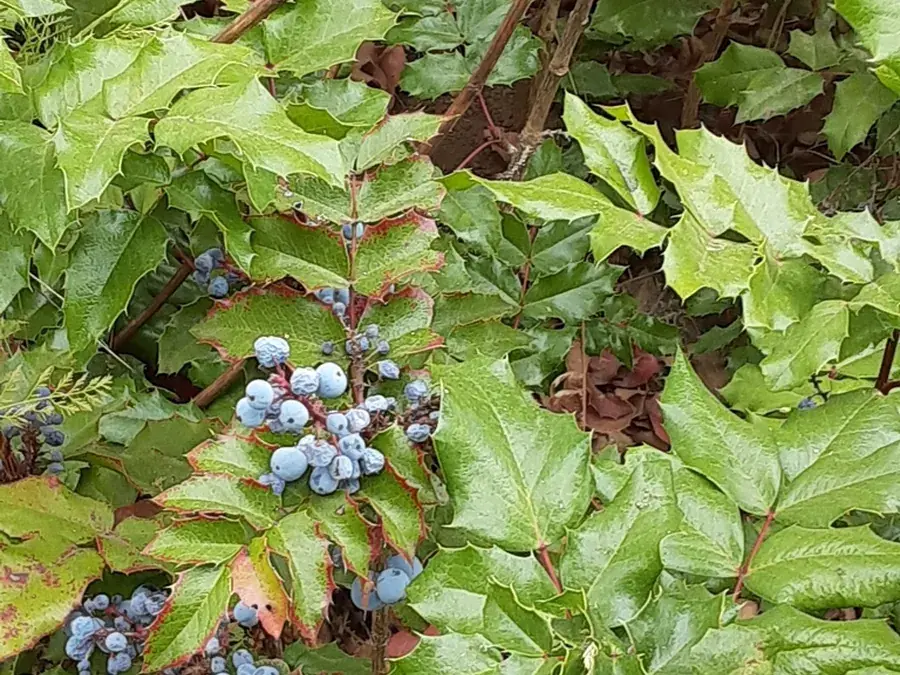
Photo by Doodlepede on iNaturalist · CC BY 4.0
BerrySeason: August – September
Oregon grape
Berberis aquifolium
- When
- Typically August – September — August, September. Earlier in the south, later in the north.
- Where it grows
- Douglas-fir and pine understory, rocky slopes, road cuts and city plantings from sea level into the mountains; the creeping species carpet dry open forest in the Rockies.
- How to know it
- An evergreen shrub with holly-like pinnate leaves of five to nine spiny-edged leaflets, upright clusters of yellow flowers in spring, and powdery blue-black berries in grape-like bunches by late summer. Scrape a stem: the inner bark and wood are bright yellow.
- Look-alikes
- True hollies (Ilex) have the same spiny leaves but each leaf is single, not a row of leaflets, and the berries are red and in the leaf axils; holly berries cause vomiting. Nothing with blue berries in grape-like clusters on a yellow-wooded, pinnate-leaved shrub is anything but a Berberis.
- Harvest and use
- Very tart — jelly, juice and syrup, usually sweetened or blended with salal or other berries; a traditional mixer for Coast and Plateau peoples. Pick the whole cluster when the berries are dusty blue and soft, and leave plenty for the birds.
- Caution
- Oregon grape contains berberine, bitter and in quantity upsetting to the stomach, especially for children; tradition and herbal references both avoid it in pregnancy. Eat the berries in sauce and jelly rather than by the handful. Oregon’s state flower and protected in parks.
Oregon grape at a glance
- Also called
- Tall Oregon grape, holly-leaved barberry, mahonia (Mahonia aquifolium in older books and garden labels). Dull or Cascade Oregon grape (Berberis nervosa), a knee-high plant with 9–19 leaflets, and creeping Oregon grape (B. repens), an ankle-high carpet of the Rockies and Great Basin, have the same berries and the same uses.
- Family
- Berberidaceae, the barberry family (which also includes the barberries, mayapple and blue cohosh).
- Where it grows
- Native from the Alaska panhandle and coastal British Columbia through Washington, Oregon and northern California, and inland through interior BC, Idaho and western Montana; creeping Oregon grape carries the group through the Rockies to Alberta, Colorado, Utah, Arizona and New Mexico. Tall Oregon grape is planted everywhere as a hedge and has naturalised around towns in the East and Great Lakes, where the berries are just as usable.
- When to pick
- August and September, when the clusters have turned from green through red to a dusty blue-black and the berries soften; in a warm lowland garden they can be ready in late July, and creeping Oregon grape in the mountains runs into October. Tart at any stage, they lose a little acid after frost. The yellow flowers open March–May, and bright flowers in spring usually mean a good crop.
- Parts used
- The berries, cooked and strained for juice, jelly, syrup and wine, or dried; the seeds are large and the pulp scant, so the yield is in the juice. Traditionally eaten mixed with salal or other sweeter berries. The yellow roots and inner bark are not food; they are a dye and a bitter traditional medicine, and digging roots kills the plant.
- Is any of it poisonous?
- The whole plant contains berberine, a bitter yellow alkaloid concentrated in the roots and bark and present in smaller amounts in the berries. Berries in jelly or juice are fine for most people; a handful of raw berries can upset a child’s stomach, and herbal references advise avoiding berberine-rich plants in pregnancy and for infants. Do not make teas or tinctures from the root and bark on the strength of a foraging guide.
- More look-alikes to know
- English holly (Ilex aquifolium), an invasive tree of Pacific Northwest woods, is the one people mean: same spiny glossy leaves at a glance, but each leaf is single and alternate, the wood is white, and the berries are red; the berries contain saponins and cause vomiting and diarrhoea in children and pets. Salal (Gaultheria shallon) grows in the same understory with dark blue berries but has oval, spineless leaves; edible and a traditional partner in dried cakes. Blue elderberry and blue huckleberry are the other blue fruits of western woods, both edible, neither with a holly leaf.
Questions people ask about oregon grape
Are Oregon grape berries edible?
Yes — once identified by the holly-like pinnate leaves, yellow spring flowers and yellow inner wood, the dusty-blue berries are edible, though so tart and seedy that almost everyone cooks them into juice, jelly or syrup. They contain a little berberine, so eat them as a preserve rather than by the handful, especially for children.
How do you identify Oregon grape?
An evergreen shrub whose leaves are pinnate — a row of five to nine (or more) spiny, glossy leaflets along a central stalk, unlike holly’s single leaves — with upright clusters of small yellow flowers in spring and grape-like bunches of powdery blue-black berries in late summer. Nick a stem or root: the wood is bright yellow. Leaves often flush red or bronze in winter.
What is the difference between Oregon grape and holly?
Leaves and berries. Holly has single spiny leaves set alternately along the twig and red berries in the leaf axils; Oregon grape has compound leaves made of several spiny leaflets, yellow flowers and blue berries in clusters at the shoot tips. Holly berries are mildly poisonous — vomiting and diarrhoea — and English holly is an invasive weed in Pacific Northwest forests.
When do you pick Oregon grape?
August and September across most of its range, when the berries are fully blue-black with a dusty bloom and give slightly to the fingers; mountain creeping Oregon grape runs later. Taste one from the cluster: if it is green-sour rather than fruit-sour, wait a week. Frost softens them and takes a little acid off.
Is Oregon grape poisonous to dogs or children?
The berries are low-risk: a few cause nothing, a lot can cause stomach upset or vomiting because of berberine, in children and in dogs alike. The roots and bark are far more concentrated and are not for eating by anyone. Jelly made from the strained juice is the family-friendly form.
Why is Oregon grape the state flower of Oregon?
It was adopted in 1899 as a plant found across the whole state and useful to the people living there: a dye, a traditional medicine and a food. It grows wild from the coast to the Blue Mountains, and it is protected in Oregon’s state parks like every other plant, so pick it on private land or roadsides.
Found in these regions
Hardiness zones 5–8.
Is it ready near you?
Get this week's foraging guide for your area
Enter a town, postal code or ZIP and we'll tell you what's in season right there this week — from your local climate, this week's weather and your ecological region.
Also ready in October
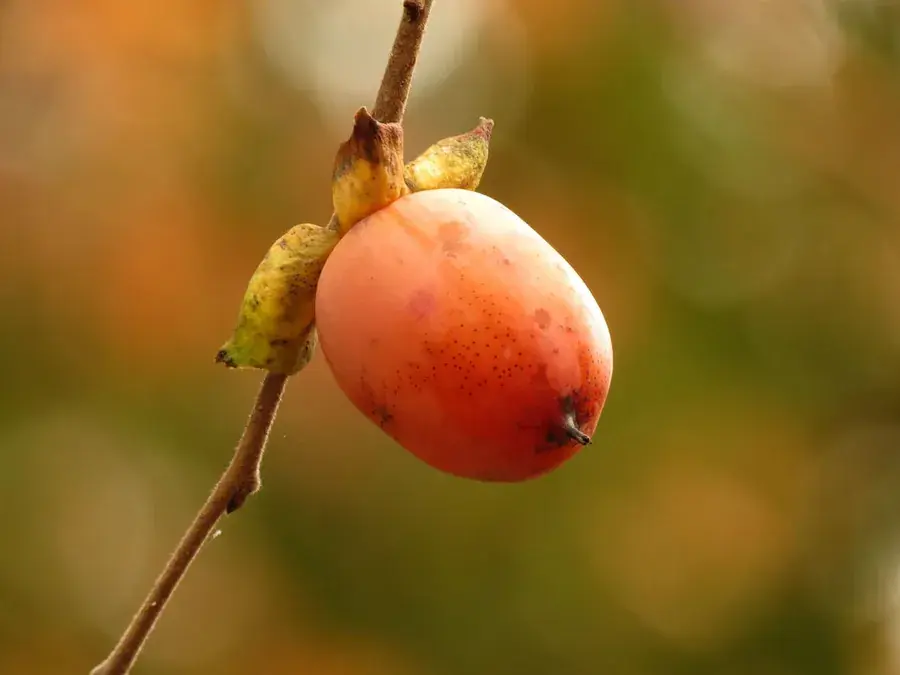 FruitOctober – November
American persimmon
Diospyros virginiana
Blocky alligator-hide bark; orange fruit the size of a plum, only ripe when it is wrinkled, squishy and usually on the ground.
How to know it & its look-alikes →Photo: Katja Schulz · CC BY 4.0
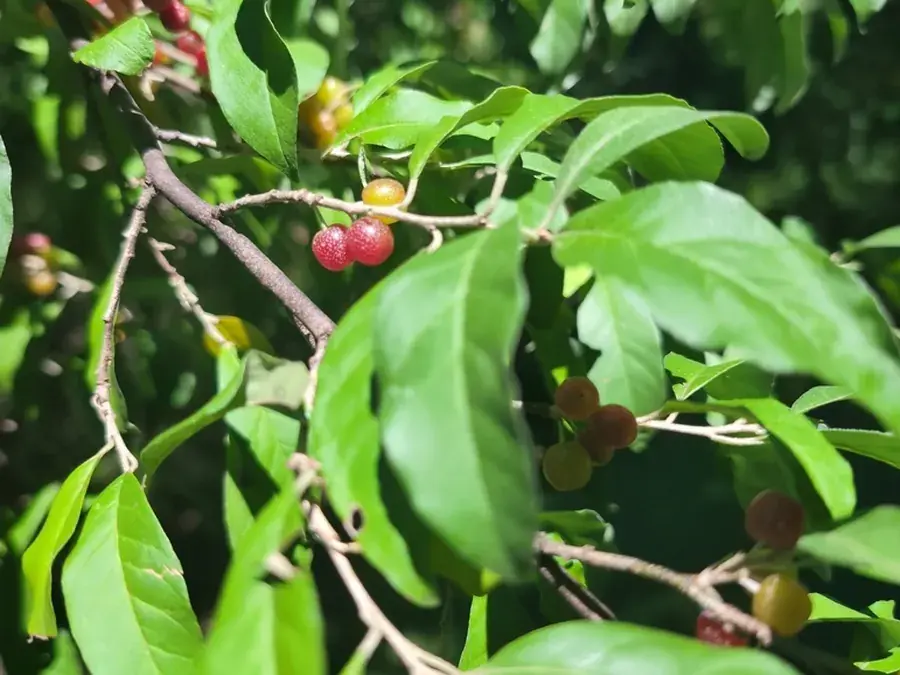 BerrySeptember – October
Autumn olive
Elaeagnus umbellata
A sprawling thorny shrub whose leaves flash silver underneath; in autumn it is weighed down with small red berries finely speckled with silver and brown scales, each with one soft seed.
How to know it & its look-alikes →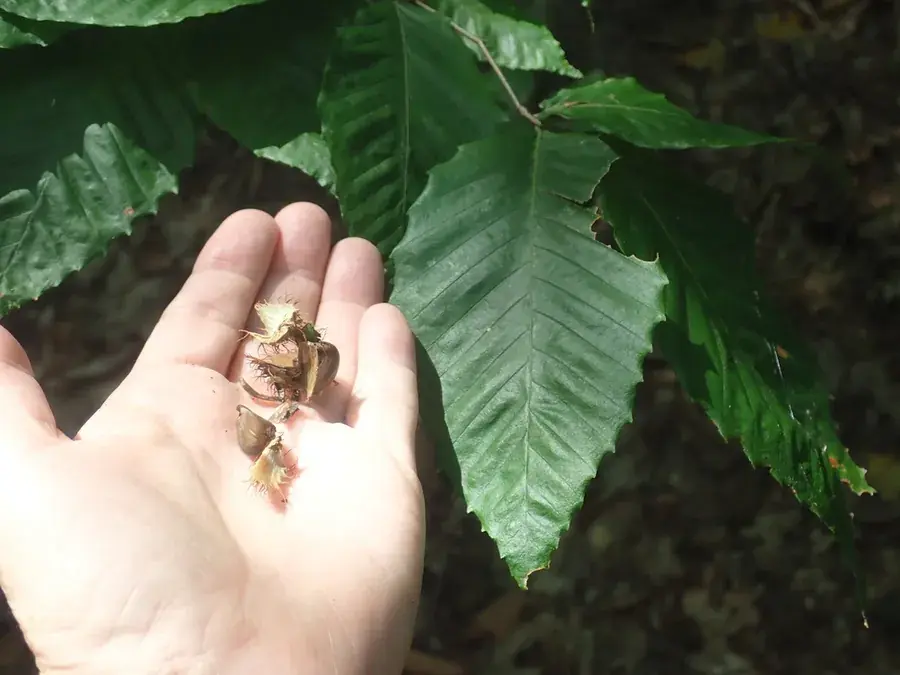 NutSeptember – October
Beechnuts
Fagus grandifolia
Smooth, pale grey bark on a tall tree; long, sharp, cigar-shaped buds; oval leaves with coarse teeth and straight parallel veins, many held, bleached, through winter. The nuts are small, three-sided and come two to a soft-bristled husk that splits into four.
How to know it & its look-alikes →
Checked against these sources ·
- NC State Extension — Berberis aquifolium
- US National Park Service, Klamath Network — Oregon grape
- Virginia Department of Health — Toxic holiday plants (holly)
- Wikipedia — Berberis aquifolium
- Wikipedia — Berberis repens
Seasons are typical for the middle of the range and move by weeks north and south, and up and down hills.
Educational information only. Never eat a wild plant or mushroom identified from a single photograph or description — confirm with a regional field guide or an experienced forager, and know the poisonous species in your area first.