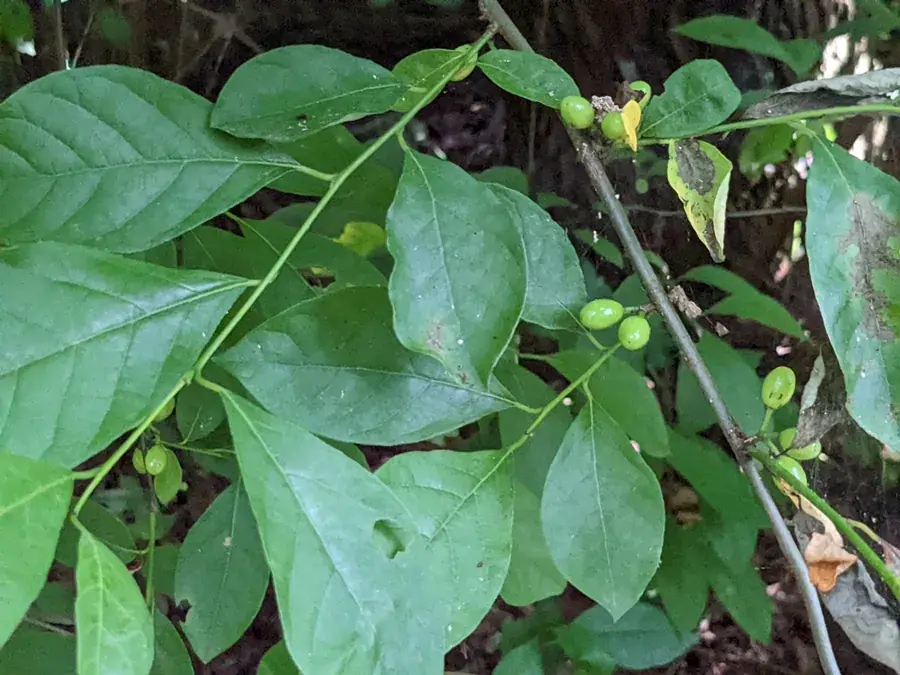
Photo by Kailey Alderfer on iNaturalist · CC BY 4.0
BerryIn season now (October)
Spicebush
Lindera benzoin
- When
- Typically January – December — January, February, March, April, May, June, July, August, September, October, November, December. Earlier in the south, later in the north.
- Where it grows
- Damp, rich understory — stream sides, floodplain woods, ravines and the shady feet of slopes — often the commonest shrub there.
- How to know it
- A loose understory shrub with smooth-edged oval leaves and fine white dots on the twigs; scratch a twig and it smells sharply of lemon and allspice. Tiny yellow flowers hug the bare twigs in early spring, and female shrubs carry glossy red oval berries in September.
- Look-alikes
- Bush honeysuckle (Lonicera) hangs red berries in pairs at the leaf joints on hollow twigs with no smell, and the berries are mildly poisonous. Winterberry holly holds red berries tight to the twig into winter and is poisonous, with toothed leaves and no scent. The spicebush smell rules both out: no spice, no spicebush.
- Harvest and use
- Twigs and leaves steeped for tea in any month; the red berries picked in September, dried whole and ground as a hot, allspice-like seasoning. Snip twig tips from several bushes; only female plants fruit, so leave some berries to grow new ones.
- Caution
- Spicebush swallowtail caterpillars live in the folded leaves — leave them. Harvesting is prohibited in most parks.
Spicebush at a glance
- Also called
- Northern spicebush, wild allspice, Benjamin bush, feverbush, benjoin (Quebec).
- Family
- Lauraceae, the laurel family (which also includes sassafras, bay laurel, cinnamon and avocado).
- Where it grows
- Native to the eastern deciduous forest from southern Ontario and southern Maine through New England, the mid-Atlantic and the Appalachians, west across Ohio, Indiana and Illinois to Missouri and eastern Oklahoma, and south to the Carolinas, Georgia, Louisiana and east Texas. In Canada it grows only in the Carolinian woods of south-western Ontario. It is a shrub of damp, rich ground — stream banks, floodplain forest and ravine bottoms — where it can be the commonest thing in the understory.
- When to pick
- Twigs and leaves at any time of year: the twigs are at their most fragrant in late winter and early spring, when the yellow flowers open on bare wood in March or April, and the leaves from May to the first frost. Berries ripen from green through red in late August and September, hanging only on female shrubs, and are at full flavour when glossy, deep red and slightly soft; birds strip them fast, so September is the month. Pick a few twig tips from each of many bushes.
- Parts used
- Young twigs and leaves, fresh or dried, simmered or steeped for a lemony, spicy tea. The ripe red berries, dried whole on a screen until the flesh is hard, then ground seed and all as a hot, peppery allspice for baking, sausages, squash and chai; fresh berries can also be frozen. The whole dried berry keeps its flavour better than ground. Nothing on the shrub is poisonous, but the oily berries go rancid if stored moist.
- More look-alikes to know
- Sassafras is the close relative: spicy twigs too, but with lobed ‘mitten’ leaves on a tree, and dark blue fruit in red cups. Bush honeysuckles (Lonicera tatarica, L. morrowii and their hybrids), invasive across the same range, are the shrub most often confused: opposite leaves, hollow older twigs and translucent red or orange berries in pairs at the leaf joints that are mildly poisonous and taste bitter; crushed, they smell of nothing in particular. Winterberry holly (Ilex verticillata) keeps bright red berries tight along the twig into winter in the same swamps, with toothed leaves and no scent, and its berries cause vomiting. Spicebush leaves are alternate and smooth-edged, its twigs solid, and a scratched twig smells unmistakably of allspice and lemon.
Questions people ask about spicebush
Is spicebush edible?
Yes — the twigs and leaves of spicebush make a traditional tea and the dried red berries are ground as a wild allspice, once you have confirmed the shrub by the sharp, spicy-citrus smell of a scratched twig. There is nothing poisonous on the plant; the smell is what separates it from the red-berried honeysuckles and hollies that grow beside it.
How do you identify spicebush?
Scratch a twig: spicebush smells strongly and at once of allspice and lemon, and nothing else in the eastern understory does. Beyond that, a loose rounded shrub 2–4 m (6–12 ft) tall of damp woods, with smooth-edged oval leaves set alternately, slender twigs dotted with pale pores, clusters of tiny yellow flowers on bare wood in early spring, and on female plants glossy red oval berries about 1 cm (⅜ in) long in September.
When do you pick spicebush berries?
September, in most of its range — late August in the South, into early October in southern Ontario and New England — when the berries have turned fully red and glossy and give slightly under the thumb. Only female shrubs fruit, and birds take the crop within a couple of weeks of ripening. Dry them whole on a screen out of the sun until they are hard, then grind as you need them.
What looks like spicebush but is poisonous?
The invasive bush honeysuckles, whose red or orange berries come in pairs at the leaf joints on hollow twigs with leaves in opposite pairs; they are mildly poisonous and cause vomiting and diarrhea. Winterberry holly holds red berries tight to the twig through the winter, has toothed leaves and is poisonous too. Neither has any spice smell when a twig is scratched. No smell, no spicebush.
How do you make spicebush tea?
Snip a small handful of twig tips, 10–15 cm (4–6 in) long, cut them into short lengths and simmer them gently in a litre (quart) of water for 15 to 20 minutes, or steep fresh or dried leaves in hot water for 10 minutes. The tea is pale, lemony and warming. Spicebush has been drunk this way in the eastern woodlands for a very long time; enjoy it as a drink, not as a remedy.
Is spicebush safe for children?
Yes — there is nothing poisonous on a spicebush, and a child can learn the smell test and the red oval berries. The lesson to pair with it is that red berries in the same woods are not all alike: honeysuckle’s paired, see-through berries and winterberry’s tight red beads will make a child sick, so the rule is ‘scratch and smell with a grown-up before anything goes in your mouth’.
Found in these regions
- Great Lakes & St. Lawrence Lowlands
- Northeast Atlantic Coast & Piedmont
- Appalachian Highlands
- Central Hardwoods & Interior Plateaus
- Southeastern Piedmont & Coastal Plain
- Gulf Coast & Mississippi Lowlands
Hardiness zones 5–9.
Is it ready near you?
Get this week's foraging guide for your area
Enter a town, postal code or ZIP and we'll tell you what's in season right there this week — from your local climate, this week's weather and your ecological region.
Also ready in October
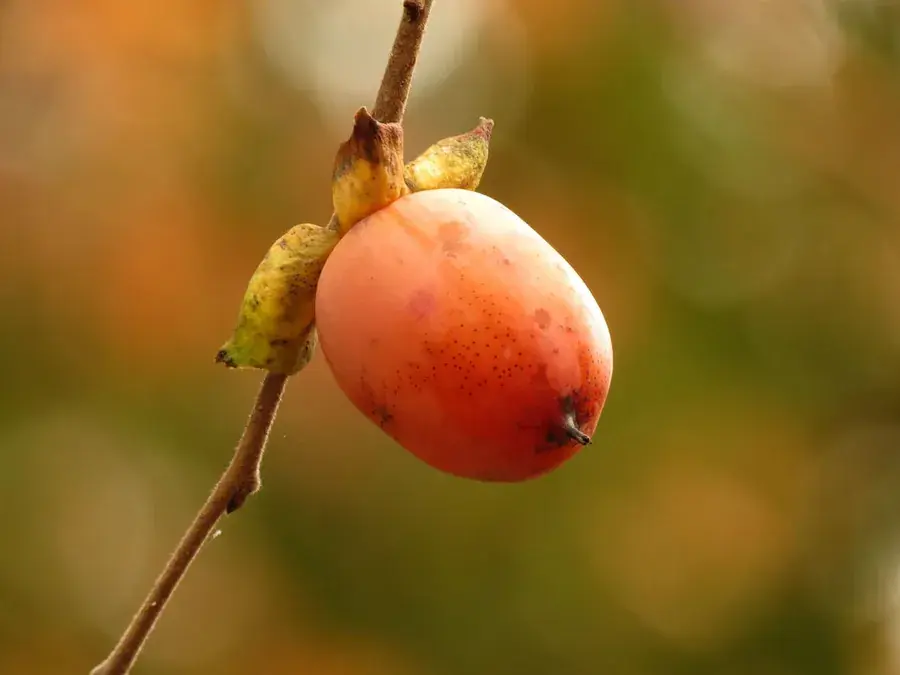 FruitOctober – November
American persimmon
Diospyros virginiana
Blocky alligator-hide bark; orange fruit the size of a plum, only ripe when it is wrinkled, squishy and usually on the ground.
How to know it & its look-alikes →Photo: Katja Schulz · CC BY 4.0
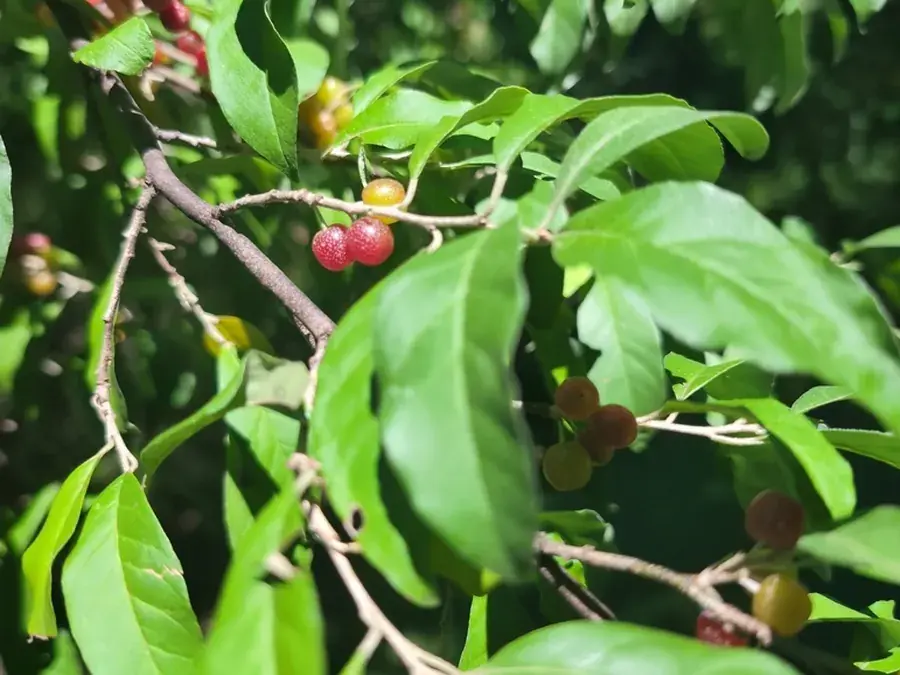 BerrySeptember – October
Autumn olive
Elaeagnus umbellata
A sprawling thorny shrub whose leaves flash silver underneath; in autumn it is weighed down with small red berries finely speckled with silver and brown scales, each with one soft seed.
How to know it & its look-alikes →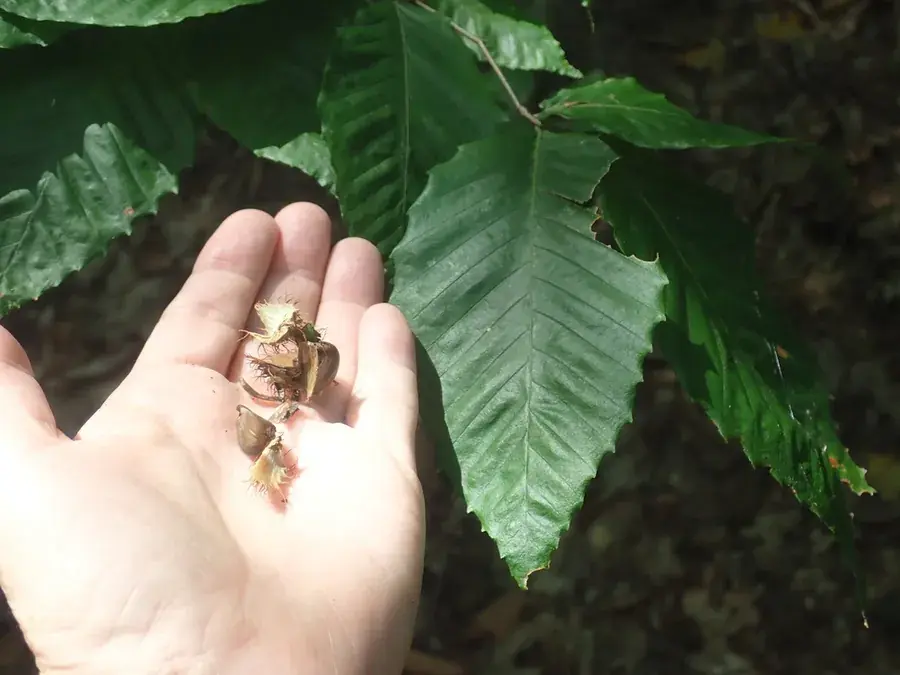 NutSeptember – October
Beechnuts
Fagus grandifolia
Smooth, pale grey bark on a tall tree; long, sharp, cigar-shaped buds; oval leaves with coarse teeth and straight parallel veins, many held, bleached, through winter. The nuts are small, three-sided and come two to a soft-bristled husk that splits into four.
How to know it & its look-alikes →
Checked against these sources ·
- NC State Extension — Lindera benzoin
- Illinois Wildflowers — Spicebush
- NC State Extension — Lonicera tatarica (Tatarian honeysuckle)
- NC State Extension — Ilex verticillata (winterberry)
- VASCAN (Database of Vascular Plants of Canada) — Lindera benzoin
Seasons are typical for the middle of the range and move by weeks north and south, and up and down hills.
Educational information only. Never eat a wild plant or mushroom identified from a single photograph or description — confirm with a regional field guide or an experienced forager, and know the poisonous species in your area first.