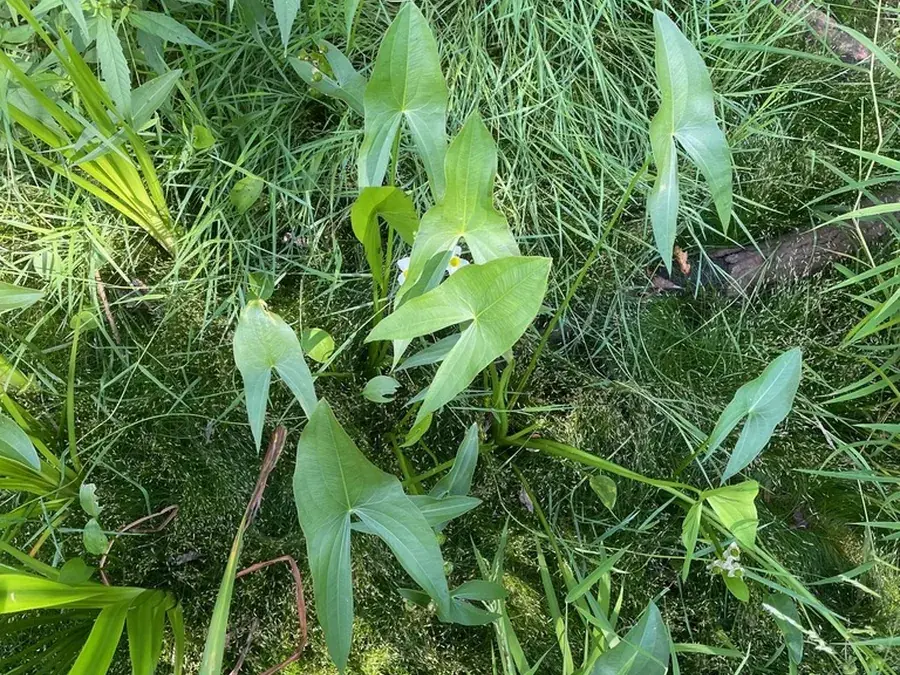
RootIn season now (October)
Wapato (arrowhead)
Sagittaria latifolia
- When
- Typically September – November — September, October, November. Earlier in the south, later in the north.
- Where it grows
- Shallow still or slow water and mud — marsh edges, pond margins, sloughs, river backwaters and ditches — across the continent.
- How to know it
- Arrow-shaped leaves with two long basal lobes pointing backward and veins that radiate from where the stalk joins the blade; white three-petalled flowers in whorls of three on a separate leafless stalk, July–September. The tubers sit at the ends of long runners in the mud, up to 1 m (3 ft) from the plant.
- Look-alikes
- Arrow arum (Peltandra virginica) grows in the same mud with a similar arrow-shaped leaf, but it has one strong midvein with side veins running out to the edge, a green hooded spathe instead of white flowers, and a drooping cluster of green-brown berries; its root and berries are loaded with calcium oxalate and burn the mouth. Pickerelweed has heart-shaped leaves with many fine parallel veins and a blue-violet flower spike.
- Harvest and use
- Tubers dug or trodden loose in fall once the leaves yellow — the traditional way is to wade in and work them free with your feet so they float. Always cooked: roasted, boiled or baked like a small potato with a chestnut note. A culturally important Indigenous food; take little, from big stands, and never from a bed someone else tends.
- Caution
- Wapato is a sacred and historic staple of the Katzie and other Coast Salish peoples of the lower Fraser and of the Chinookan peoples of the lower Columbia, and communities are restoring their beds — respect them. Many wetlands are inside parks, refuges and conservation areas where digging is prohibited; check first and harvest only from clean water.
Wapato (arrowhead) at a glance
- Also called
- Broadleaf arrowhead, duck potato, Indian potato, katniss, sagittaire (Quebec); sqewth in Halkomelem. ‘Wapato’ is the Chinook Jargon name. Other arrowheads (Sagittaria cuneata, S. rigida and relatives) make smaller tubers and are eaten the same way.
- Family
- Alismataceae, the water-plantain family.
- Where it grows
- Native in every province from British Columbia to Nova Scotia and Newfoundland, and in nearly every state — the Great Lakes and St. Lawrence, New England, the Atlantic and Gulf coastal plains, Florida, the Mississippi and Ohio valleys, the prairie potholes, and the lower Fraser, Columbia and Willamette in the Pacific Northwest. It is scarce in the dry interior west and the deserts except along rivers.
- When to pick
- Fall, once the leaves yellow and collapse — September to November in most of the range, and on the mild Pacific coast the Katzie dug it from October right through February. The tubers are at their largest then; by late spring the plant has drawn them down to grow. Work when the water is low and the mud is soft.
- Parts used
- The tubers, 2–5 cm (1–2 in), formed at the tips of runners up to 1 m (3 ft) from the plant. Always cooked — roasted in ashes the traditional way, or boiled, baked or fried — and peeled after cooking, when the skin slips off. Raw they are bitter and unpleasant. The leaves and flowers are not eaten.
- Is any of it poisonous?
- Wapato itself has nothing worse than a bitter raw tuber. The hazard is its neighbours: arrow arum (Peltandra virginica) and wild calla (Calla palustris), both arums whose roots and berries are packed with needle-like calcium oxalate crystals that cause instant burning and swelling of the mouth and throat; Indigenous cooks who used arrow arum dried or cooked it for hours first. Tubers felt out blind in the mud can come from any plant on that bank, so dig only under arrowhead leaves you have identified, and keep arum roots out of the basket.
- More look-alikes to know
- Wild calla (Calla palustris): heart-shaped rather than arrow-shaped leaves, a white spathe and a head of red berries, in northern bogs; calcium oxalate. Water plantain (Alisma): oval leaves with no backward lobes and tiny white three-petalled flowers in an open spray; its root is acrid raw and not a wapato substitute. Bur-reed (Sparganium): strap leaves and spiky round seed balls. Arrowhead leaves themselves vary enormously — narrow and grass-like in deep water, broad in mud — so look for the whorls of three white flowers and the backward-pointing lobes with veins fanning from the stalk.
Questions people ask about wapato
How do you tell wapato from arrow arum?
By the veins and the flowers. Arrowhead’s veins fan out from the point where the stalk meets the blade and run to the tips of the lobes; arrow arum has a strong single midvein with side veins running out toward a vein along the leaf edge. Arrowhead carries white three-petalled flowers in whorls of three; arrow arum has a green hooded spathe and a drooping cluster of green-brown berries. Arrow arum’s root burns the mouth with calcium oxalate — never eat it.
How do you harvest wapato?
The traditional way is to wade into the shallows in fall and work the mud with your feet until the tubers break free from their runners and float, then gather them from the surface — Lewis and Clark watched Chinookan women do it chest-deep from small canoes. A potato fork or rake works from the bank. Take a few from a big stand; the mud settles and the bed regrows.
Who traditionally harvested wapato?
It was a staple and trade good across the Pacific Northwest and beyond. The Katzie First Nation of the Pitt River and lower Fraser tended wapato beds for thousands of years — a 3,800-year-old wapato garden with a rock-paved harvesting floor was excavated in Katzie territory at Pitt Meadows — and Chinookan peoples of the lower Columbia harvested it so heavily around Sauvie Island that Lewis and Clark called the place Wapato Island and the root ‘the most valuable of all their roots’. The Katzie are restoring their beds today.
Can you eat wapato raw?
No — raw tubers are bitter and acrid. Roast them in coals or bake, boil or fry them, then slip the skins off; cooked, they taste between a potato and a chestnut, slightly sweet. They store well in a cool, damp place.
Is it legal to dig wapato?
Often not where it grows best. Many wapato marshes lie inside national, provincial and state parks, wildlife refuges and conservation areas, where digging plants is prohibited, and private shorelines need the owner’s permission. Check the rules for the specific wetland, avoid waterfowl nesting season, and never dig a bed that an Indigenous community is tending or restoring.
Is wapato safe for children?
The cooked tubers are a good, mild food for children, and treading them out of the mud is a game. The risks are the water and the neighbours: cold deep mud, and arrow arum and wild calla, whose roots burn the mouth. Let children gather the floating tubers while an adult chooses the plants, and cook everything.
Found in these regions
- Boreal Forest & Shield
- Acadian Forest & Atlantic Coast
- Great Lakes & St. Lawrence Lowlands
- Northeast Atlantic Coast & Piedmont
- Appalachian Highlands
- Central Hardwoods & Interior Plateaus
- Southeastern Piedmont & Coastal Plain
- Gulf Coast & Mississippi Lowlands
- Florida Peninsula
- Prairies & Great Plains
- Pacific Maritime
Hardiness zones 3–10.
Is it ready near you?
Get this week's foraging guide for your area
Enter a town, postal code or ZIP and we'll tell you what's in season right there this week — from your local climate, this week's weather and your ecological region.
Also ready in October
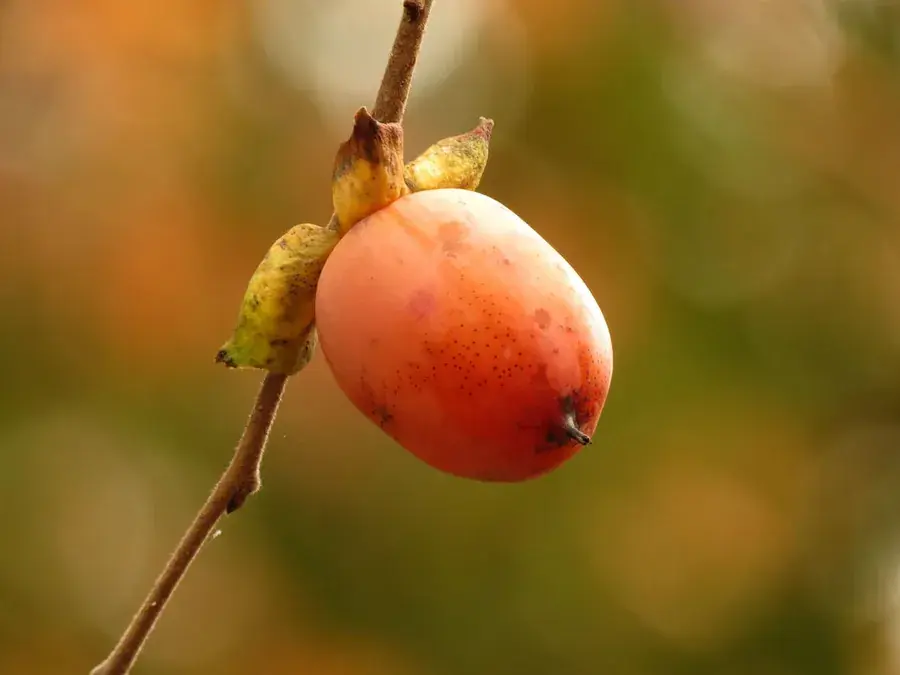 FruitOctober – November
American persimmon
Diospyros virginiana
Blocky alligator-hide bark; orange fruit the size of a plum, only ripe when it is wrinkled, squishy and usually on the ground.
How to know it & its look-alikes →Photo: Katja Schulz · CC BY 4.0
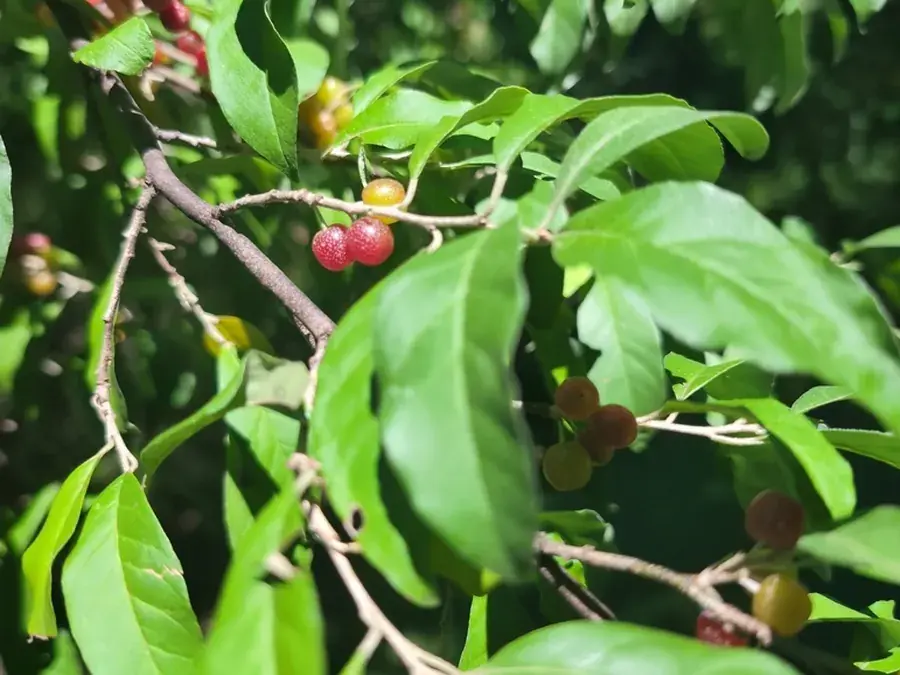 BerrySeptember – October
Autumn olive
Elaeagnus umbellata
A sprawling thorny shrub whose leaves flash silver underneath; in autumn it is weighed down with small red berries finely speckled with silver and brown scales, each with one soft seed.
How to know it & its look-alikes →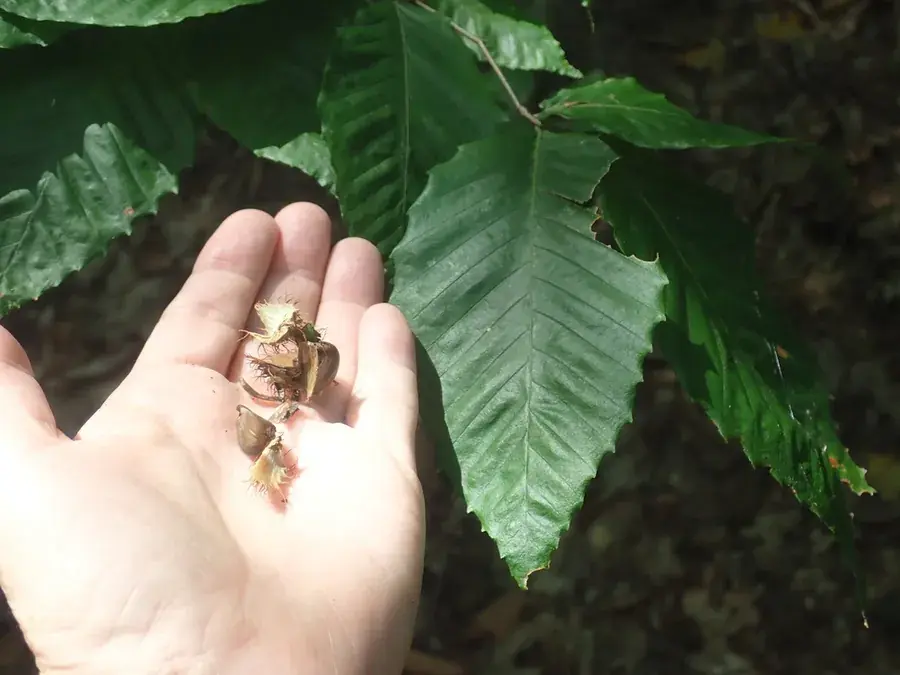 NutSeptember – October
Beechnuts
Fagus grandifolia
Smooth, pale grey bark on a tall tree; long, sharp, cigar-shaped buds; oval leaves with coarse teeth and straight parallel veins, many held, bleached, through winter. The nuts are small, three-sided and come two to a soft-bristled husk that splits into four.
How to know it & its look-alikes →
Checked against these sources ·
- Minnesota Wildflowers: Broad-leaf arrowhead
- Virginia Institute of Marine Science: Arrowhead wetland plant report
- Wikipedia: Peltandra virginica (arrow arum)
- US National Park Service: Wapato (Lewis and Clark)
- Hoffmann et al. (2016), Engineered feature used to enhance gardening at a 3800-year-old site on the Pacific Northwest Coast — Science Advances
- Environment and Climate Change Canada: Eco-cultural restoration of wapato in Katzie territory
Seasons are typical for the middle of the range and move by weeks north and south, and up and down hills.
Educational information only. Never eat a wild plant or mushroom identified from a single photograph or description — confirm with a regional field guide or an experienced forager, and know the poisonous species in your area first.