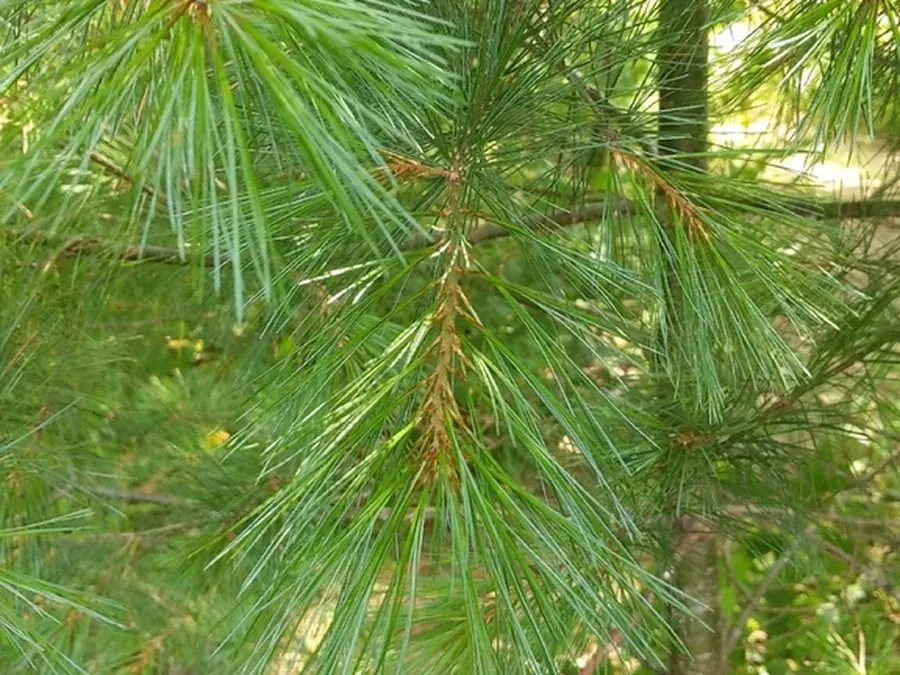
Photo by Public domain (iNaturalist) on iNaturalist · CC0 (public domain)
TreeIn season now (October)
Eastern white pine
Pinus strobus
This one has a dangerous look-alike
Yew (Taxus) is the deadly one: flat, dark, single needles in two rows, a red fleshy cup around each seed instead of a cone, and every part except that red flesh can stop the heart. Pine needles are long, three-sided, and always in bundles. Norfolk Island pine and Australian pine are not pines at all — if the needles are not in bundles, do not make tea.
- When
- Typically January – December — January, February, March, April, May, June, July, August, September, October, November, December. Earlier in the south, later in the north.
- Where it grows
- Sandy and rocky soils, old fields, lake shores and mixed forest from the Maritimes to Minnesota; the tallest tree in most eastern woods, and a common planted tree far beyond that.
- How to know it
- Soft, flexible, bluish-green needles in bundles of five — the only eastern pine with five — and long, slender, curved cones with resin-tipped scales. Horizontal whorls of branches give old trees a layered look.
- Harvest and use
- A small handful of chopped fresh needles steeped, not boiled, for a resinous tea; the spring pollen can be shaken into flour; the inner bark is a famine food, not a treat. Snip needles from several branches rather than stripping one.
- Caution
- Needles of ponderosa, lodgepole and some other pines cause late-term abortion in cattle; there is no good human evidence either way, so the long-standing advice is that pregnant people skip pine-needle tea. Keep to small amounts of white pine and never use yew, which can grow as a hedge beside it.
Eastern white pine at a glance
- Also called
- Eastern white pine, northern white pine, Weymouth pine, pin blanc (Quebec). Other five-needle pines — western white pine, sugar pine, whitebark and limber pine — are used the same way in the west.
- Family
- Pinaceae, the pine family (which also includes the spruces, firs, larches and hemlocks).
- Where it grows
- Native from Newfoundland, the Maritimes and southern Quebec across Ontario to south-eastern Manitoba, and south through New England, the Great Lakes states and the Appalachians to northern Georgia. It is the tallest tree in the eastern forest and the provincial tree of Ontario. Beyond that range it is one of the most planted conifers in North America, so a five-needle pine in a prairie shelterbelt or a Pacific Northwest park is very likely this one.
- When to pick
- Needles can be picked in any month; the new growth of late May and June is the softest and most citrusy, and midwinter is when the tea is most welcome. The yellow pollen sheds from the small male cones for a week or two around early June in southern Ontario and Quebec, earlier to the south. Inner bark is a spring harvest, when it peels, and only from a branch or a tree already down.
- Parts used
- The needles, chopped and steeped in hot but not boiling water for a resinous, lemony tea — a small handful per cup is plenty. The pollen, tapped from the male cones into a bag, as a flour stretcher. The inner bark, dried and pounded, is a famine food of the north woods, not a treat, and stripping it from a living trunk kills the tree. The seeds inside the long cones are edible but tiny; western pines carry the pine nuts worth the trouble.
- Is any of it poisonous?
- Pine needles themselves are not poisonous, but two cautions stand. The needles of ponderosa, lodgepole and some other pines contain isocupressic acid, which causes late-term abortion in cattle; there is no reliable evidence for people either way, and the long-standing advice is that pregnant people avoid pine-needle tea altogether, white pine included. Second, strong pine tea drunk by the potful is hard on the stomach; keep it to a cup. The real danger is a wrong tree: yew, which is lethal.
- More look-alikes to know
- Other eastern pines are safe and the needle count tells them apart: red pine and Scots pine have two long needles per bundle, jack pine two short twisted ones, pitch pine three; all can be used for tea. Spruce (square needles that roll in the fingers) and fir (flat needles with white lines beneath) are also used. Yew (Taxus canadensis, a low native forest shrub across the east, and the planted hedge yews) is the one that kills: flat, single, dark green needles in two rows, no bundles, no cones, a red fleshy cup around each seed, and no resin smell. Norfolk Island pine and Australian pine (Casuarina) are not pines; neither has needles in bundles.
Questions people ask about eastern white pine
Is white pine needle tea safe to drink?
Once you are certain the tree is a pine — long needles in bundles of five, soft and bluish — a cup made from a small handful of chopped needles is a traditional drink across the north. Steep rather than boil, keep to a cup or two, and skip it in pregnancy: needles of several pines are known to cause abortion in cattle and nobody has proved the human case either way. Never use yew.
How do you tell white pine from yew?
Count and feel the needles. White pine needles come in bundles of five, are 6–13 cm (2½–5 in) long, soft and flexible, and the tree carries long slender cones. Yew needles grow singly in two flat rows along the twig, are short and dark, and the shrub never has a cone — instead a red, fleshy cup around a single seed. Every part of yew except that red flesh is deadly, and it is planted as a hedge across the continent.
Can pregnant women drink pine needle tea?
The usual advice is no. Ponderosa, lodgepole and some other pine needles contain a compound that causes late-term abortion in cattle, and because no one has tested the question in people, herbalists and foragers have long told pregnant people to leave all pine-needle tea alone. White pine has not been implicated specifically, but the caution stands.
Does pine needle tea have vitamin C?
Fresh conifer needles do contain vitamin C, and the story everyone tells is Jacques Cartier’s crew at Stadacona (Quebec City) in the winter of 1535–36, saved from scurvy with a tea of bark and twigs the St. Lawrence Iroquoians called annedda. Which tree it was is uncertain — Parks Canada says probably eastern white cedar, and white pine is the other usual candidate. Enjoy the tea as a tea; it is not medicine.
What should kids know about pine needle tea?
That tea comes only from a tree a grown-up has checked, and that the hedge in the yard may be a yew. Yew’s red berries look tempting and the flesh is harmless, but the seed inside and the needles are among the most poisonous things in a garden. If a child has chewed yew, call poison control at once.
When do you collect white pine pollen?
For a week or two in late May or early June in the Great Lakes region, when the clusters of small yellow male cones at the branch tips puff yellow dust when tapped. Hold a paper bag under a cluster and shake. Earlier in the south, later in the north and uphill.
Found in these regions
- Boreal Forest & Shield
- Acadian Forest & Atlantic Coast
- Great Lakes & St. Lawrence Lowlands
- Northeast Atlantic Coast & Piedmont
- Appalachian Highlands
- Central Hardwoods & Interior Plateaus
Hardiness zones 3–8.
Is it ready near you?
Get this week's foraging guide for your area
Enter a town, postal code or ZIP and we'll tell you what's in season right there this week — from your local climate, this week's weather and your ecological region.
Also ready in October
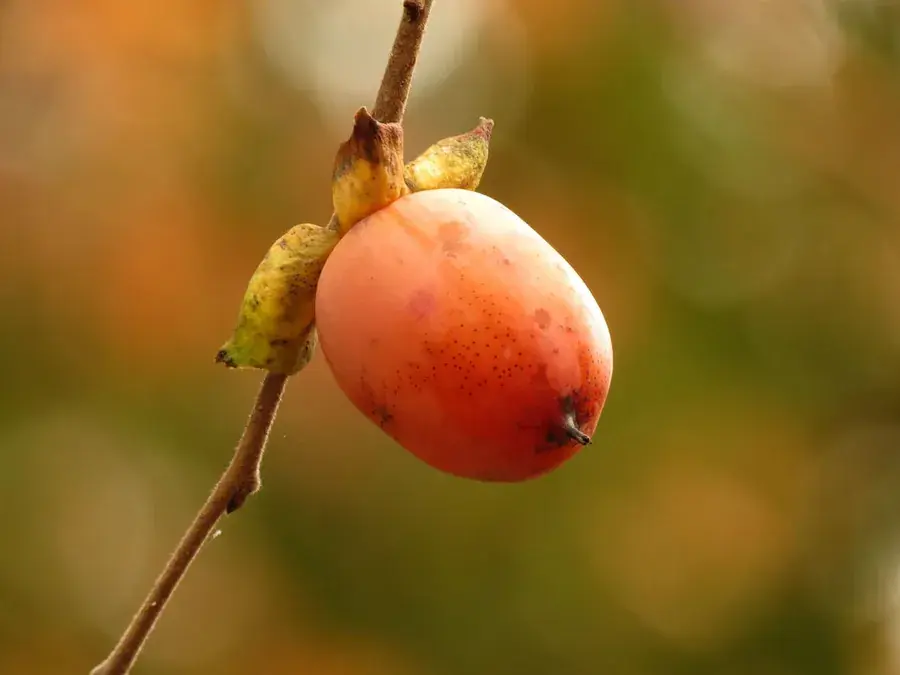 FruitOctober – November
American persimmon
Diospyros virginiana
Blocky alligator-hide bark; orange fruit the size of a plum, only ripe when it is wrinkled, squishy and usually on the ground.
How to know it & its look-alikes →Photo: Katja Schulz · CC BY 4.0
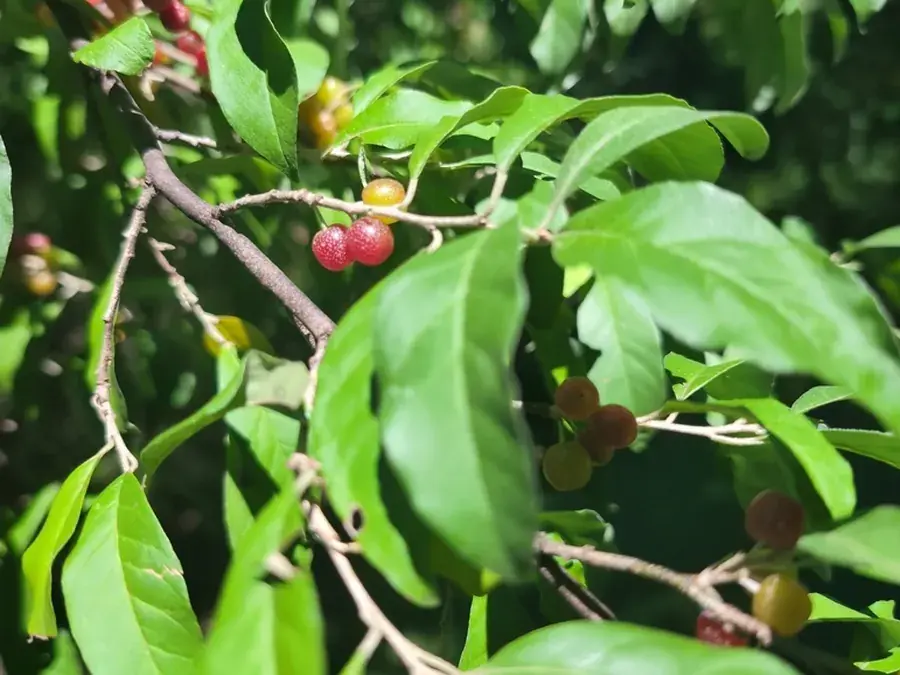 BerrySeptember – October
Autumn olive
Elaeagnus umbellata
A sprawling thorny shrub whose leaves flash silver underneath; in autumn it is weighed down with small red berries finely speckled with silver and brown scales, each with one soft seed.
How to know it & its look-alikes →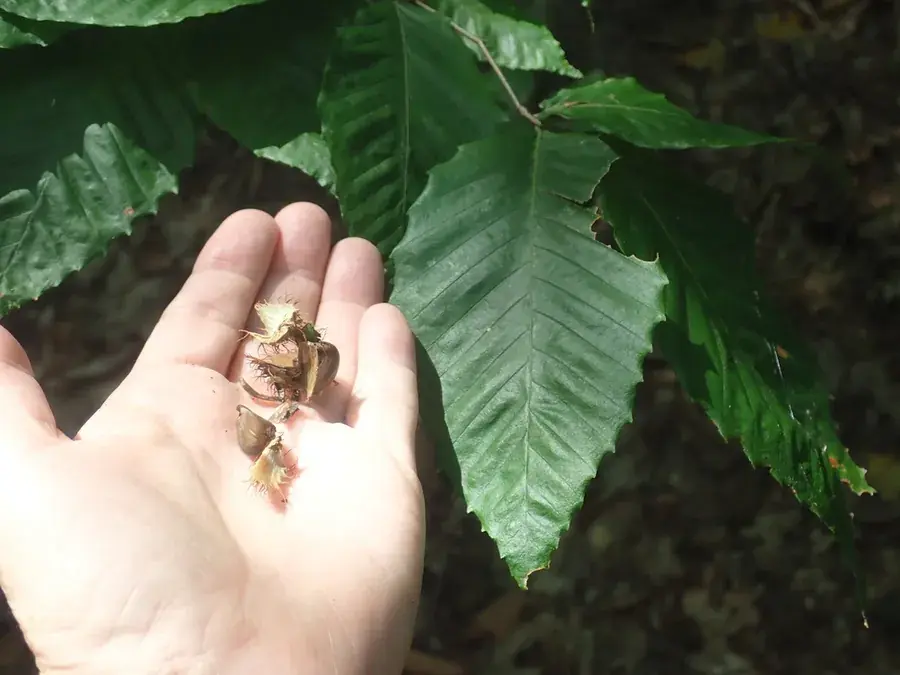 NutSeptember – October
Beechnuts
Fagus grandifolia
Smooth, pale grey bark on a tall tree; long, sharp, cigar-shaped buds; oval leaves with coarse teeth and straight parallel veins, many held, bleached, through winter. The nuts are small, three-sided and come two to a soft-bristled husk that splits into four.
How to know it & its look-alikes →
Checked against these sources ·
- NC State Extension — Pinus strobus
- Minnesota Wildflowers — White pine
- Cornell University Poisonous Plants — Yew
- South Dakota State University Extension — Pine needles: another possible threat to beef cow pregnancies
- Parks Canada, Cartier-Brébeuf National Historic Site — Wintering (1535–1536)
- VASCAN (Database of Vascular Plants of Canada) — Pinus strobus
Seasons are typical for the middle of the range and move by weeks north and south, and up and down hills.
Educational information only. Never eat a wild plant or mushroom identified from a single photograph or description — confirm with a regional field guide or an experienced forager, and know the poisonous species in your area first.