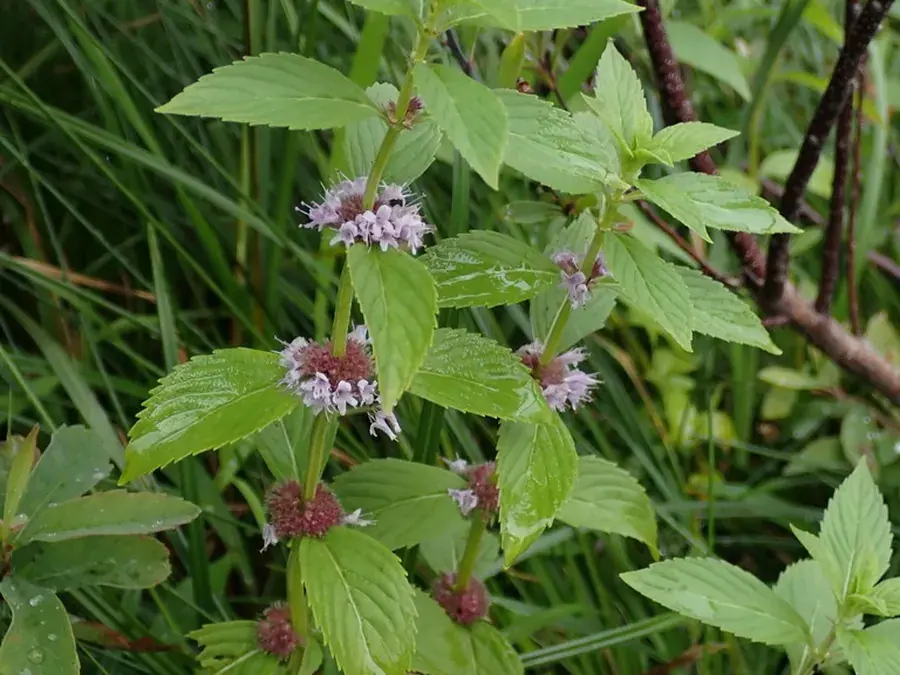
GreenSeason: June – September
Wild mint (Canada mint)
Mentha canadensis
- When
- Typically June – September — June, July, August, September. Earlier in the south, later in the north.
- Where it grows
- Wet feet: lakeshores, riverbanks, beaver meadows, ditches and the damp edge of a field, often smelled before it is seen.
- How to know it
- A square, usually hairy stem 20–60 cm (8–24 in) tall with opposite, toothed leaves and a strong, clean mint smell; the small pink-to-white flowers sit in tight whorls in the leaf axils up the stem, never in a spike at the top. If the flowers crown the stem, it is a different mint.
- Look-alikes
- American pennyroyal and European pennyroyal also put their flowers in the leaf axils and smell minty, but pennyroyal is a slender plant under 40 cm (16 in) with small, nearly toothless leaves and a harsher, more pungent smell, and its oil is dangerously toxic — avoid pennyroyal in pregnancy altogether. Bugleweed and water horehound (Lycopus) grow in the same wet ground with the same axillary flower whorls, but they have no mint smell and white flowers.
- Harvest and use
- Leaves and flowering tops, fresh or dried, for tea, sauces, jelly and anywhere a garden mint goes. Pinch the tops and leave the runners; a patch regrows within weeks.
- Caution
- Mint and wet ground go together, so pick above the waterline and away from farm runoff and sewage outfalls. Strongly flavoured; a tea or seasoning, not a bulk green.
Wild mint (Canada mint) at a glance
- Also called
- Canada mint, American wild mint, field mint, menthe du Canada (Quebec). Older books call it Mentha arvensis or M. arvensis var. canadensis; the Eurasian corn mint, M. arvensis proper, is a separate species that is occasionally naturalised.
- Family
- Lamiaceae, the mint family (which also includes peppermint, spearmint, bugleweed and pennyroyal).
- Where it grows
- The only mint native to North America, and found across almost all of it: every province and territory from Newfoundland west, plus Yukon and the Northwest Territories, Alaska, New England and New York, the Great Lakes states, the Midwest, the Prairies, the Rockies, the Great Basin, the Pacific coast and California’s wetlands. It is a plant of the north and west; south of the Ohio valley it is scattered and confined to mountain streams, and it is absent from the Southeast lowlands, the Gulf coast, Florida, the low deserts and Hawaii.
- When to pick
- June through September, with the strongest flavour just before and during flowering in July and August in the Great Lakes, St. Lawrence and Prairie country; a few weeks later in the boreal forest and the mountains, from late May on the Pacific coast and in the Ohio valley. Pick on a dry morning and use fresh, or dry it quickly in the shade. After hard frost the leaves blacken and are finished.
- Parts used
- Leaves and flowering tops, fresh or dried: tea, mint sauce, jelly, iced drinks, with peas and potatoes, anywhere garden mint goes. Pinch the top few pairs of leaves and the plant branches and regrows. Roots and old woody stems are not used.
- Is any of it poisonous?
- Wild mint itself is as safe as garden mint, in the amounts anyone would use. The danger is the look-alike: the pennyroyals (American Hedeoma pulegioides and European Mentha pulegium) are rich in pulegone, and pennyroyal essential oil has caused liver failure and death at doses of a few teaspoons; pennyroyal tea has traditionally been used to bring on menstruation and must be avoided in pregnancy. Learn pennyroyal’s smaller size, tiny nearly toothless leaves and harsher, more pungent smell, and when in doubt do not brew it.
- More look-alikes to know
- Spearmint and peppermint, escaped from gardens along the same streams, carry their flowers in a spike at the top of the stem rather than in whorls down the leaf axils; both are edible. Bugleweed and water horehound (Lycopus americanus, L. uniflorus) match wild mint’s wet habitat, square stem, opposite leaves and axillary flower whorls almost exactly, but their flowers are white with only two stamens and their crushed leaves have no mint smell; they are not eaten. Hedge-nettle (Stachys) and skullcap (Scutellaria) grow in the same ditches with square stems and no mint smell. The rule: no clean mint smell, no mint.
Questions people ask about wild mint
Is wild mint edible?
Yes, once identified with certainty by its square stem, opposite toothed leaves, flowers in whorls at the leaf axils and strong clean mint smell. It is used exactly like garden mint — tea, sauce, jelly, drinks. The one plant to learn and avoid is pennyroyal, which smells minty but is smaller with tiny leaves and a harsher scent, and whose oil is dangerously toxic.
How do you identify wild mint?
A square, usually hairy stem 20–60 cm (8–24 in) tall in wet ground; opposite, toothed, oval to lance-shaped leaves; small pink, lavender or white tubular flowers in tight rings around the stem at the leaf axils, never in a spike at the tip; and a strong, clean mint smell when a leaf is crushed. If the flowers crown the stem it is a spearmint or peppermint; if there is no mint smell it is a bugleweed or something else entirely.
What looks like wild mint and is poisonous?
Pennyroyal. American pennyroyal is a slender annual under 40 cm (16 in) with small, nearly toothless leaves and tiny flowers in the leaf axils, and European pennyroyal creeps; both smell minty but harsher and more pungent. Pennyroyal oil has killed people at doses of a few teaspoons, and even the tea must be avoided in pregnancy. Bugleweed and water horehound look alike too but have no smell and white flowers; they are not dangerous, just not mint.
When do you pick wild mint?
From June into September, best just before and during flowering in July and August across southern Canada and the northern US. Pick the top few pairs of leaves on a dry morning; the plant branches and gives you a second picking within weeks. Dry it in the shade and it keeps its flavour for a year.
Where does wild mint grow?
In wet ground: lakeshores, riverbanks, beaver meadows, ditches, the damp low corner of a hayfield. You will often smell a patch before you see it, when you step on it along a shoreline. It is a northern and western plant — common across Canada, Alaska, the Great Lakes, the Prairies and the mountain West, scattered and rare south of the Ohio valley.
Can children pick wild mint?
Yes, with an adult confirming the first plant of the patch. The smell test is one children do well, and mint tea they picked themselves is a good first forage. Teach them that a minty smell alone is not enough — it has to be the clean, familiar mint, on a plant with flowers in rings down the stem — and keep them from picking at the waterline below a farm or an outfall.
Found in these regions
- Boreal North & Taiga
- Boreal Forest & Shield
- Acadian Forest & Atlantic Coast
- Great Lakes & St. Lawrence Lowlands
- Northeast Atlantic Coast & Piedmont
- Central Hardwoods & Interior Plateaus
- Prairies & Great Plains
- Western Mountains & Interior Plateaus
- Pacific Maritime
Hardiness zones 2–8.
Is it ready near you?
Get this week's foraging guide for your area
Enter a town, postal code or ZIP and we'll tell you what's in season right there this week — from your local climate, this week's weather and your ecological region.
Also ready in October
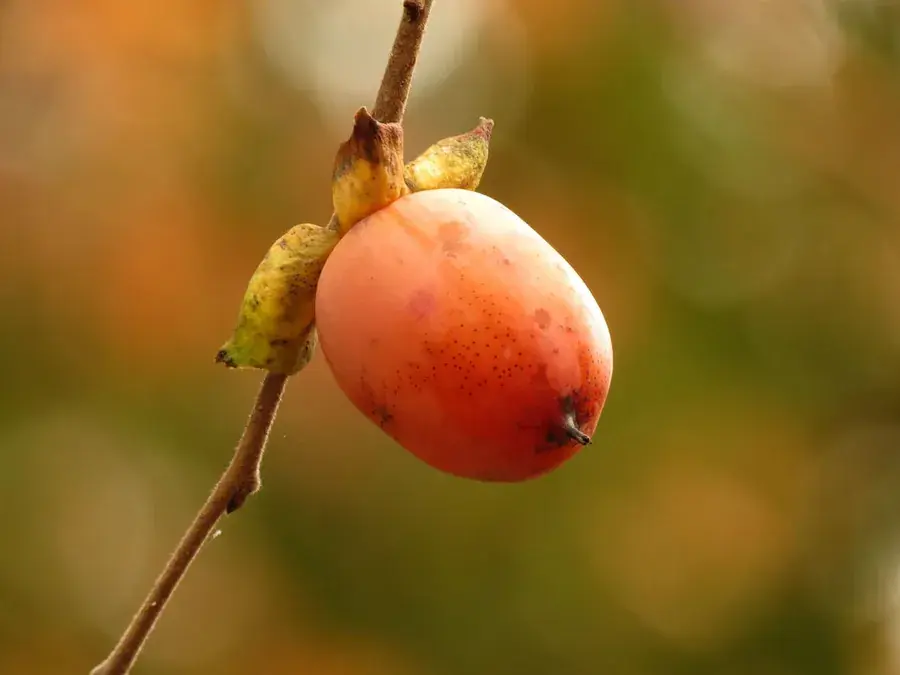 FruitOctober – November
American persimmon
Diospyros virginiana
Blocky alligator-hide bark; orange fruit the size of a plum, only ripe when it is wrinkled, squishy and usually on the ground.
How to know it & its look-alikes →Photo: Katja Schulz · CC BY 4.0
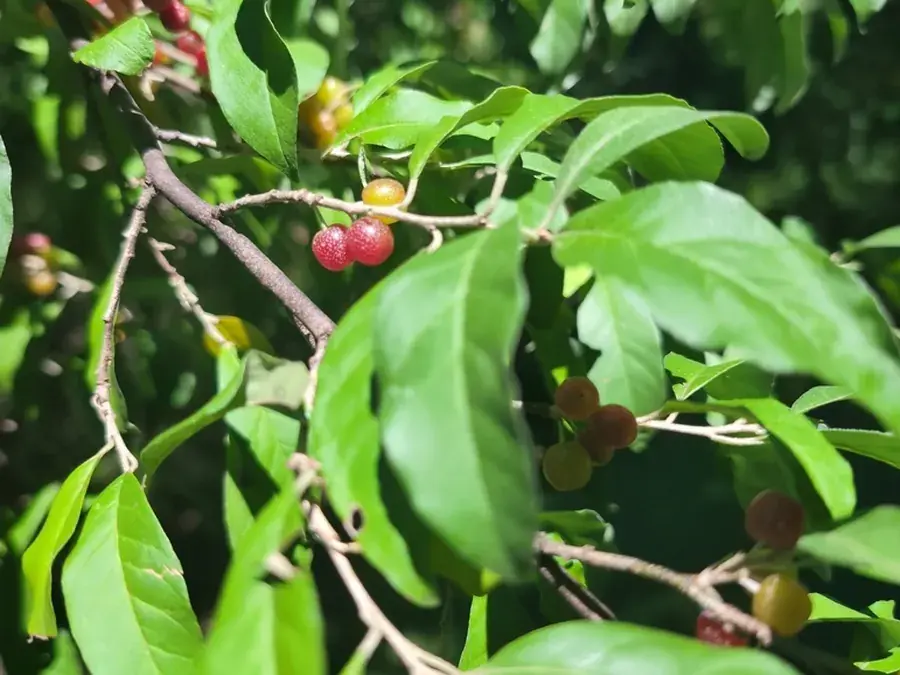 BerrySeptember – October
Autumn olive
Elaeagnus umbellata
A sprawling thorny shrub whose leaves flash silver underneath; in autumn it is weighed down with small red berries finely speckled with silver and brown scales, each with one soft seed.
How to know it & its look-alikes →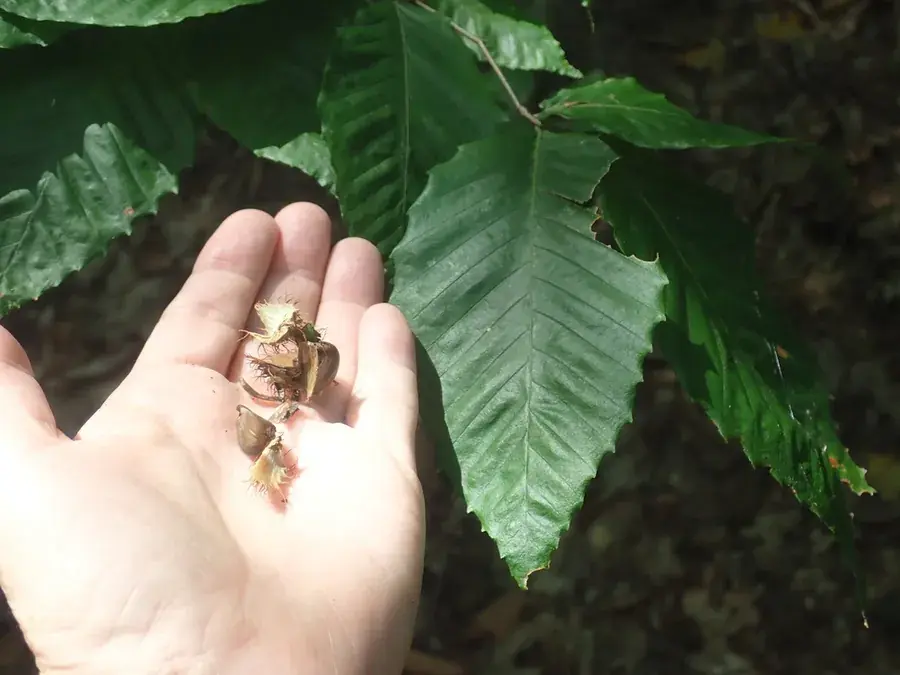 NutSeptember – October
Beechnuts
Fagus grandifolia
Smooth, pale grey bark on a tall tree; long, sharp, cigar-shaped buds; oval leaves with coarse teeth and straight parallel veins, many held, bleached, through winter. The nuts are small, three-sided and come two to a soft-bristled husk that splits into four.
How to know it & its look-alikes →
Checked against these sources ·
- Minnesota Wildflowers: Wild mint
- Go Botany (Native Plant Trust): Mentha canadensis
- Drugs.com professional monograph: Pennyroyal (pulegone toxicity)
- VASCAN: Mentha canadensis
Seasons are typical for the middle of the range and move by weeks north and south, and up and down hills.
Educational information only. Never eat a wild plant or mushroom identified from a single photograph or description — confirm with a regional field guide or an experienced forager, and know the poisonous species in your area first.