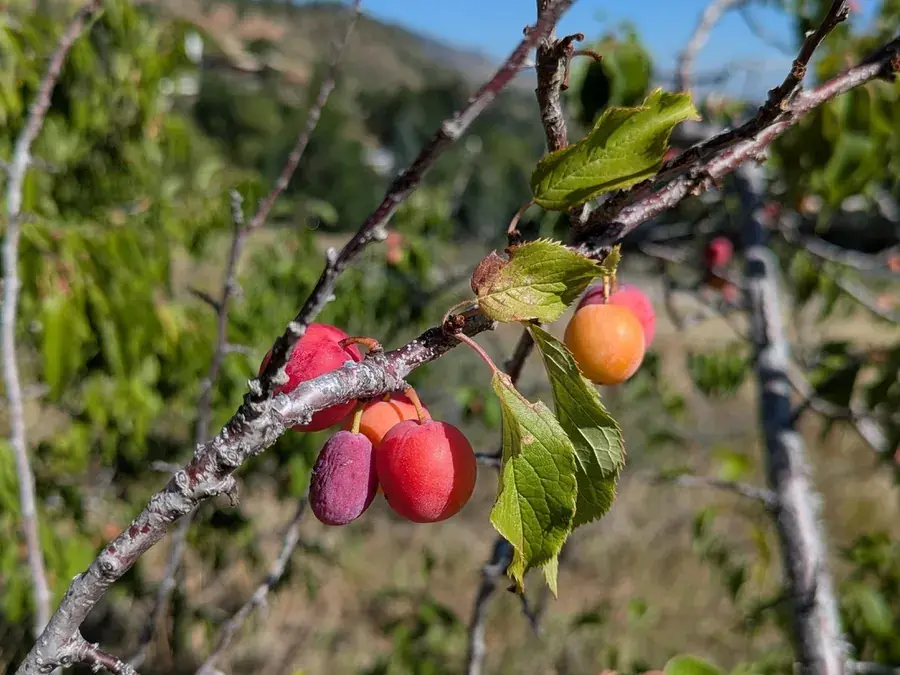
Photo by Public domain (iNaturalist) on iNaturalist · CC0 (public domain)
FruitSeason: August – September
Wild plums
Prunus americana
- When
- Typically August – September — August, September. Earlier in the south, later in the north.
- Where it grows
- Thickets on fence lines, coulees, riverbanks, pasture edges and roadsides, spreading by root suckers into dense stands; Chickasaw plum favours sandy ground in the south.
- How to know it
- A thorny shrub or small tree that flowers white before the leaves, with short spur branches ending in a sharp point. Fruit a true plum, 2–3 cm (1 in), red, orange or yellow with a whitish bloom and a single flattened stone.
- Look-alikes
- Common buckthorn has black four-seeded berries, not a single-stoned red or yellow plum, and its berries are a harsh purgative. Hawthorn haws are edible but have several hard seeds, and hawthorn thorns are long, shiny and unbranched. Crabapples have a core of small seeds, never a stone.
- Harvest and use
- Eat the ripe flesh fresh, or simmer and sieve for jam, fruit leather and sauce; the skins are tart and the stones are discarded. Take from a thicket, not a lone tree, and leave plenty — plum thickets feed everything from grouse to foxes.
- Caution
- The stone and leaves contain cyanide-forming compounds; do not crack the pits for the kernels. Plums on a neighbour’s fence line belong to the neighbour.
Wild plums at a glance
- Also called
- American plum (Prunus americana), Canada plum or red plum (P. nigra, prunier noir in Quebec) and Chickasaw plum (P. angustifolia) — three native plums that trade places across the continent and are gathered the same way.
- Family
- Rosaceae, the rose family (which also includes the cherries, apples and hawthorns).
- Where it grows
- American plum is native from southern Ontario west through Manitoba to south-eastern Saskatchewan and across most of the US east of the Rockies, especially the Plains and the Midwest, and native, if scattered, in Quebec and New Brunswick. Canada plum takes over in the north-east — Quebec, Ontario, New Brunswick, Nova Scotia and Manitoba, south into New England and the upper Great Lakes — and is the plum of old Quebec farm hedges. Chickasaw plum covers the south-east and south-central US from the Carolinas to Texas and into Florida; its common name records the Chickasaw, who are thought to have planted it around their towns.
- When to pick
- Mid-August to mid-September for American and Canada plums in southern Ontario, Quebec and the northern Plains; a little earlier in the Midwest. Chickasaw plum is a summer fruit, May to July in the Deep South. A plum is ready when its skin has turned fully red, orange or yellow with a dusty bloom, it gives slightly to the thumb, and it comes away from the twig with a gentle twist; the tart skin never fully sweetens, which is why these plums make such good jam. Shake a laden branch over a sheet.
- Parts used
- The flesh and skin of the ripe fruit — eaten fresh, split and dried, or simmered and pressed through a food mill for jam, jelly, sauce, fruit leather and plum butter. The stone is discarded whole; do not crack it for the kernel. Nothing else on the shrub is eaten.
- Is any of it poisonous?
- Like all stone fruit, the pit kernels, leaves and twigs contain cyanogenic glycosides. A swallowed pit passes through intact and is not a poisoning, but chewed or crushed kernels release cyanide, and wilted leaves on broken branches can poison livestock. Keep the pits out of anything you cook down and never grind them.
- More look-alikes to know
- Chokecherry and black cherry grow in the same hedgerows but hang their small dark fruit in long chains, where plums hang singly or in twos and threes on short stalks. Planted and escaped cherry plum (Prunus cerasifera), common in cities, has thornless twigs and purple or yellow fruit and is edible. Nanking cherry and sand cherry are low shrubs with small cherries, also edible. Any red or yellow fruit with a single flattened stone, a seam down one side and a bloom on the skin is a plum; count seeds if in doubt — a hawthorn or crabapple has several.
Questions people ask about wild plums
Are wild plums edible?
Yes — American, Canada and Chickasaw plums are all native plums with sweet yellow flesh under a tart skin, edible fresh once fully ripe and better still as jam, sauce or fruit leather. Identify the shrub by its spur thorns, early white flowers and single-stoned fruit, and discard the pits whole.
When are wild plums ripe?
Mid-August to mid-September across southern Canada and the northern US for American and Canada plums; May to July for Chickasaw plum in the South. Ripe fruit is fully coloured, slightly soft, has a powdery bloom and drops when the branch is shaken. Underripe plums are mouth-puckering and will not ripen much off the bush.
How do you identify a wild plum thicket?
A dense stand of crooked shrubs or small trees 2–6 m (6–20 ft) tall, spreading from root suckers, with short side branches ending in a dull thorn. In spring it is a cloud of white five-petalled flowers before the leaves; in late summer, red, orange or yellow plums about 2–3 cm (1 in) across. The leaves are oval with sharp or glandular teeth; Canada plum’s are broader with red glands on the leaf stalk.
What looks like a wild plum but is poisonous?
Common buckthorn shares the thorny twig tip and the hedgerow, but its fruit is a black berry with four seeds in clusters at the leaf joints, and it is a strong purgative. Nothing with a red or yellow single-stoned plum is dangerous, but do confirm the stone: hawthorn haws and crabapples have several seeds and are edible; buckthorn never looks like a plum once you cut it open.
Can you eat the pits of wild plums?
No. The kernel inside the stone contains cyanide-forming compounds, as apricot and peach kernels do. Swallowing a pit whole by accident is not dangerous, but cracked or chewed kernels are, and the pits should be strained out of jam and sauce before the long simmer.
Are wild plums safe for children?
Ripe wild plums are a good first foraged fruit for a child, with two rules: spit out the stone, and stay away from the black berries. A child should also know the thorns — plum spurs are short and stout and will scratch, which is reason enough to let an adult shake the branch.
Found in these regions
- Great Lakes & St. Lawrence Lowlands
- Northeast Atlantic Coast & Piedmont
- Appalachian Highlands
- Central Hardwoods & Interior Plateaus
- Southeastern Piedmont & Coastal Plain
- Gulf Coast & Mississippi Lowlands
- Florida Peninsula
- Prairies & Great Plains
- Western Mountains & Interior Plateaus
Hardiness zones 3–9.
Is it ready near you?
Get this week's foraging guide for your area
Enter a town, postal code or ZIP and we'll tell you what's in season right there this week — from your local climate, this week's weather and your ecological region.
Also ready in October
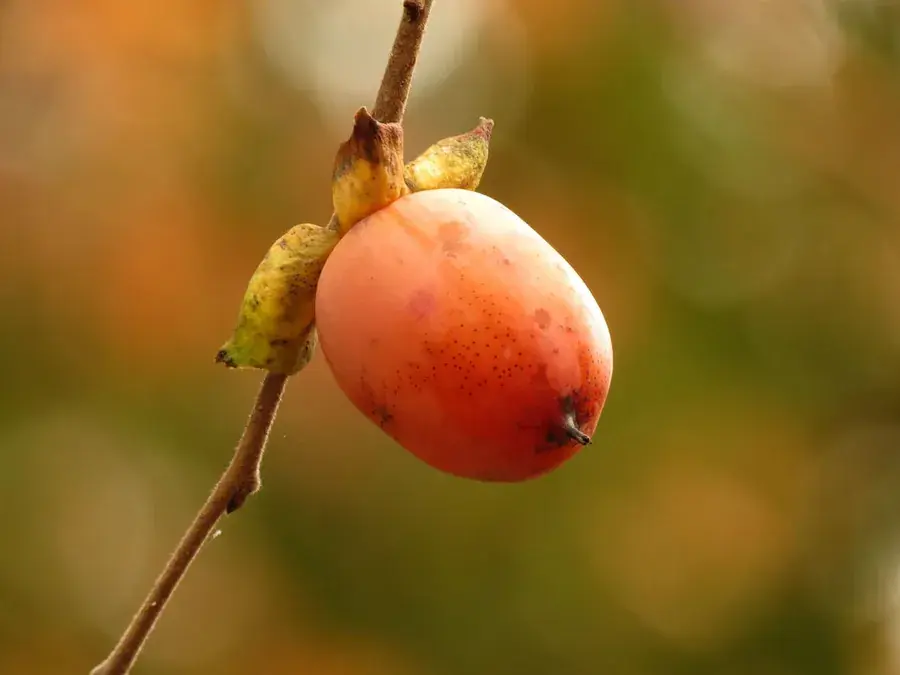 FruitOctober – November
American persimmon
Diospyros virginiana
Blocky alligator-hide bark; orange fruit the size of a plum, only ripe when it is wrinkled, squishy and usually on the ground.
How to know it & its look-alikes →Photo: Katja Schulz · CC BY 4.0
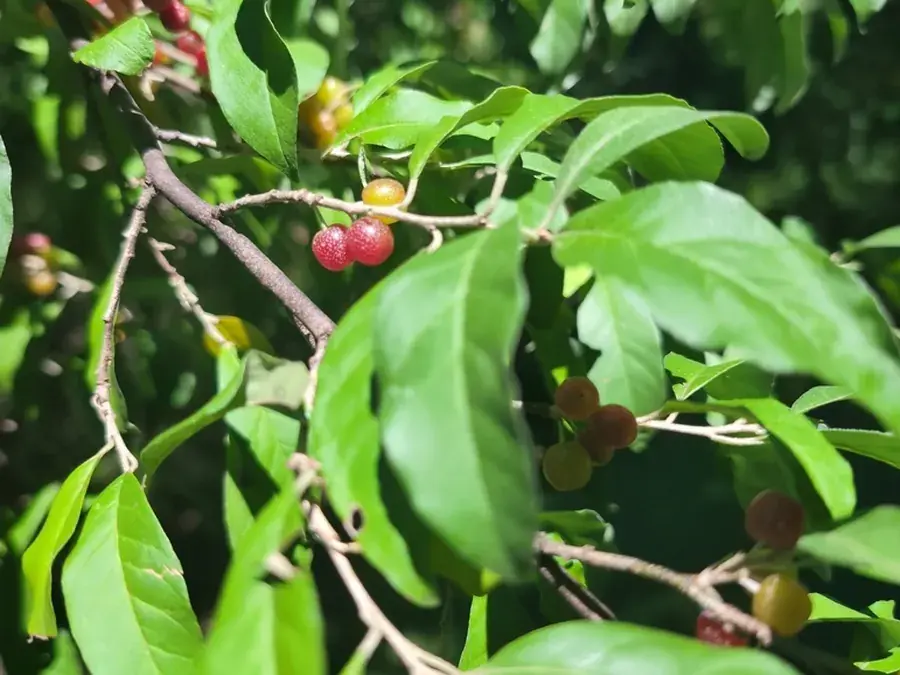 BerrySeptember – October
Autumn olive
Elaeagnus umbellata
A sprawling thorny shrub whose leaves flash silver underneath; in autumn it is weighed down with small red berries finely speckled with silver and brown scales, each with one soft seed.
How to know it & its look-alikes →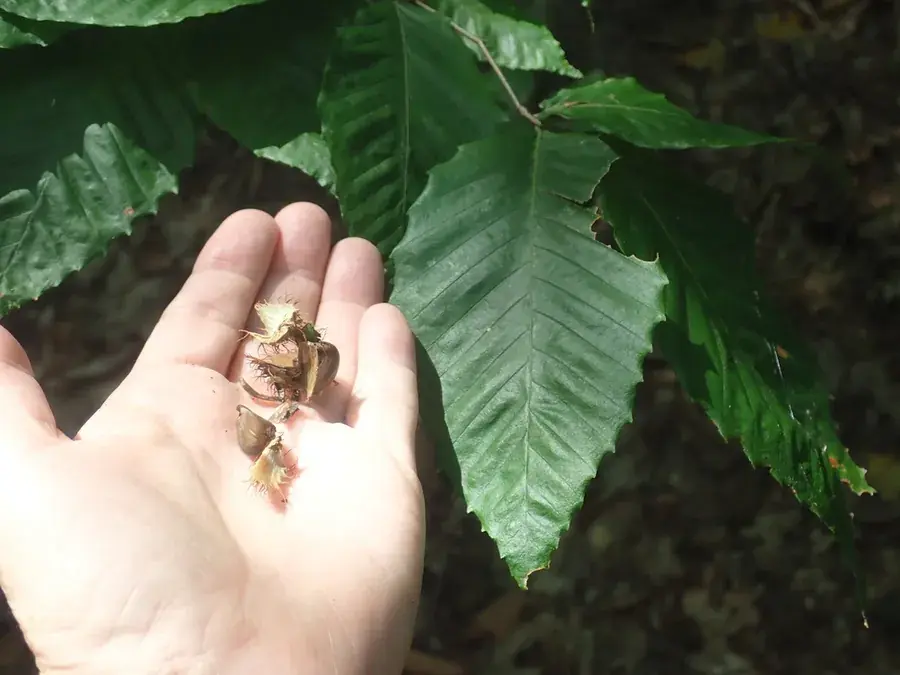 NutSeptember – October
Beechnuts
Fagus grandifolia
Smooth, pale grey bark on a tall tree; long, sharp, cigar-shaped buds; oval leaves with coarse teeth and straight parallel veins, many held, bleached, through winter. The nuts are small, three-sided and come two to a soft-bristled husk that splits into four.
How to know it & its look-alikes →
Checked against these sources ·
- Natural Resources Canada, Trees of Canada — American plum
- Natural Resources Canada, Trees of Canada — Canada plum
- Minnesota Seasons — American plum
- NC State Extension — Prunus angustifolia (Chickasaw plum)
- VASCAN (Database of Vascular Plants of Canada) — Prunus americana
- Minnesota Wildflowers — Common buckthorn
Seasons are typical for the middle of the range and move by weeks north and south, and up and down hills.
Educational information only. Never eat a wild plant or mushroom identified from a single photograph or description — confirm with a regional field guide or an experienced forager, and know the poisonous species in your area first.