Pear halves in light syrup or juice
Bartletts picked hard and ripened in a box, then put up in a light syrup or plain apple juice — winter dessert on a shelf.
Makes
About 7 × 1 L (quart) jars from 8 kg (17½ lb) of pears; 5 kg (11 lb) fills 9 × 500 ml (pint) jars
Active time
1½ hours
Total
2½ hours, plus 12–24 hours cooling
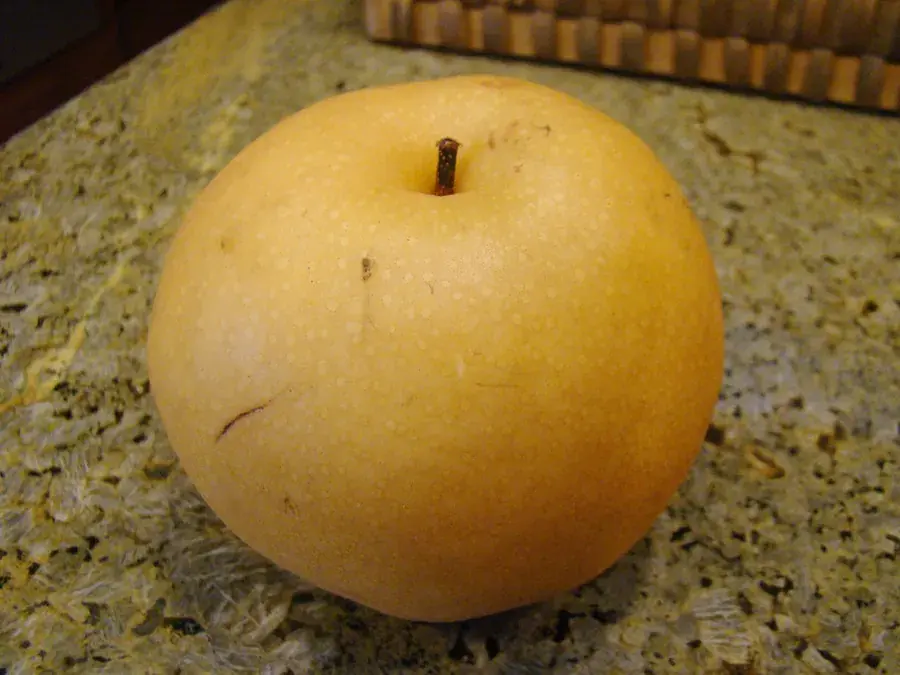
Photo Vegan Feast Catering on Flickr · CC BY 2.0
Before you start
What keeps this jar safe
- Pears are acidic enough on their own; the syrup is for flavour, colour and shape, not safety, so a very light syrup or plain juice is just as safe as a heavy one.
- Hot pack only — 5 minutes boiling in the liquid before filling — and the processing time assumes it.
- Use ripe, sound fruit; cut away bruises generously and leave out anything soft or fermenting.
- Boiling-water processing is the better choice for pears; the source notes that pressure canning can turn them pink.
This follows NCHFP: Pears, Halved. Quantities, acid and times are theirs; do not scale the vegetables without scaling everything, and do not change the vinegar, lemon juice or processing time.
Ingredients
- 8 kg (17½ lb) ripe but firm pears — about 1.1 kg (2½ lb) per litre jar
- Anti-browning bath: 1 teaspoon (3 g) ascorbic acid, or six crushed 500 mg vitamin C tablets, in 4 L (1 US gallon) cold water
- Light syrup for a 7-quart load: 2.25 L (9 cups) water with 450 g (2¼ cups) sugar — for 9 pints, 1.45 L (5¾ cups) water with 300 g (1½ cups) sugar
- Very light syrup instead, if you prefer: 2.6 L (10½ cups) water with 250 g (1¼ cups) sugar for 7 quarts — or skip syrup and use plain apple juice, white grape juice or water
Processing
- Jars
- 500 ml (pint) · 1 L (quart) in brackets
- Headspace
- 1.25 cm (½ inch)
- Time at 0–300 m (0–1,000 ft)
- 20 min
- Higher up
- 1 L jars: 25 min. For both sizes add 5 min at 300–900 m (1,001–3,000 ft), 10 min at 900–1,800 m (3,001–6,000 ft), 15 min above 1,800 m (6,000 ft).
Method
- 1
Set the washed jars to heat in the canner and wash the lids. Mix the ascorbic-acid bath in a big bowl.
- 2
Wash and peel the pears, halve them lengthwise and scoop out the core with a melon baller or a metal measuring spoon — children manage the scooping once an adult has halved. Drop the halves straight into the ascorbic-acid water.
- 3
Heat the water and sugar for the syrup (or the juice) to a boil in a wide pot.
- 4
Drain the pears and boil them 5 minutes in the syrup or juice. Raw-packed pears turn out poorly, so do not skip this.
- 5
Fill the hot jars with the hot pear halves, cut side down and overlapping, and cover with the hot cooking liquid, leaving 1.25 cm (½ inch) headspace. Free bubbles with a chopstick, top up, wipe the rims, centre the lids and screw the bands on fingertip-tight.
- 6
Lower into the canner with at least 5 cm (2 inches) of water over the lids, bring to a full rolling boil and time it: 500 ml jars 20 minutes, 1 L jars 25 minutes at 0–300 m.
- 7
Turn off the heat, uncover, wait 5 minutes, lift the jars onto a towel and leave 12–24 hours. Check the seals; refrigerate any that failed and eat within a few days.
Keeps: 12–18 months in a cool dark cupboard. Refrigerate after opening and eat within 3–4 days.
Variations: A vanilla bean or a strip of lemon zest in the syrup is a flavouring, not a vegetable, and is fine. Asian pears are a different fruit with their own NCHFP recipe that requires added lemon juice — do not use these times for them.
Tested source: NCHFP: Pears, Halved. Checked October 2026. If a jar did not seal, refrigerate it and use it within a few days. Never taste anything from a jar that is bulging, leaking, spurting or smells wrong — when in doubt, throw it out without tasting.
The crop
Pears: when to pick, how to store, what else to make →
Pears are the home canner’s best fruit after peaches: ripened-but-still-firm halves, held in ascorbic-acid water while you work, boiled 5 minutes in very light or light syrup, apple juice or plain water, hot-packed with 1 cm (½ in) headspace and processed 20 minutes for 500 ml jars and 25 for litres at 0–300 m. Use fruit that has had its chilling and a few days on the counter — a rock-hard pear cans woody, a soft one cans to mush. Pear butter and pear sauce follow the tested apple recipes. Dried pear slices (5 mm, dipped in ascorbic acid, 60 °C/140 °F for 6–10 hours until suede-like with no moist pockets) are excellent and keep a year. Freezing is the weak option: pears go brown and soft when thawed, so freeze them only as purée, or in syrup with ascorbic acid for smoothies and sauce. What does not work: canning pears raw-packed (the tested method is hot pack only), canning unripe fruit, and waiting for tree-ripe pears to make anything — by then the core has gone.