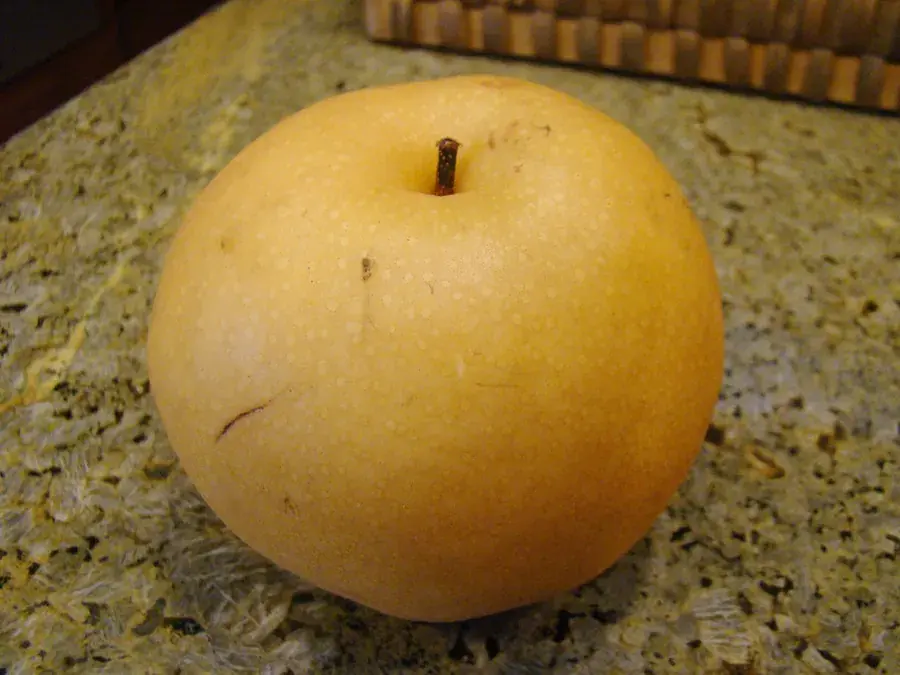
Photo Vegan Feast Catering on Flickr · CC BY 2.0
Pears
Pyrus communis
The fruit you must pick before it is ripe — a pear left to soften on the tree is mush outside and grit at the core.
- Ready when
- This is the crop people get wrong, because the sign of readiness is not softness. A European pear is picked mature but hard and ripened off the tree; left on, it ripens from the inside out, the core goes brown and the flesh turns gritty. Ready to pick means: full size for the variety; the skin has lightened from deep green to a paler green or yellow-green; the lenticels (the little dots) have gone from white to brown; the seeds are turning brown; and when you cup the pear and tilt it to horizontal it snaps cleanly off the spur. If you have to twist and pull, wait a few days. It is better to pick a little early than a little late. Bartlett comes in mid-August to early September in zones 5–6; Bosc, Anjou and the other winter pears in late September and October.
- How to pick
- Lift the pear to horizontal and let it snap off; keep the stem on. Handle gently — hard pears bruise invisibly and the bruise shows up as a brown patch when they ripen. Into shallow boxes, one or two layers, and straight to a cold place. Separate the two kinds: summer pears (Bartlett, Clapp’s, Flemish Beauty) to ripen soon, winter pears (Bosc, Anjou, Comice) to the cold room for their chilling first.
- On a frost night
- Pears are normally off the tree before the first hard frost, which is one more reason to pick them mature-green in September rather than waiting for them to soften. The fruit itself behaves like an apple: a light frost on the branch does no harm, but around −2 °C the flesh starts to freeze and a few such nights ruin it. If a hard freeze is forecast and the pears are full size and lift off when tilted, pick them all that afternoon and ripen them indoors. Frozen fruit must thaw on the tree before you touch it.
Where it keeps
Storing pears
| Where | Temperature | Humidity | Keeps | How |
|---|---|---|---|---|
| Fridge or cold room, for storage pears | 0–2 °C32–36 °F | high | Bartlett 4–6 weeks; Bosc 7–10 weeks; Anjou 3–4 months | In perforated bags or a lined crate, away from vegetables. Winter pears need this cold spell before they will ripen properly: Bosc and Comice want 2–4 weeks, Anjou 4–8 weeks; Bartlett needs only a day or two. Pull a few at a time to ripen on the counter. |
| Kitchen counter, to ripen | 18–24 °C64–75 °F | moderate | 3–10 days to ripe, then 2–3 days in the fridge | In a bowl or a paper bag out of the sun; a ripe banana or apple in the bag speeds it up. Bartlett takes about 5 days, Bosc and Comice about 7, Anjou up to 9. Check the neck daily — press gently just below the stem — and refrigerate the ones that yield. |
| Unheated garage or porch | 2–8 °C36–46 °F | high | 2–6 weeks, variety and weather allowing | Boxes with newspaper between layers, checked weekly. Warmer than a fridge, so it ripens them slowly rather than holding them; fine for a month of Bartletts, not for keeping Anjou until February. |
Putting it up
What to do with too many pears
Pears are the home canner’s best fruit after peaches: ripened-but-still-firm halves, held in ascorbic-acid water while you work, boiled 5 minutes in very light or light syrup, apple juice or plain water, hot-packed with 1 cm (½ in) headspace and processed 20 minutes for 500 ml jars and 25 for litres at 0–300 m. Use fruit that has had its chilling and a few days on the counter — a rock-hard pear cans woody, a soft one cans to mush. Pear butter and pear sauce follow the tested apple recipes. Dried pear slices (5 mm, dipped in ascorbic acid, 60 °C/140 °F for 6–10 hours until suede-like with no moist pockets) are excellent and keep a year. Freezing is the weak option: pears go brown and soft when thawed, so freeze them only as purée, or in syrup with ascorbic acid for smoothies and sauce. What does not work: canning pears raw-packed (the tested method is hot pack only), canning unripe fruit, and waiting for tree-ripe pears to make anything — by then the core has gone.
Jars boiled in a big pot — for high-acid food only.
The oldest method: the right cold, the right damp, and darkness.
A dehydrator or a low oven; light, keeps for a year.
The fastest route and the one that keeps flavour best.
- Water-bath canning
Pear halves in light syrup or juice
Bartletts picked hard and ripened in a box, then put up in a light syrup or plain apple juice — winter dessert on a shelf.
About 7 × 1 L (quart) jars from 8 kg (17½ lb) of pears; 5 kg (11 lb) fills 9 × 500 ml (pint) jars · 1½ hours active
The recipe →
Saving seed
Grown from tubers, cloves, crowns or runners, not seed
Like apples, pears do not come true from seed: every seedling is a cross and a gamble, and the named varieties are grafted onto rootstock. Pear seeds sown outdoors in autumn will sprout in spring if a child wants to grow a tree, but it will be a new pear of its own and may take ten years to show you what. To propagate a variety, graft a dormant scion onto a pear or quince rootstock in late winter; pears graft easily.
Keeps: Not applicable — the variety lives in the grafted wood.
The seed-saving guide →Next year
Planning pears for next season
Pears need a partner: plant two different varieties that bloom together, within sight of each other, or you will get flowers and no fruit. Full sun, deep soil, and go easy on nitrogen — soft lush growth is what fire blight attacks, and that disease is the reason to prune out any blackened, hooked shoot tips the moment you see them, cutting 30 cm below the damage into clean wood and wiping the blade. Prune lightly in late winter; pears fruit on spurs that last for years. Pick up drops, mouse-guard the trunk before snow, and plant bare-root trees in early spring. In zones 3–4 choose prairie-bred varieties and a sheltered spot; standard Bartlett is a zone 5 tree.
Pears at a glance
- Botanical name
- Pyrus communis
- Group
- Tree fruit
- Picked
- August, September
- Frost
- Half-hardy: scorched by a light frost, killed at −3 °c.
- Best put up as
- water-bath canning, cold storage, drying, freezing
- Seed
- Grown from tubers, cloves, crowns or runners, not seed
Questions people ask about pears
When do you pick pears?
Before they are ripe. Pick when the pear is full size, the skin has lightened a shade, the little dots on the skin have gone brown, and the fruit snaps off cleanly when you tilt it to horizontal — but while it is still hard. Bartlett comes in late August to early September in southern Ontario and Quebec; Bosc and Anjou in late September and October. If you wait for softness on the tree, the core goes brown and the flesh gritty.
Do pears ripen off the tree?
Yes — that is how European pears are meant to be ripened. Pick them mature and hard, give winter varieties their cold spell, then bring them to room temperature (18–24 °C) for 3–10 days. Bartlett needs only a day or two in the fridge first; Bosc and Comice want 2–4 weeks at 0–2 °C and Anjou 4–8, or they ripen unevenly or not at all. A banana or apple in the bag speeds things up.
How do you tell when a pear is ripe to eat?
Check the neck: press gently with a thumb just below the stem. When that spot gives slightly, the pear is ripe all the way through; by the time the fat end is soft, the middle is past it. Colour helps with Bartlett, which goes from green to yellow, but Bosc and Anjou barely change colour at all. This is a good daily job for a child — one pear, one thumb, no squeezing the rest.
How do you store pears for the winter?
Pick them hard and put them straight into the coldest place you have, ideally 0–2 °C with high humidity — a fridge, a cold room or a crisper drawer in perforated bags. Bartlett keeps 4–6 weeks that way, Bosc 2 months, Anjou up to 4 months. Bring out a few at a time to ripen on the counter. An unheated garage at 5–8 °C ripens them slowly rather than holding them, so it buys weeks, not months.
Can you freeze pears?
You can, but they come out brown and soft, so freeze them only in the forms where that does not matter: puréed as pear sauce, or sliced into syrup with a half-teaspoon of ascorbic acid per litre for smoothies and baking. For eating quality, can them in light syrup or dry them instead.
Are pears frost hardy?
The trees are hardy to zone 5 for most varieties (prairie-bred pears to zone 3), and the fruit on the branch takes a light frost without harm. Around −2 °C the flesh begins to freeze, and a few nights like that ruin it — but since pears are picked hard in September, they should be in the cold room before that happens. If a hard freeze is forecast and the fruit lifts off when tilted, pick it all that afternoon.
Your own frost dates
When does this come in where you are?
Enter a town, postal code or ZIP and the garden year, the frost watch and this week’s guide are built from your own weather.
Also in tree fruit
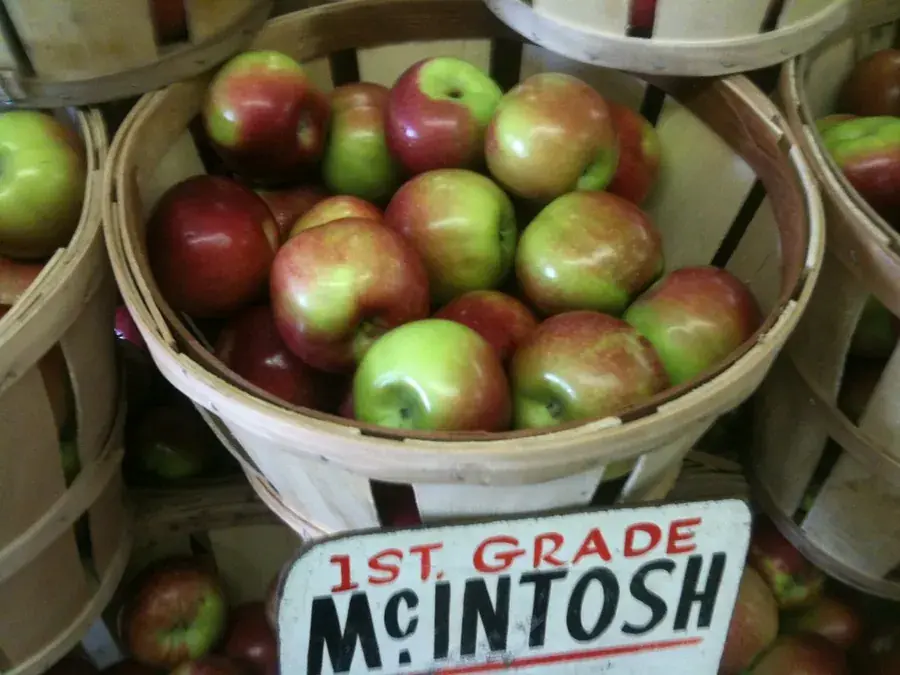 Half-hardyTree fruitPicked Aug–Oct
Apples
The one harvest that can feed a family until March — if you know which apples keep and which don’t.
Cold storage · Water-bath · FreezingPick, store, put up →
Checked against these sources ·
- Penn State Extension: Ripening European pears from the home orchard
- OSU Extension: Picking and storing apples and pears (FS 147)
- OSU Extension: How to know when apples and pears are ready to harvest
- NCHFP: Canning pears, halved
- Colorado State Extension: Drying fruits
Harvest months are typical for zones 4–6 and move by weeks north and south. Storage figures are for the ideal; a house without a cold room will get the shorter end of each range.