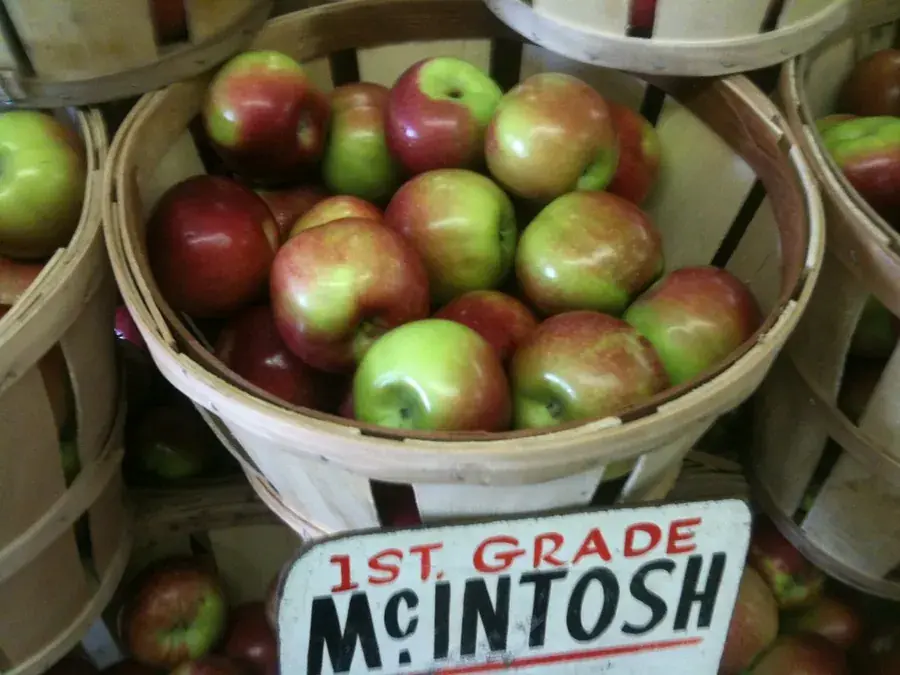
Photo JeepersMedia on Flickr · CC BY 2.0
Apples
Malus domestica
The one harvest that can feed a family until March — if you know which apples keep and which don’t.
- Ready when
- Cut one open: the seeds have gone from white to brown (on late varieties this happens weeks early, so it is a necessary sign, not a sufficient one). The ground colour — the skin in the stem dimple and on the shaded side — has shifted from leaf-green to yellow or cream. The flesh is white or cream, not greenish. Cup the apple, lift it and give it a quarter turn: a ripe apple comes away with its stem; one you have to yank is not ready. A few sound apples on the ground under the tree means the rest are days away. The keen can buy tincture of iodine, cut an apple across and paint the cut face: starch stains blue-black, so an unripe apple goes dark all over and a ripe one stains only a thin ring under the skin. Iodine is poisonous — the tested apple goes in the compost, not a mouth.
- How to pick
- Lift and twist upward with the stem on; never pull straight down, which tears out the spur that carries next year’s fruit, and never pull the stem out of the apple, because that hole is where rot starts. Handle them like eggs and set them, not drop them, into a padded basket — a bruise you cannot see today is a rotten apple in November. Pick on a dry day. Sort as you go: perfect fruit for storage, anything marked for the kitchen this week. Storage varieties can be picked a touch early and firm; apples for eating now want full ripeness.
- On a frost night
- The tree does not care about frost; the fruit does. Apples on the branch start to freeze at about −2 °C (28 °F). One short dip to there only shortens their storage life; several nights below it soften skin and flesh, and at −5 °C (22 °F) the fruit freezes solid and turns to mush when it thaws. If a hard freeze is forecast, pick everything that is ripe or close to it that afternoon. If you miss it and wake to frozen apples, leave them alone until midday — picking a frozen apple bruises it — and use any that are still firm soon, because they will not keep.
Where it keeps
Storing apples
| Where | Temperature | Humidity | Keeps | How |
|---|---|---|---|---|
| Cold room or second fridge | 0–4 °C32–39 °F | high | 2–6 months by variety; late keepers (Northern Spy, Haralson, Golden Russet types) longest, early apples weeks only | One layer deep in crates lined with newspaper, or in plastic bags with a few holes punched in them to hold humidity. Keep them in their own space: apples give off ethylene that ages everything stored near them, and they take up the smell of onions and potatoes. Hold McIntosh and Honeycrisp at about 3 °C rather than 0 — they suffer chilling injury at the coldest setting. |
| Fridge crisper | 1–4 °C34–39 °F | high | 1–3 months | In a bag with holes, away from the vegetables. Apples ripen roughly four times faster at 10 °C than at 0 °C, so the fridge is worth a lot more than the counter. |
| Unheated garage, porch or stairwell | 2–10 °C36–50 °F | moderate | 4–10 weeks, less in a warm fall | Boxes with newspaper between layers, off the concrete, checked every week. Pull anything soft or spotted at once — one rotting apple really does spoil the box, because the ethylene it gives off ripens its neighbours. |
Putting it up
What to do with too many apples
Apples are high-acid, so everything you make from them water-baths without added acid: applesauce (sugar optional, hot pack, 15 minutes for 500 ml jars and 20 for litres at 0–300 m), apple butter (the tested recipe cooks apples down with cider, vinegar and sugar until a spoonful mounds without weeping, then 5 minutes for 500 ml jars), and sliced apples in very light syrup, juice or water (hot pack, 20 minutes). Slices freeze well for pies if you hold them in water with ascorbic acid first or steam-blanch them 2 minutes, then tray-freeze; the texture is for cooking, not eating. Dried rings are the children’s favourite: dip 5 mm slices in ascorbic-acid water, dry at 60 °C (140 °F) for about six hours until leathery with no damp centre, and condition them in a loose jar for a week before sealing. Fresh-pressed cider is unpasteurized: bring it to a boil before giving it to children, older people or anyone with a weakened immune system — freezing keeps the flavour but does not make it safe. What does not work: canning pie filling thickened with flour or cornstarch (only Clear Jel, in a tested recipe, is safe — thickeners stop the heat reaching the centre of the jar), raw-packing apple slices (they float and brown), and putting windfalls in jars or juice — extension food-safety services say drops have been in contact with soil and animals, are often bruised enough for moulds to start inside, and are less acidic than picked fruit, and the mould toxin patulin survives cooking. Windfalls that are sound go in a pie this week; the rest go to the compost.
The oldest method: the right cold, the right damp, and darkness.
Jars boiled in a big pot — for high-acid food only.
The fastest route and the one that keeps flavour best.
A dehydrator or a low oven; light, keeps for a year.
- Water-bath canning
Applesauce, water-bath canned
Sound apples — seconds are fine once the bruises are cut away — into the easiest jar of the year; no added acid needed, and sugar optional.
About 7 × 1 L (quart) jars from 9.5 kg (21 lb) of apples; 6.1 kg (13½ lb) fills 9 × 500 ml (pint) jars · 1¼ hours active
The recipe → - Water-bath canning
Apple butter, water-bath canned
A long, slow pot of apples, cider and spice cooked down to something that mounds on a spoon — the whole house smells of it.
About 9–10 × 500 ml (pint) jars, or twice as many 250 ml · 1½ hours active
The recipe → - Drying
Dried apple rings
Leathery, chewy, lunchbox-sized apple: the drying recipe to start with, because it forgives almost everything except skipping the dip.
About 500 g of dried rings from 5 kg of fresh apples (they lose about nine-tenths of their weight) · 40 minutes active
The recipe → - Drying
Fruit leather, apple or berry
Purée poured thin and dried into a roll-up: the snack children ask for by name, made from the fruit that was too soft for anything else.
500 ml (2 cups) of purée makes one 33 × 38 cm (13 × 15 inch) sheet, about 8 roll-ups · 20 minutes active
The recipe →
Saving seed
Grown from tubers, cloves, crowns or runners, not seed
An apple seed does not grow into its parent. Every seed is a cross with whatever tree the bees visited, so the seedling is a new and almost always sour apple; named varieties exist only because someone grafted a bud of the original onto a rootstock, and every McIntosh in the world is a piece of the first one. If a child wants to try, the honest version is an experiment: push a few seeds into a pot of soil outdoors in October (they need a cold winter before they will sprout), and see what comes up in May. It will be a tree; it will not be the apple they ate. To make more of a variety you like, learn to graft in late winter — a cleft or whip graft onto a hardy rootstock is a good Saturday with a ten-year-old.
Keeps: Not applicable — the variety lives in the grafted wood, not the seed. Seeds sown outdoors in autumn come up the following spring, as wild cards.
The seed-saving guide →Next year
Planning apples for next season
There is no rotation; there is housekeeping. Pick up and compost every drop as it falls through September and October — apple maggot and codling moth overwinter in dropped fruit — and rake the leaves out from under the tree in November to break the scab cycle. Put a plastic spiral or hardware-cloth guard on the trunk before snow so mice and rabbits cannot girdle it. Do not feed after midsummer; prune in late winter while the tree is bare. Plant new trees bare-root in early spring as soon as the ground thaws, in full sun with drainage, and plant two different varieties (or one near a flowering crab) — most apples will not set fruit on their own pollen. In zones 3–4 choose trees on hardy rootstock and varieties bred for the cold, Honeycrisp and Haralson among the known ones; late keepers are the ones most likely to still be on the tree when the first hard freeze comes, so plan to pick them before, not after.
Apples at a glance
- Botanical name
- Malus domestica
- Group
- Tree fruit
- Picked
- August, September, October
- Frost
- Half-hardy: scorched by a light frost, killed at −3 °c.
- Best put up as
- cold storage, water-bath canning, freezing, drying
- Seed
- Grown from tubers, cloves, crowns or runners, not seed
Questions people ask about apples
When are apples ready to pick?
When the seeds inside have turned brown, the skin colour in the stem dimple has gone from green to yellow, and the apple lifts off with a twist instead of a tug. A few sound apples dropping on their own is the tree telling you the rest are close. Early varieties ripen in August and do not keep; the storage apples come in late September and October, and in most of southern Canada the whole crop is in before the end of October.
How do I store apples for the winter?
Cold and damp: 0–4 °C with high humidity, which in a house means a cold room, a second fridge or a crisper drawer, with the apples in bags with a few holes punched in them. Keep them away from the vegetables — apples give off ethylene that ages everything near them and they pick up the smell of onions and potatoes. Late varieties keep 3–6 months this way; an early apple keeps a few weeks whatever you do. Check every week and pull anything soft.
Can you freeze apples?
Yes, as slices for pies and sauce, not for eating out of hand. Peel and slice, hold the slices in water with a half-teaspoon of ascorbic acid per litre (or steam-blanch them 2 minutes) so they do not brown, then freeze on a tray and bag them. Applesauce freezes perfectly as it is and is the fastest way through a glut on a weeknight.
Can I grow an apple tree from a seed?
You can grow a tree; you cannot grow that apple. Apple seeds are crosses with whichever tree pollinated the flower, so the seedling is a new variety and almost always a sour one. It is still a good experiment for a child — plant a few seeds in a pot outside in autumn, since they need a cold winter to sprout, and watch for them in May. Named apples are made by grafting a bud onto a rootstock, which is a skill worth learning in late winter.
Will frost hurt apples still on the tree?
A light frost, no — apples do not start to freeze until about −2 °C (28 °F), and a brief dip to there only shortens how long they keep. Several nights below that soften the flesh, and at around −5 °C (22 °F) the fruit freezes hard and is ruined. If a hard freeze is forecast, pick what is ripe that afternoon. If the apples do freeze, wait until they have thawed at midday before touching them, and use the firm ones soon.
Are windfall apples safe to use?
For the kitchen this week, a windfall that fell today, is firm and unbroken, cut open and cooked, is a judgement call most gardeners make in favour of pie. For jars and juice, no: extension food-safety services say not to can or juice from dropped fruit, because drops have touched soil and animal droppings, are usually bruised enough for moulds to start in the core where you cannot see them, are less acidic than picked fruit, and the mould toxin patulin is not destroyed by heat. The useful children’s job is picking up drops every day into a bucket for the compost, which also keeps the wasps down. Teach them to look before they lift: a wasp feeding inside the hollow of a dropped apple is the commonest sting in an orchard, and no one bites into a windfall.
Do apples need added lemon juice when canning?
No. Apples are a high-acid fruit, well below the pH 4.6 line, so applesauce, apple butter and sliced apples are safely water-bath canned by their tested recipes without extra acid. The ascorbic acid or lemon juice you see in sliced-apple recipes is there to stop browning, not for safety. Where it does matter is anything mixed with low-acid ingredients — apple pie filling is only safe by a tested recipe with Clear Jel, and apple-and-vegetable chutneys need their vinegar measured, not tasted.
Your own frost dates
When does this come in where you are?
Enter a town, postal code or ZIP and the garden year, the frost watch and this week’s guide are built from your own weather.
Also in tree fruit
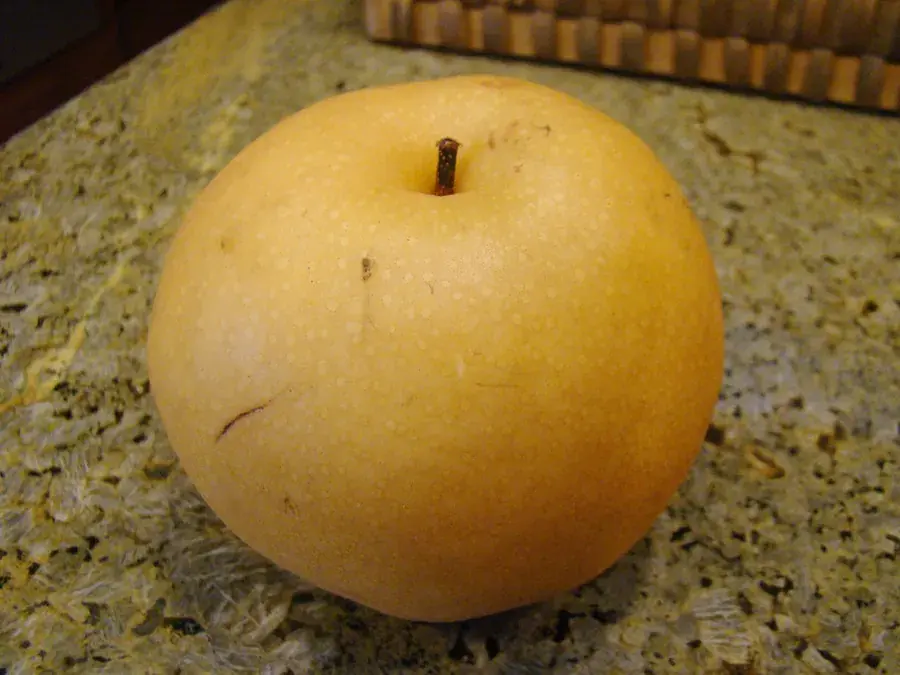 Half-hardyTree fruitPicked Aug–Sep
Pears
The fruit you must pick before it is ripe — a pear left to soften on the tree is mush outside and grit at the core.
Water-bath · Cold storage · DryingPick, store, put up →
Checked against these sources ·
- OSU Extension: Picking and storing apples and pears (FS 147)
- UW–Madison Extension: Apple and pear harvest timing
- NCHFP: Home-canned applesauce
- NCHFP: Freezing apples
- Nebraska Extension: Harvesting and storing apples
Harvest months are typical for zones 4–6 and move by weeks north and south. Storage figures are for the ideal; a house without a cold room will get the shorter end of each range.