Raspberry jam with liquid pectin
The brightest jar on the shelf, from the canes that fruit again in September. Liquid pectin keeps the cooking short and the flavour fresh.
Makes
About 6 × 250 ml jars
Active time
30 minutes
Total
1 hour including processing; 24 hours to cool and set
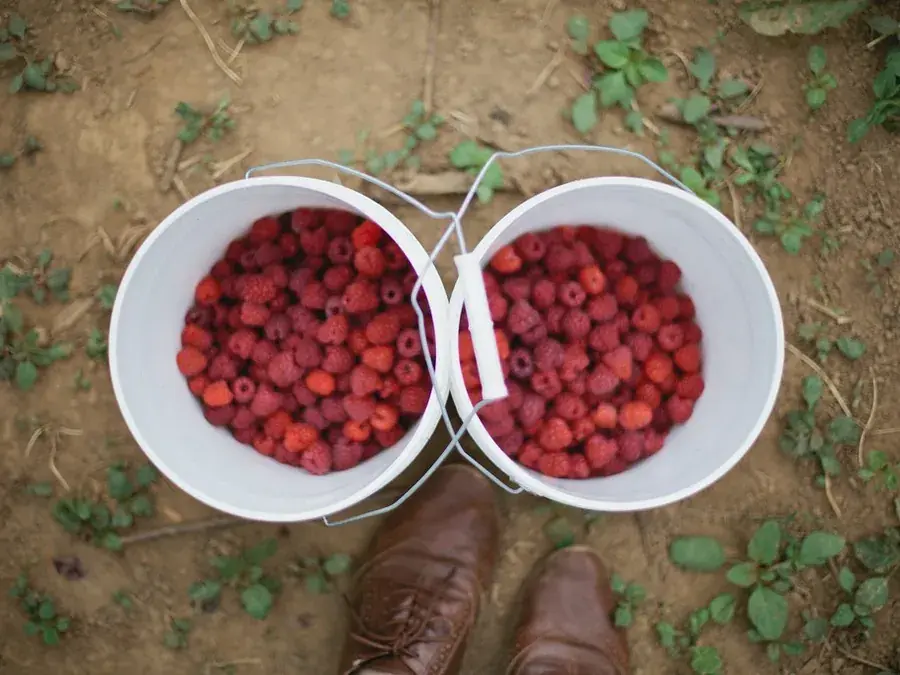
Photo Vanilla and lace on Flickr · CC BY 2.0
Before you start
What keeps this jar safe
- This is a liquid-pectin recipe: the sugar goes in with the fruit at the start and the pectin at the end. Do not swap in powdered pectin without switching to its recipe, and do not change the 1,000 ml fruit to 1,625 ml sugar ratio.
- A full rolling boil, then exactly 1 minute after the pectin goes in. Timing by the clock, not by eye.
- Process in a boiling-water canner 10 minutes with the jars fully covered. Open-kettle sealing (hot jam, lid on, no bath) is not safe and often fails to seal.
- Skim the foam before filling; foam trapped under the lid can spoil the seal.
This follows Bernardin: Raspberry Jam — Liquid Pectin. Quantities, acid and times are theirs; do not scale the vegetables without scaling everything, and do not change the vinegar, lemon juice or processing time.
Ingredients
- 1,000 ml (4 cups) prepared raspberries — about 1.5 L of whole berries, crushed; press some or all through a sieve first if you want fewer seeds
- 1,625 ml (6½ cups, about 1.3 kg) granulated sugar
- 1 pouch (85 ml) Bernardin Liquid Pectin
- ½ teaspoon (2 ml) butter or margarine, optional, to reduce foaming
Processing
- Jars
- 250 ml (half-pint) · 125 ml (quarter-pint) same time
- Headspace
- 0.5 cm (¼ inch)
- Time at 0–300 m (0–1,000 ft)
- 10 min
- Higher up
- Same time for 250 ml jars. Above 305 m (1,000 ft) add 5 min; above 915 m (3,000 ft) add 10 min; above 1,830 m (6,000 ft) add 15 min; above 2,440 m (8,000 ft) add 20 min.
Method
- 1
Put 6 clean 250 ml jars on the rack of a boiling-water canner, cover with water and heat to a simmer (82 °C, 180 °F). Wash the lids and set them aside dry.
- 2
Pick over the raspberries and crush them in a bowl with a potato masher — small hands do this well — measuring 1,000 ml (4 cups) when done. Sieve out some seeds first if you prefer.
- 3
In a large, deep stainless-steel pot, stir together the crushed fruit, all of the sugar and the butter.
- 4
Over high heat, stirring, bring to a full rolling boil that cannot be stirred down. Squeeze in the whole pouch of liquid pectin, return to a full boil and boil hard exactly 1 minute, stirring constantly. Remove from the heat and skim the foam.
- 5
Ladle into one hot jar at a time to 0.5 cm (¼ inch) from the rim. Free the air bubbles with a plastic tool, adjust the headspace, wipe the rim, centre the lid and screw the band on fingertip-tight. Return to the canner and repeat.
- 6
With the jars covered by at least 2.5 cm (1 inch) of water, put the lid on, bring to a full rolling boil and process 10 minutes at 0–305 m (0–1,000 ft).
- 7
Turn off the heat, remove the lid, wait 5 minutes and lift the jars straight up onto a towel. Leave 24 hours, then check that each lid is dished and firm, remove the bands, label and store.
Keeps: Best within a year in a cool dark cupboard. Refrigerate after opening and use within 3 weeks.
Variations: Half raspberries, half blackberries or black raspberries, measured together to the same 1,000 ml. Everbearing fall raspberries make a slightly softer, deeper-flavoured jam than July ones.
Tested source: Bernardin: Raspberry Jam — Liquid Pectin. Checked October 2026. If a jar did not seal, refrigerate it and use it within a few days. Never taste anything from a jar that is bulging, leaking, spurting or smells wrong — when in doubt, throw it out without tasting.
The crop
Raspberries: when to pick, how to store, what else to make →
Rinse them gently in cold water, drain and dry on a towel, then spread them on a tray, freeze and bag. They hold their shape and flavour better than any other berry. For jam, raspberries have enough natural pectin to set with sugar alone by a tested long-boil recipe, or quickly with added pectin; for seedless jam press half or all of the fruit through a food mill or sieve before measuring, then follow the recipe’s weights. Whole raspberries are on the tested list for canning (raw pack in syrup, 15 minutes for 500 ml jars at 0–300 m) but come out soft and pale — jam, syrup and the freezer suit them better. Raspberry vinegar is a safe and good use for a surplus. What does not work: washing before storage (mould in a day), and drying — a dried raspberry is a hard seedy pebble; make leather from the purée instead.
More for raspberries
- Freezing
Tray-frozen berries: raspberries, strawberries, haskap
No sugar, no syrup, nothing to measure — a single layer on a tray, then a bag you can pour from. The way to save a picking before it moulds overnight.
A standard baking sheet holds about 1 kg of berries per freezing round · 15 minutes active
The recipe → - Drying
Fruit leather, apple or berry
Purée poured thin and dried into a roll-up: the snack children ask for by name, made from the fruit that was too soft for anything else.
500 ml (2 cups) of purée makes one 33 × 38 cm (13 × 15 inch) sheet, about 8 roll-ups · 20 minutes active
The recipe →