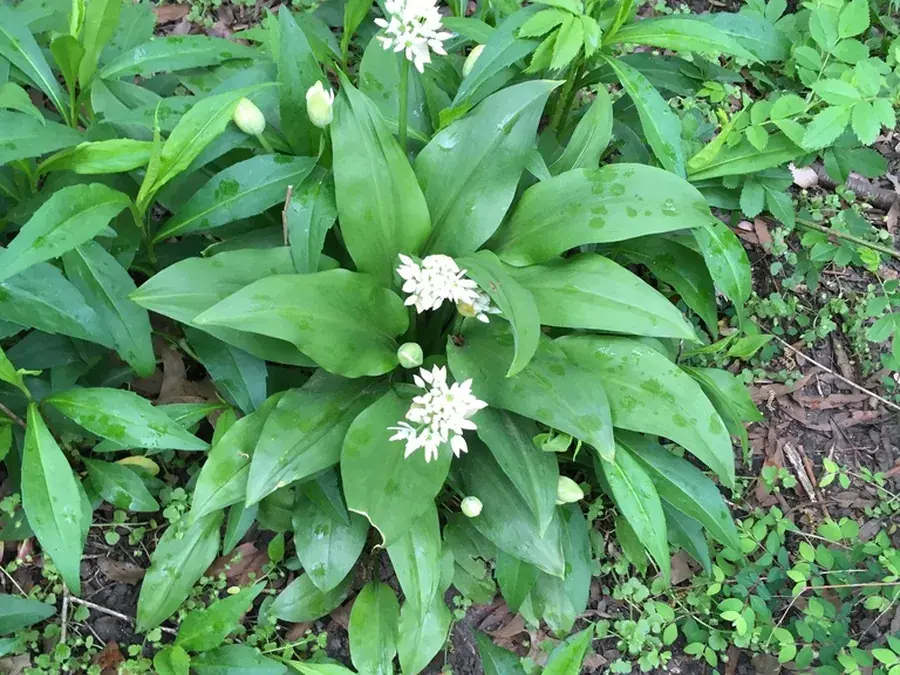
Photo by Public domain (iNaturalist) on iNaturalist · CC0 (public domain)
GreenSeason: March – May
Wild garlic (ramsons)
Allium ursinum
This one has a dangerous look-alike
Lily of the valley, autumn crocus (meadow saffron) and lords-and-ladies come up in the same places, and every spring people in Europe are poisoned after picking them as wild garlic; autumn crocus has killed. Lily of the valley has two or three duller leaves wrapped round one stem; autumn crocus makes a stalkless tuft; arum leaves are arrow-shaped and net-veined. None of them smells of garlic.
- When
- Typically March – May — March, April, May. Earlier in warm, low country; later in the hills.
- Where it grows
- Damp, shady deciduous woods, stream banks and old hedgerows, often carpeting the ground in spring — an ancient-woodland plant.
- How to know it
- Broad, bright green, smooth-edged leaves up to 25 cm (10 in) long, each on its own slender stalk straight from the ground, and a strong garlic smell from every crushed leaf. From April, round heads of white star-shaped flowers on a leafless stalk.
- Harvest and use
- Leaves raw or wilted — pesto, soup, butter, cheese — best before the flowers open; the flowers and green seed heads are good too. Cut leaves and leave the bulbs in the ground.
- Caution
- Crush and smell every leaf, not just the first — once your fingers smell of garlic, everything will. Never grab handfuls from a mixed patch.
Wild garlic (ramsons) at a glance
- Also called
- Ramsons, bear’s garlic, wood garlic, broad-leaved garlic, buckrams; ail des ours (France), Bärlauch (Germany), aglio orsino (Italy)
- Family
- Amaryllidaceae (the onion and garlic group)
- Where it grows
- Temperate Europe from Ireland and Britain east to the Caucasus: common in lowland Britain and Ireland (absent only from the far north of Scotland, Orkney and Shetland), and through France, the Low Countries, Germany, Poland, the Alps and the Carpathians. An eastern subspecies takes over in the east and south-east. A plant of moist deciduous woodland, often with bluebells.
- When to pick
- Leaves come up in late winter or early spring, before the trees leaf out — from late February in the mildest Atlantic woods, March and April further east and higher up. They are best before the flowers open, from April to June in Britain, and they yellow and die back by early summer.
- Parts used
- Leaves, flower buds, flowers and green seed heads, raw or cooked. The narrow bulbs are edible too, but digging them kills the plant, and in Britain uprooting any wild plant without the landowner’s permission is an offence.
- More look-alikes to know
- Lords-and-ladies (Arum maculatum) unfurls among wild garlic: open arum leaves are arrow-shaped with irregular edges and many veins in a net, often dark-spotted, where wild garlic leaves are smooth-edged with a single main vein. In the Alps and Carpathians, white false hellebore (Veratrum) has broad, pleated, strongly ribbed leaves spiralling up a stout stem, and has been eaten in salads and soups as wild garlic.
Questions people ask about wild garlic
What looks like wild garlic but is poisonous?
Lily of the valley, autumn crocus (meadow saffron), lords-and-ladies and, in the mountains, white false hellebore. All grow where wild garlic grows, none smells of garlic, and people are poisoned every spring after picking them by mistake. Autumn crocus has killed foragers: its colchicine has no antidote.
How do you tell wild garlic from lily of the valley?
Look at how the leaves grow and smell them. Each wild garlic leaf rises on its own stalk from the ground, bright green and slightly glossy, and smells of garlic when crushed. Lily of the valley has two or three duller leaves wrapped around one reddish-purple stem, and no smell. In flower, wild garlic has a round head of white stars; lily of the valley has nodding white bells.
When is wild garlic season?
Late winter to late spring. The leaves appear in February or March and are at their best before the flowers open in April and May; by early summer they have yellowed and gone.
Can you eat wild garlic flowers?
Yes. The flowers can go raw into salads, and the buds and green seed heads are eaten too. The flavour of the whole plant is gentler than a garlic bulb.
Is it legal to pick wild garlic?
Picking leaves for your own use is generally fine where you have access, but in Britain uprooting any wild plant without the landowner’s permission is an offence under the Wildlife and Countryside Act, and nature reserves have their own rules. Cut leaves; leave the bulbs.
Found in these regions
Hardiness zones 4–8.
Is it ready near you?
Get this week's foraging guide for your area
Enter a town, postal code or ZIP and we'll tell you what's in season right there this week — from your local climate, this week's weather and your ecological region.
Also ready in October
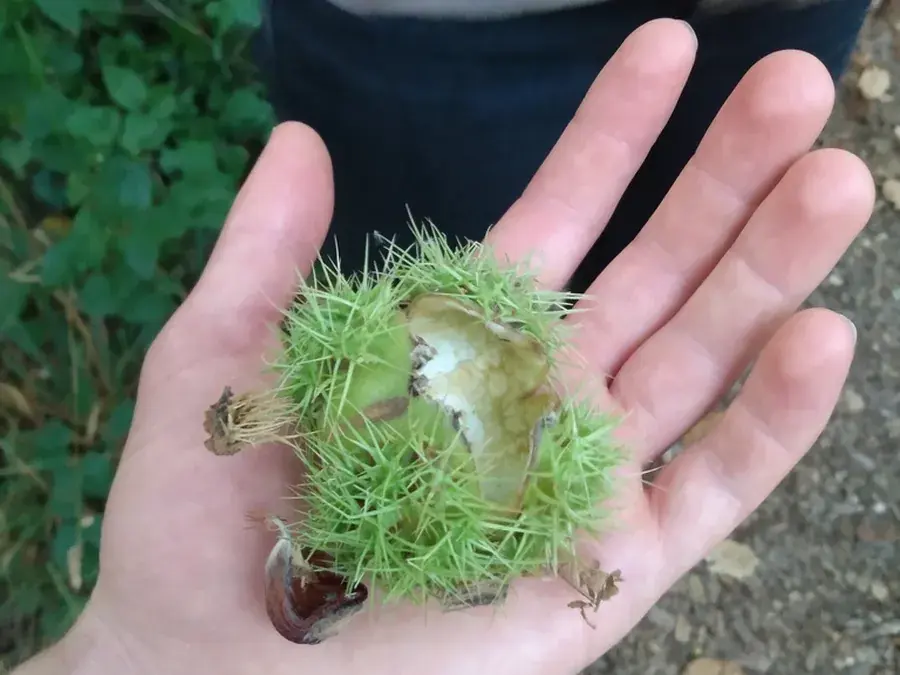 NutOctober – November
Sweet chestnut
Castanea sativa
A big tree with long, glossy leaves edged with sharp, regular teeth, and bark that twists in spiralling ridges on old trunks. The nuts come in twos and threes inside a husk covered in dense, needle-sharp spines; each is glossy brown, flat on one side, with a pointed tuft at the tip.
How to know it & its look-alikes →Photo: John Powers · CC BY 4.0
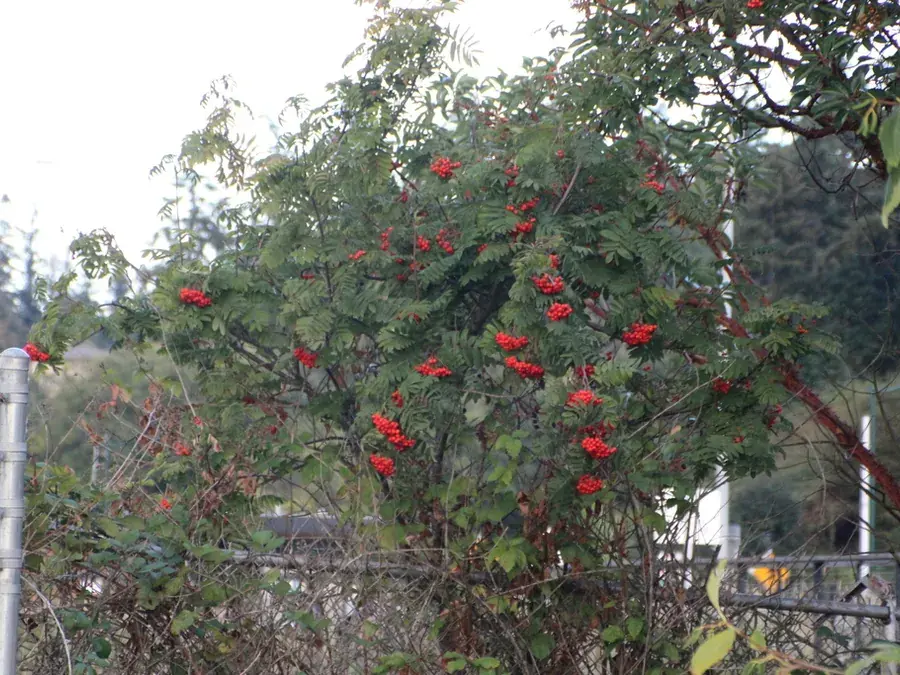 BerryAugust – October
Rowan berries
Sorbus aucuparia
A slim tree with smooth silvery-grey bark and feathery leaves of many toothed leaflets in pairs; big flat clusters of scarlet-orange berries, each about 1 cm (⅜ in) across with a tiny black five-pointed star at the tip.
How to know it & its look-alikes →Photo: Therese Phillips · CC BY 4.0
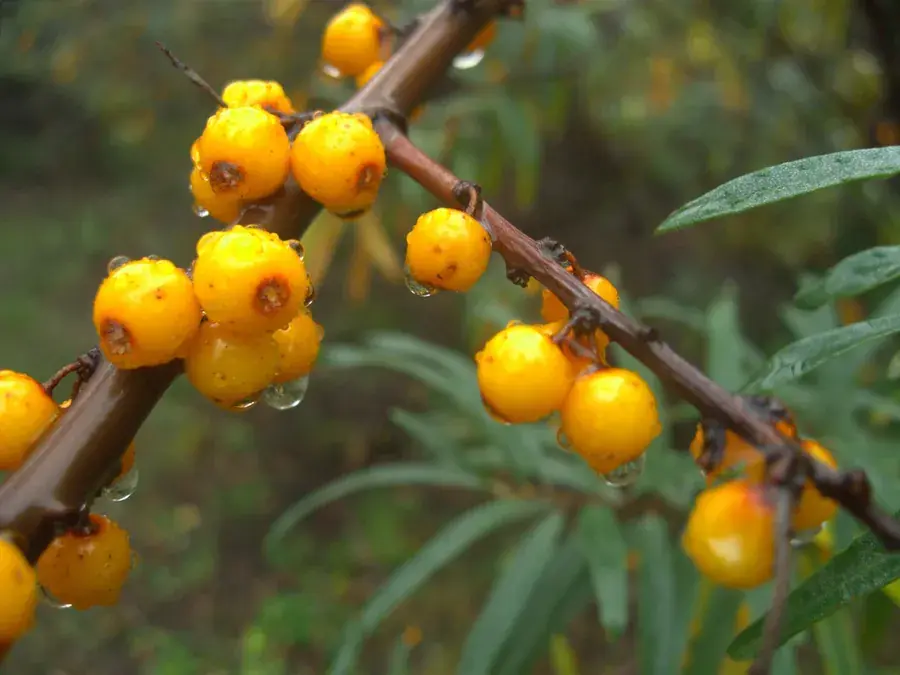 BerryAugust – October
Sea buckthorn
Hippophae rhamnoides
A thorny shrub with narrow, silvery-grey, willow-like leaves and branches packed with bright orange berries 6–8 mm (¼ in) across, from late summer into winter. Only female bushes fruit.
How to know it & its look-alikes →
Checked against these sources ·
- Wikipedia — Allium ursinum (look-alikes and distribution)
- Woodland Trust — Wild garlic
- Woodland Trust — Lily-of-the-valley
- Brvar et al., Critical Care (2004) — Case report: fatal poisoning with Colchicum autumnale (eaten as wild garlic)
Seasons are typical for the middle of the range and move by weeks north and south, and up and down hills.
Educational information only. Never eat a wild plant or mushroom identified from a single photograph or description — confirm with a regional field guide or an experienced forager, and know the poisonous species in your area first.