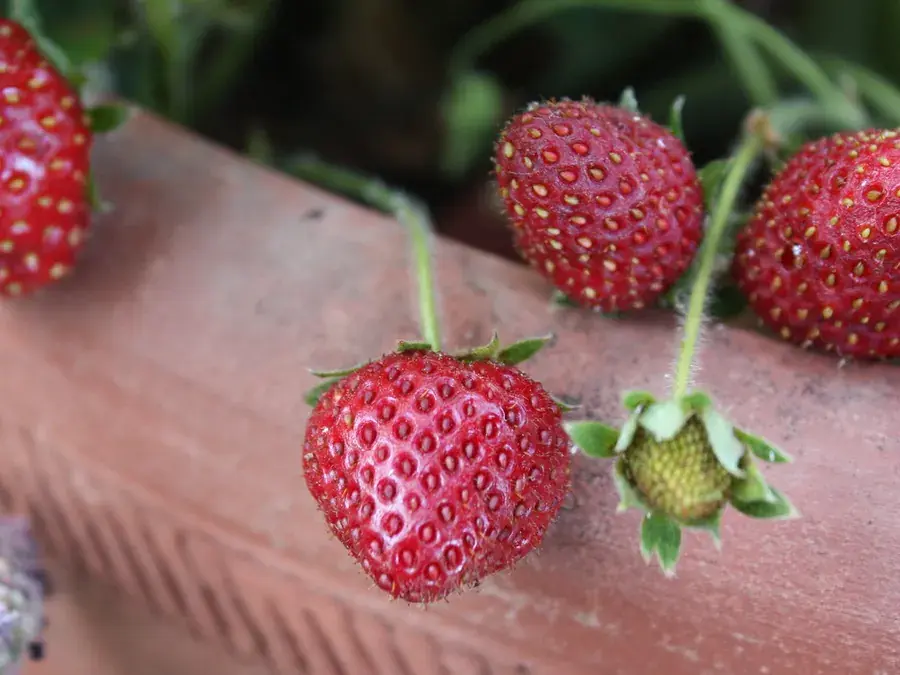
Photo ewen and donabel on Flickr · CC BY 2.0
Strawberries
Fragaria × ananassa
Three weeks of June glory from a June-bearer, or a trickle until frost from a day-neutral — either way, the freezer is the answer.
- Ready when
- Red to the very tip and up under the cap with no white shoulder — a strawberry ripens from the tip toward the stem and does not ripen one bit after picking. Fully coloured, glossy, and giving slightly to a thumb. Check every day once the first ones colour; a berry goes from perfect to overripe in two warm days. June-bearers crop for about three weeks from mid-June; day-neutrals from June until frost with a lull in the July heat; everbearers in early summer and again in early fall.
- How to pick
- Pinch the stem with a thumbnail just above the cap so the berry comes away with its cap on; pulling the berry off the cap bruises it and it will not keep. Pick in the cool of the morning, into shallow containers no more than two berries deep, and get them out of the sun. Do not wash them until you use them. Pick off and bin any mouldy or bird-pecked fruit as you go, so grey mould does not spread down the row.
- On a frost night
- The plants shrug off autumn frost; it is the flowers and fruit that do not. If you grow day-neutral or everbearing plants that are still fruiting in September and October, throw a row cover or old sheet over them on a frost night: open blossoms die at −1 °C, white-bud flowers and green fruit at about −2 °C, and anything already coloured should be picked that evening. June-bearers need nothing until the mulch goes on. Do not mulch at the first frost — wait until the plants have hardened through two or three frosts and the soil is cold, usually late October or November, then cover the rows with 10–15 cm (4–6 in) of clean straw. An unmulched crown dies at about −9 °C (15 °F), and in a snowless January that is an ordinary night. Pull the straw into the paths when growth starts in April.
Where it keeps
Storing strawberries
| Where | Temperature | Humidity | Keeps | How |
|---|---|---|---|---|
| Fridge, unwashed | 0–4 °C32–39 °F | high | 3–5 days, 7 at most for firm varieties | In a shallow, covered container or a perforated bag, caps on, unwashed, one or two layers. Sort out any soft one the day you pick. |
| Kitchen counter | 15–22 °C59–72 °F | moderate | The same day | For eating now only. A strawberry at room temperature is a strawberry in decline. |
Putting it up
What to do with too many strawberries
Freeze them. Hull, rinse, dry on a towel, spread on a tray, freeze, bag: whole berries that pour out loose all winter for smoothies, sauce and muffins. Sliced or crushed berries freeze well with 180 ml (¾ cup) sugar per litre of fruit for pie and shortcake. Strawberry jam is the other great use — a tested powdered- or liquid-pectin recipe, water-bathed 5–10 minutes depending on the recipe and your altitude — and uncooked freezer jam, which tastes more like the fruit than any cooked jam, keeps three weeks in the fridge and a year in the freezer. What does not work: canning strawberries whole. They are not on the tested list for canned berries because they collapse, float, bleach pale and lose their flavour in the jar; the way to keep strawberries in a jar is as jam. Dried strawberry slices and fruit leather are good but a lot of fruit for a little result.
The fastest route and the one that keeps flavour best.
Jars boiled in a big pot — for high-acid food only.
A dehydrator or a low oven; light, keeps for a year.
- Water-bath canning
Strawberry jam with Original Fruit Pectin
Canada’s jam. Eight jars in under an hour, set every time, from the berries picked the same morning or from the freezer in January.
About 8 × 250 ml jars · 40 minutes active
The recipe → - Water-bath canning
Strawberry rhubarb jam with Original Fruit Pectin
June in a jar: the first strawberries and the last tender rhubarb, set with powdered pectin so the tartness stays sharp.
About 6 × 250 ml jars · 40 minutes active
The recipe → - Freezing
Tray-frozen berries: raspberries, strawberries, haskap
No sugar, no syrup, nothing to measure — a single layer on a tray, then a bag you can pour from. The way to save a picking before it moulds overnight.
A standard baking sheet holds about 1 kg of berries per freezing round · 15 minutes active
The recipe → - Drying
Fruit leather, apple or berry
Purée poured thin and dried into a roll-up: the snack children ask for by name, made from the fruit that was too soft for anything else.
500 ml (2 cups) of purée makes one 33 × 38 cm (13 × 15 inch) sheet, about 8 roll-ups · 20 minutes active
The recipe →
Saving seed
Grown from tubers, cloves, crowns or runners, not seed
Strawberries make their own plants: after the June crop every plant sends out runners with daughter plants along them. Choose the first daughter on each runner (the one nearest the mother, the strongest), set it onto bare soil or into a sunk pot of potting mix while it is still attached, pin it down with a bent wire or a stone, and keep it watered. It roots in three to four weeks; cut the cord and, by early September at the latest, move it to its new bed — plants rooted later than that will not fruit well next June. Take runners only from healthy, vigorous mothers. Seed is pointless: garden strawberries are hybrids and their seedlings do not come true. Note that many modern varieties are protected by plant breeders’ rights, which forbid propagating them for sale; your own garden is your own business.
Keeps: Not from seed. A daughter plant rooted by early September fruits the following June, and a bed renews itself from its own runners every 3–4 years.
The seed-saving guide →Next year
Planning strawberries for next season
Next year’s crop is made this summer. Right after the last June picking — before the first of August — renovate June-bearing beds: mow or shear the leaves off 2–3 cm above the crowns, rake them away, narrow the rows back to 30 cm, pull the weakest plants, feed, and water the stubble back to life. Skip the mowing for day-neutrals; just thin them. Beds wear out after three or four years, so start a new one every second spring from your own runners, and put it where tomatoes, potatoes, peppers or raspberries have not grown for several years — they share verticillium wilt. Full sun, well-drained soil, 45 cm between plants; pinch every flower off June-bearers in their planting year and off day-neutrals for the first six weeks. In zones 3–4 choose hardy June-bearers such as Kent, Honeoye and Cavendish, and treat the straw mulch as non-negotiable.
Strawberries at a glance
- Botanical name
- Fragaria × ananassa
- Group
- Berries
- Picked
- June, July, August, September
- Frost
- Half-hardy: scorched by a light frost, killed at −3 °c.
- Best put up as
- freezing, water-bath canning, drying
- Seed
- Grown from tubers, cloves, crowns or runners, not seed
Questions people ask about strawberries
When are strawberries ready to pick?
When they are red to the tip and up under the cap, with no white shoulder, glossy, and just yielding to a thumb. They ripen from the tip up and stop ripening the second they are picked, so a half-white berry stays half-white. June-bearers crop for about three weeks from mid-June in southern Ontario and Quebec, a week or two later in zone 3–4; day-neutrals keep going until frost.
Can you freeze strawberries?
Yes, and it is the best way to keep them. Hull, rinse, dry well, freeze whole on a tray and bag them; they keep a year. For pies and shortcake, slice or crush them with ¾ cup of sugar per litre of fruit before freezing. Thawed strawberries are soft, so they are for sauce, smoothies and baking rather than a bowl.
How do you store fresh strawberries?
Unwashed, caps on, in a shallow covered container in the fridge at 0–4 °C, and eat them within three to five days. Washing before storage starts the rot; wash just before eating. Sort out anything soft the day you pick, because one mouldy berry takes the container with it.
Can you can strawberries?
Not whole — strawberries are left off the tested list for canned berries because they collapse, float and lose colour and flavour in the jar. Strawberry jam is how they go in a jar: a tested pectin recipe, water-bathed. Uncooked freezer jam tastes even more like June, keeps three weeks in the fridge or a year frozen, and is a fine first canning project for a child because there is no hot jar to handle.
Do strawberries need to be covered for winter?
Yes, in most of Canada. The crowns can die at around −9 °C without snow cover, so after the plants have hardened through two or three frosts and the soil has gone cold — late October or November — cover the rows with 10–15 cm of clean straw. Not earlier, or the plants rot under warm mulch. Rake it into the paths when growth starts in April, and pull it back over the rows on a frosty night during bloom, since open flowers die at −1 °C.
What is strawberry renovation?
The after-harvest haircut that keeps a June-bearing bed productive. Within a week or two of the last picking, mow or shear the leaves off just above the crowns, rake them away, narrow each row to about 30 cm wide, thin out the weakest plants, fertilise, and water well. It feels brutal and the bed looks like a stubble field for a fortnight; by September it is dense with new leaves and the fruit buds for next June are being set. Do it before August 1.
What should kids know about picking strawberries?
Pinch the stem above the green cap rather than pulling the berry, and put it in the box, not drop it. Only the all-red ones — a strawberry does not ripen after picking, so a white-tipped berry is a wasted berry. Picking into a shallow box two deep keeps them from crushing, and the picker gets to eat the ones the slugs started.
Your own frost dates
When does this come in where you are?
Enter a town, postal code or ZIP and the garden year, the frost watch and this week’s guide are built from your own weather.
Also in berries
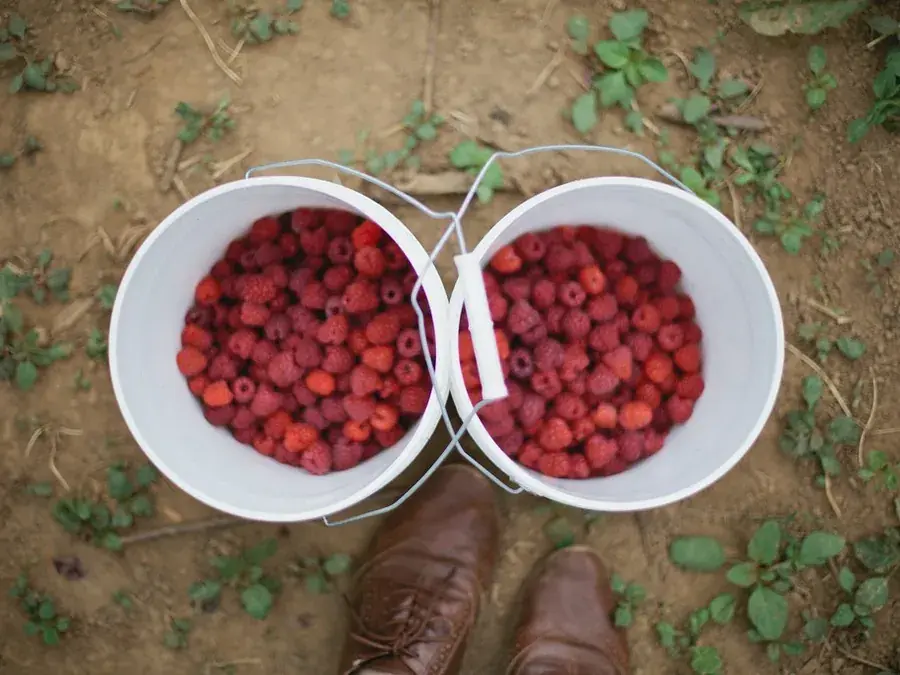 Half-hardyBerriesPicked Jul–Oct
Raspberries
Pick every second day or lose them — and tray-freeze the surplus the same afternoon.
Freezing · Water-bath · DryingPick, store, put up →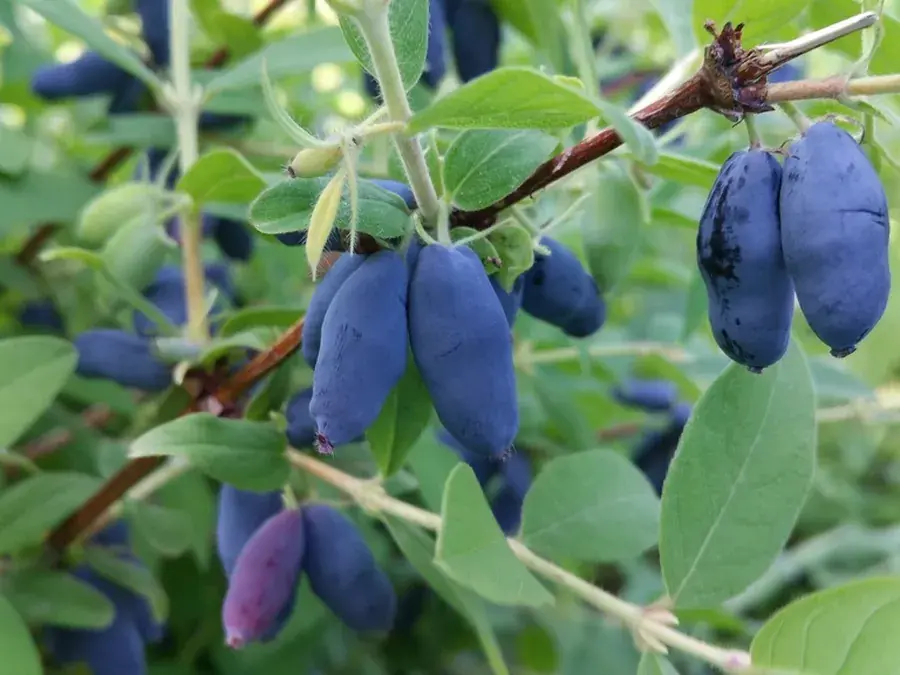 Very hardyBerriesPicked Jun–Jul
Haskap (honeyberry)
The Canadian berry: hardy to zone 2, ripe before the strawberries, and the first jam of the year.
Freezing · Water-bath · DryingPick, store, put up →
Checked against these sources ·
- University of Minnesota Extension: Growing strawberries in the home garden
- NCHFP: Freezing strawberries
- NCHFP: Canning berries, whole (strawberries not included)
- WSU Extension: Preserving strawberries
- Manitoba Agriculture: Frost damage and protection in strawberry orchards
Harvest months are typical for zones 4–6 and move by weeks north and south. Storage figures are for the ideal; a house without a cold room will get the shorter end of each range.