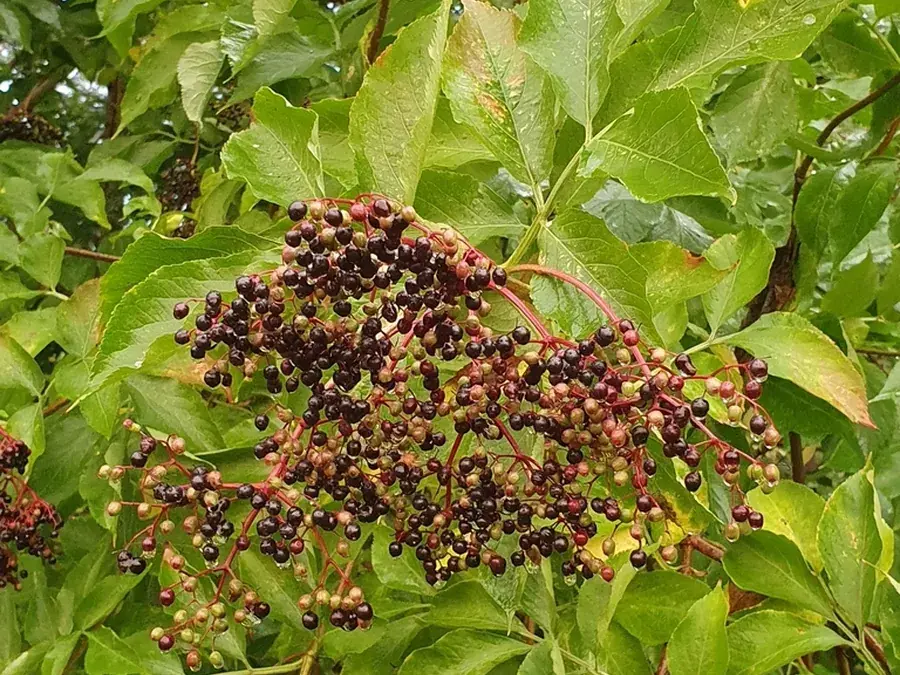
Photo by Public domain (iNaturalist) on iNaturalist · CC0 (public domain)
BerrySeason: August – September
Elderberries (European elder)
Sambucus nigra
- When
- Typically August – September — August, September. Earlier in warm, low country; later in the hills.
- Where it grows
- The same hedges, scrub and waste ground where the shrubs flowered in June.
- How to know it
- Drooping, flat-topped clusters of glossy purple-black berries 6–8 mm (¼ in) across on purple-red stalks, on a woody shrub with corky bark and opposite compound leaves.
- Look-alikes
- Dwarf elder looks like a short elder with its berry heads held upright on soft green stems that die back every winter; it is poisonous. Dogwood and privet carry black berries on shrubs with simple leaves, and deadly nightshade bears single shiny berries in a green star — none of them in a drooping, flat elder head.
- Harvest and use
- Always cooked: syrup, jelly, chutney, wine, Germany’s elderberry soup, and with apples or blackberries in pies. Strip the berries with a fork and pick out every green stalk and unripe berry.
- Caution
- Raw berries, seeds, leaves and stems contain cyanogenic compounds that cause nausea, vomiting and diarrhoea. Cook them through.
Elderberries (European elder) at a glance
- Also called
- Elder, black elder, European elder; sureau noir (France), Holunder or Fliederbeere (Germany), fläder (Sweden), hyld (Denmark), bez czarny (Poland)
- Family
- Viburnaceae (formerly Adoxaceae)
- Where it grows
- Native from the Azores across Europe to Turkey and the Middle East, and common throughout Britain and Ireland, in hedges, scrub, woodland edges, riverbanks and waste ground; introduced to most other continents.
- When to pick
- The berries ripen from late summer into autumn — mostly late August and September. Take whole heads when every berry is glossy purple-black and the cluster droops under its weight.
- Parts used
- Ripe berries, cooked: syrup, jelly, chutney, soup, wine, and in pies with apple or blackberry.
- Is any of it poisonous?
- Raw berries are mildly poisonous, and the seeds, leaves, stems and bark contain the cyanogenic glycoside sambunigrin; badly prepared berries cause nausea, vomiting and severe diarrhoea. Cook them through and remove every bit of green stalk.
- More look-alikes to know
- Red-berried elder (Sambucus racemosa), a shrub of central European woods and mountains, flowers earlier in domed clusters and carries scarlet berries; treat them as not edible.
Questions people ask about elderberries
Are raw elderberries poisonous?
Mildly. Raw berries, and the seeds and green parts, contain compounds that cause nausea, vomiting and diarrhoea. The ripe berries are eaten cooked; never eat the leaves or stalks.
When are elderberries ripe?
In late August and September in most of Europe, when the clusters hang heavy and every berry is purple-black.
What is the difference between elder and dwarf elder?
Elder is a woody shrub or small tree with corky bark and drooping berry heads. Dwarf elder (danewort) is a herb 1–2 m (3–6 ft) tall that dies back to the ground every winter, grows in patches, smells foul when bruised and holds its berry heads upright. Every part of dwarf elder is poisonous.
Can children eat elderberries?
Only cooked, in syrups, jams and pies. Raw berries, leaves and stalks make people sick, and children are the ones most likely to graze on a hedge — teach them that elderberries go in the pot first.
Found in these regions
- Atlantic Europe
- Continental Europe
- Alps, Pyrenees & Carpathians
- Mediterranean Europe
- Pannonian Basin & Eastern Plains
Hardiness zones 5–9.
Is it ready near you?
Get this week's foraging guide for your area
Enter a town, postal code or ZIP and we'll tell you what's in season right there this week — from your local climate, this week's weather and your ecological region.
Also ready in October
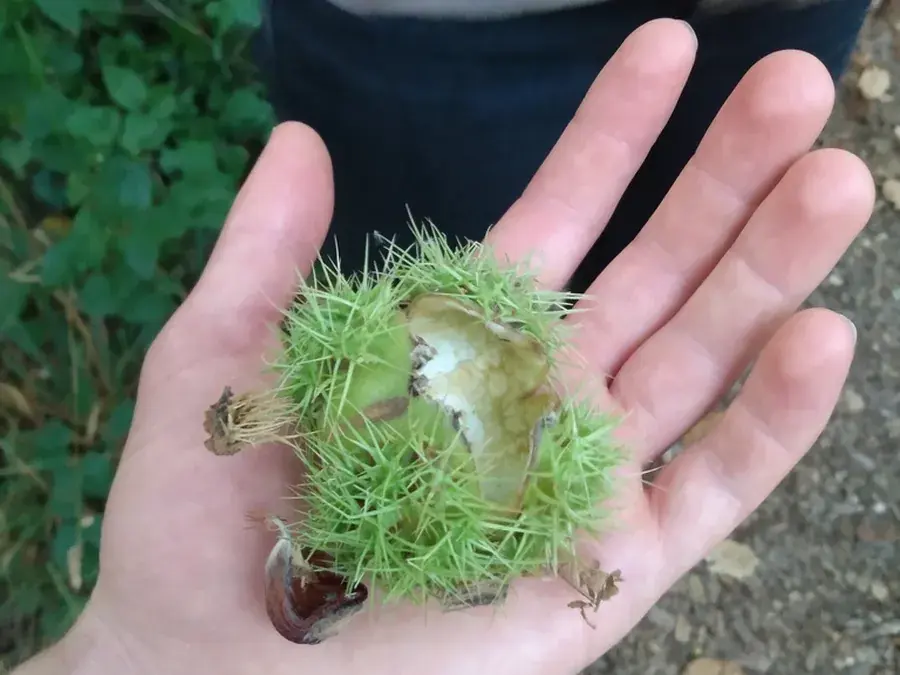 NutOctober – November
Sweet chestnut
Castanea sativa
A big tree with long, glossy leaves edged with sharp, regular teeth, and bark that twists in spiralling ridges on old trunks. The nuts come in twos and threes inside a husk covered in dense, needle-sharp spines; each is glossy brown, flat on one side, with a pointed tuft at the tip.
How to know it & its look-alikes →Photo: John Powers · CC BY 4.0
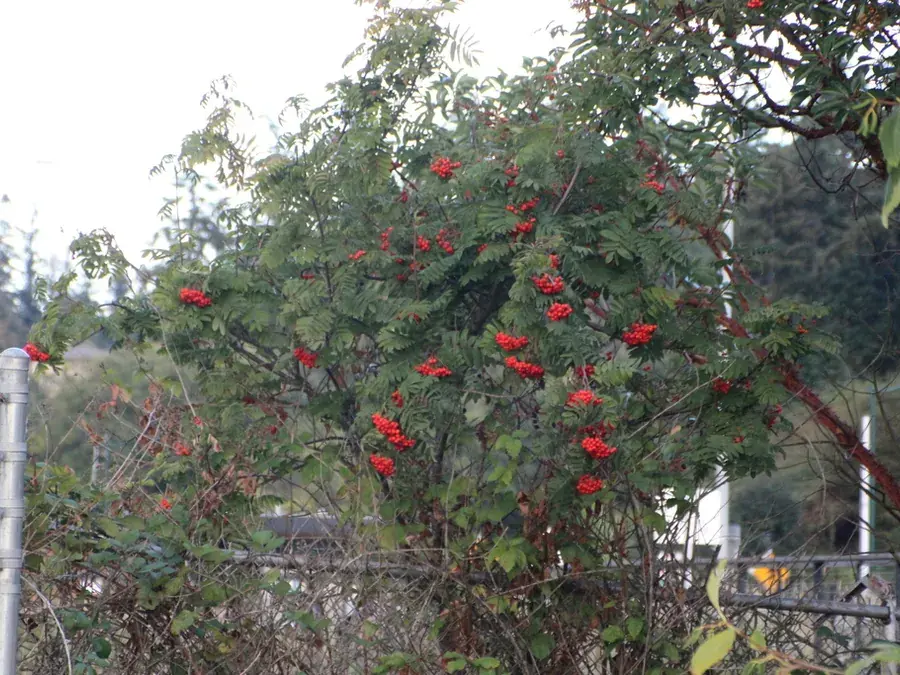 BerryAugust – October
Rowan berries
Sorbus aucuparia
A slim tree with smooth silvery-grey bark and feathery leaves of many toothed leaflets in pairs; big flat clusters of scarlet-orange berries, each about 1 cm (⅜ in) across with a tiny black five-pointed star at the tip.
How to know it & its look-alikes →Photo: Therese Phillips · CC BY 4.0
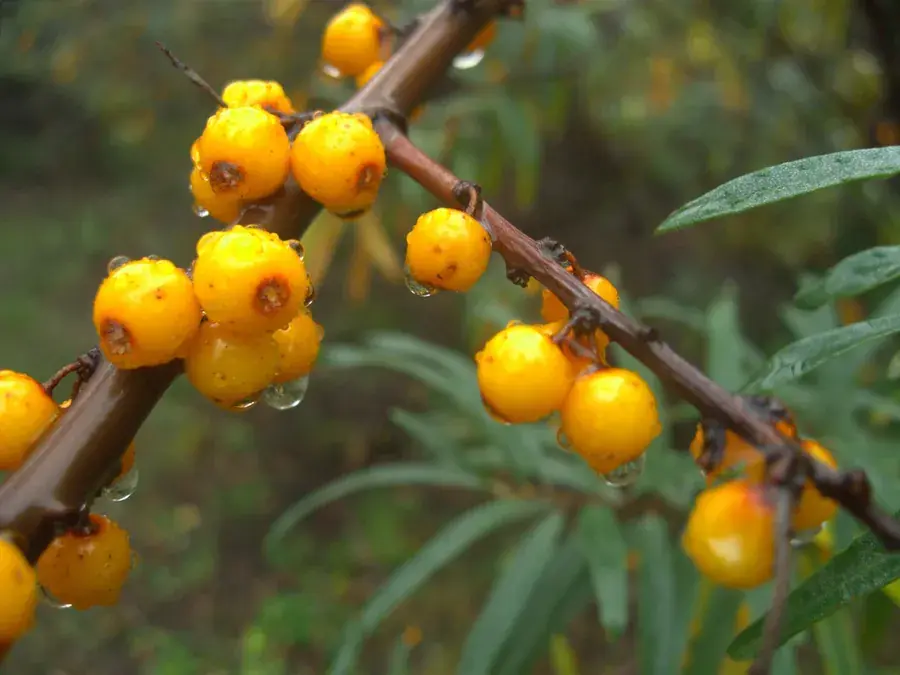 BerryAugust – October
Sea buckthorn
Hippophae rhamnoides
A thorny shrub with narrow, silvery-grey, willow-like leaves and branches packed with bright orange berries 6–8 mm (¼ in) across, from late summer into winter. Only female bushes fruit.
How to know it & its look-alikes →
Checked against these sources ·
Seasons are typical for the middle of the range and move by weeks north and south, and up and down hills.
Educational information only. Never eat a wild plant or mushroom identified from a single photograph or description — confirm with a regional field guide or an experienced forager, and know the poisonous species in your area first.