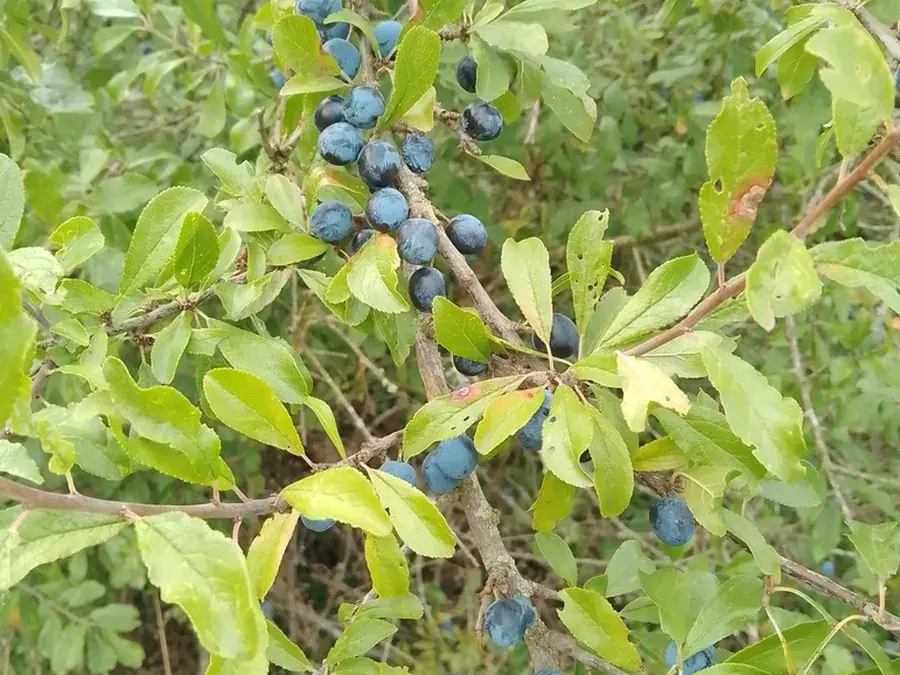
Photo by Public domain (iNaturalist) on iNaturalist · CC0 (public domain)
FruitIn season now (October)
Sloes (blackthorn)
Prunus spinosa
- When
- Typically September – November — September, October, November. Earlier in warm, low country; later in the hills.
- Where it grows
- Hedgerows, scrub, woodland edges and field margins, in dense thickets that spread by suckers.
- How to know it
- A dense, very thorny shrub with dark bark and white blossom on bare black twigs in early spring, before the leaves. In autumn, round blue-black fruits about 1 cm (⅜ in) across with a waxy blue bloom, each holding one stone.
- Look-alikes
- Cherry plum fruits a month or two earlier, with bigger yellow or red plums, and is edible. Buckthorn has black berries with several seeds, not one stone, and is a purgative. Deadly nightshade’s black berries grow on a soft herb, not a thorny shrub.
- Harvest and use
- Sloe gin, and patxaran in Navarre and the Basque Country; also jelly, chutney and wine. Far too astringent to eat raw until frost — or a night in the freezer — softens them.
- Caution
- Like all Prunus stones, sloe stones contain cyanide-releasing compounds: strain them out and never crush them.
Sloes (blackthorn) at a glance
- Also called
- Blackthorn; prunelle (France), Schlehe (Germany), endrina (Spain)
- Family
- Rosaceae (rose family)
- Where it grows
- Native to Europe and western Asia, and locally in north-west Africa — hedgerows, scrub, copses and woodland edges, from Britain and Ireland to the Mediterranean and the Black Sea. Naturalized in parts of eastern North America.
- When to pick
- White blossom in March and April, before the leaves. The sloes ripen in late autumn and are traditionally picked in October or November, after the first frosts have softened the skins; a night in the freezer has the same effect.
- Parts used
- The fruit, steeped in spirit or cooked. In France the young spring shoots flavour épine wine.
- Is any of it poisonous?
- The stone, like all Prunus stones, contains compounds that release hydrogen cyanide. Never crush or eat the stones.
Questions people ask about sloes
When should you pick sloes?
Once they are dull blue-black and slightly soft — in Britain traditionally October or November, after the first frosts. If you pick earlier, freeze them overnight before using them.
Can you eat sloes raw?
You can, but they are so astringent that one is usually enough. Frost or freezing softens them a little; they are really for gin, jelly and wine.
How do you tell blackthorn from hawthorn?
In spring, blackthorn flowers on bare black twigs before its leaves open; hawthorn leafs first and flowers in May. In autumn, blackthorn has blue-black sloes with one stone, and hawthorn has red haws.
Are sloes poisonous to children?
The flesh is not, and it is so sour that children rarely eat many. The stones should never be cracked or chewed, because they hold cyanide-releasing compounds. Make sure it came off a thorny bush: deadly nightshade’s shiny black berries grow on a soft, leafy herb.
Found in these regions
- Atlantic Europe
- Continental Europe
- Alps, Pyrenees & Carpathians
- Mediterranean Europe
- Pannonian Basin & Eastern Plains
Hardiness zones 4–8.
Is it ready near you?
Get this week's foraging guide for your area
Enter a town, postal code or ZIP and we'll tell you what's in season right there this week — from your local climate, this week's weather and your ecological region.
Also ready in October
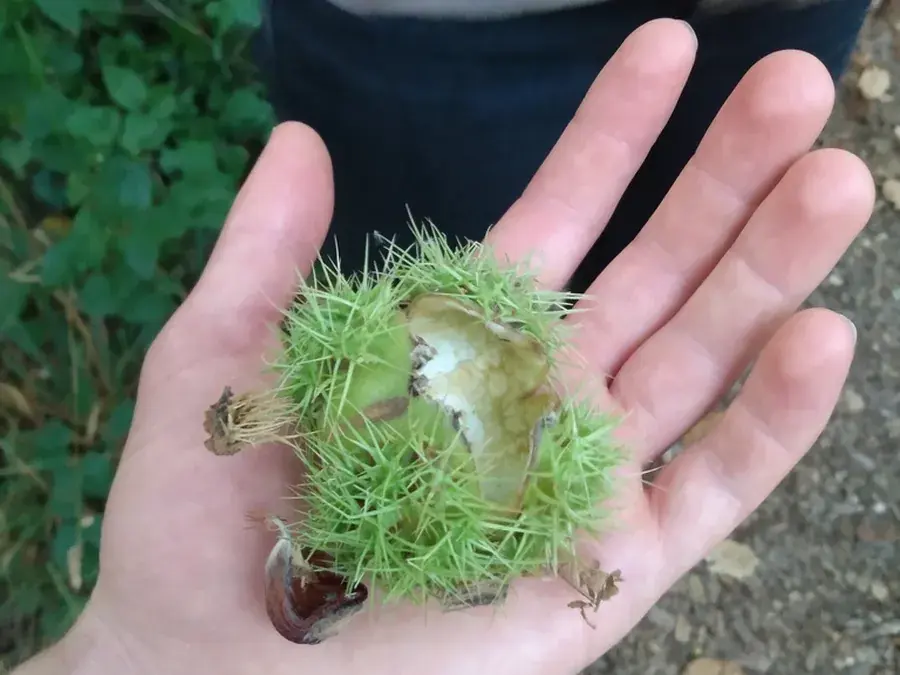 NutOctober – November
Sweet chestnut
Castanea sativa
A big tree with long, glossy leaves edged with sharp, regular teeth, and bark that twists in spiralling ridges on old trunks. The nuts come in twos and threes inside a husk covered in dense, needle-sharp spines; each is glossy brown, flat on one side, with a pointed tuft at the tip.
How to know it & its look-alikes →Photo: John Powers · CC BY 4.0
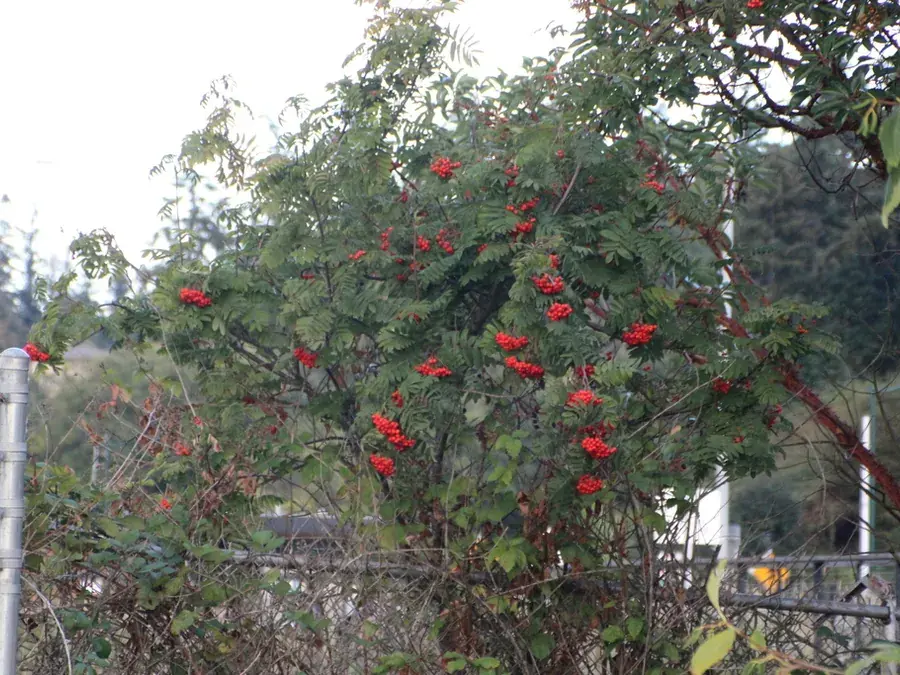 BerryAugust – October
Rowan berries
Sorbus aucuparia
A slim tree with smooth silvery-grey bark and feathery leaves of many toothed leaflets in pairs; big flat clusters of scarlet-orange berries, each about 1 cm (⅜ in) across with a tiny black five-pointed star at the tip.
How to know it & its look-alikes →Photo: Therese Phillips · CC BY 4.0
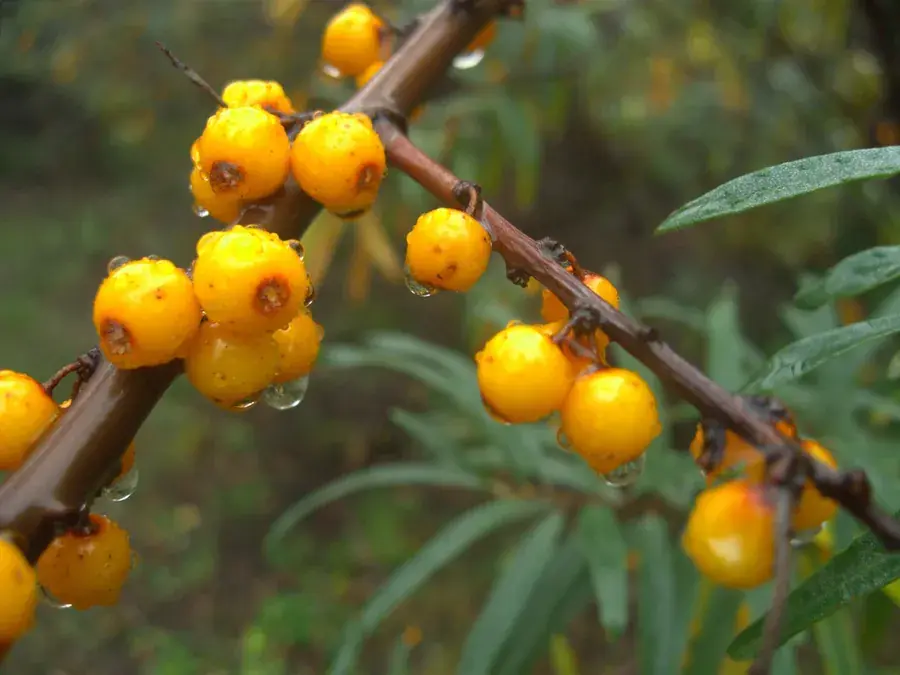 BerryAugust – October
Sea buckthorn
Hippophae rhamnoides
A thorny shrub with narrow, silvery-grey, willow-like leaves and branches packed with bright orange berries 6–8 mm (¼ in) across, from late summer into winter. Only female bushes fruit.
How to know it & its look-alikes →
Checked against these sources ·
Seasons are typical for the middle of the range and move by weeks north and south, and up and down hills.
Educational information only. Never eat a wild plant or mushroom identified from a single photograph or description — confirm with a regional field guide or an experienced forager, and know the poisonous species in your area first.