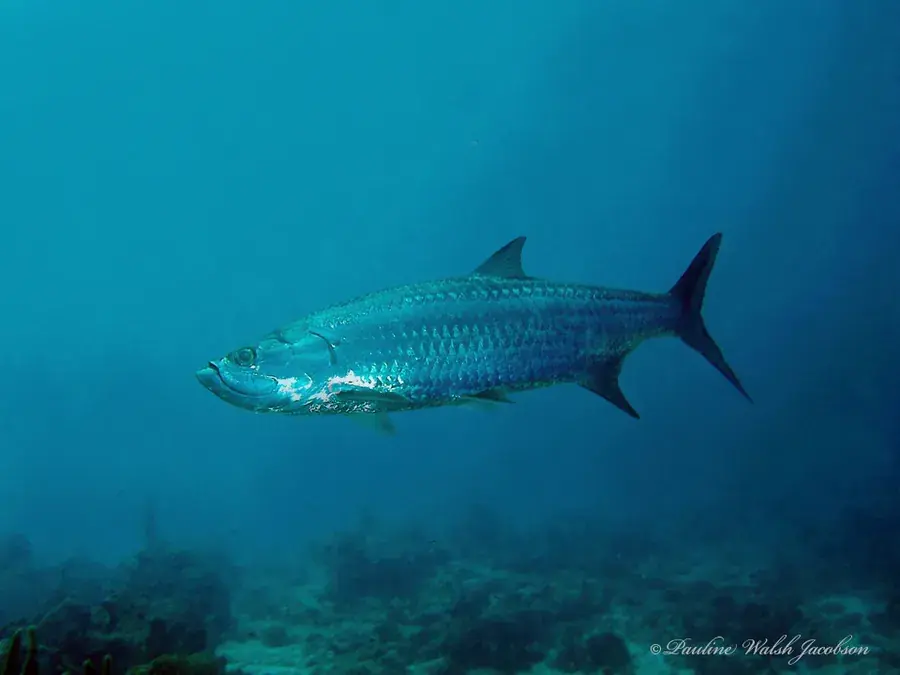
Photo by Pauline Walsh Jacobson on iNaturalist · CC BY 4.0
Atlantic tarpon
Megalops atlanticus
- When
- Active all year; habitat and behaviour shift with the season.
- Habitat
- Estuaries, lagoons, river mouths, mangrove creeks and passes — in Florida the Keys and Boca Grande Pass; in West Africa from Senegal to Angola, with famous fisheries in the Bijagós Islands of Guinea-Bissau and at Port-Gentil in Gabon.
- Identification
- A huge, deep silver fish with very large, armour-like scales, a big upturned mouth with a long bony plate in the lower jaw, and a last dorsal ray drawn out into a long filament that nearly reaches the tail.
- Notes
- The silver king: famous for leaping clear of the water when hooked. It can gulp air into its swim bladder and so thrives in warm, oxygen-poor water. In West Africa the season runs through the dry months, about October to May; in Florida it is fished all year, and Boca Grande Pass carries extra gear rules from April to June.
- Method
- Live mullet or crab drifted through a pass or river mouth on a circle hook; a big baitfish fly cast to rolling fish.
- Caution
- Florida is catch-and-release only: tarpon of 40 in (102 cm) or more must stay in the water, and one may be kept only with a tarpon tag in pursuit of a record. West African rules vary — release them.
Seasons, size limits and catch limits change every year and differ by water body. Check the current regulations for the local jurisdiction and the water before fishing.
Atlantic tarpon facts
- Also called
- Tarpon, silver king.
- Family
- Megalopidae, the tarpons.
- Native range
- The Atlantic: from Nova Scotia and Bermuda through the Gulf of Mexico and the Caribbean to Brazil, and from Mauritania to Angola; stray fish have reached Portugal, the Azores and south-western France.
- Habitat
- Coastal water, bays, estuaries, mangrove lagoons and rivers, usually shallower than 15 m (50 ft); it often enters fresh water, and a few populations complete their lives there.
- Water temperature
- Tropical and subtropical. AquaMaps puts its preferred surface water at about 22–28°C (72–82°F); FishBase records a tolerance of 10–40°C.
- Size
- Most adults 90–180 cm (35–71 in); the largest measured about 250 cm (98 in).
- Record
- IGFA all-tackle world record: 129.98 kg (286 lb 9 oz), Max Domecq, Rubane, Guinea-Bissau, 20 March 2003.
- Lifespan
- Up to 55 years.
- What it eats
- Shoaling fish — sardines, anchovies, mullet, snook and cichlids — and crabs and shrimp.
- Spawning
- At sea. Females are enormously fertile: a 2 m fish is estimated to carry over 12 million eggs. The transparent, ribbon-like larvae drift into estuaries.
- Young fish
- The larvae drift into estuaries, and young tarpon grow up in estuaries and lagoons, where breathing air lets them cope with oxygen-poor water.
- Teeth and mouth
- A large, upturned mouth with fine teeth and a long bony plate on the throat.
- Look-alikes
- Ladyfish (Elops species) are slimmer and silvery, with much smaller scales — more than 100 along the lateral line in the American ladyfish — and no long trailing dorsal ray.
- Eating
- Bony and generally thought poor in the United States, where it is almost always released, but eaten fresh or salted in parts of its range. Ciguatera has been reported.
- Status
- Vulnerable on the IUCN Red List (2018).
Interactive
Atlantic tarpon: size range
Move the slider from a typical adult to the largest recorded specimen, shown against objects of known size.
Most adults you'll catch: 90–180 cm (35–71 in).
This atlantic tarpon: 135 cm. Longer than a four-year-old, shorter than a canoe paddle.
The record
IGFA all-tackle world record: 129.98 kg (286 lb 9 oz), Max Domecq, Rubane, Guinea-Bissau, 20 March 2003.
Questions people ask about atlantic tarpon
Can you keep a tarpon in Florida?
Only to claim a record. Florida’s tarpon fishery is catch-and-release; one tarpon tag per person per year may be bought when pursuing a state or world record. Fish of 40 in (102 cm) or more must stay in the water otherwise.
Where was the biggest tarpon caught?
In West Africa. The IGFA all-tackle world record, 129.98 kg (286 lb 9 oz), came from Rubane in Guinea-Bissau’s Bijagós Islands in 2003.
When is tarpon season in West Africa?
Through the dry season. Outfitters in Guinea-Bissau fish from about November to May, with a peak from March to May; at Port-Gentil in Gabon the season runs from October to May.
How do tarpon breathe air?
Their swim bladder connects to the gut and works like a primitive lung: tarpon roll at the surface to gulp air, which lets them live in warm, oxygen-poor lagoons and creeks.
Found in these regions
Checked against these sources ·
- FishBase — Megalops atlanticus
- Wikipedia — Atlantic tarpon
- Florida Fish and Wildlife Conservation Commission — Tarpon
- Fishing World Guide — Guinea-Bissau
- Frontiers Travel — Port-Gentil tarpon experience
- IGFA — World Records search
Sizes, records and ranges are for the species as a whole; local populations and rules vary. Records change; the record-keeper named above holds the current one.
Local activity
This week's guide for a place
Enter a town, postal code or ZIP for this week's conditions there, based on the local climate, this week's weather and the ecological region.
Also active in October
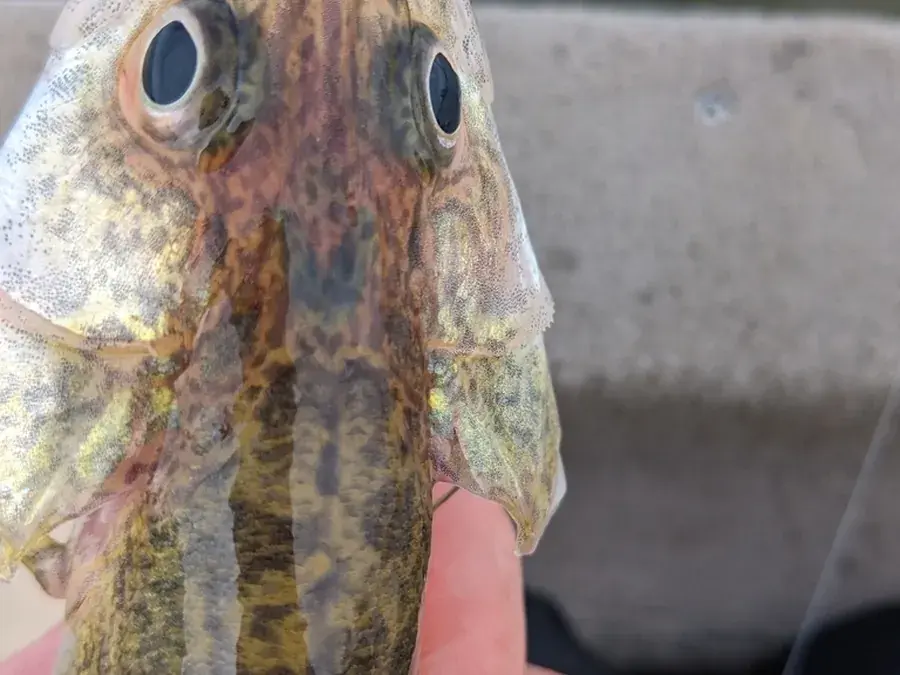 FishYear-round
Walleye
Sander vitreus
Olive-gold flanks, a spiny first dorsal, and the big glassy eye that gives it the name and lets it hunt in low light.
Habitat and methods →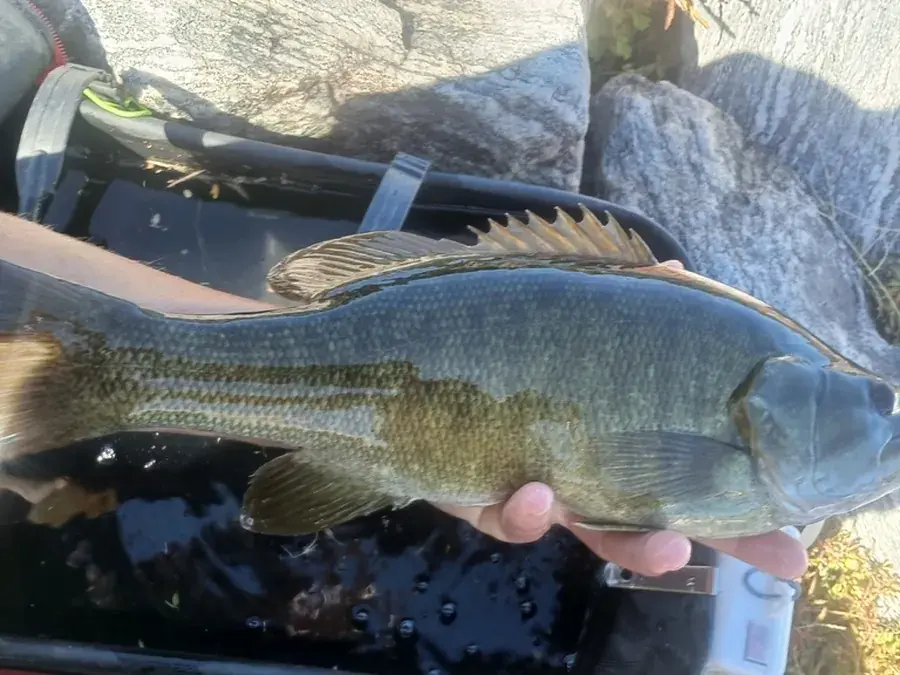 FishMay–Oct
Smallmouth bass
Micropterus dolomieu
Bronze-brown with vertical bars, red eye, and a jaw that ends level with the eye — not past it.
Habitat and methods →Photo: Joshua Johnson · CC BY 4.0
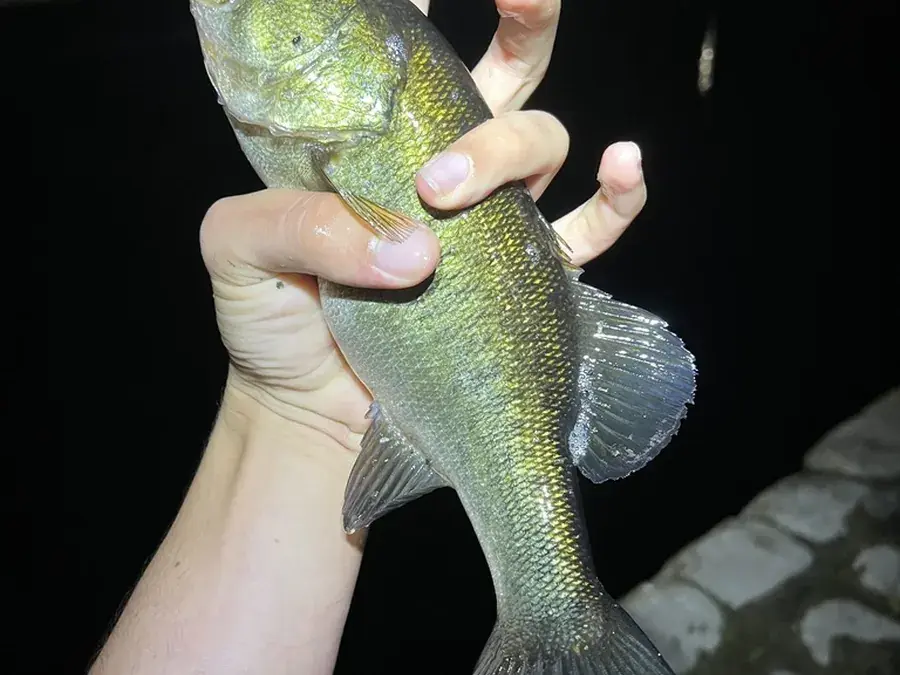 FishApr–Oct
Largemouth bass
Micropterus nigricans
Green with a dark lateral stripe, and an upper jaw that extends past the back of the eye.
Habitat and methods →Photo: Nick Tobler (Cowturtle) · CC BY 4.0