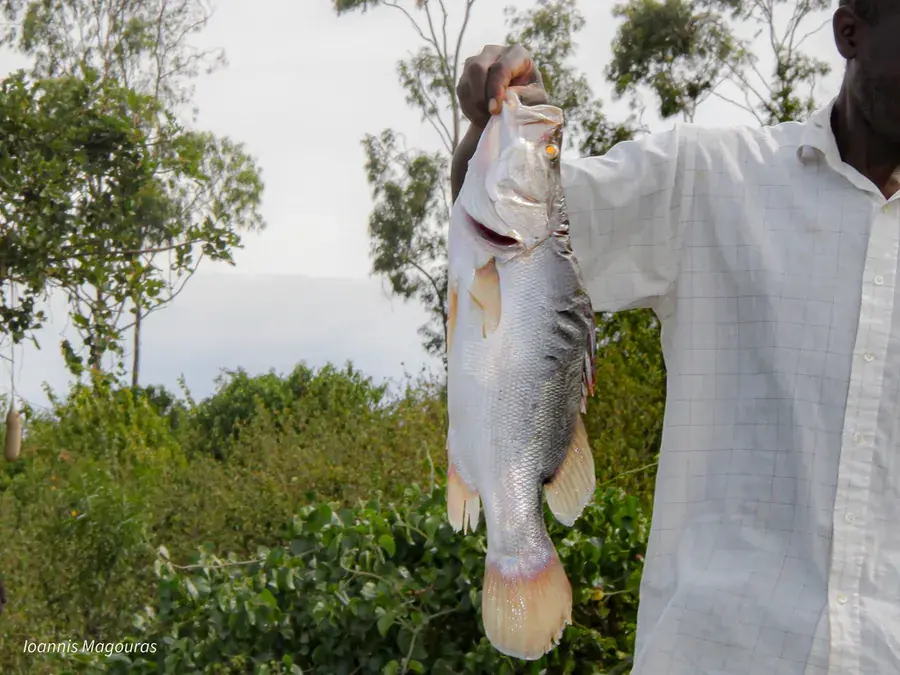
Photo by Ioannis Magouras on iNaturalist · CC BY 4.0
Nile perch
Lates niloticus
- When
- Active all year, though the way you fish or find it changes with the season.
- Where it holds
- Big lakes and rivers — Lake Nasser, Lakes Victoria, Albert and Turkana, the Nile below Murchison Falls, and the Niger, Volta and Senegal. Big fish hold deep on drop-offs and rocky points; young ones stay in the shallows.
- How to know it
- A huge silver perch with a blue sheen, a dorsal fin cut deeply into spiny and soft halves, a rounded tail, and a dark eye ringed in bright yellow.
- What to know
- One of the biggest freshwater fish on Earth — rod-caught fish over 100 kg have come from Lake Nasser. Native to the Nile and West Africa’s big rivers; put into Lake Victoria in the 1950s, where it is blamed for the loss of hundreds of native cichlids and now supports a huge export fishery.
- The tactic
- Troll or cast big deep-diving plugs along drop-offs and rocky points at first light, on heavy tackle.
- Caution
- Nile crocodiles live in Lake Nasser and along the Nile, and hippos crowd the Victoria Nile below Murchison Falls — fish with a local guide and keep back from the water’s edge, especially at dusk.
Seasons, size limits and catch limits change every year and differ by water body. Check the current regulations for the country and the water before you fish.
Nile perch facts
- Also called
- Capitaine in French-speaking Africa; mbuta or mputa (Luo) and sangara in Tanzania; also African snook and African barramundi. ‘Victoria perch’ is a trade name — and a misleading one, since the fish is not native to Lake Victoria.
- Family
- Latidae, the lates perches — a close cousin of the barramundi of Asia and Australia.
- Native range
- The Nile–Sudan region of Africa: the Nile, Lake Chad, and the Niger, Volta and Senegal basins, plus the Congo basin and Lakes Albert and Turkana. Lake Nasser, behind the Aswan High Dam, holds Nile perch from the river itself.
- Introduced to
- Released into Lake Victoria and Uganda’s Lake Kyoga in the 1950s, and it now dominates both. It is listed among the world’s 100 worst invasive species, and the United States lists it as injurious wildlife.
- Habitat
- Lakes, river channels and even irrigation canals. Adults live deep — 10–60 m (33–200 ft) — wherever there is enough oxygen; juveniles stay in shallow water near shore.
- Water temperature
- Warm water only. A tropical fish (FishBase): the lakes and rivers it lives in run roughly 22–30°C (72–86°F).
- Size
- Most adults 50–130 cm (20–51 in); the largest measured about 200 cm (79 in).
- Record
- IGFA all-tackle world record: 104.32 kg (230 lb), William Toth, Lake Nasser, Egypt, 20 December 2000. Nets have taken bigger: FishBase notes a 180 cm, 164 kg fish from Lake Albert, and the species is reported to reach 200 kg.
- Lifespan
- Up to about 16 years in the wild; males tend to die younger than females.
- What it eats
- Fish above all, including its own kind. In Lake Victoria it first ate out the native cichlids and now lives largely on small shrimp and minnows. Juveniles eat zooplankton, then insects and larger crustaceans.
- Spawning
- In Lake Victoria, breeding peaks from March to June. A female sheds 3–15 million small eggs that hatch in about 20 hours, with no parental care. Fish mature at about 3 years and roughly 50–85 cm.
- Young fish
- Juveniles are brownish with paler marbling on the head and sides, and live in the shallows until they grow big enough to move deep.
- Teeth and mouth
- A large, protrusible mouth with a slightly jutting lower jaw and bands of fine, bristle-like teeth — no fangs. The gill cover carries a strong spine and the cheek bones are serrated, so lift big fish with care.
- Look-alikes
- Its own cousins: Lake Turkana and Lake Tanganyika each have smaller endemic Lates species. Outside Africa, the barramundi (Lates calcarifer) is very similar but smaller. Nile tilapia shares its lakes but is a small, deep-bodied, plant-eating cichlid.
- Eating
- A major food and export fish, with firm white fillets shipped from Lake Victoria to Europe. Its flesh is fatty enough that it is smoked locally rather than sun-dried.
- Status
- Least Concern on the IUCN Red List. Heavy and sometimes illegal netting has shrunk the average fish in Lake Victoria.
Try it
How big does a nile perch get?
Slide it from an ordinary adult to the biggest one ever measured, next to things you know the size of.
Most adults you'll catch: 50–130 cm (20–51 in).
This nile perch: 90 cm. Longer than a loaf of bread, shorter than a four-year-old.
The record
IGFA all-tackle world record: 104.32 kg (230 lb), William Toth, Lake Nasser, Egypt, 20 December 2000. Nets have taken bigger: FishBase notes a 180 cm, 164 kg fish from Lake Albert, and the species is reported to reach 200 kg.
Questions people ask about nile perch
How big do Nile perch get?
Up to about 2 m (6 ft 7 in) and 200 kg (440 lb). The IGFA rod-and-reel world record is 104.32 kg (230 lb), from Lake Nasser, Egypt, in 2000, and commercial nets on Lake Albert have landed a 164 kg fish.
Why is the Nile perch in Lake Victoria?
It was released there in the 1950s to create a big commercial and sport fishery. Commercially it worked — Nile perch became a major export — but it is blamed for the extinction or near-extinction of hundreds of the lake’s native cichlid species.
Where can you catch a Nile perch?
Lake Nasser in southern Egypt is the classic trophy water. The Nile below Murchison Falls and Lake Victoria in Uganda, Kenya and Tanzania, Lake Turkana in Kenya, and the big West African rivers — the Niger, Volta and Senegal — all hold them.
Is a Nile perch the same as a tilapia?
No. The Nile perch is a huge predatory lates perch, related to the barramundi. The Nile tilapia is a much smaller, mostly plant-eating cichlid. The two share the Nile and Lake Victoria, and both are important food fish.
Found in these regions
Checked against these sources ·
- FishBase — Lates niloticus
- Animal Diversity Web (University of Michigan) — Lates niloticus
- USDA National Invasive Species Information Center — Nile perch
- IGFA — World Records search
Sizes, records and ranges are for the species as a whole; local fish, and local rules, vary. Records change — the record-keeper named above has the current one.
Is it active near you?
Get this week's guide for your area
Enter a town, postal code or ZIP and we'll tell you what's happening right there this week — from your local climate, this week's weather and your ecological region.
Also active in October
 FishYear-round
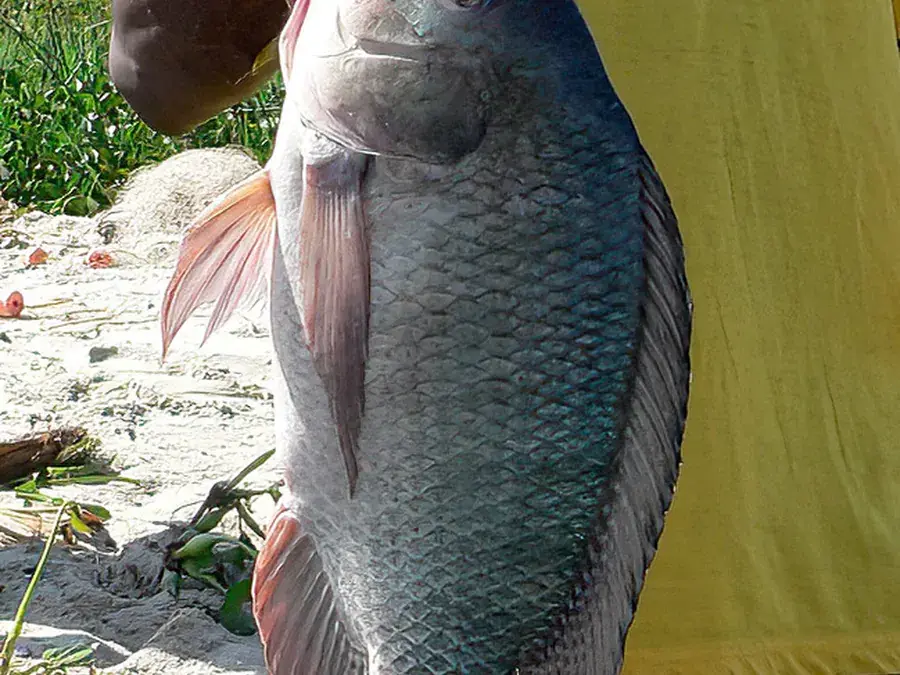
Nile tilapia
Oreochromis niloticus
Deep-bodied and grey-brown with faint bars, and the tell: regular dark vertical stripes right across the tail fin. Breeding males turn reddish, especially on the fins.
Where and how to catch it →Photo: Pål A. Olsvik · CC BY 4.0
 FishSep–Apr
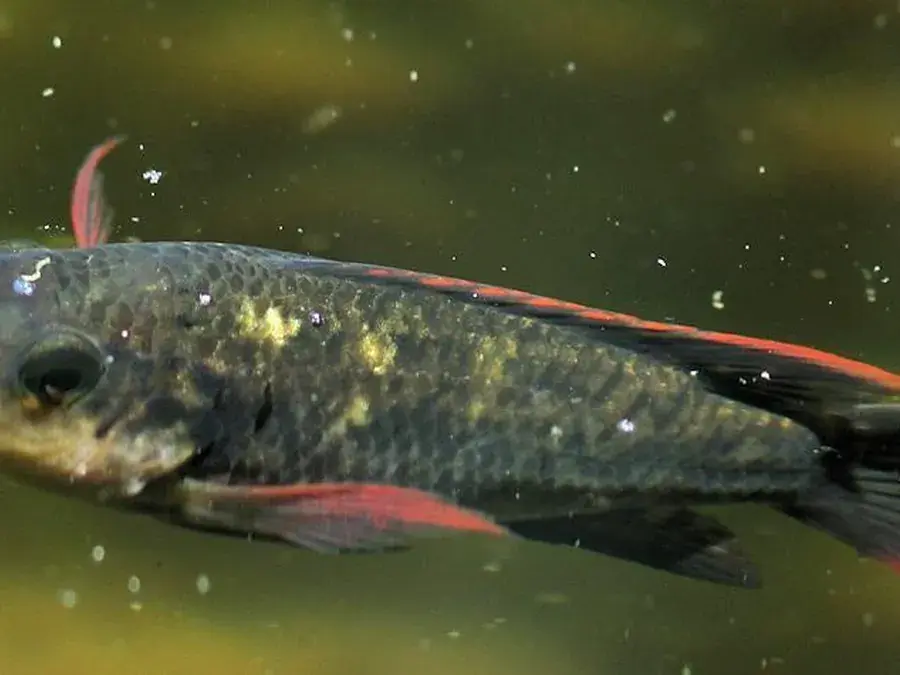
Mozambique tilapia (blue kurper)
Oreochromis mossambicus
Deep-bodied and dull silvery-olive with a few dark blotches along the side and no regular stripes on the tail. Breeding males turn black with a white throat, red-edged fins and a pointed, duck-bill snout.
Where and how to catch it →Photo: Wynand Uys · CC BY 4.0
 FishYear-round
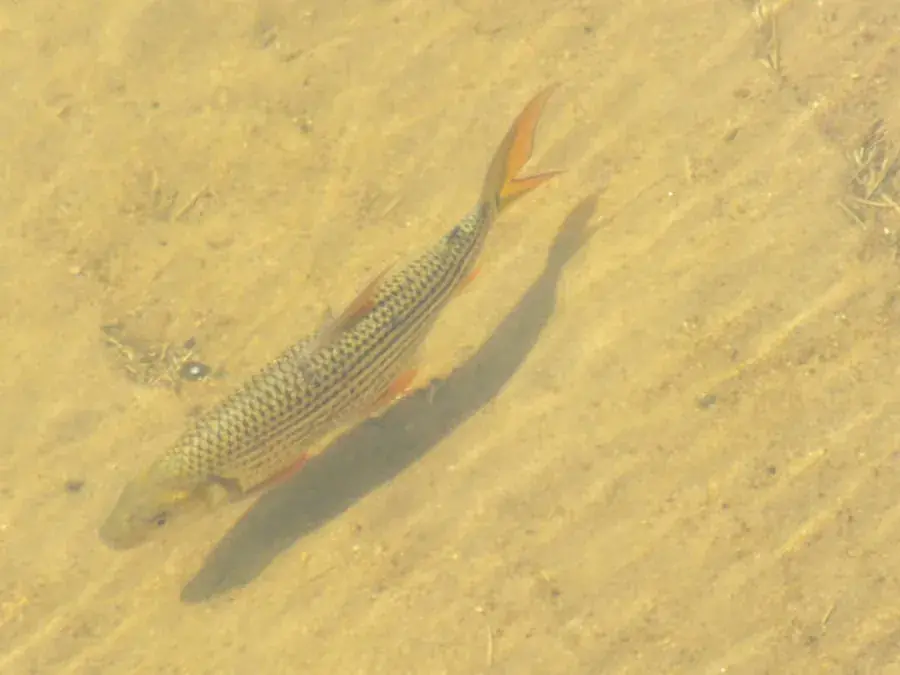
Tigerfish
Hydrocynus vittatus
Silver with dark horizontal stripes along the upper sides, a red-orange tail edged in black, and big fang-like teeth that overlap the jaws even with the mouth shut.
Where and how to catch it →