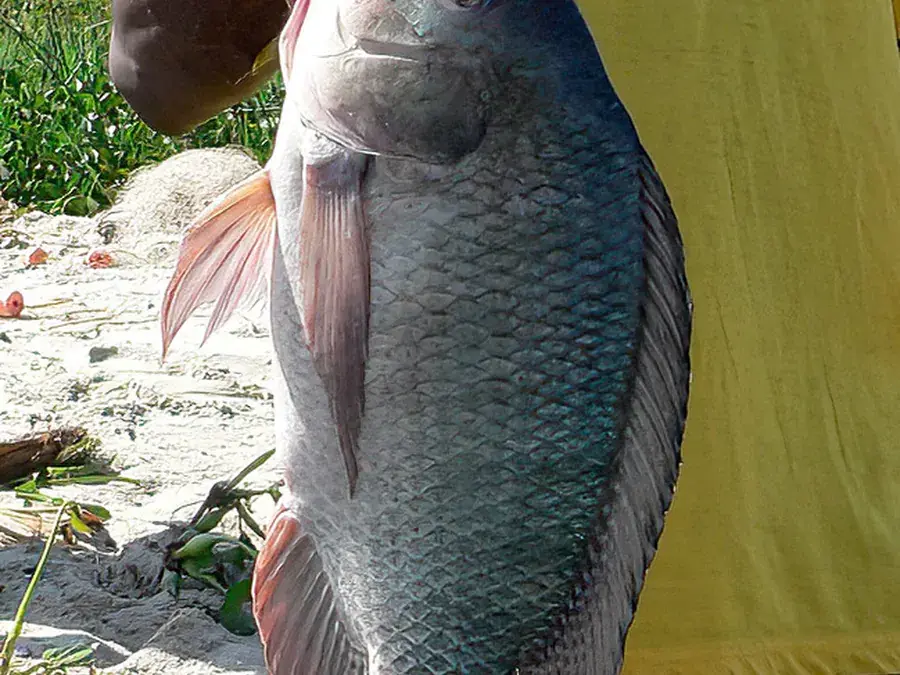
Photo by Pål A. Olsvik on iNaturalist · CC BY 4.0
Nile tilapia
Oreochromis niloticus
- When
- Active all year, though the way you fish or find it changes with the season.
- Where it holds
- Warm, shallow, weedy margins of lakes, rivers, dams and irrigation canals, from the Nile delta to Lake Victoria and — introduced — Lake Kariba.
- How to know it
- Deep-bodied and grey-brown with faint bars, and the tell: regular dark vertical stripes right across the tail fin. Breeding males turn reddish, especially on the fins.
- What to know
- The world’s most important farmed tilapia and a staple food fish from Egypt to Ghana to Uganda; in Zimbabwe and Zambia, tilapias are simply ‘bream’. A grazer, so it bites best on small baits near the bottom or the weed.
- The tactic
- A small hook with a worm or dough bait under a light float, close to the weed; a small nymph on the fly.
- Caution
- Bilharzia (schistosomiasis) is spread by snails in warm, still fresh water across much of Africa — where it occurs, fish from a boat or a dry bank rather than wading, and tell a doctor about the exposure if you feel unwell afterwards.
Seasons, size limits and catch limits change every year and differ by water body. Check the current regulations for the country and the water before you fish.
Nile tilapia facts
- Also called
- Tilapia; bolti (bulti) in Egypt. In Zimbabwe and Zambia anglers call tilapias ‘bream’. Tilapias are sometimes marketed as St. Peter’s fish.
- Family
- Cichlidae, the cichlids.
- Native range
- The Nile basin (including Lakes Albert, Edward and Tana), Lake Kivu, Lake Tanganyika, the Awash and Omo rivers, Lake Turkana and other Ethiopian and Kenyan Rift lakes, and in West Africa the Senegal, Gambia, Volta, Niger, Benue and Chad basins. Also the coastal rivers of Israel.
- Introduced to
- Farmed around the world. Established in Africa outside its range in Lake Victoria, Lake Kariba and the Zambezi, Madagascar, Mauritius and Réunion. South Africa, Malawi and Zambia have banned further stocking because it hybridises with local tilapias.
- Habitat
- Almost any fresh water — rivers, lakes, dams, canals and irrigation channels — from sea level to about 1,830 m (6,000 ft). It copes with brackish water but not full sea water for long.
- Water temperature
- Warm water. FAO gives a preferred range of 31–36°C (88–97°F); it survives about 12–42°C and breeds only once the water reaches about 24°C (75°F).
- Size
- Most adults 20–40 cm (8–16 in); the largest measured about 60 cm (24 in).
- Record
- IGFA all-tackle world record: 6.01 kg (13 lb 3 oz), Sarel van Rooyen, Antelope Island, Lake Kariba, Zimbabwe, 5 July 2002 — from an introduced population.
- Lifespan
- FishBase records 9 years; FAO notes it can live longer than 10.
- What it eats
- Mainly phytoplankton and algae, with detritus, plants and insect larvae; young fish eat more animal food than adults.
- Spawning
- Males dig shallow pits in firm sand. The female takes the eggs into her mouth and carries them, then the fry, for one to two weeks. In warm water it spawns again and again, about every 30 days, and matures in as little as 3–6 months.
- Young fish
- Fry shelter in the mother’s mouth until the yolk is used up; even small fish show the striped tail.
- Teeth and mouth
- A small mouth with fine teeth for grazing algae — no fangs.
- Look-alikes
- Blue tilapia lacks the striped tail and has a red edge to the dorsal fin. Mozambique tilapia has no regular tail stripes, and its breeding males turn black with a pointed snout. Redbreast tilapia (Coptodon rendalli) shows a red-pink chest. Farmed strains and hybrids often cannot be told apart by eye.
- Eating
- Excellent: mild white fillets. It is the most important tilapia in fish farming worldwide.
- Status
- Least Concern on the IUCN Red List. Outside its native range it is invasive, and it threatens other tilapias by hybridising with them.
Try it
How big does a nile tilapia get?
Slide it from an ordinary adult to the biggest one ever measured, next to things you know the size of.
Most adults you'll catch: 20–40 cm (8–16 in).
This nile tilapia: 30 cm. About as long as a loaf of bread.
The record
IGFA all-tackle world record: 6.01 kg (13 lb 3 oz), Sarel van Rooyen, Antelope Island, Lake Kariba, Zimbabwe, 5 July 2002 — from an introduced population.
Questions people ask about nile tilapia
How do you identify a Nile tilapia?
Look at the tail. A Nile tilapia has regular dark vertical stripes running right across the tail fin at every age — the single best tell. It is deep-bodied and grey-brown with faint bars, and breeding males turn reddish, especially on the fins.
How big do Nile tilapia get?
Most are 20–40 cm (8–16 in). They can reach about 60 cm (24 in) and more than 5 kg (11 lb). The IGFA world record is 6.01 kg (13 lb 3 oz), from Lake Kariba, Zimbabwe, in 2002.
Is it safe to wade where tilapia live?
Not everywhere. In much of Africa the warm, still, weedy water tilapia love can carry bilharzia (schistosomiasis), a parasite spread by freshwater snails that gets in through the skin. Where it occurs, fish from a boat, jetty or dry bank, and tell a doctor about the exposure if you feel unwell after a trip.
Why have some countries banned stocking Nile tilapia?
Because it hybridises with local tilapias and outcompetes them. South Africa, Malawi and Zambia have banned further stocking; in the Zambezi and Limpopo it is already hybridising with the native Mozambique tilapia.
Found in these regions
Checked against these sources ·
- FishBase — Oreochromis niloticus
- FAO Cultured Aquatic Species — Nile tilapia
- Wikipedia — Nile tilapia
- World Health Organization — Schistosomiasis fact sheet
Sizes, records and ranges are for the species as a whole; local fish, and local rules, vary. Records change — the record-keeper named above has the current one.
Is it active near you?
Get this week's guide for your area
Enter a town, postal code or ZIP and we'll tell you what's happening right there this week — from your local climate, this week's weather and your ecological region.
Also active in October
 FishYear-round
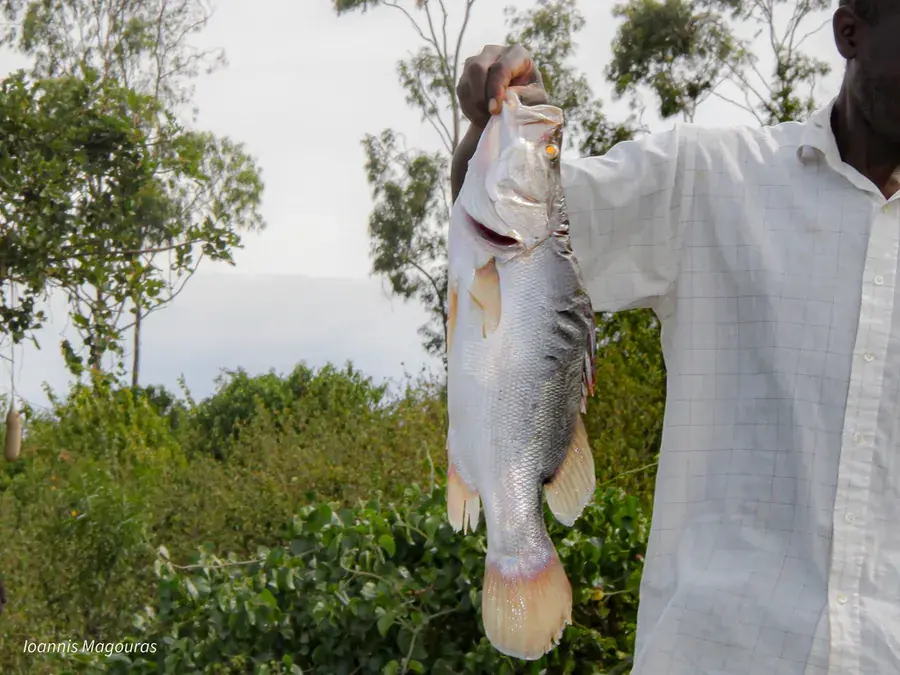
Nile perch
Lates niloticus
A huge silver perch with a blue sheen, a dorsal fin cut deeply into spiny and soft halves, a rounded tail, and a dark eye ringed in bright yellow.
Where and how to catch it →Photo: Ioannis Magouras · CC BY 4.0
 FishSep–Apr
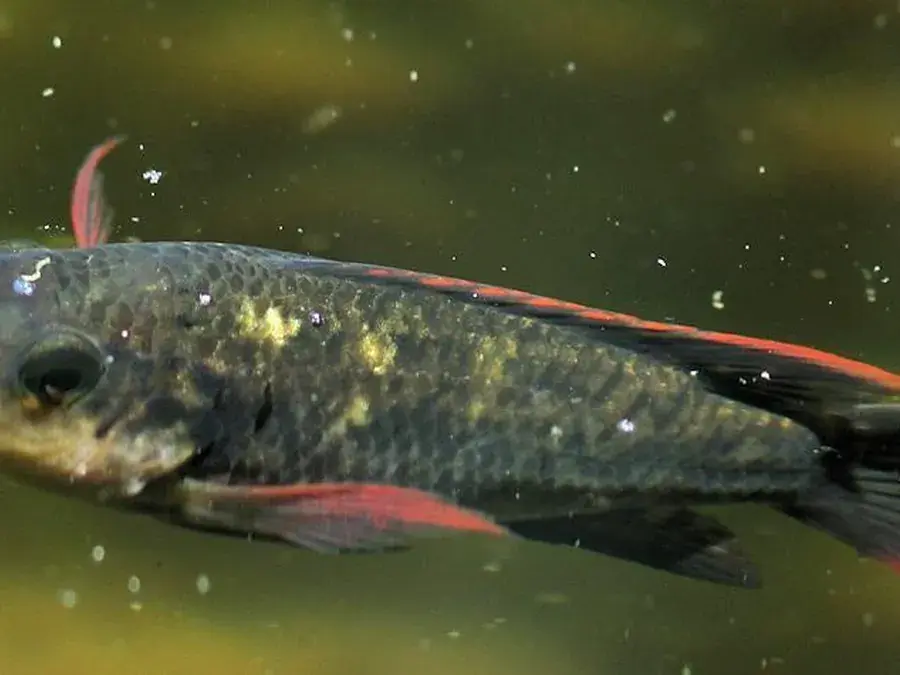
Mozambique tilapia (blue kurper)
Oreochromis mossambicus
Deep-bodied and dull silvery-olive with a few dark blotches along the side and no regular stripes on the tail. Breeding males turn black with a white throat, red-edged fins and a pointed, duck-bill snout.
Where and how to catch it →Photo: Wynand Uys · CC BY 4.0
 FishYear-round
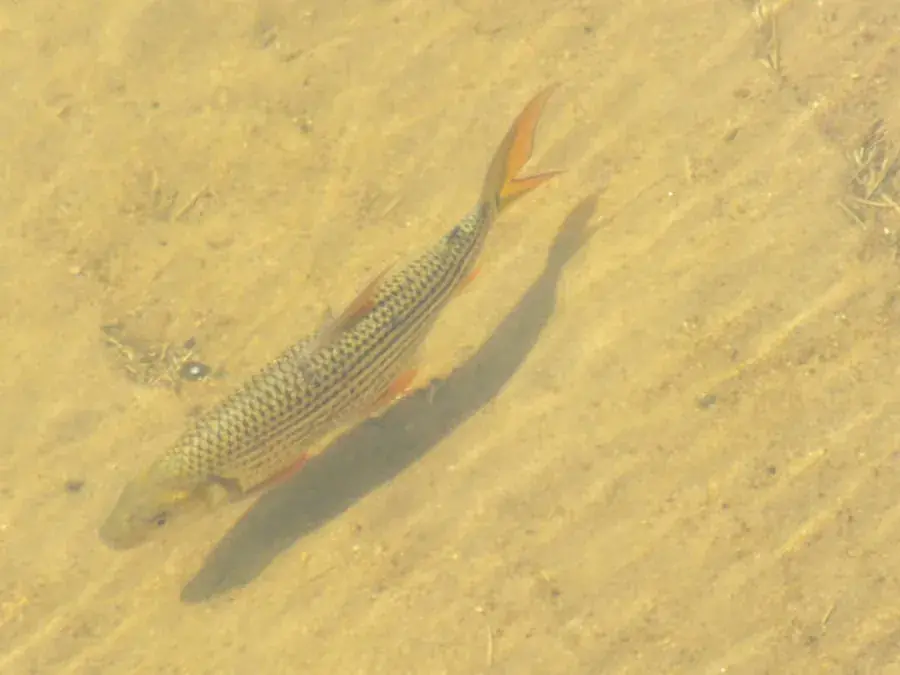
Tigerfish
Hydrocynus vittatus
Silver with dark horizontal stripes along the upper sides, a red-orange tail edged in black, and big fang-like teeth that overlap the jaws even with the mouth shut.
Where and how to catch it →