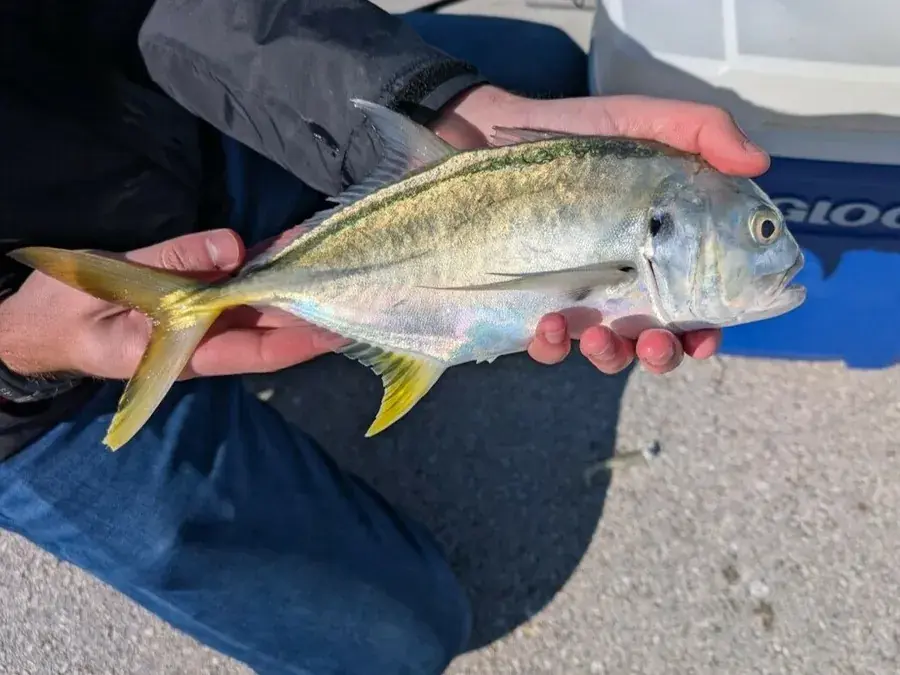
Photo by Public domain (iNaturalist) on iNaturalist · CC0 (public domain)
Crevalle jack (jack crevalle)
Caranx hippos
- When
- Active all year; habitat and behaviour shift with the season.
- Habitat
- River mouths, lagoon inlets, channels, surf beaches, harbour walls and rocky points wherever baitfish shoal — along West Africa from Senegal to Angola, with the Bijagós Islands, Sierra Leone and the Gulf of Guinea among the best ground, and in the Americas from the Carolinas round Florida to Texas. Young fish fill the lagoons and estuaries.
- Identification
- A deep, heavy jack with a steep, blunt head, olive to blue-green above and silvery to brassy below, a black spot on the edge of the gill cover, another at the base of the pectoral fin and a row of hard scutes along the rear of the lateral line. The chest is bare except for a small patch of scales in front of the pelvic fins, and the anal-fin lobe and the underside of the tail stalk are yellow.
- Notes
- A schooling hunter that pins sardines and anchovies against the surface and grunts when it is landed. In the Gulf of Guinea big shoals move inshore from about September to December, and young fish live in the lagoons all year until they head to sea at about 12 cm. West Africa grows the biggest crevalle jacks: the IGFA world record came from Angola.
- Method
- Poppers, stickbaits, metal jigs or a live mullet worked fast where birds and bait show at a river mouth or along the surf, on strong line with a heavy leader — it fights long and deep.
- Caution
- Ciguatera has been reported from crevalle jack — ask locally before eating a big one from tropical reefs. West African rules vary — ask locally. In the United States each state sets its own limits; check before you keep one.
Seasons, size limits and catch limits change every year and differ by water body. Check the current regulations for the local jurisdiction and the water before fishing.
Crevalle jack (jack crevalle) facts
- Also called
- Jack crevalle, common jack, couvalli jack, black cavalli or crevalle; carangue crevalle in French. West African catch statistics lump it with the longfin crevalle jack.
- Family
- Carangidae, the jacks and pompanos.
- Native range
- Both sides of the Atlantic, mostly over the continental shelf. In the west from Nova Scotia (only as rare strays) and Massachusetts, where it is a regular summer visitor, through the Gulf of Mexico and the Greater Antilles to Uruguay; in the east from Mauritania to Angola. Old Mediterranean and Canary Islands records were other jacks.
- Habitat
- Coastal water from the shoreline and shallow flats out to about 350 m (1,150 ft), usually less than 200 m; adults run up rivers. Juveniles crowd into brackish estuaries, lagoons and mangroves over mud, near sandy beaches and on seagrass beds.
- Water temperature
- Tropical to subtropical. AquaMaps puts its preferred surface water at about 20–28°C (67–82°F). It cannot survive the winter north of Cape Hatteras, and water below about 9°C (48°F) kills it.
- Size
- Most adults 40–90 cm (16–35 in); the largest measured about 129 cm (51 in).
- Record
- IGFA all-tackle world record: 30 kg (66 lb 2 oz), Carlos Alberto Leal Simoes, Barra do Dande, Angola, 1 June 2010.
- Lifespan
- At least 20 years: Gulf of Mexico fish have been aged to 20 from their otoliths.
- What it eats
- Mostly fish — in the Gulf of Guinea, anchovies and sardines above all — with shrimps, crabs and squid. Young West African fish eat small fish and juvenile shrimps, which can make up half or more of their diet in the dry season.
- Spawning
- Offshore or over inshore reefs, in big pre-spawning schools, with pelagic eggs. In Ghana spawning runs over a long season with a peak from about October to January; off southern Florida it runs from about March to September. Males mature at about 55 cm and four to five years, females at about 66 cm and five to six years.
- Young fish
- Young fish live in West African lagoons all year — in Ghana’s Keta lagoon in every month — and return to the sea at about 12 cm. On the US coast young-of-the-year reach estuaries as far north as New York in summer and must move south before winter.
- Teeth and mouth
- A large mouth reaching to below the back of the eye, with an outer row of strong teeth and enlarged canines at the tip of the lower jaw.
- Look-alikes
- Longfin crevalle jack (Caranx fischeri), described from West Africa in 2007, shares its coast: it has more dorsal and anal rays, longer fin lobes and an anal-fin lobe that is white at the front, where the crevalle jack’s is lemon yellow. Horse-eye jack (Caranx latus) has a fully scaled chest.
- Eating
- Edible but coarse, dark and strong-tasting; small fish bled at once are best. It is sold fresh, frozen, salted and smoked, and West Africa’s beach-seine catches once supported a large dried-fish trade. Ciguatera has been reported.
- Status
- Least Concern on the IUCN Red List (2018). West African landings, which combine it with the longfin crevalle jack, topped 15,000 t a year in Ghana and Angola in some years of the 1950s to 1970s; such catches no longer occur.
Interactive
Crevalle jack: size range
Move the slider from a typical adult to the largest recorded specimen, shown against objects of known size.
Most adults you'll catch: 40–90 cm (16–35 in).
This crevalle jack (jack crevalle): 65 cm. Longer than a loaf of bread, shorter than a four-year-old.
The record
IGFA all-tackle world record: 30 kg (66 lb 2 oz), Carlos Alberto Leal Simoes, Barra do Dande, Angola, 1 June 2010.
Questions people ask about crevalle jack
What is the world record crevalle jack?
30 kg (66 lb 2 oz), caught at Barra do Dande, Angola, in June 2010, according to the IGFA. West Africa grows the biggest crevalle jacks: the previous record, 26.5 kg (58 lb 6 oz), came from Barra do Kwanza, also in Angola, in 2000.
Is crevalle jack good to eat?
Edible, but not highly rated: the flesh is dark, coarse and strong-tasting. Choose a smaller fish, bleed it as soon as it is landed and eat it fresh or smoked. Ciguatera has been reported, so ask locally before eating a big one from tropical reefs.
How do you tell a crevalle jack from a longfin crevalle jack?
Look at the anal fin. The crevalle jack’s anal-fin lobe is lemon yellow and the underside of its tail stalk is yellow too; the longfin crevalle jack’s anal lobe is white at the front and its fin lobes are longer. Both live in West Africa and were treated as one species until 2007.
When are crevalle jacks inshore in West Africa?
They are caught all year, but big shoals move inshore from about September to December: in Ghana spawning peaks from October to January, and in Nigeria the fish arrive from September to November.
Found in these regions
Checked against these sources ·
- FishBase — Caranx hippos
- Smith-Vaniz and Carpenter, Review of the crevalle jacks, Caranx hippos complex — Fishery Bulletin 105(2) (2007)
- Jefferson et al., Age, growth and diet of crevalle jack in the Gulf of Mexico — Fisheries Management and Ecology 29(5) (2022)
- Florida Museum — Crevalle jack
- Wikipedia — Crevalle jack
- Wikipedia — Longfin crevalle jack
- IGFA — World Records search
Sizes, records and ranges are for the species as a whole; local populations and rules vary. Records change; the record-keeper named above holds the current one.
Local activity
This week's guide for a place
Enter a town, postal code or ZIP for this week's conditions there, based on the local climate, this week's weather and the ecological region.
Also active in October
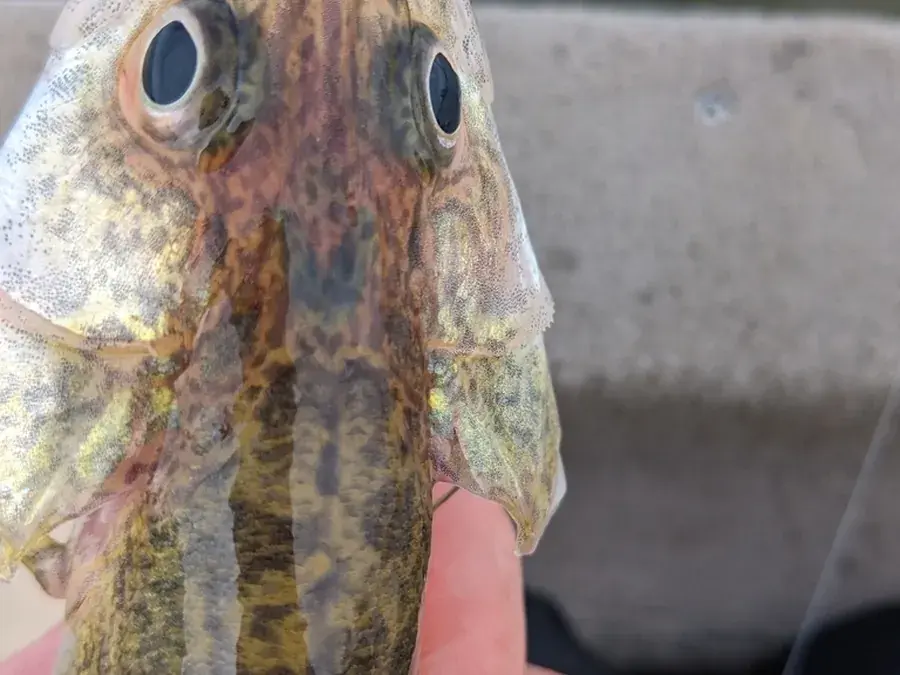 FishYear-round
Walleye
Sander vitreus
Olive-gold flanks, a spiny first dorsal, and the big glassy eye that gives it the name and lets it hunt in low light.
Habitat and methods →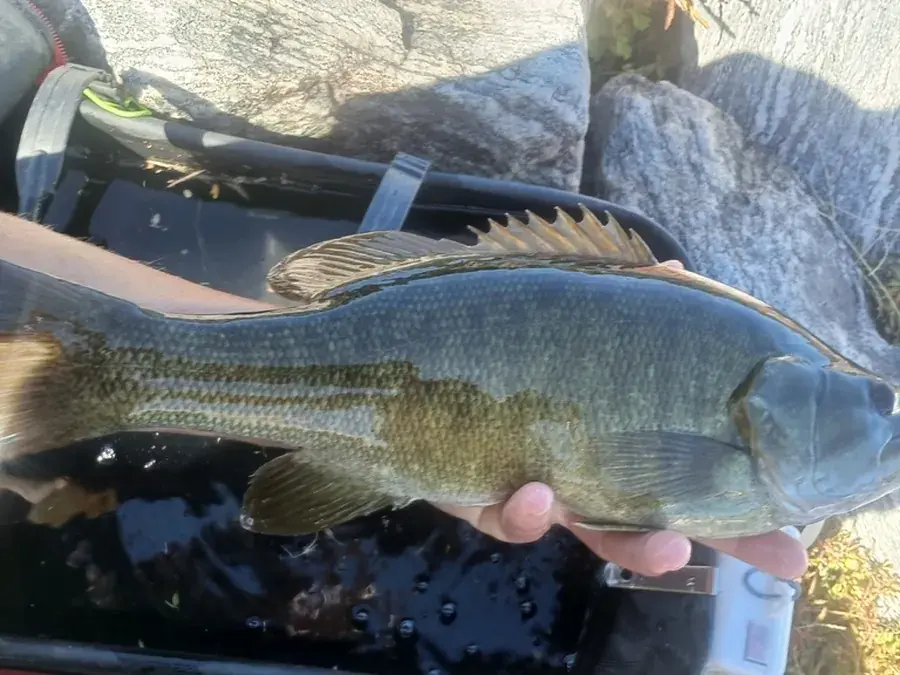 FishMay–Oct
Smallmouth bass
Micropterus dolomieu
Bronze-brown with vertical bars, red eye, and a jaw that ends level with the eye — not past it.
Habitat and methods →Photo: Joshua Johnson · CC BY 4.0
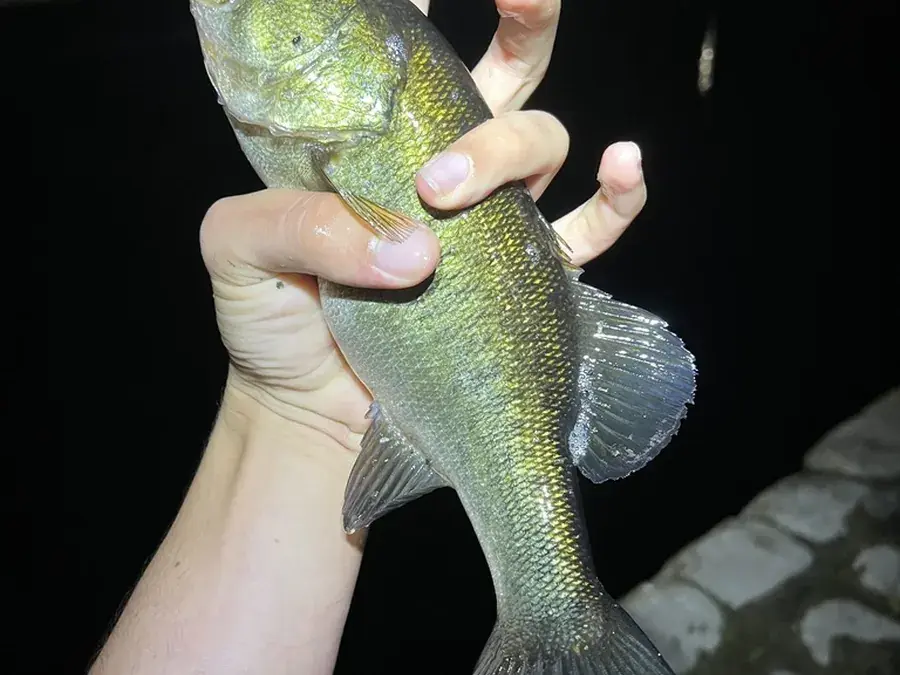 FishApr–Oct
Largemouth bass
Micropterus nigricans
Green with a dark lateral stripe, and an upper jaw that extends past the back of the eye.
Habitat and methods →Photo: Nick Tobler (Cowturtle) · CC BY 4.0