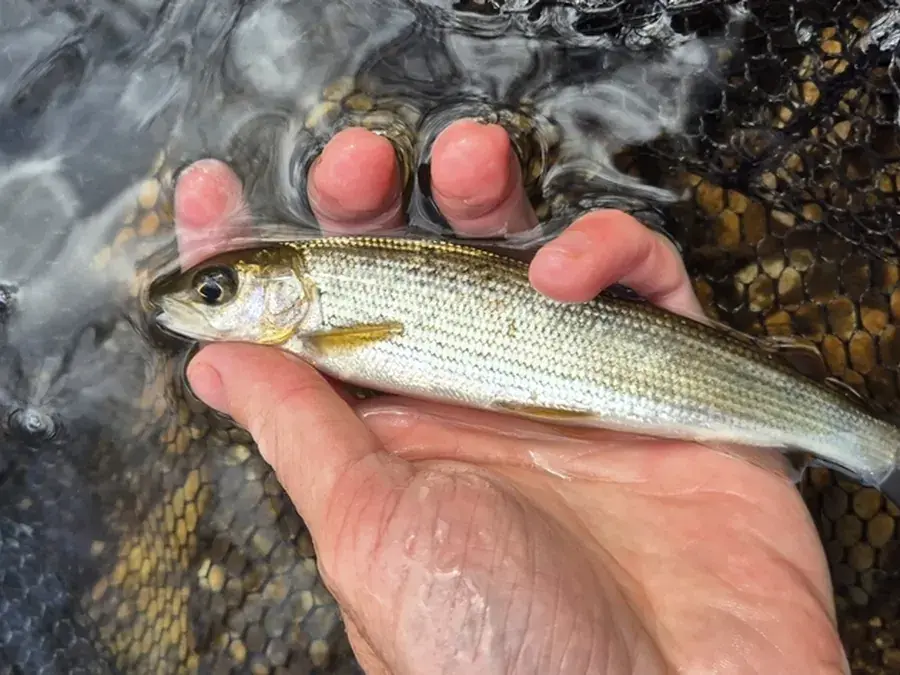
Photo by Justin Schoon on iNaturalist · CC BY 4.0
European grayling
Thymallus thymallus
- When
- Jun–Feb — January, February, June, July, August, September, October, November, December. Earlier where the water warms first.
- Where it holds
- Cold, clear, fast rivers over clean gravel — shoals hold in steady runs and pool tails; also clear lakes in Scandinavia.
- How to know it
- A tall, sail-like dorsal fin flecked with purple and red, silver-grey flanks with scattered dark spots, and a small mouth set low.
- What to know
- The 'lady of the stream'. It gives sport on the fly through autumn and winter, long after the trout season has closed.
- The tactic
- Small weighted nymphs bumped along the bottom; tiny dry flies on summer evenings.
- Caution
- Grayling spawn in spring and are protected then — in England and Wales the river season runs 16 June to 14 March. Very sensitive to pollution: handle gently and release quickly.
Seasons, size limits and catch limits change every year and differ by water body. Check the current regulations for the country and the water before you fish.
European grayling facts
- Also called
- Grayling, common grayling, 'the lady of the stream'; ombre in French, Äsche in German, temolo in Italian, harr in Swedish, harjus in Finnish. The genus name Thymallus refers to a faint smell of thyme said to hang on a fresh fish.
- Family
- Salmonidae — a member of the salmon and trout family, with the small adipose fin to show it.
- Native range
- Europe from England, Wales and France (west to the Loire, and the Rhône) east to the Urals: the North Sea, Baltic, White Sea, Black Sea and Caspian basins, and the northern Adriatic basin east to the Soča. Absent from Ireland and the south of Europe.
- Introduced to
- Scotland and much of southern and central Finland. It was put into Morocco in 1948 but seems not to have become established.
- Habitat
- Cold, clean, well-oxygenated, fast rivers with gravel or stone bottoms, holding in hollows behind boulders and shaded water. In Scandinavia it also lives in clear lakes and the low-salt northern Baltic.
- Water temperature
- Cold water; FishBase gives about 6–18°C (43–64°F). It spawns in spring on shallow gravel.
- Size
- Most adults 25–40 cm (10–16 in); the largest measured about 60 cm (24 in).
- Record
- IGFA all-tackle world record: 2.18 kg (4 lb 12 oz), Adriano Gargantini, the Drava at Steinfeld, Austria, 2009.
- Lifespan
- Up to about 14 years.
- What it eats
- Mostly insects and their nymphs and larvae, plus small worms, crustaceans, snails and zooplankton, some plant matter, and occasionally small fish such as minnows.
- Spawning
- In spring, on clean gravel in shallow runs about 20–40 cm deep with a moderate current.
- Young fish
- Fry keep to shallow, slack water at the edges before moving out into the current.
- Teeth and mouth
- Small and set low on the head, with tiny teeth — built for picking nymphs off the bottom.
- Look-alikes
- Arctic grayling, of northern Canada, Alaska and Siberia, is very similar; the European grayling has 5–8 spines at the front of the dorsal fin and 3–4 in the anal fin, which the Arctic grayling lacks. Whitefish have a small dorsal fin; trout have a bigger mouth and spots.
- Eating
- Good when fresh, but grayling stocks are fragile in many rivers and most anglers release them.
- Status
- IUCN Least Concern overall, but listed on Appendix III of the Bern Convention, declining in many rivers, and critically endangered in the Baltic Sea.
Try it
How big does a european grayling get?
Slide it from an ordinary adult to the biggest one ever measured, next to things you know the size of.
Most adults you'll catch: 25–40 cm (10–16 in).
This european grayling: 33 cm. Longer than a loaf of bread, shorter than a four-year-old.
The record
IGFA all-tackle world record: 2.18 kg (4 lb 12 oz), Adriano Gargantini, the Drava at Steinfeld, Austria, 2009.
Questions people ask about european grayling
What is a grayling?
A member of the salmon and trout family with a tall, sail-like dorsal fin, silver-grey flanks and a small mouth. It lives in cold, clean, fast rivers from England and France to the Urals, and in clear Scandinavian lakes, and it feeds mostly on insects — which makes it a favourite fly-fishing fish.
When is the grayling season in England?
On rivers in England and Wales, grayling follow the coarse season: 16 June to 14 March. That makes them the fly angler's winter fish, open long after the trout season closes. In Scotland, where they were introduced, there is no closed season for grayling.
Are there grayling in Ireland?
No. Grayling are native to England and Wales and were introduced to Scotland, but Ireland has none.
How big do grayling get?
Most are 25–40 cm (10–16 in) and under 1 kg; a 1.5 kg (3 lb) grayling is a fish of a lifetime. The IGFA world record is 2.18 kg (4 lb 12 oz), from the Drava in Austria in 2009.
Found in these regions
Checked against these sources ·
Sizes, records and ranges are for the species as a whole; local fish, and local rules, vary. Records change — the record-keeper named above has the current one.
Is it active near you?
Get this week's guide for your area
Enter a town, postal code or ZIP and we'll tell you what's happening right there this week — from your local climate, this week's weather and your ecological region.
Also active in October
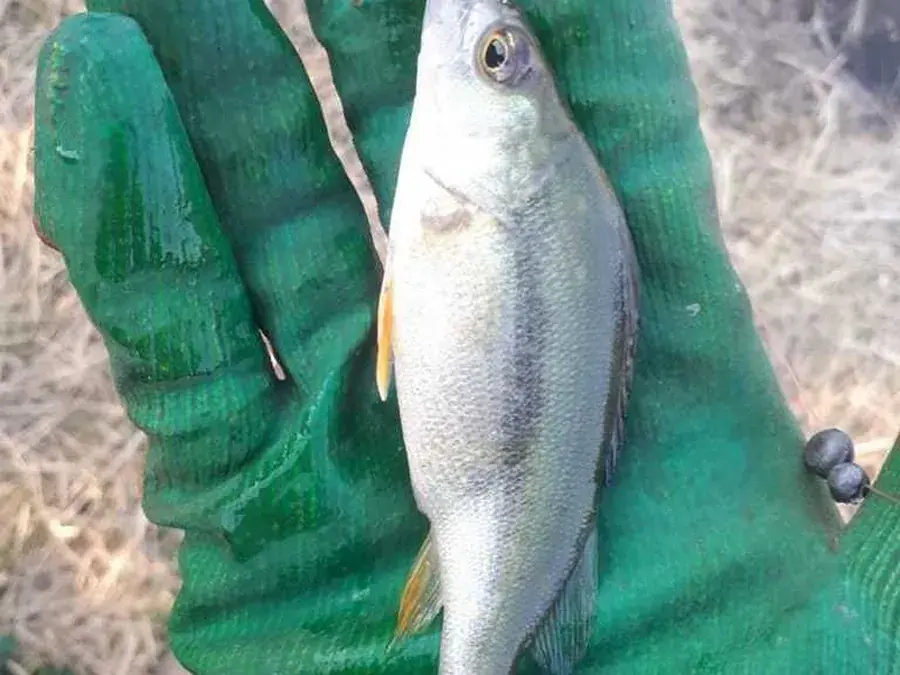 FishJun–Mar
European perch
Perca fluviatilis
Five to eight dark bars on a greenish flank, bright red-orange lower fins, and a spiny first dorsal fin with a black blotch at the back.
Where and how to catch it →Photo: Дауд Арсанукаев · CC BY 4.0
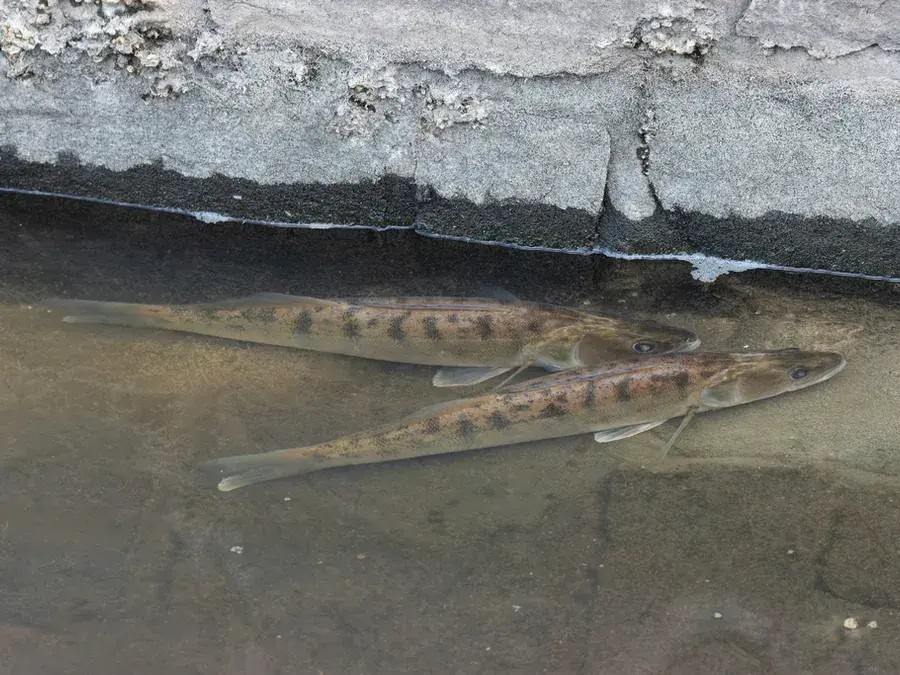 FishJun–Mar
Zander
Sander lucioperca
Slim and glassy-eyed, with grey-brown saddles, rows of black spots on the spiny dorsal fin, and long fang-like canine teeth.
Where and how to catch it →Photo: Tomas Broucek · CC BY 4.0
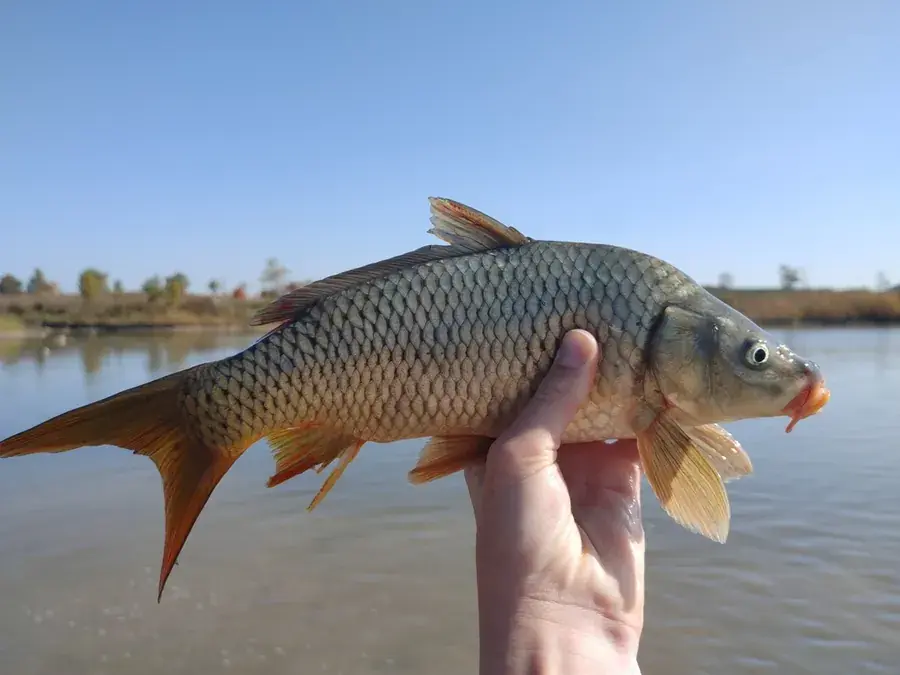 FishApr–Oct
Common carp
Cyprinus carpio
Big bronze scales (or the scattered big scales of a mirror carp), a long dorsal fin, and two pairs of barbels at a rubbery, tube-like mouth.
Where and how to catch it →