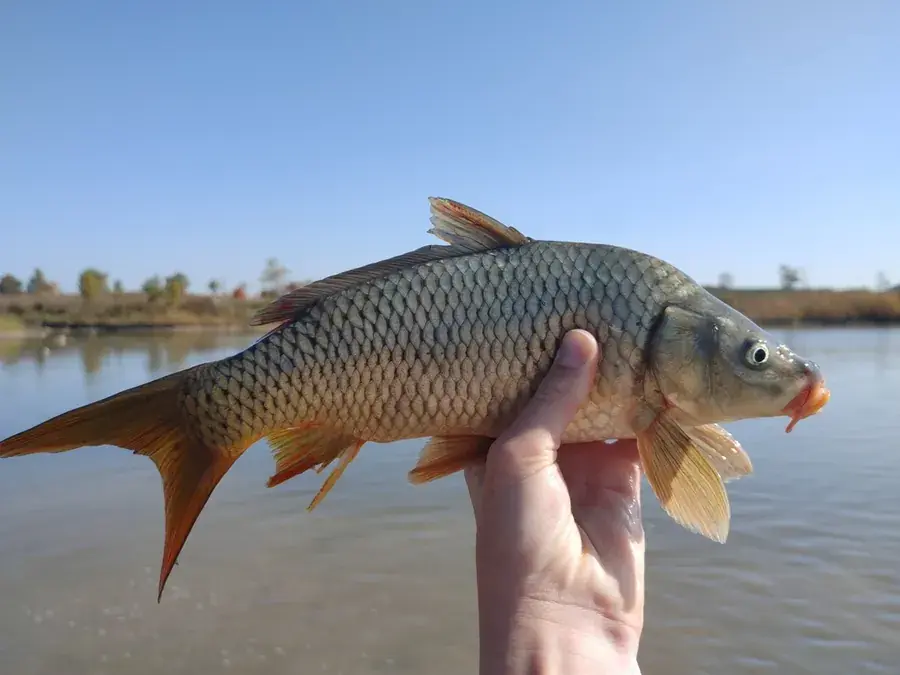
Common carp
Cyprinus carpio
- When
- Apr–Oct — April, May, June, July, August, September, October. Earlier where the water warms first.
- Where it holds
- Warm, weedy, silty lakes, gravel pits, canals and slow rivers — margins, lily pads, and the patches of bubbles and mud that mark feeding fish.
- How to know it
- Big bronze scales (or the scattered big scales of a mirror carp), a long dorsal fin, and two pairs of barbels at a rubbery, tube-like mouth.
- What to know
- Europe's great specimen fish, kept in Roman ponds and monastery stews long before anyone fished for sport. Wary, strong and long-lived; most are released.
- The tactic
- A hair-rigged boilie or tiger nut over a bed of bait, or floating bread on a calm summer day.
- Caution
- Invasive across North America and in much of Africa and the southern hemisphere — never move live carp. Use an unhooking mat and keep big fish wet.
Seasons, size limits and catch limits change every year and differ by water body. Check the current regulations for the country and the water before you fish.
Common carp facts
- Also called
- Carp, European carp; wild carp for the slim, fully scaled river form. Mirror carp carry a few big scales, leather carp almost none, and koi are a Japanese ornamental strain. Karpfen in German, carpe in French, karp in Polish.
- Family
- Cyprinidae, the carp and minnow family.
- Native range
- Wild carp are native only to rivers draining to the Black, Caspian and Aral seas; the Danube's wild river carp is thought to be the ancestor of Europe's carp. Kept in ponds since Roman times, carp were spread across the rest of Europe long ago.
- Introduced to
- Almost worldwide. In North America it has been recorded in every US state except Alaska (in Florida it is established only in the panhandle) and lives across southern Canada. It is also widespread in Africa — from Morocco and the Nile to Kenya, South Africa and Madagascar — and in Australia and South America, where it is often a pest.
- Habitat
- Warm, slow or still water with soft bottoms and plenty of weed: lowland rivers, lakes, ponds, reservoirs and canals, and slightly brackish water. Tough and adaptable, it does well in big, turbid rivers and is most active at dawn and dusk.
- Water temperature
- Warm water. The FAO gives best growth at 23–30°C (73–86°F), but carp survive cold winters and tolerate a very wide range. European carp begin to spawn at about 17–18°C (63–64°F).
- Size
- Most adults 35–80 cm (14–31 in); the largest measured about 129 cm (51 in).
- Record
- IGFA all-tackle world record: 34.35 kg (75 lb 11 oz), Leo van der Gugten, Lac de St. Cassien, France, 1987.
- Lifespan
- Long-lived: FishBase gives 38 years as the oldest reported.
- What it eats
- An omnivore that roots in the bottom for insect larvae, worms, snails and small mussels, and eats seeds and plant matter; it also sucks insects off the surface. The rooting muddies the water and tears out water plants.
- Spawning
- Late spring and early summer, in warm, shallow, weedy margins and flooded meadows, often with a lot of splashing. The sticky eggs cling to plants, and the larvae survive only in very warm, shallow, weedy water.
- Young fish
- Fry live among shallow weed. Maturity depends on warmth rather than age: in temperate water it takes several years, and males mature sooner than females.
- Teeth and mouth
- No teeth in the jaws: a rubbery mouth that shoots out into a tube, with two pairs of barbels (the upper pair short), and strong grinding teeth in the throat.
- Look-alikes
- Crucian carp, Prussian carp and goldfish have no barbels. Grass carp is long and slim with no barbels. Barbel has four barbels but a low body and a short dorsal fin — a carp's dorsal fin is long. In North America, buffaloes and carpsuckers also lack barbels.
- Eating
- A traditional food fish — carp is the Christmas Eve dish in Poland, Czechia and Slovakia — but bony. Most carp anglers in western Europe release their fish. Check consumption advice for fish from industrial rivers.
- Status
- IUCN Least Concern as a species, but truly wild river carp are rare and declining, harmed by river engineering and by breeding with escaped farm and ornamental stock.
Try it
How big does a common carp get?
Slide it from an ordinary adult to the biggest one ever measured, next to things you know the size of.
Most adults you'll catch: 35–80 cm (14–31 in).
This common carp: 58 cm. Longer than a loaf of bread, shorter than a four-year-old.
The record
IGFA all-tackle world record: 34.35 kg (75 lb 11 oz), Leo van der Gugten, Lac de St. Cassien, France, 1987.
Questions people ask about common carp
Are carp native to Europe?
Only in the southeast. Wild carp are native to rivers draining to the Black, Caspian and Aral seas, the Danube among them. The Romans kept carp in ponds, monasteries farmed them through the Middle Ages, and people carried them across the rest of Europe — and later the world.
What is the difference between a common carp and a mirror carp?
They are the same species. A common carp is fully scaled; a mirror carp is a farm-bred form with a few large, shiny, irregular scales; a leather carp has almost none. Koi are an ornamental strain bred in Japan.
How big do carp get?
Most are 35–80 cm (14–31 in). The largest measured about 1.3 m. The IGFA world record is 34.35 kg (75 lb 11 oz), from Lac de St. Cassien in southern France in 1987.
Are carp invasive in North America?
Yes. Common carp were brought over in the 1800s and are now recorded in every US state except Alaska and across southern Canada. Their rooting muddies the water and rips out the water plants that ducks and native fish depend on.
Do carp have teeth?
Not in the mouth. A carp has toothless, rubbery lips and grinds its food with flat teeth in the throat, called pharyngeal teeth.
Found in these regions
- Atlantic Europe
- Continental Europe
- Alps, Pyrenees & Carpathians
- Mediterranean Europe
- Pannonian Basin & Eastern Plains
- Acadian Forest & Atlantic Coast
- Great Lakes & St. Lawrence Lowlands
- Northeast Atlantic Coast & Piedmont
- Appalachian Highlands
- Central Hardwoods & Interior Plateaus
- Southeastern Piedmont & Coastal Plain
- Gulf Coast & Mississippi Lowlands
- Prairies & Great Plains
- Western Mountains & Interior Plateaus
- Pacific Maritime
- Mediterranean California
- Deserts & Dry Basins
- Mediterranean North Africa & Atlas
- Sahara, Nile & Horn
- East African Highlands & Great Lakes
- Southern Savanna & Subtropical Coast
- Highveld & Drakensberg
- Namib, Kalahari & Karoo
- Cape Fynbos & Winter-Rain Coast
- Madagascar & Indian Ocean Islands
Checked against these sources ·
- FishBase — Cyprinus carpio
- FAO Cultured Aquatic Species — Common carp
- USGS Nonindigenous Aquatic Species — Common Carp
- IGFA world records — Carp, common
Sizes, records and ranges are for the species as a whole; local fish, and local rules, vary. Records change — the record-keeper named above has the current one.
Is it active near you?
Get this week's guide for your area
Enter a town, postal code or ZIP and we'll tell you what's happening right there this week — from your local climate, this week's weather and your ecological region.
Also active in October
 FishJun–Mar
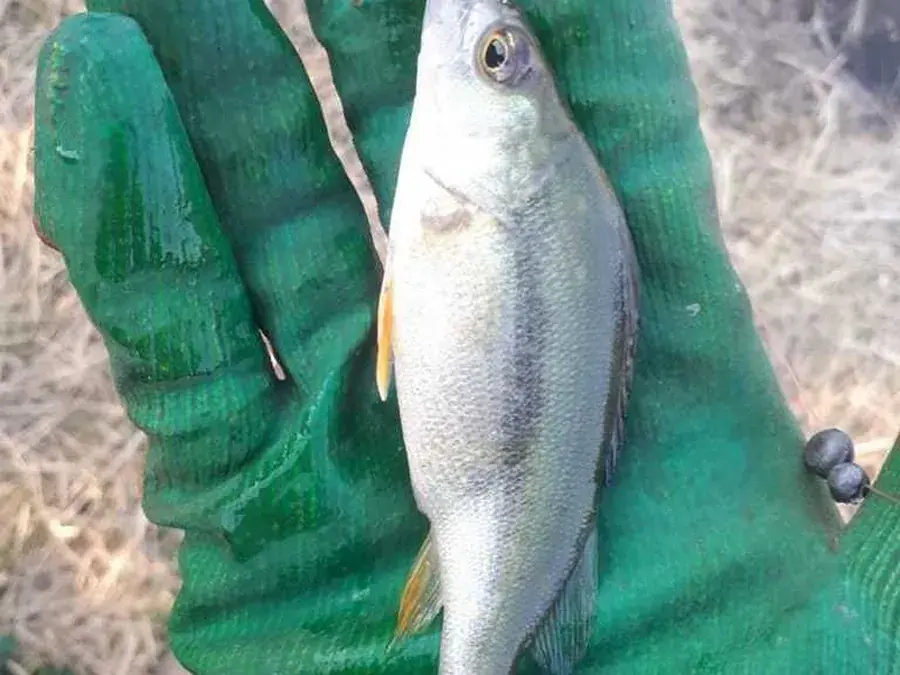
European perch
Perca fluviatilis
Five to eight dark bars on a greenish flank, bright red-orange lower fins, and a spiny first dorsal fin with a black blotch at the back.
Where and how to catch it →Photo: Дауд Арсанукаев · CC BY 4.0
 FishJun–Mar
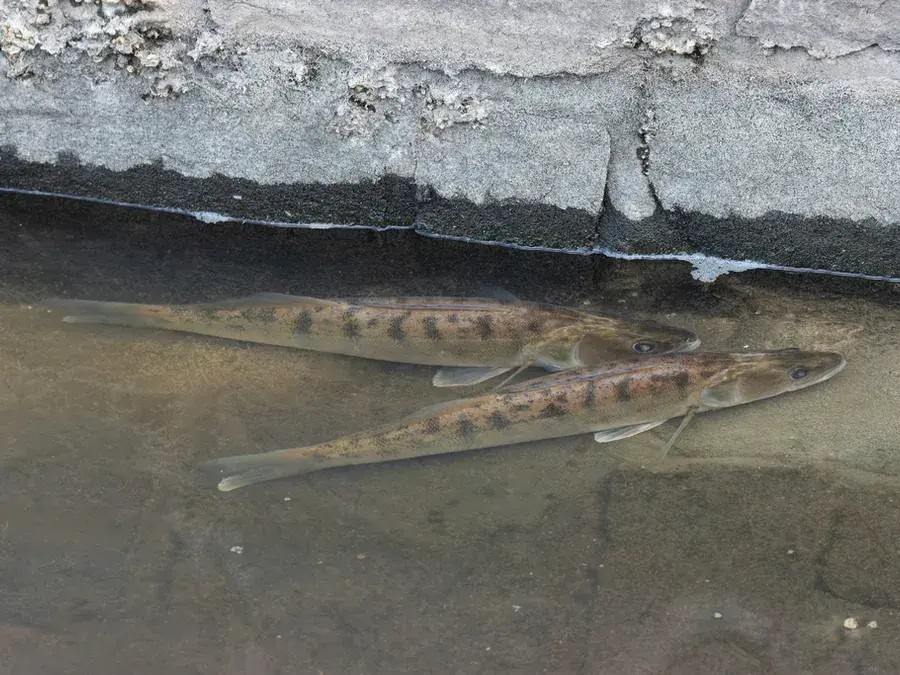
Zander
Sander lucioperca
Slim and glassy-eyed, with grey-brown saddles, rows of black spots on the spiny dorsal fin, and long fang-like canine teeth.
Where and how to catch it →Photo: Tomas Broucek · CC BY 4.0
 FishJun–Mar
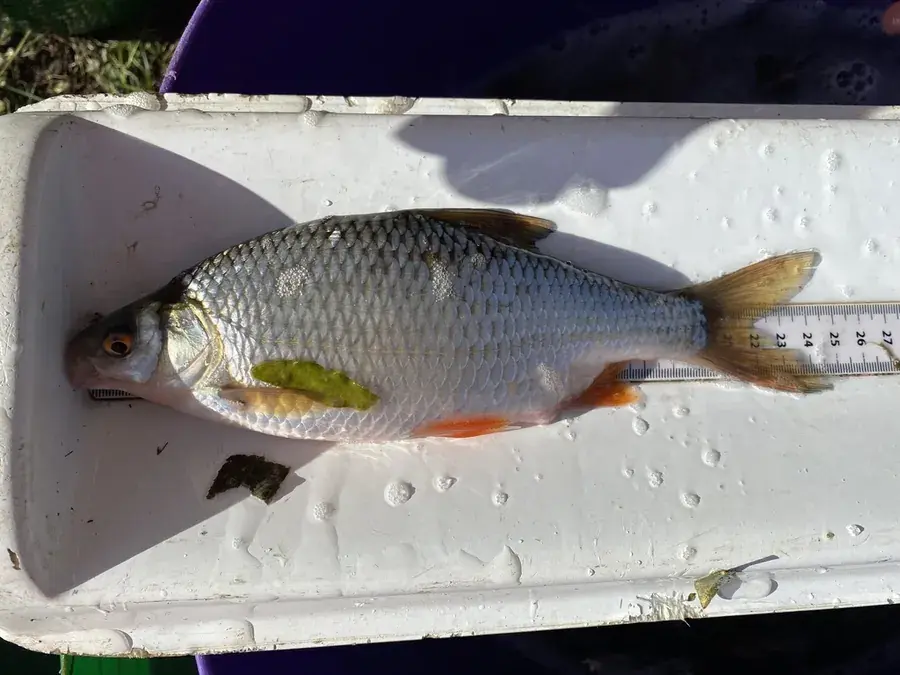
Roach
Rutilus rutilus
Silver with a blue-green back, bright red eyes, reddish lower fins, and a dorsal fin set directly above the pelvic fins.
Where and how to catch it →