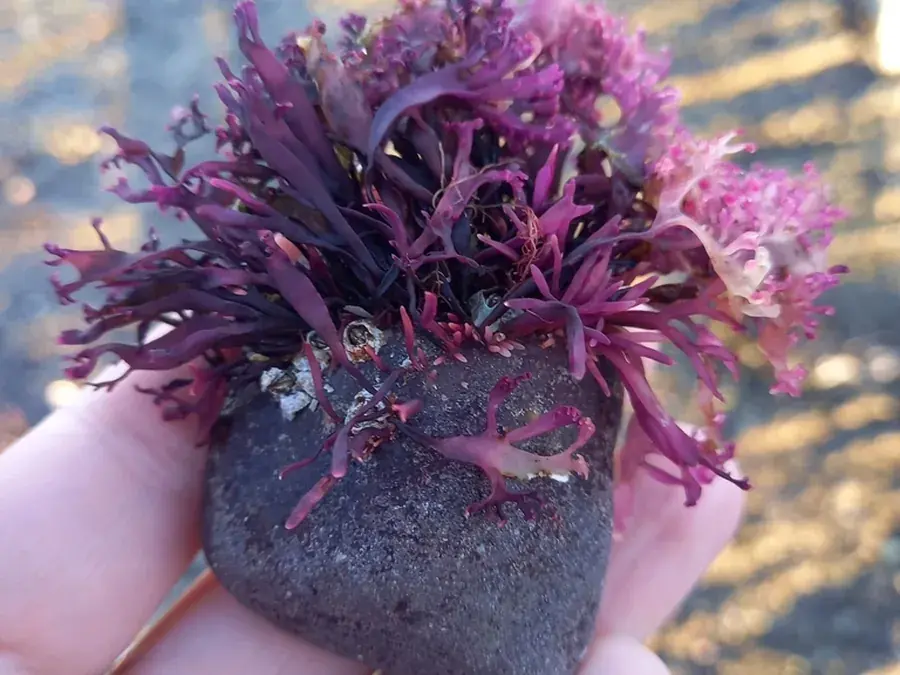
Photo by sugarsnap_t on iNaturalist · CC BY 4.0
Coastal·Season: May – September
Carrageen (Irish moss)
Chondrus crispus
- When
- Typically May – September — May, June, July, August, September. Earlier in warm, low country; later in the hills.
- Where it grows
- Rocks and pools on the middle and lower shore and down to about 24 m (80 ft), on both sides of the North Atlantic: from Iceland and Norway to Spain, and from Labrador to New Jersey.
- Identification
- A small, tough, springy red seaweed up to about 22 cm (9 in), in tufts from a disc-shaped holdfast. A narrow, unbranched stalk widens into flat fronds that fork up to five times into a fan with rounded tips. The colour runs from deep purple-red to green or yellow in strong sun, and under water the tips often shine blue-violet.
- Look-alikes
- False Irish moss (Mastocarpus stellatus) grows in the same places: its fronds are channelled and often twisted, with thickened edges and its reproductive bodies in small, pimple-like bumps on the surface. Carrageen's fronds are flat.
- Harvest and use
- Cut tufts at low spring tides and leave the holdfast. Rinse and dry it; dried carrageen is brown and crisp and unfurls as soon as it is wet. Simmer a small handful in milk for about 20 minutes, strain, sweeten and leave to set: carrageen moss pudding, the Irish blancmange. It thickens soups and jellies the same way.
- Caution
- Cut, don't pull, and take it only from clean, open shores, away from outfalls and harbours. Like all seaweeds it contains iodine: eat it in modest amounts, and ask a doctor first if you have a thyroid condition or are pregnant. Check local rules; some states and provinces license seaweed harvest.
Carrageen (Irish moss) at a glance
- Also called
- Irish moss, carrageen moss, jelly moss; carraigín (Irish)
- Family
- Gigartinaceae (red seaweeds)
- Where it grows
- Both sides of the North Atlantic: in Europe from Iceland, the Faroes and Norway to southern Spain, on every British and Irish coast; in North America from Labrador to New Jersey.
- When to pick
- Cut at low spring tides from late spring to early autumn, when the plants are fullest; it grows on the mid to lower shore and in pools.
- Parts used
- The whole frond, fresh or dried, cooked to release its jelly.
Questions people ask about carrageen
What is carrageen moss used for?
Above all for carrageen moss pudding, an Irish blancmange set by the seaweed's natural jelly. It also thickens soups, jellies and aspics, and its extract, carrageenan (E407), thickens ice cream and other foods.
How do you make carrageen moss pudding?
Soak a small handful of dried carrageen, simmer it in milk for about 20 minutes, strain, then sweeten and flavour the milk and leave it to set; some cooks fold in whisked egg.
How do I tell carrageen from false Irish moss?
Carrageen's fronds are flat and fork repeatedly into a fan with rounded tips. False Irish moss (Mastocarpus stellatus) has channelled, often twisted fronds with thickened edges, and its reproductive bodies sit in small pimple-like bumps on the surface.
Why does carrageen shine blue?
The branch tips, especially of female plants, show a blue-violet iridescence under water.
Found in these regions
Local season
This week's foraging guide for a place
Enter a town, postal code or ZIP for what is in season there this week, based on the local climate, this week's weather and the ecological region.
Also in season in October
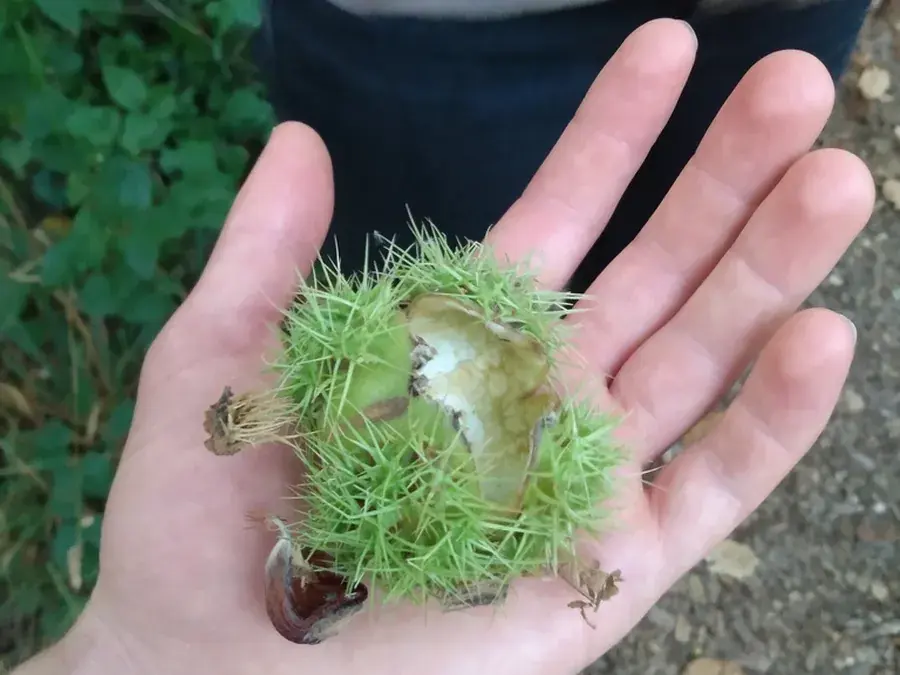 NutOctober – November
Sweet chestnut
Castanea sativa
A big tree with long, glossy leaves edged with sharp, regular teeth, and bark that twists in spiralling ridges on old trunks. The nuts come in twos and threes inside a husk covered in dense, needle-sharp spines; each is glossy brown, flat on one side, with a pointed tuft at the tip.
Identification and look-alikes →Photo: John Powers · CC BY 4.0
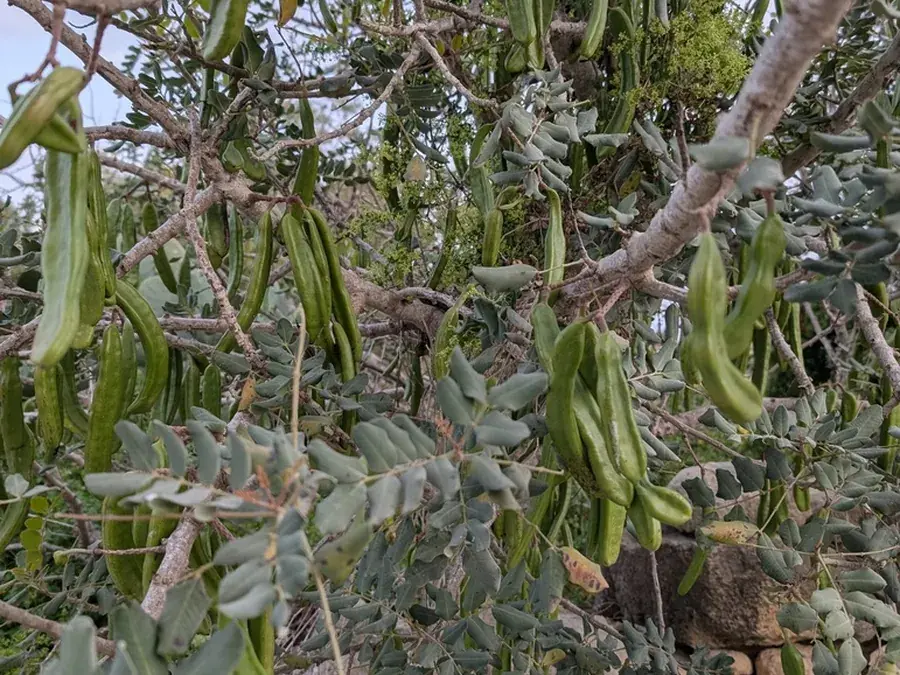 FruitAugust – October
Carob (St John's bread)
Ceratonia siliqua
A broad, round-crowned evergreen tree up to 15 m (50 ft) with leaves 10–20 cm (4–8 in) long, divided into pairs of leaflets. Small flowers grow straight from the trunk and old branches in autumn. The pods are flat, leathery and slightly curved, 10–30 cm (4–12 in) long, ripening from green to dark brown, sweet-smelling, with 10–13 very hard seeds. Most trees are male or female, and only females bear pods.
Identification and look-alikes →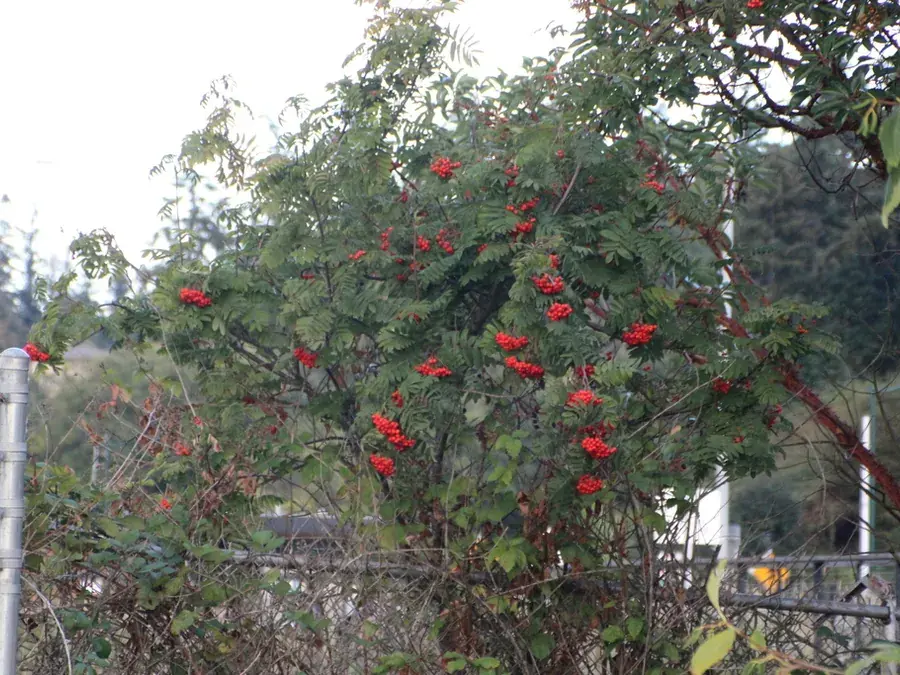 BerryAugust – October
Rowan berries
Sorbus aucuparia
A slim tree with smooth silvery-grey bark and feathery leaves of many toothed leaflets in pairs; big flat clusters of scarlet-orange berries, each about 1 cm (⅜ in) across with a tiny black five-pointed star at the tip.
Identification and look-alikes →Photo: Therese Phillips · CC BY 4.0
Checked against these sources ·
- Wikipedia — Chondrus crispus
- MarLIN (Marine Biological Association) — Carrageen
- AlgaeBase / The Seaweed Site — Chondrus crispus fact sheet
- Smithsonian Magazine — A brief history of Ireland's carrageen moss pudding
- ANSES — Seaweed consumption and excess iodine
Seasons are typical for the middle of the range and move by weeks north and south, and up and down hills.
Educational information only. Never eat a wild plant or mushroom identified from a single photograph or description — confirm with a regional field guide or an experienced forager, and know the poisonous species in your area first.