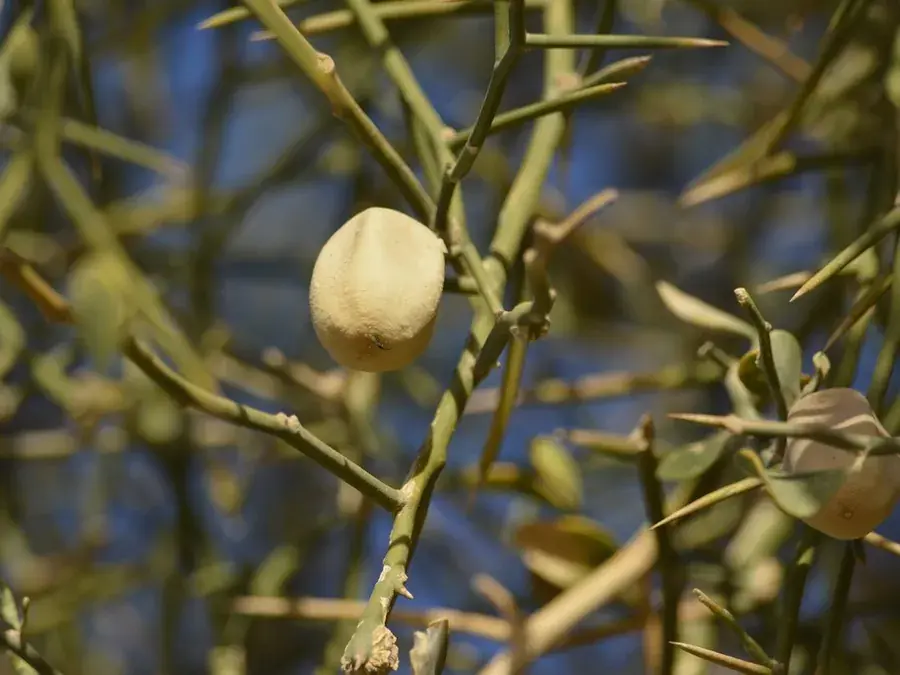
Photo by Karim Haddad on iNaturalist · CC BY 4.0
FruitSeason: December – March
Desert date (balanites)
Balanites aegyptiaca
- When
- Typically December – March — December, January, February, March. Earlier in warm, low country; later in the hills.
- Where it grows
- Woodland and scrub along the Sahara's southern edge from the Atlantic to the Red Sea, and the dry country of the Nile, the Horn and East Africa; it shrugs off sand, clay, floods, fire and goats.
- How to know it
- A spiny tree up to about 10 m with long, straight, green spines arranged in a spiral, and dark green leaves of two small leaflets growing from the base of the spines. The date-like fruit is under 4 cm (1½ in) long, green when unripe, ripening yellow to pale brown, with a brittle skin over sticky, bittersweet pulp and one very hard stone.
- Look-alikes
- No dangerous double is known. The green spines with leaflets growing from their base are unmistakable.
- Harvest and use
- Eat ripe fruit raw, or sun-dry it and store it like dates; the pulp is soaked for a drink or stirred into porridge. Young leaves and tender shoots are boiled and eaten as a vegetable. The oily kernel inside the stone is food only after long processing to remove its bitterness.
- Caution
- The kernel, bark and fruit contain saponins — laxative, and potent enough that extracts kill bilharzia snails and stun fish. Eat the pulp in moderation and never the raw kernel. The spines are razor-sharp.
Desert date (balanites) at a glance
- Also called
- Egyptian balsam, soapberry tree, thorn tree, Egyptian myrobalan; lalob (Sudan)
- Family
- Zygophyllaceae (sometimes given its own family, Balanitaceae)
- Where it grows
- Native to 29 African countries: along the Sahara's southern edge from the Atlantic to the Red Sea, the Nile valley (cultivated in Egypt for over 4,000 years), the Horn, and East Africa south into parts of southern Africa; also Arabia. Not in the rainforest, South Africa, Namibia or Madagascar.
- When to pick
- Fruit ripens at the height of the dry season. In Nigeria ripe fruit comes in December and January, and occasionally later, from March to July. Dried fruit keeps like dates.
- Parts used
- Pulp (fresh, dried, soaked for drinks or mixed into porridge), young leaves and tender shoots (boiled), flowers, and the kernel — as cooking oil, or as food only after long processing.
- Is any of it poisonous?
- Kernel, bark, roots and fruit contain saponins: laxative, and strong enough to kill water snails and stun fish. The bitter kernel must be cooked twice and then steeped for three to four days, or leached in hot water (60 °C) for two days, before it is eaten.
Questions people ask about desert date
Is desert date edible?
Yes. The ripe, sticky, bittersweet pulp is eaten fresh or dried like dates, made into drinks and sweets, and mixed into porridge; young leaves are cooked as a vegetable. The raw kernel is not eaten.
How do you make desert date kernels edible?
By removing the bitter saponins: cook the kernels twice, then steep them for three to four days, or leach them in hot water at about 60 °C (140 °F) for two days. Pressed, the kernels also give a cooking oil.
Why is balanites used against bilharzia?
Extracts of its bark and fruit kill the freshwater snails that carry bilharzia (schistosomiasis) and the tiny copepods (water crustaceans) that carry guinea worm. The same saponins are why the kernel needs processing.
When is desert date ripe?
At the height of the dry season, when the fruit has turned from green to yellow or pale brown and the skin is crisp. In Nigeria that is mostly December and January.
Found in these regions
Is it ready near you?
Get this week's foraging guide for your area
Enter a town, postal code or ZIP and we'll tell you what's in season right there this week — from your local climate, this week's weather and your ecological region.
Also ready in October
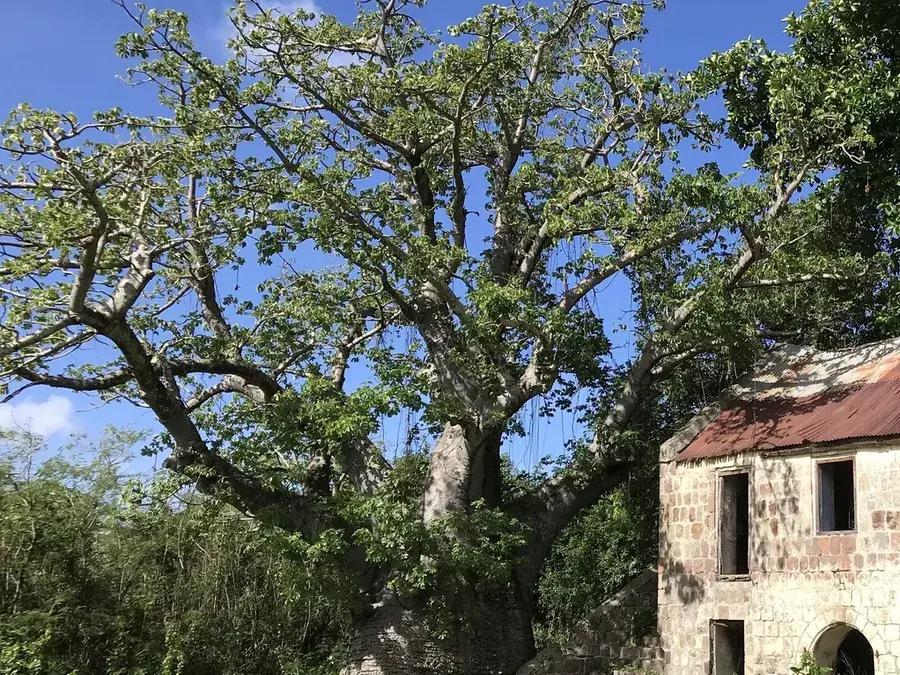 FruitOctober – February
Baobab (fruit and leaves)
Adansonia digitata
A vast, swollen grey trunk with smooth, folded bark and stubby branches that look like roots, bare of leaves for most of the dry season. The leaves are hand-shaped, with five to seven finger-like leaflets. The fruit is a velvety, egg- to sausage-shaped pod up to 25 cm (10 in) long on a long hanging stalk: a hard woody shell around chalky, off-white pulp and black kidney-shaped seeds.
How to know it & its look-alikes →Photo: Cliff Tyllick · CC BY 4.0
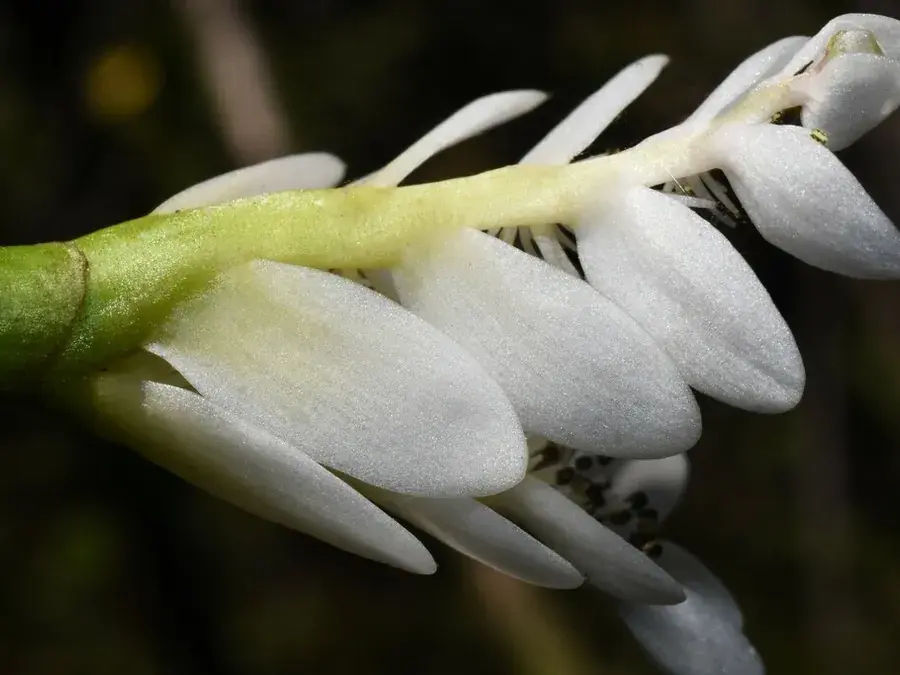 GreenJune – October
Waterblommetjie (Cape pondweed)
Aponogeton distachyos
Long-stalked, narrow-oval leaves floating flat on the water, and above them forked white flower spikes shaped like a 'Y', each branch lined with white petal-like bracts and dark purple-brown stamens, sweetly scented. The plant dies back as the pools dry in summer and regrows with the autumn rain.
How to know it & its look-alikes →Photo: Gabriel Campbell-Martinez · CC BY 4.0
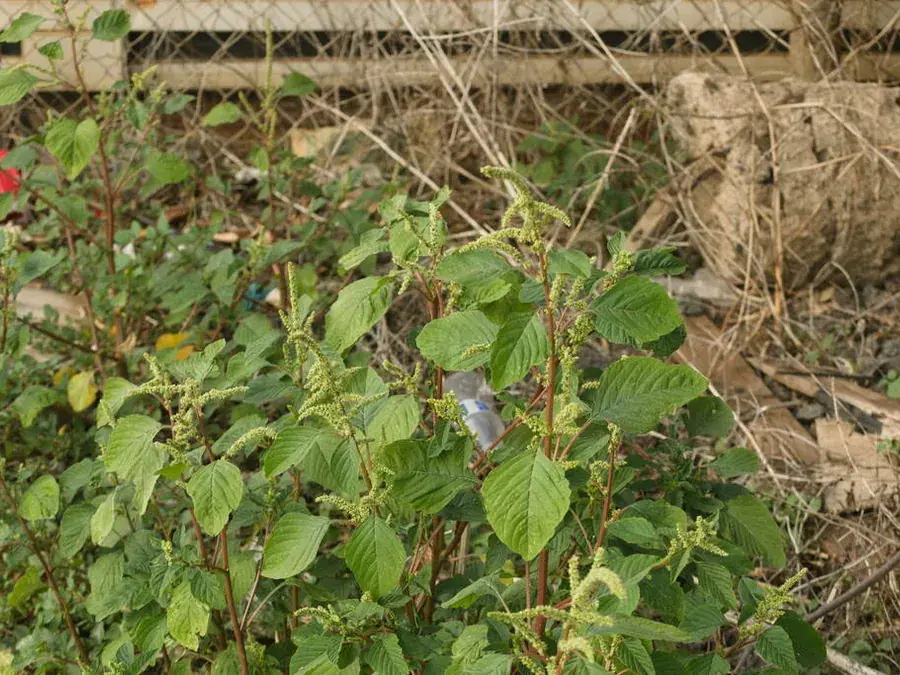 Has a dangerous look-alikeGreenMay – October
Amaranth greens (morogo, mchicha)
Amaranthus spp.
Upright or sprawling herbs, often with reddish stems, carrying alternate, oval to diamond-shaped, smooth-edged leaves on long stalks, and dense, bristly spikes of tiny green or reddish flowers at the top and in the leaf joints. No milky sap, no berries, no trumpet flowers. Spiny amaranth has a pair of sharp spines at each leaf base.
How to know it & its look-alikes →Photo: Kevin Faccenda · CC BY 4.0
Checked against these sources ·
- National Research Council — Lost Crops of Africa, Vol. III: Fruits — Balanites
- World Agroforestry (ICRAF) Agroforestree Database — Balanites aegyptiaca
- Wikipedia — Balanites aegyptiaca
Seasons are typical for the middle of the range and move by weeks north and south, and up and down hills.
Educational information only. Never eat a wild plant or mushroom identified from a single photograph or description — confirm with a regional field guide or an experienced forager, and know the poisonous species in your area first.