Cape Fynbos & Winter-Rain Coast · Spring · 7 October 2026
The ground under Gqeberha
Gqeberha stands on sedimentary rocks rock, about 299 million years old. The rock decides the soil, the soil decides what grows, and the lie of the land decides where the rain runs off to.
- Semi-arid climate
- 457 mm of rain a year
- Sea coast
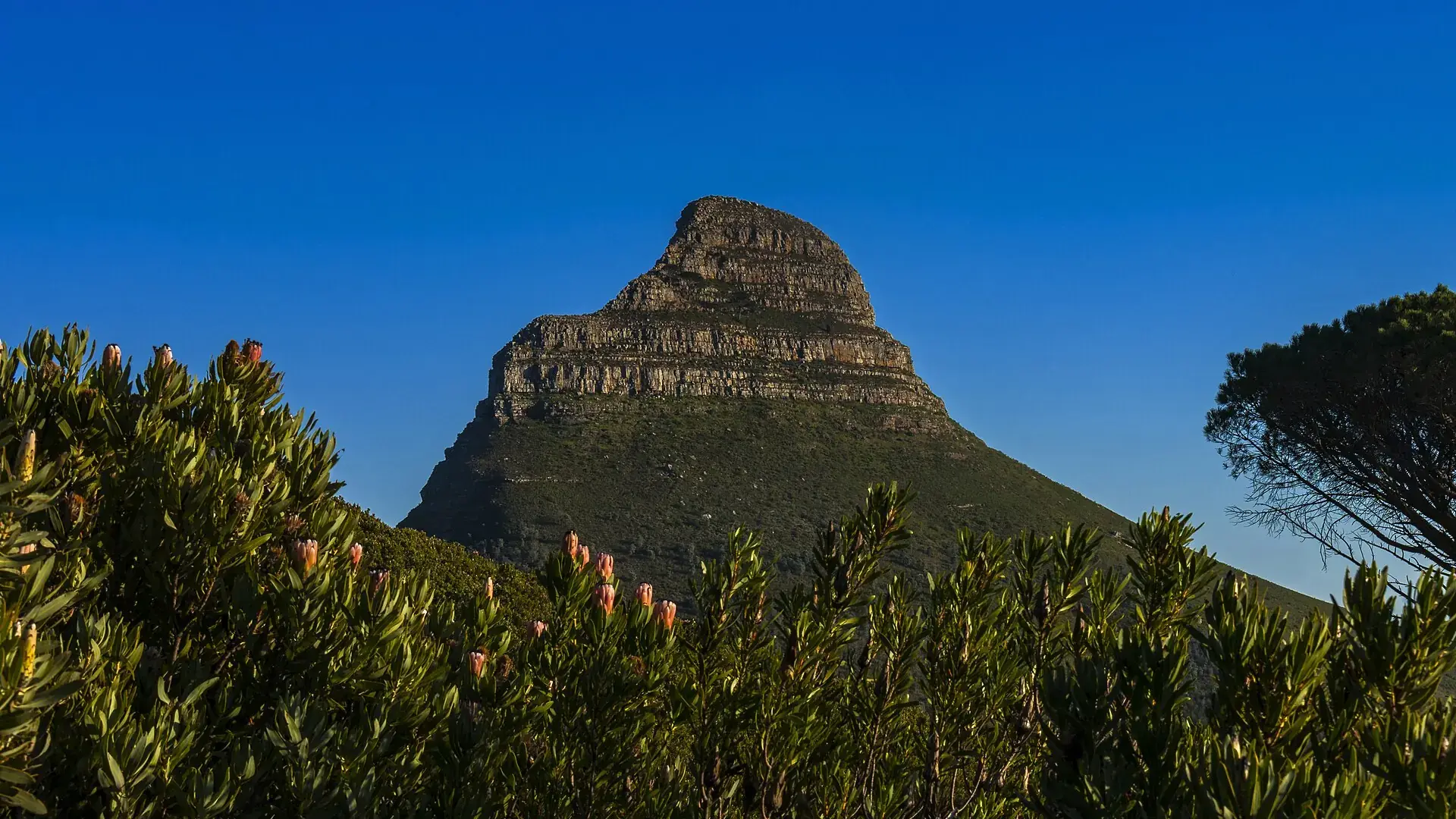
Photograph: Daniel Case · CC BY-SA 3.0
Bedrock
Gqeberha sits on Permian sedimentary rock
About 299 million years old — from the age of the first forests, amphibians and reptiles.
Rock types and how they form →
- At the surface299 million years oldLittle effect on pH
Sedimentary rock
Paleozoic sedimentary rocks · Permian
- What it is
- The family that covers about three quarters of the land surface, in a thin skin over everything else. Some geological maps say only this much, which still tells you it will be layered and may hold fossils.
- Weathering
- Along its bedding planes, layer by layer, at a rate set by whatever the layers are made of — which is why sedimentary country weathers into steps.
- Effect on soil and vegetation
- Layered country with flat-topped hills and stepped valley sides. What grows on it depends entirely on whether the beds are limey or sandy, which is the question worth asking next.
- Below, layer 2485 million years old
Table Mountain Group of Cape Supergroup
· Ordovician
- Below, layer 3485 million years oldLittle effect on pH
Sedimentary rock
sedimentary · Ordovician
- What it is
- The family that covers about three quarters of the land surface, in a thin skin over everything else. Some geological maps say only this much, which still tells you it will be layered and may hold fossils.
- Weathering
- Along its bedding planes, layer by layer, at a rate set by whatever the layers are made of — which is why sedimentary country weathers into steps.
- Effect on soil and vegetation
- Layered country with flat-topped hills and stepped valley sides. What grows on it depends entirely on whether the beds are limey or sandy, which is the question worth asking next.
Nearby waters
Named waters near Gqeberha
Named lakes, rivers and streams within about 20 km, nearest first, from OpenStreetMap.
- North End LakeLake3 km
- Former Bayworld DolphinariumLake4.7 km
- PapenkuilsStream5 km
- Mount Pleasant DamLake7.4 km
- Baakens RiverRiver8.2 km
- Boundary Lane PondLake8.2 km
- Barkens RiverStream9.1 km
- Marine WayLake10.8 km
- Salt PansLake11 km
- VarsvleiLake12 km
- Chatty RiverRiver13 km
- Kemps Kloof StreamStream13.2 km
- Lake
- Still water that layers in summer: warm at the top, cold below, with a sharp boundary between. Fish sit at the depth that suits them and move as that boundary does.
- Stream
- Small, cold, and shaded by whatever grows over it. Most of what lives here eats insects that fall in from the trees, so a stream through woodland is a richer place than the same stream through a field.
- River
- Moving water sorts itself into riffles, runs and pools, and everything in it lives where the current brings food without costing more energy than the food is worth. Learn to read the seams and you have learned the river.
Bedrock and soil figures are modelled from national geological surveys and global soil mapping, at a resolution of a few hundred metres — right for the shape of a district, not for a particular garden. River discharge is modelled, not gauged. For anything that matters, dig a hole and look.
For children: dig down through the soil under Gqeberha to the bedrock, an interactive cross-section.
The weekly field note for Gqeberha
One email, Sunday evening. Unsubscribe at any time.