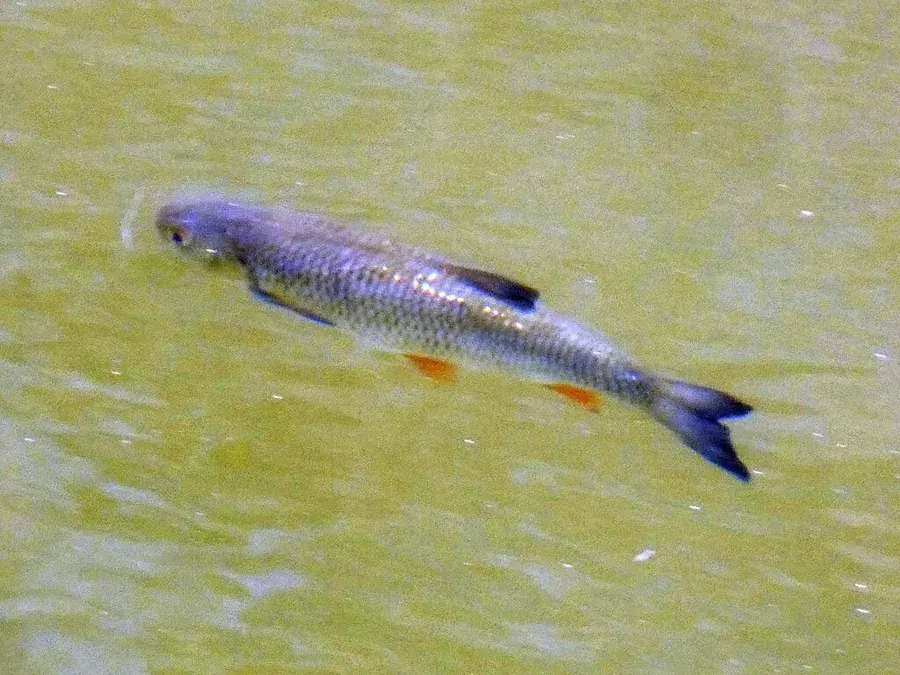
Photo by Matthew Gerke on iNaturalist · CC BY 4.0
Chub
Squalius cephalus
- When
- Jun–Mar — January, February, March, June, July, August, September, October, November, December. Earlier where the water warms first.
- Where it holds
- Rivers of every size — under overhanging willows, beside snags and rafts of debris, and in the slack water beside fast runs.
- How to know it
- Thick-set and broad-headed with a big white-lipped mouth, large dark-edged scales in a net pattern, and a convex, reddish anal fin.
- What to know
- Eats almost anything and bolts at a shadow. Chub keep feeding in cold weather when other river fish go quiet, which makes them the winter river fish.
- The tactic
- Bread flake or cheese paste trotted or ledgered under the willows; a slug or a small plug in summer.
Seasons, size limits and catch limits change every year and differ by water body. Check the current regulations for the country and the water before you fish.
Chub facts
- Also called
- European chub; formerly Leuciscus cephalus. Chevesne in French, Döbel or Aitel in German, färna in Swedish, turpa in Finnish. Italy's cavedano is a separate, native species.
- Family
- Leuciscidae, the Eurasian minnows (formerly included in the carp family, Cyprinidae).
- Native range
- From the Atlantic rivers of France (south to the Adour) east to the Caspian, White and Barents Sea basins; Britain north to about 56°N; southern Finland and Sweden north to about Stockholm; and France's Mediterranean rivers from the Var to the Hérault. Naturally absent from Italy and the Adriatic basin.
- Habitat
- Rivers of every size, from small streams to big lowland rivers, most common in runs of riffles and pools; also large lakes, from which it runs up inflowing streams to spawn. Adults are often solitary; young fish shoal.
- Water temperature
- Wide-tolerant; FishBase gives about 4–20°C (39–68°F). It spawns from about May into summer, once the water reaches about 14°C (57°F).
- Size
- Most adults 25–50 cm (10–20 in); the largest measured about 60 cm (24 in).
- Record
- IGFA all-tackle world record: 3.45 kg (7 lb 10 oz), Joachim Ochmann, River Main, Germany, 2017. The British record is 4.224 kg (9 lb 5 oz), Andy Maker, from a southern stillwater in 2007.
- Lifespan
- Up to about 22 years.
- What it eats
- Almost anything: insects, worms, crustaceans and plant material, and — in big chub — mainly fish. One of the least fussy feeders in fresh water.
- Spawning
- In fast water over gravel. Males gather on the shallows and follow ripe females with much splashing; each female spawns more than once, with several males, and the sticky eggs lodge among the stones.
- Young fish
- Larvae and fry live in very shallow water along the bank. Chub often hybridise with bleak.
- Teeth and mouth
- A big, wide mouth with thick white lips, able to take crayfish and small fish whole. No teeth in the jaws.
- Look-alikes
- Dace: slimmer and smaller, with concave edges to the dorsal and anal fins (a chub's anal fin is convex and reddish). Ide: smaller scales and a deeper body. Roach: red eye and a much smaller mouth.
- Eating
- Poor — soft, bony and bland; chub are almost always returned.
- Status
- IUCN Least Concern.
Try it
How big does a chub get?
Slide it from an ordinary adult to the biggest one ever measured, next to things you know the size of.
Most adults you'll catch: 25–50 cm (10–20 in).
This chub: 38 cm. Longer than a loaf of bread, shorter than a four-year-old.
The record
IGFA all-tackle world record: 3.45 kg (7 lb 10 oz), Joachim Ochmann, River Main, Germany, 2017. The British record is 4.224 kg (9 lb 5 oz), Andy Maker, from a southern stillwater in 2007.
Questions people ask about chub
How do you tell a chub from a dace?
Look at the anal fin: a chub's has a rounded, convex edge and is usually reddish; a dace's is concave and pale. Chub are also much thicker-set, with a bigger head and mouth.
How big do chub get?
Most are 25–50 cm (10–20 in) and up to about 2 kg. The IGFA world record is 3.45 kg (7 lb 10 oz), from Germany's River Main in 2017; Britain's record is 4.224 kg (9 lb 5 oz), from 2007.
What do chub eat?
Nearly anything they can fit in their wide mouths: insects, worms, crayfish, plant matter and, when they are big, other fish. Anglers catch them on bread, cheese paste, slugs, worms and small lures.
Can you catch chub in winter?
Yes — chub keep feeding in cold water when most river fish go quiet, which makes them a favourite winter target. Fish slow, deep glides near cover with bread, cheese paste or worms.
Found in these regions
Checked against these sources ·
- FishBase — Squalius cephalus
- IGFA world records — Chub
- British Record (Rod Caught) Fish Committee — coarse fish records, January 2026
- Wikipedia — Squalius cephalus
Sizes, records and ranges are for the species as a whole; local fish, and local rules, vary. Records change — the record-keeper named above has the current one.
Is it active near you?
Get this week's guide for your area
Enter a town, postal code or ZIP and we'll tell you what's happening right there this week — from your local climate, this week's weather and your ecological region.
Also active in October
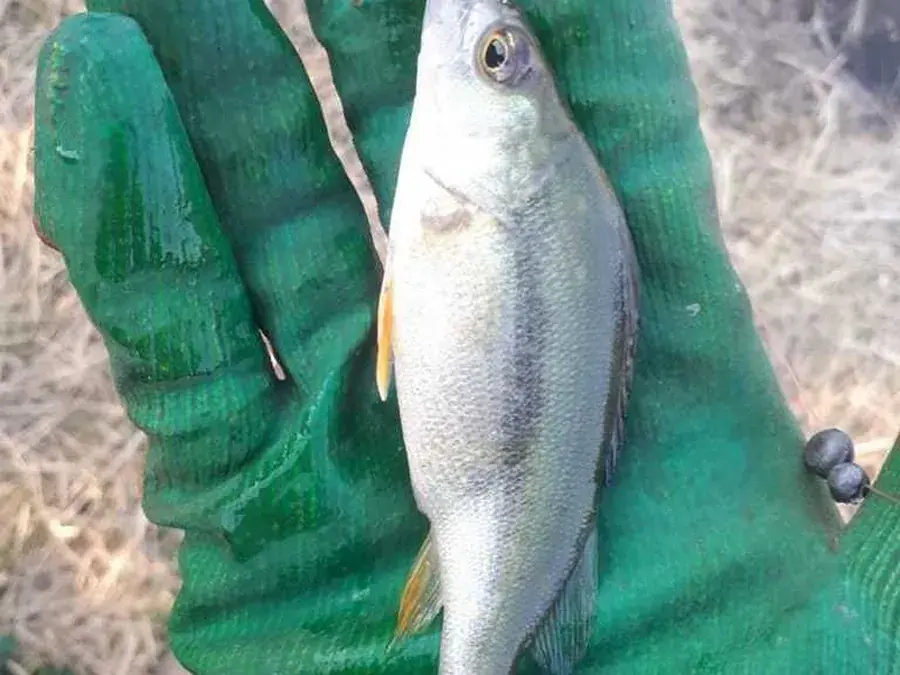 FishJun–Mar
European perch
Perca fluviatilis
Five to eight dark bars on a greenish flank, bright red-orange lower fins, and a spiny first dorsal fin with a black blotch at the back.
Where and how to catch it →Photo: Дауд Арсанукаев · CC BY 4.0
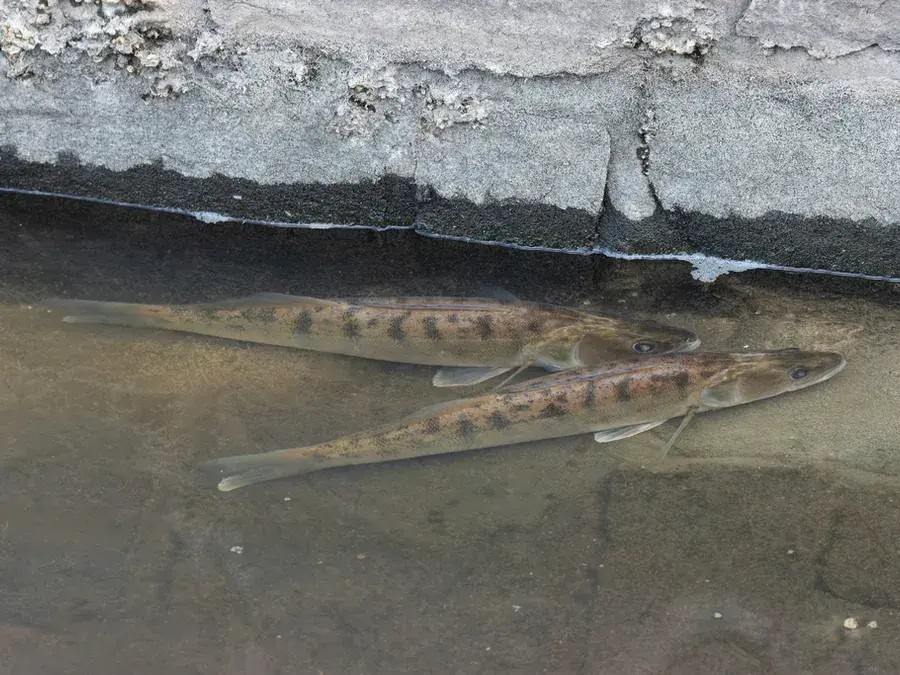 FishJun–Mar
Zander
Sander lucioperca
Slim and glassy-eyed, with grey-brown saddles, rows of black spots on the spiny dorsal fin, and long fang-like canine teeth.
Where and how to catch it →Photo: Tomas Broucek · CC BY 4.0
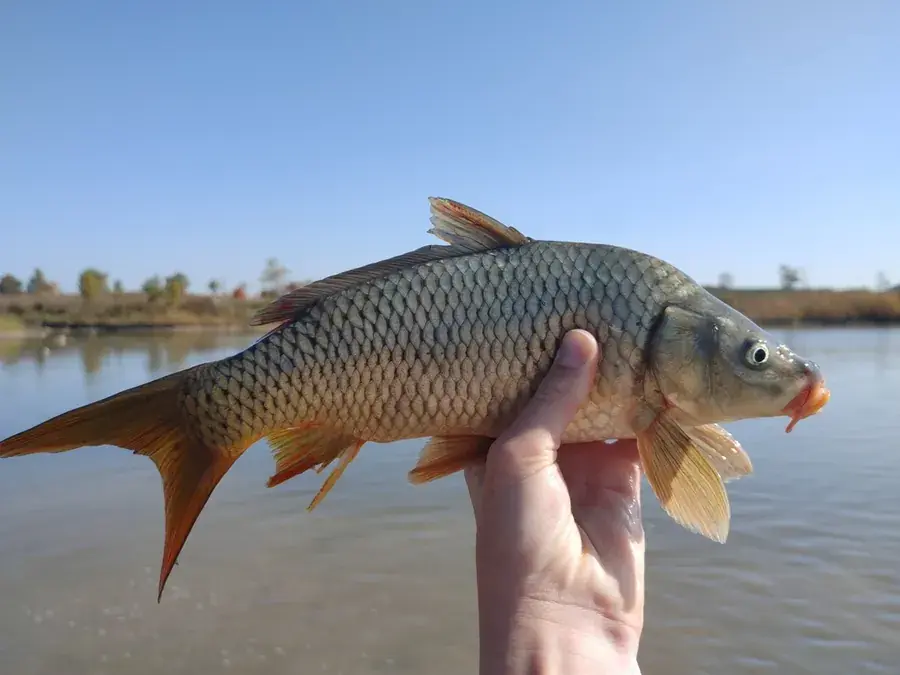 FishApr–Oct
Common carp
Cyprinus carpio
Big bronze scales (or the scattered big scales of a mirror carp), a long dorsal fin, and two pairs of barbels at a rubbery, tube-like mouth.
Where and how to catch it →