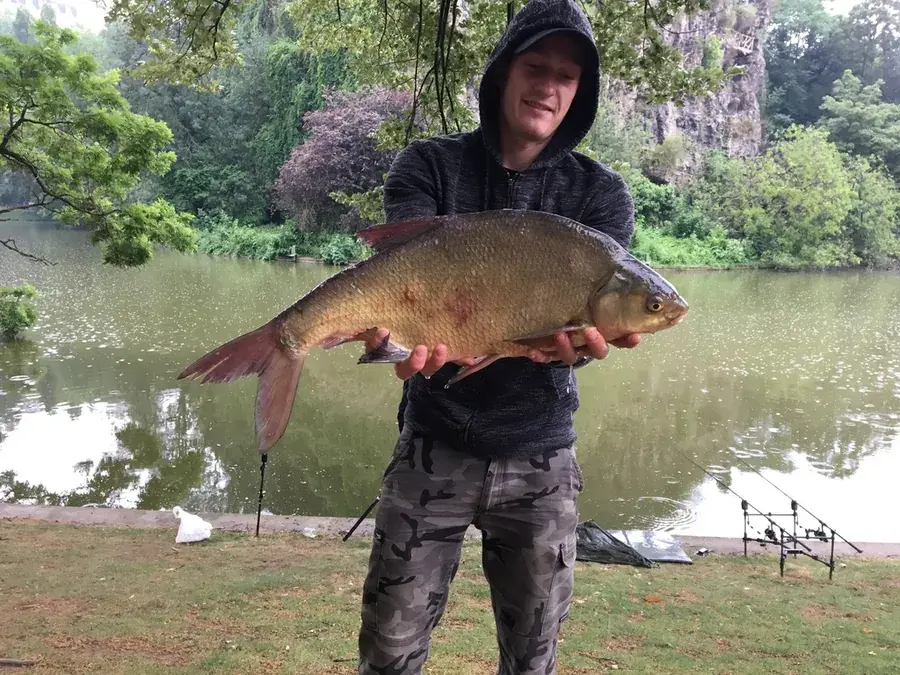
Photo by Carrie Seltzer on iNaturalist · CC BY 4.0
Common bream
Abramis brama
- When
- May–Oct — May, June, July, August, September, October. Earlier where the water warms first.
- Where it holds
- Big lowland lakes, reservoirs, canals and slow rivers; shoals graze soft bottoms, often in deeper water.
- How to know it
- Deep, flat-sided and slimy; bronze as an adult (silvery when young), with a long anal fin and a mouth that shoots out into a tube.
- What to know
- A shoal fish caught in numbers: find the shoal, then keep it in front of you with groundbait. Coloured water and fizzing bubbles give bream away.
- The tactic
- A method or swimfeeder packed with groundbait, and worm, maggot or corn on the hook, fished into dusk.
Seasons, size limits and catch limits change every year and differ by water body. Check the current regulations for the country and the water before you fish.
Common bream facts
- Also called
- Bream, bronze bream; big ones are 'slabs' and small silvery ones 'skimmers' to British anglers. Brème in French, Brachse or Blei in German, brasem in Dutch, braxen in Swedish, lahna in Finnish.
- Family
- Leuciscidae, the Eurasian minnows (formerly included in the carp family, Cyprinidae).
- Native range
- Most of Europe, from the Adour in southwest France east to the Pechora and on to the Aral basin. Naturally absent from Iberia, Italy, the Adriatic basin, Scotland, and Scandinavia north of Bergen and about 67°N in Finland.
- Introduced to
- Ireland, Spain and northeastern Italy; also Lake Baikal and parts of Siberia.
- Habitat
- Big, warm, nutrient-rich lowland lakes, reservoirs and canals, the lower reaches of slow rivers, backwaters and brackish estuaries. It travels in big shoals over soft bottoms.
- Water temperature
- Temperate; FishBase gives about 10–24°C (50–75°F). It spawns from April to June when the water is around 12–20°C (54–68°F).
- Size
- Most adults 30–55 cm (12–22 in); the largest measured about 82 cm (32 in).
- Record
- IGFA all-tackle world record: 6.01 kg (13 lb 3 oz), Luis Kilian Rasmussen, Hagbyån, Sweden, 1984. The British record is far heavier: 10.291 kg (22 lb 11 oz), Scot Crook, Ferry Lagoon, Cambridgeshire, 2012.
- Lifespan
- Up to about 23 years.
- What it eats
- A bottom feeder: midge larvae and other insect larvae, small crustaceans, snails and small mussels, and plants; big bream may take small fish. When zooplankton is thick it can switch to filter-feeding. Young bream eat zooplankton.
- Spawning
- April to June, in shallow, densely vegetated backwaters, floodplains and lake margins. Males grow white spawning tubercles on the head.
- Young fish
- Young bream are silvery and flat, turning bronze as they grow. They spend their first year or two in backwaters, then move out to the main river to feed.
- Teeth and mouth
- A toothless mouth that shoots forward into a tube to suck food out of the mud.
- Look-alikes
- Silver bream: smaller and silvery, with a bigger eye and reddish bases to the paired fins. Roach × bream hybrids: in between, with a shorter anal fin than a bream. Roach and ide are much less deep-bodied.
- Eating
- Soft, bony and mild; eaten fresh, smoked or dried in eastern Europe, but almost always returned in the west.
- Status
- IUCN Least Concern.
Try it
How big does a common bream get?
Slide it from an ordinary adult to the biggest one ever measured, next to things you know the size of.
Most adults you'll catch: 30–55 cm (12–22 in).
This common bream: 43 cm. Longer than a loaf of bread, shorter than a four-year-old.
The record
IGFA all-tackle world record: 6.01 kg (13 lb 3 oz), Luis Kilian Rasmussen, Hagbyån, Sweden, 1984. The British record is far heavier: 10.291 kg (22 lb 11 oz), Scot Crook, Ferry Lagoon, Cambridgeshire, 2012.
Questions people ask about common bream
How big do bream get?
Most adults are 30–55 cm (12–22 in) and 1–4 kg. The IGFA world record is 6.01 kg (13 lb 3 oz), from Sweden in 1984, but Britain's record is much bigger: 10.291 kg (22 lb 11 oz), from a Cambridgeshire lake in 2012.
What is the difference between a common bream and a silver bream?
Common bream grow far bigger and turn bronze with age. Silver bream stay small and silvery, with a larger eye and reddish bases to the pectoral and pelvic fins. Small common bream are silvery too, so check the eye and fins.
What is a skimmer bream?
A young common bream — flat, silvery and about plate-sized. Anglers call them skimmers; they turn bronze as they grow into 'slabs'.
Is bream good to eat?
It is edible but soft and bony, with a mild taste. Bream is eaten fresh, smoked or dried in eastern Europe; in western Europe anglers almost always return it.
Found in these regions
Checked against these sources ·
- FishBase — Abramis brama
- IGFA world records — Bream
- British Record (Rod Caught) Fish Committee — coarse fish records, January 2026
- Wikipedia — Common bream
Sizes, records and ranges are for the species as a whole; local fish, and local rules, vary. Records change — the record-keeper named above has the current one.
Is it active near you?
Get this week's guide for your area
Enter a town, postal code or ZIP and we'll tell you what's happening right there this week — from your local climate, this week's weather and your ecological region.
Also active in October
 FishJun–Mar
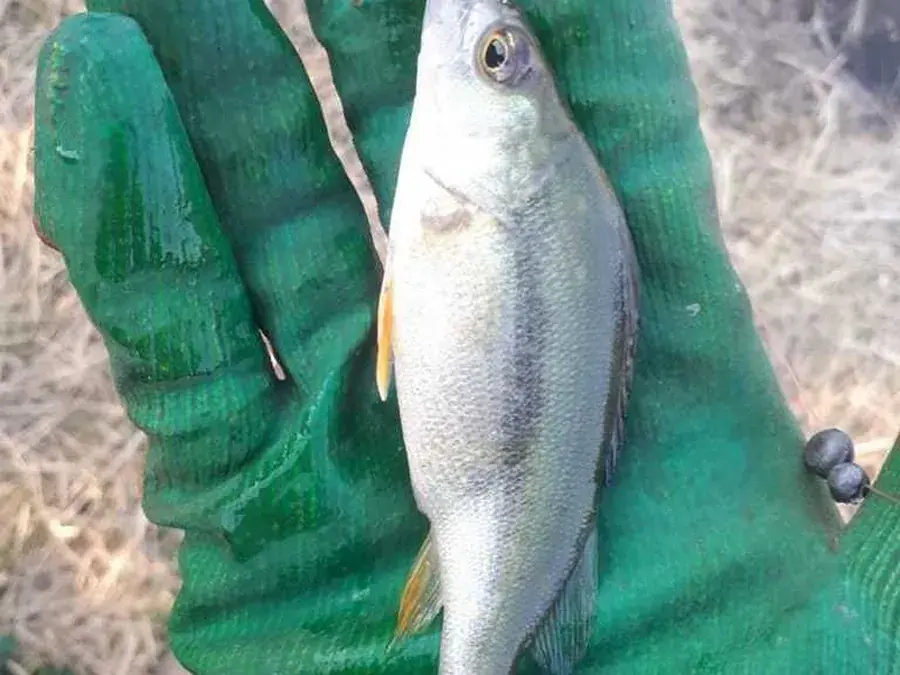
European perch
Perca fluviatilis
Five to eight dark bars on a greenish flank, bright red-orange lower fins, and a spiny first dorsal fin with a black blotch at the back.
Where and how to catch it →Photo: Дауд Арсанукаев · CC BY 4.0
 FishJun–Mar
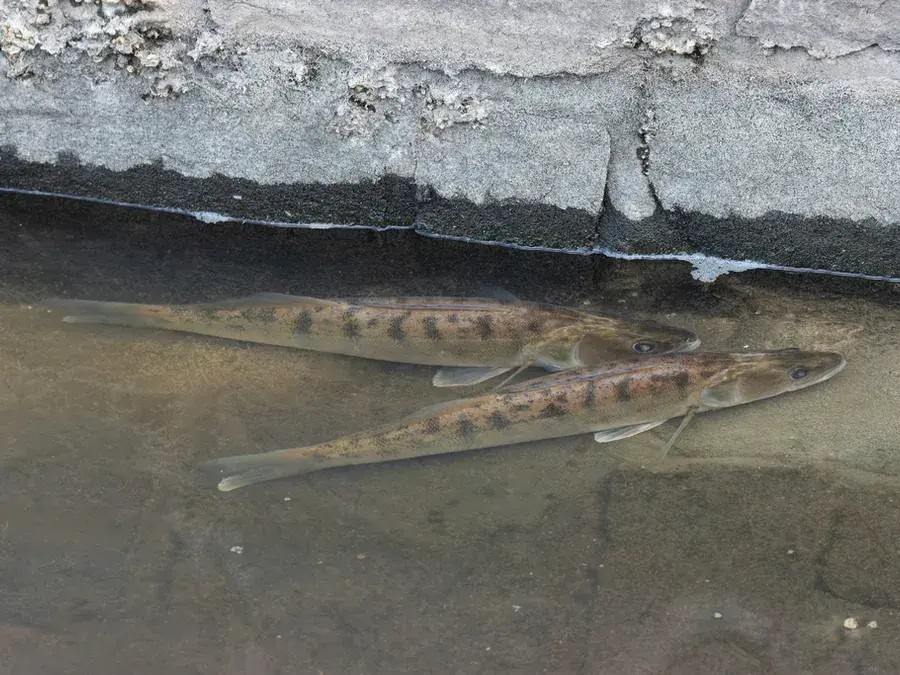
Zander
Sander lucioperca
Slim and glassy-eyed, with grey-brown saddles, rows of black spots on the spiny dorsal fin, and long fang-like canine teeth.
Where and how to catch it →Photo: Tomas Broucek · CC BY 4.0
 FishApr–Oct
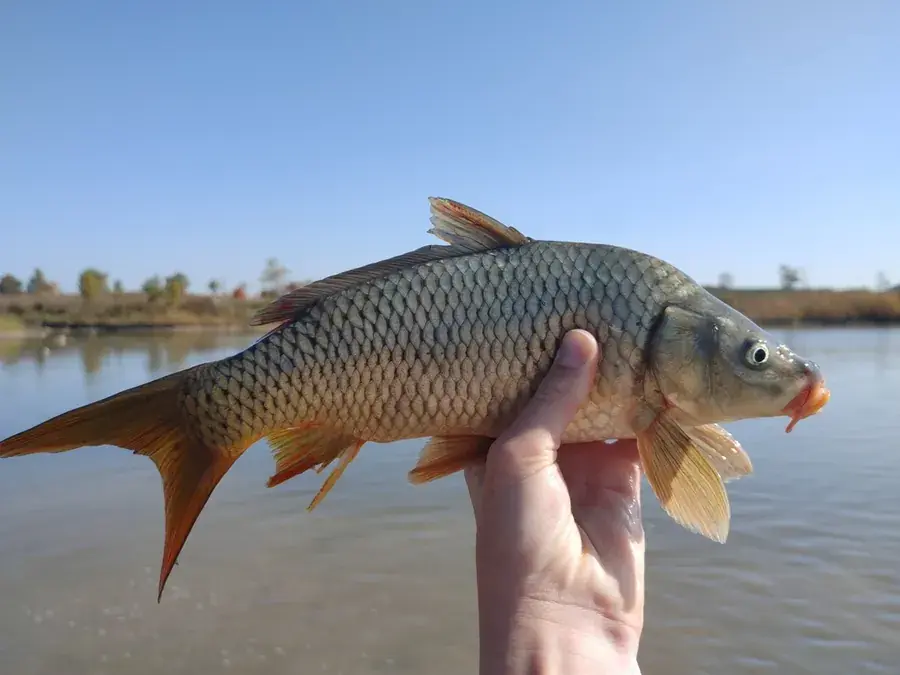
Common carp
Cyprinus carpio
Big bronze scales (or the scattered big scales of a mirror carp), a long dorsal fin, and two pairs of barbels at a rubbery, tube-like mouth.
Where and how to catch it →