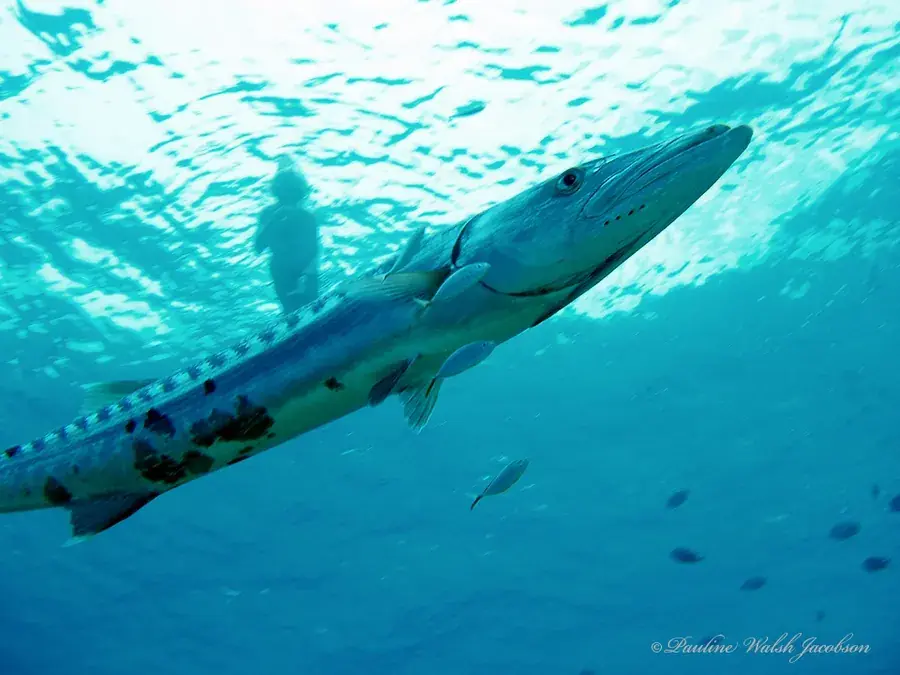
Photo by Pauline Walsh Jacobson on iNaturalist · CC BY 4.0
Great barracuda
Sphyraena barracuda
- When
- Active all year; habitat and behaviour shift with the season.
- Habitat
- Reefs, wrecks, channels, mangrove edges and seagrass flats — the flats and reefs of south Florida, the Red Sea and East African coast, Madagascar, northern KwaZulu-Natal, and West Africa from Mauritania to Nigeria.
- Identification
- A long, pike-like fish with a big, pointed head, a jutting lower jaw and fang-like teeth. Blue-grey above and silver below, with dark oblique bars on the upper side that stop short of the lateral line, scattered black blotches low on the flank, and a dark tail with white tips.
- Notes
- An ambush predator that relies on surprise and short bursts of speed — up to about 58 km/h (36 mph). Young fish school in mangroves and estuaries; big adults hunt alone around reefs and wrecks.
- Method
- A fast-retrieved tube lure or a bright plug over the flats and reef edges; live bait on a wire trace from a boat.
- Caution
- Barracuda can carry ciguatera toxin in many tropical waters, though it has not been reported from them in the eastern Atlantic — ask locally before eating one. In south-east Florida and the Keys the limit is two a day at 15–36 in (38–91 cm) fork length, with one larger fish allowed. Use a wire trace and keep hands clear of the teeth.
Seasons, size limits and catch limits change every year and differ by water body. Check the current regulations for the local jurisdiction and the water before fishing.
Great barracuda facts
- Also called
- Barracuda, ’cuda, sea pike or giant sea pike.
- Family
- Sphyraenidae, the barracudas.
- Native range
- Tropical and subtropical seas except the eastern Pacific: the Indo-Pacific from the Red Sea and East Africa to Hawaiʻi and French Polynesia; the western Atlantic from Massachusetts and Bermuda through the Caribbean to Brazil; the eastern Atlantic from Mauritania and Senegal to Nigeria and São Tomé. In South Africa mainly from KwaZulu-Natal northwards.
- Habitat
- Near the surface over reefs, seagrass, wrecks and channels, down to about 100 m (330 ft); juveniles live in mangroves, estuaries and sheltered inner reefs.
- Water temperature
- Tropical. AquaMaps puts its preferred surface water at about 25–29°C (77–84°F).
- Size
- Most adults 60–120 cm (24–47 in); the largest measured about 200 cm (79 in).
- Record
- IGFA all-tackle world record: 39.55 kg (87 lb 3 oz), Christian Loranger, Christmas Island, Kiribati, 23 September 2012.
- Lifespan
- Up to about 18 years.
- What it eats
- Fish — needlefish, halfbeaks, puffers, jacks and mullet among them — with squid and sometimes shrimp.
- Spawning
- In summer in the tropics; in the western Atlantic from about April to October, peaking July to September. Males mature at about two years and 55 cm fork length, females at three years and 70 cm.
- Young fish
- Young fish live among mangroves and reed beds in estuaries; small ones have a forked tail and irregular dark blotches along the sides.
- Teeth and mouth
- A large mouth with a jutting lower jaw and strong, fang-like teeth of unequal size, set in sockets in the jaws and the roof of the mouth.
- Look-alikes
- Pickhandle barracuda (Sphyraena jello) of the Indian Ocean has dark bars that cross the lateral line and a largely yellow tail. Wahoo has a snout as long as the rest of its head and a long first dorsal fin of 23–27 spines.
- Eating
- Sold fresh, dried or salted, but barracuda are a known source of ciguatera poisoning in many tropical waters; FishBase notes it has not been reported from them in the eastern Atlantic.
- Status
- Least Concern on the IUCN Red List (2013).
Interactive
Great barracuda: size range
Move the slider from a typical adult to the largest recorded specimen, shown against objects of known size.
Most adults you'll catch: 60–120 cm (24–47 in).
This great barracuda: 90 cm. Longer than a loaf of bread, shorter than a four-year-old.
The record
IGFA all-tackle world record: 39.55 kg (87 lb 3 oz), Christian Loranger, Christmas Island, Kiribati, 23 September 2012.
Questions people ask about great barracuda
Is barracuda safe to eat?
Not reliably. Barracuda can carry ciguatera toxin from reef food chains in many tropical waters, though FishBase notes no reports from the eastern Atlantic. Ask locally before eating one.
Are barracuda dangerous to swimmers?
Rarely. FishBase records that they occasionally attack people with a single, fierce strike — serious but rarely fatal. Keep hands well clear of a hooked fish’s teeth.
How big do great barracuda get?
Most adults are 60–100 cm (24–39 in); the species reaches 2 m (6 ft 7 in). The IGFA world record is 39.55 kg (87 lb 3 oz), from Christmas Island, Kiribati, in 2012.
Found in these regions
Checked against these sources ·
- FishBase — Sphyraena barracuda
- Mann (ed.), Southern African Marine Linefish Species Profiles — ORI Special Publication 9 (2013)
- Wikipedia — Great barracuda
- Florida Fish and Wildlife Conservation Commission — Great barracuda
- IGFA — World Records search
Sizes, records and ranges are for the species as a whole; local populations and rules vary. Records change; the record-keeper named above holds the current one.
Local activity
This week's guide for a place
Enter a town, postal code or ZIP for this week's conditions there, based on the local climate, this week's weather and the ecological region.
Also active in October
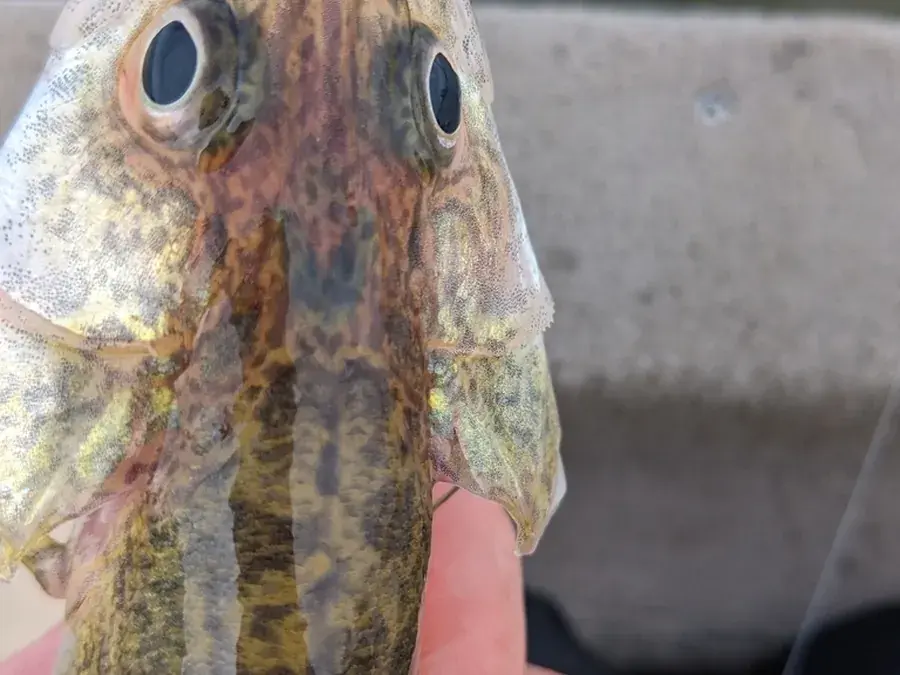 FishYear-round
Walleye
Sander vitreus
Olive-gold flanks, a spiny first dorsal, and the big glassy eye that gives it the name and lets it hunt in low light.
Habitat and methods →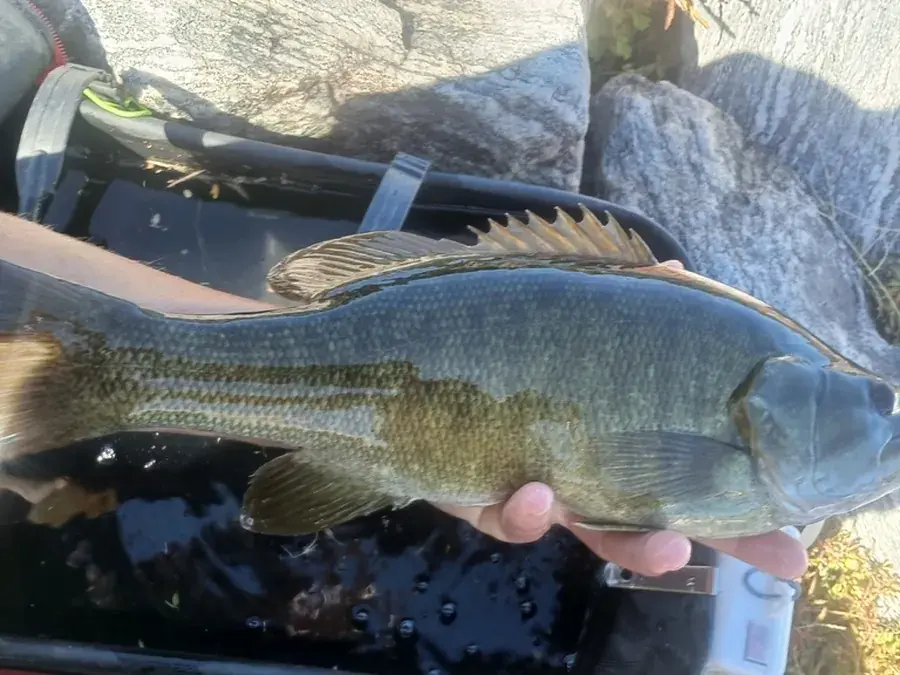 FishMay–Oct
Smallmouth bass
Micropterus dolomieu
Bronze-brown with vertical bars, red eye, and a jaw that ends level with the eye — not past it.
Habitat and methods →Photo: Joshua Johnson · CC BY 4.0
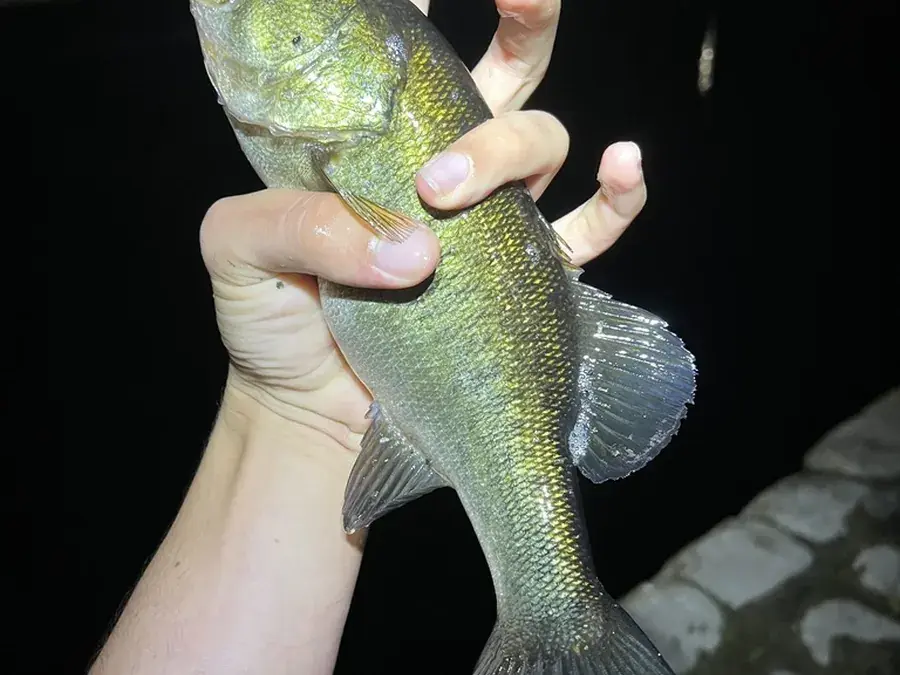 FishApr–Oct
Largemouth bass
Micropterus nigricans
Green with a dark lateral stripe, and an upper jaw that extends past the back of the eye.
Habitat and methods →Photo: Nick Tobler (Cowturtle) · CC BY 4.0