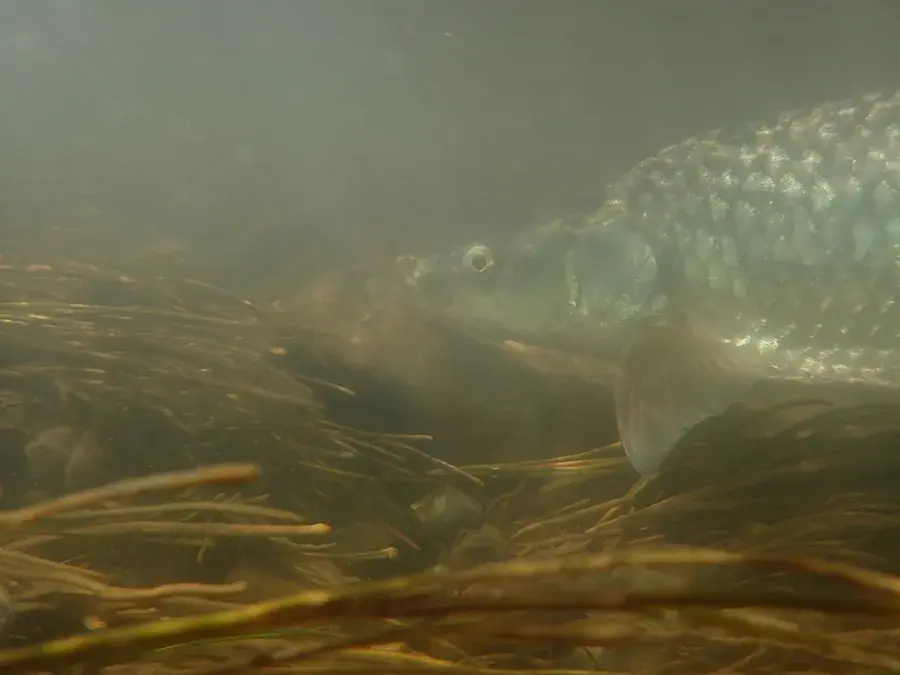
Photo by Mahomed Desai on iNaturalist · CC BY 4.0
Largemouth yellowfish
Labeobarbus kimberleyensis
- When
- May–Sep — May, June, July, August, September. Earlier where the water warms first.
- Where it holds
- Deep pools and the slow water above weirs and below rapids in the Orange and lower Vaal; the Orange below Gariep Dam and Van der Kloof Dam are the best of it.
- How to know it
- A yellowfish built for hunting: a longer, heavier head and a big mouth. The largest scaled fish native to southern Africa.
- What to know
- A slow-growing predator — about five years to reach 30 cm — and a prize for fly anglers. Most are caught in winter, May to September, when the rivers run low and clear.
- The tactic
- Black or olive Woolly Buggers and strip-leech streamers; a Dahlberg Diver on the surface for the take of a lifetime.
- Caution
- Near Threatened and listed under South Africa’s TOPS regulations: every largemouth yellowfish must be released immediately.
Seasons, size limits and catch limits change every year and differ by water body. Check the current regulations for the country and the water before you fish.
Largemouth yellowfish facts
- Also called
- Orange–Vaal largemouth yellowfish; formerly Barbus kimberleyensis. The Free State’s provincial fish emblem.
- Family
- Cyprinidae, the carp and minnow family — a large African barb.
- Native range
- Endemic to the Orange–Vaal (Orange–Senqu) system and its larger tributaries, such as the Riet, in South Africa, Lesotho and Namibia.
- Habitat
- Deep pools (over 2 m) of large rivers, and the slow water above weirs and dams; it also does well in dams. Needs plenty of cover and clean water. It roams farther than the smallmouth, often 4–6 km.
- Water temperature
- A warm-temperate river fish; it spawns in midsummer. Most are caught when the rivers are low, clear and cool in winter.
- Size
- Most adults 40–70 cm (16–28 in); the largest measured about 83 cm (33 in).
- Record
- IGFA all-tackle world record: 9.52 kg (21 lb), Ian Couryer, Vaal River, South Africa, 8 March 2005. FishBase lists fish to 82.5 cm fork length and 22.2 kg.
- Lifespan
- 12 years or more. It grows slowly, reaching 30 cm only after about five years.
- What it eats
- Insects and small crustaceans when young; above about 30 cm it eats almost nothing but fish.
- Spawning
- Midsummer to late summer, around December and January, over gravel beds in running water. A large female can lay more than 60,000 eggs in a season. Weirs, dams and silt have cut it off from many spawning grounds.
- Teeth and mouth
- A large mouth on a long, heavy head — the obvious difference from the smallmouth.
- Look-alikes
- Smallmouth yellowfish, in the same rivers, has a shorter head and a small mouth and feeds on the bottom. If in doubt, release it.
- Eating
- Do not keep it: it is protected, and toxins build up in its flesh as a top predator in polluted water.
- Status
- Near Threatened (IUCN and SANBI). Listed under South Africa’s Threatened or Protected Species (TOPS) regulations, which require every fish caught to be released immediately. Surveys after drought have found no fry in some dams.
Try it
How big does a largemouth yellowfish get?
Slide it from an ordinary adult to the biggest one ever measured, next to things you know the size of.
Most adults you'll catch: 40–70 cm (16–28 in).
This largemouth yellowfish: 55 cm. Longer than a loaf of bread, shorter than a four-year-old.
The record
IGFA all-tackle world record: 9.52 kg (21 lb), Ian Couryer, Vaal River, South Africa, 8 March 2005. FishBase lists fish to 82.5 cm fork length and 22.2 kg.
Questions people ask about largemouth yellowfish
Can you keep a largemouth yellowfish?
No. It is Near Threatened and listed under South Africa’s TOPS regulations, which prescribe immediate catch-and-release of every largemouth yellowfish. Wet your hands, keep the fight short, and get it back in the water fast.
Where can you catch largemouth yellowfish?
The Orange River below Gariep Dam holds more than the Vaal, and the lower Vaal between Bloemhof Dam and Douglas is good. Van der Kloof Dam produces outstanding fishing. Most are caught from May to September, when the rivers are low and clear.
How big do largemouth yellowfish get?
Up to about 82.5 cm (32 in) and 22 kg (49 lb), making it the largest scaled fish native to southern Africa. The IGFA all-tackle record is 9.52 kg (21 lb), from the Vaal River in 2005.
Found in these regions
Checked against these sources ·
- FishBase — Labeobarbus kimberleyensis
- SANBI Red List of South African Species — Largemouth yellowfish
- FOSAF — Guide to yellowfish
- Wikipedia — Largemouth yellowfish
Sizes, records and ranges are for the species as a whole; local fish, and local rules, vary. Records change — the record-keeper named above has the current one.
Is it active near you?
Get this week's guide for your area
Enter a town, postal code or ZIP and we'll tell you what's happening right there this week — from your local climate, this week's weather and your ecological region.
Also active in October
 FishYear-round
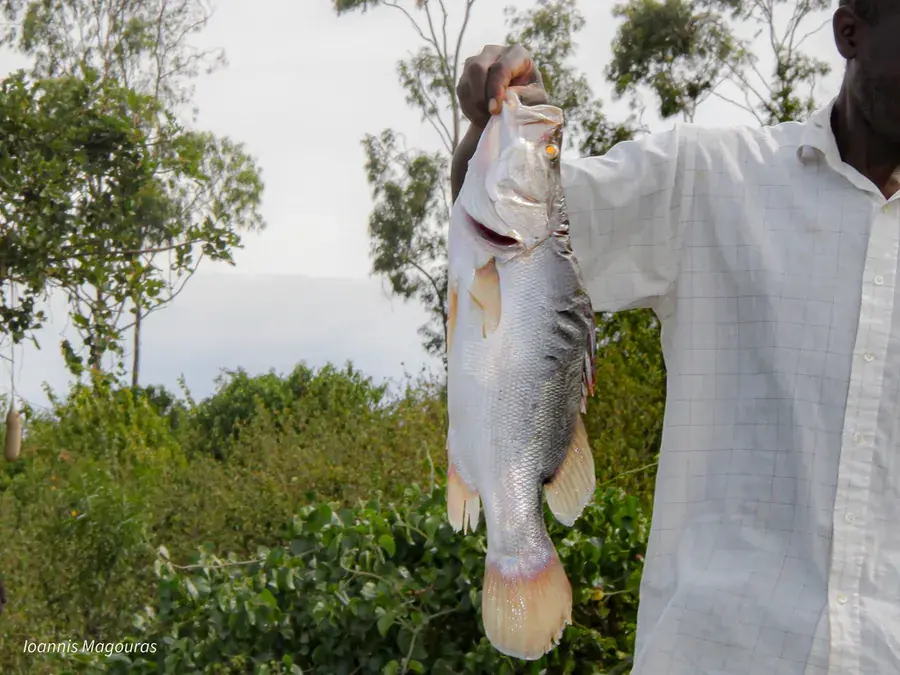
Nile perch
Lates niloticus
A huge silver perch with a blue sheen, a dorsal fin cut deeply into spiny and soft halves, a rounded tail, and a dark eye ringed in bright yellow.
Where and how to catch it →Photo: Ioannis Magouras · CC BY 4.0
 FishYear-round
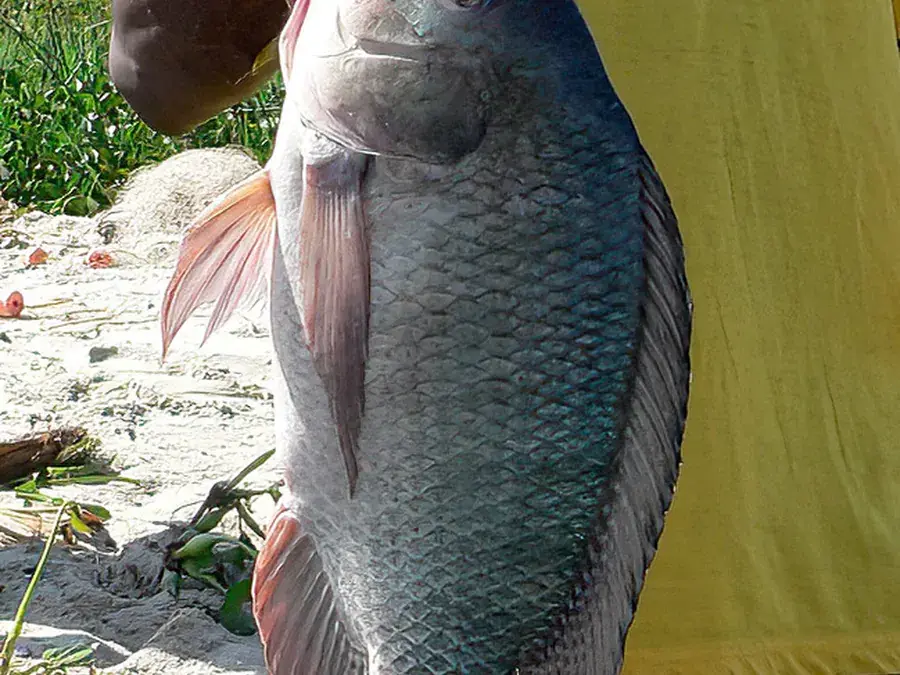
Nile tilapia
Oreochromis niloticus
Deep-bodied and grey-brown with faint bars, and the tell: regular dark vertical stripes right across the tail fin. Breeding males turn reddish, especially on the fins.
Where and how to catch it →Photo: Pål A. Olsvik · CC BY 4.0
 FishSep–Apr
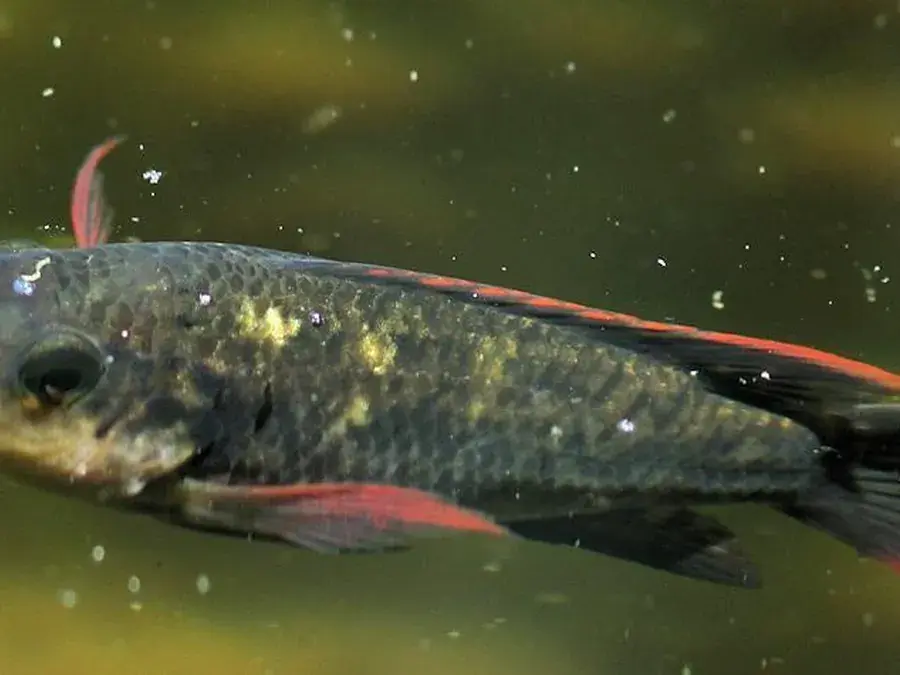
Mozambique tilapia (blue kurper)
Oreochromis mossambicus
Deep-bodied and dull silvery-olive with a few dark blotches along the side and no regular stripes on the tail. Breeding males turn black with a white throat, red-edged fins and a pointed, duck-bill snout.
Where and how to catch it →Photo: Wynand Uys · CC BY 4.0