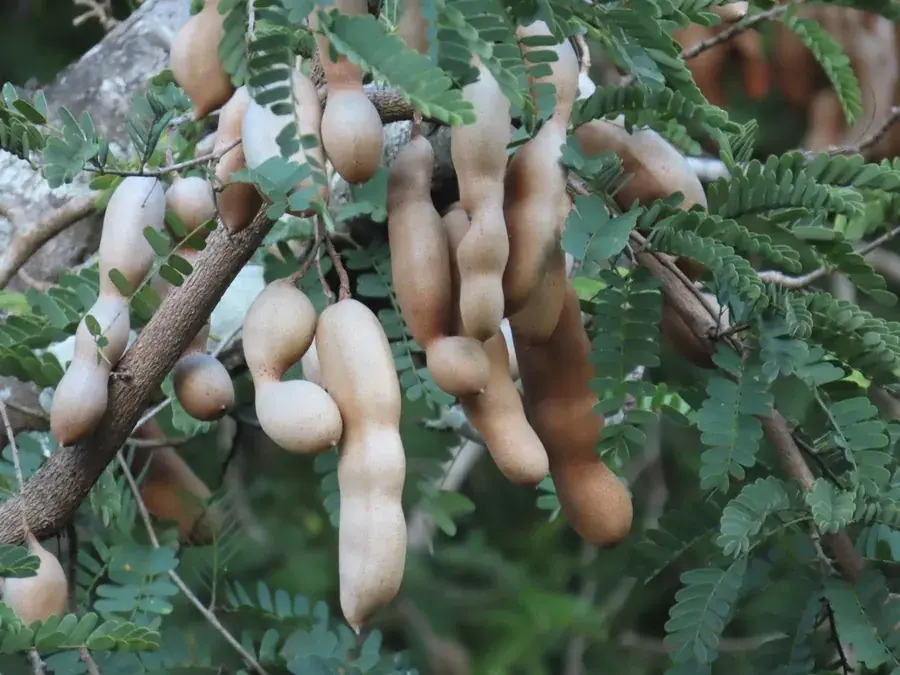
Photo by Maria Janeiro on iNaturalist · CC BY 4.0
FruitSeason: December – April
Tamarind
Tamarindus indica
- When
- Typically December – April — December, January, February, March, April. Earlier in warm, low country; later in the hills.
- Where it grows
- Dry savanna, riverbanks and village squares from Senegal to Sudan and down the east of the continent; a favourite shade tree, often very old.
- How to know it
- A big, dense, evergreen tree with feathery leaves of many small paired leaflets (no single leaflet at the tip) and small yellow flowers streaked with orange or red. The fruit is a brown, slightly curved pod with a thin, brittle shell over sticky, brown, sweet-sour pulp and one to six glossy brown seeds; African pods are the short kind.
- Look-alikes
- Other savanna pods are the confusion. A tamarind pod has a thin, brittle, cinnamon-brown shell that cracks under your thumb over sticky pulp; pods that are woody, flat, papery or hairy belong to something else.
- Harvest and use
- Crack the shell and eat the pulp off the seeds, or soak a handful in water, strain and sweeten it: tamarind drinks are made from Sudan and Egypt across West Africa and down the East African coast. A little goes into porridge. Young leaves, flowers and baby pods are pleasantly sour and used as seasoning.
- Caution
- The pulp is laxative in quantity. The seeds are edible only after soaking and boiling.
Tamarind at a glance
- Also called
- Tamarindo; in Arabic tamr hindi, 'Indian date', which gave the English name
- Family
- Fabaceae (the pea and bean family)
- Where it grows
- Native to tropical Africa, with its greatest diversity in the savannas from Senegal to Sudan. It grows wild across that savanna belt from the Atlantic to the far edge of Central Africa, and down the east of the continent through Ethiopia, Eritrea, Uganda, Kenya, Tanzania, Mozambique and Zimbabwe to Madagascar. Planted for shade and fruit almost everywhere warm.
- When to pick
- The dry season. The tree flowers with its new leaves and needs a long, well-marked dry season to set fruit; heavy crops usually come every other year. Pods are ripe when the shell is brown and brittle and the pulp sticky and brown, and fully ripe fruit can hang on the tree for up to six months without spoiling.
- Parts used
- Pulp (raw, in drinks, porridge and sauces); young leaves, flowers and baby pods as a sour seasoning; seeds only after soaking and boiling, then roasted or ground.
- Is any of it poisonous?
- Nothing poisonous in normal use. The pulp is laxative in quantity, and the seeds are inedible until soaked and boiled to remove the seed coat.
Questions people ask about tamarind
Where is tamarind native?
Tropical Africa. It has been grown in India for so long that it is sometimes taken for an Indian plant, but its origin and greatest diversity are in the African savannas from Senegal to Sudan, where it still grows wild.
When is tamarind ripe?
When the thin shell has turned brown and brittle and cracks easily, and the pulp inside is soft, sticky and brown. Pods ripen through the dry season and can stay on the tree for months.
Can you eat tamarind seeds?
Only after soaking and boiling them to remove the seed coat; then they can be roasted or ground into flour. Don't eat them raw.
How is tamarind used in Africa?
Above all as a drink: tamarind-ade is made in Sudan, Egypt, West Africa and on the East African coast. In West Africa a little tamarind goes into the millet porridge called toh, and in Uganda into millet porridge too.
Found in these regions
Is it ready near you?
Get this week's foraging guide for your area
Enter a town, postal code or ZIP and we'll tell you what's in season right there this week — from your local climate, this week's weather and your ecological region.
Also ready in October
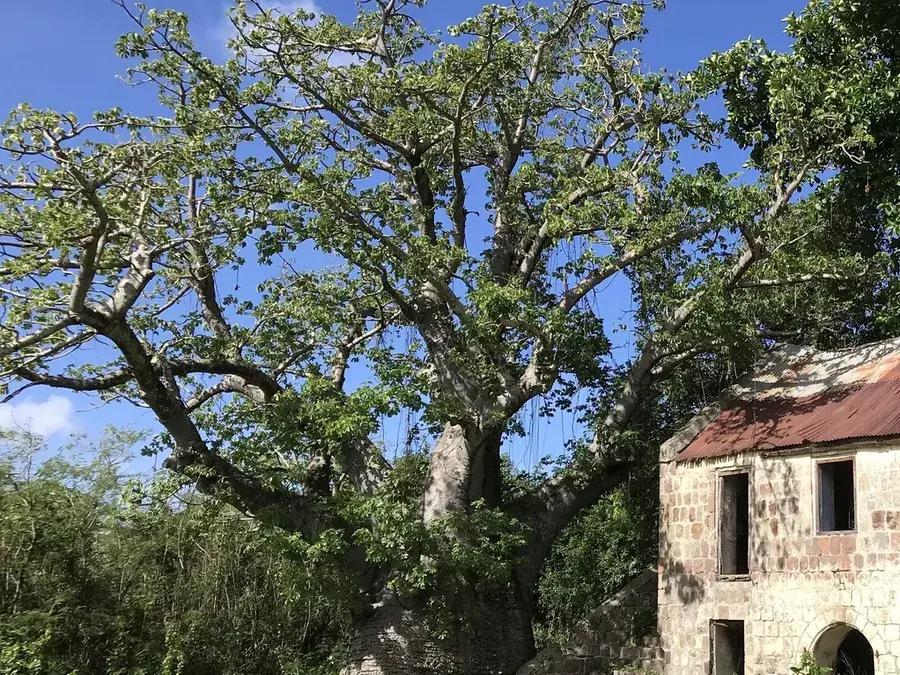 FruitOctober – February
Baobab (fruit and leaves)
Adansonia digitata
A vast, swollen grey trunk with smooth, folded bark and stubby branches that look like roots, bare of leaves for most of the dry season. The leaves are hand-shaped, with five to seven finger-like leaflets. The fruit is a velvety, egg- to sausage-shaped pod up to 25 cm (10 in) long on a long hanging stalk: a hard woody shell around chalky, off-white pulp and black kidney-shaped seeds.
How to know it & its look-alikes →Photo: Cliff Tyllick · CC BY 4.0
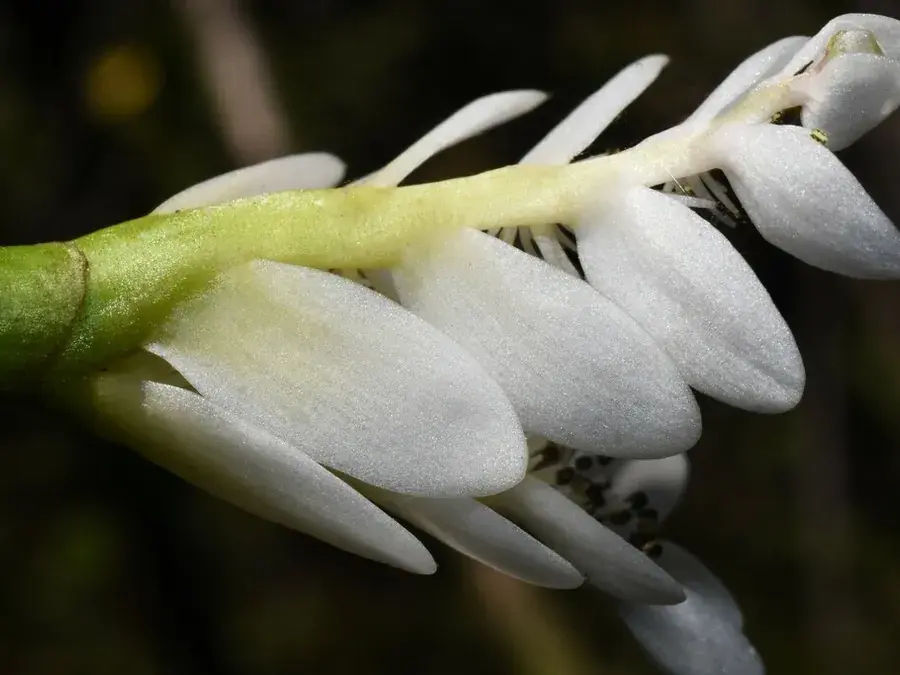 GreenJune – October
Waterblommetjie (Cape pondweed)
Aponogeton distachyos
Long-stalked, narrow-oval leaves floating flat on the water, and above them forked white flower spikes shaped like a 'Y', each branch lined with white petal-like bracts and dark purple-brown stamens, sweetly scented. The plant dies back as the pools dry in summer and regrows with the autumn rain.
How to know it & its look-alikes →Photo: Gabriel Campbell-Martinez · CC BY 4.0
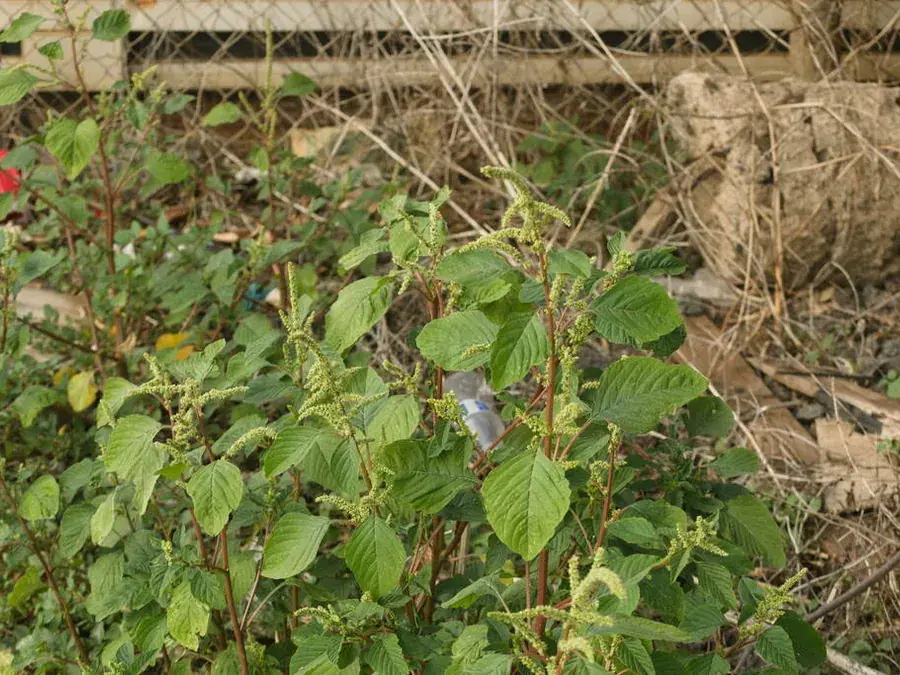 Has a dangerous look-alikeGreenMay – October
Amaranth greens (morogo, mchicha)
Amaranthus spp.
Upright or sprawling herbs, often with reddish stems, carrying alternate, oval to diamond-shaped, smooth-edged leaves on long stalks, and dense, bristly spikes of tiny green or reddish flowers at the top and in the leaf joints. No milky sap, no berries, no trumpet flowers. Spiny amaranth has a pair of sharp spines at each leaf base.
How to know it & its look-alikes →Photo: Kevin Faccenda · CC BY 4.0
Checked against these sources ·
- National Research Council — Lost Crops of Africa, Vol. III: Fruits — Tamarind
- World Agroforestry (ICRAF) Agroforestree Database — Tamarindus indica
- Wikipedia — Tamarind
Seasons are typical for the middle of the range and move by weeks north and south, and up and down hills.
Educational information only. Never eat a wild plant or mushroom identified from a single photograph or description — confirm with a regional field guide or an experienced forager, and know the poisonous species in your area first.