Giant African threadfin
Polydactylus quadrifilis
- When
- Active all year, though the way you fish or find it changes with the season.
- Where it holds
- Sandy and muddy shallows, surf beaches and river mouths along the West African coast from Senegal to Angola; the biggest fish stay out in the sea.
- How to know it
- A big silver fish with a pointed, see-through snout, a bright yellow pectoral fin with four long white threads beneath it, and a deeply forked tail.
- What to know
- West Africa’s great surf and estuary gamefish, reaching 2 m. The world record came from the mouth of Angola’s Kwanza River.
- The tactic
- Live or cut bait, or a big soft-plastic or bucktail jig, fished through the surf near a river mouth.
Seasons, size limits and catch limits change every year and differ by water body. Check the current regulations for the country and the water before you fish.
Giant African threadfin facts
- Also called
- Giant African threadfin; threadfin.
- Family
- Polynemidae, the threadfins.
- Native range
- The tropical eastern Atlantic off West Africa, from Senegal to Angola, with a single record from Mauritania.
- Habitat
- Shallow coastal water over sand and mud, surf beaches and estuaries; occasionally brackish and even fresh water. The very largest fish are found only in the sea.
- Water temperature
- Tropical coastal water, roughly 24–29°C (75–84°F) along the Gulf of Guinea.
- Size
- Most adults 80–150 cm (31–59 in); the largest measured about 200 cm (79 in).
- Record
- IGFA all-tackle world record: 55.4 kg (122 lb 2 oz), Stephan Bellingan, Barra do Kwanza, Angola, 20 July 2015.
- Lifespan
- Not well studied.
- What it eats
- Crustaceans and fish.
- Spawning
- Little is published on its spawning.
- Teeth and mouth
- Set low under a pointed, semi-transparent snout.
- Look-alikes
- Other threadfins are much smaller. The four long white filaments under a bright yellow pectoral fin, on a big silver fish, mark this one.
- Eating
- Fair to good eating, and an important commercial fish along the West African coast.
- Status
- Least Concern on the IUCN Red List.
Try it
How big does a giant african threadfin get?
Slide it from an ordinary adult to the biggest one ever measured, next to things you know the size of.
Most adults you'll catch: 80–150 cm (31–59 in).
This giant african threadfin: 115 cm. Longer than a four-year-old, shorter than a canoe paddle.
The record
IGFA all-tackle world record: 55.4 kg (122 lb 2 oz), Stephan Bellingan, Barra do Kwanza, Angola, 20 July 2015.
Questions people ask about giant african threadfin
What is a threadfin?
A fish with long, free rays — threads — under its pectoral fins, which it uses to feel for prey on the bottom. The giant African threadfin has four of them, white, beneath a bright yellow fin.
How big do giant African threadfin get?
Up to about 2 m (6 ft 7 in) and 75 kg (165 lb), with 1.5 m common. The IGFA world record is 55.4 kg (122 lb 2 oz), from the mouth of the Kwanza River in Angola, in 2015.
Where do giant African threadfin live?
Along the West African coast from Senegal to Angola, in surf, shallow sandy and muddy bays, and river mouths. They enter estuaries and occasionally fresh water, but the biggest stay at sea.
Found in these regions
Checked against these sources ·
Sizes, records and ranges are for the species as a whole; local fish, and local rules, vary. Records change — the record-keeper named above has the current one.
Is it active near you?
Get this week's guide for your area
Enter a town, postal code or ZIP and we'll tell you what's happening right there this week — from your local climate, this week's weather and your ecological region.
Also active in October
 FishYear-round
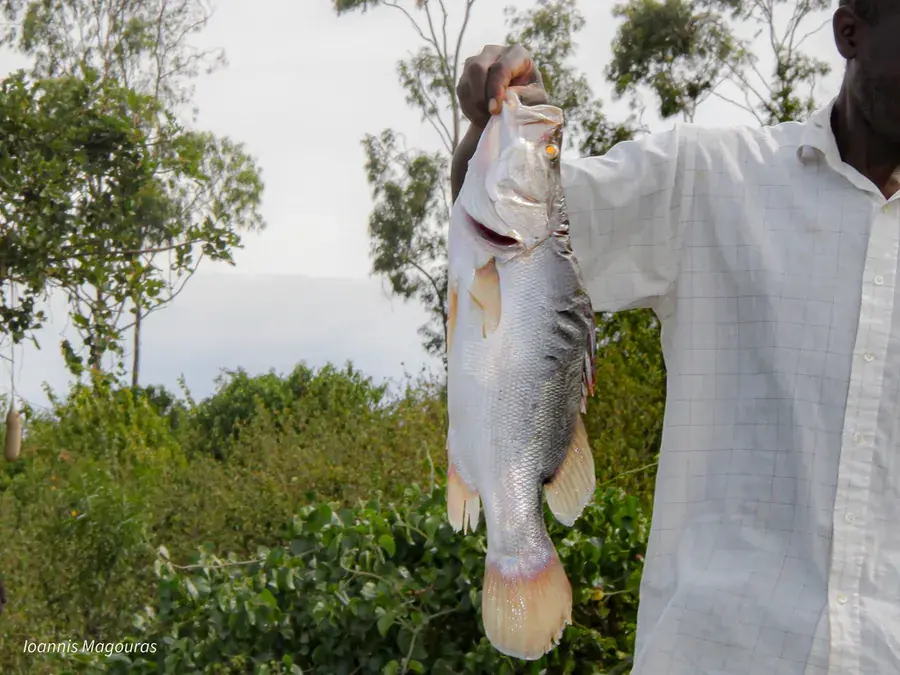
Nile perch
Lates niloticus
A huge silver perch with a blue sheen, a dorsal fin cut deeply into spiny and soft halves, a rounded tail, and a dark eye ringed in bright yellow.
Where and how to catch it →Photo: Ioannis Magouras · CC BY 4.0
 FishYear-round
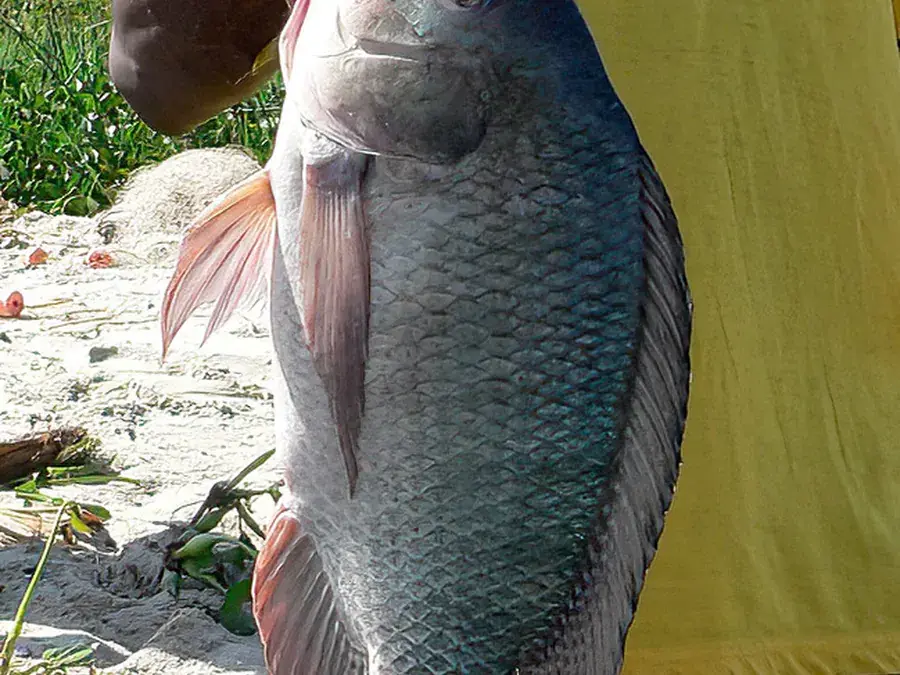
Nile tilapia
Oreochromis niloticus
Deep-bodied and grey-brown with faint bars, and the tell: regular dark vertical stripes right across the tail fin. Breeding males turn reddish, especially on the fins.
Where and how to catch it →Photo: Pål A. Olsvik · CC BY 4.0
 FishSep–Apr
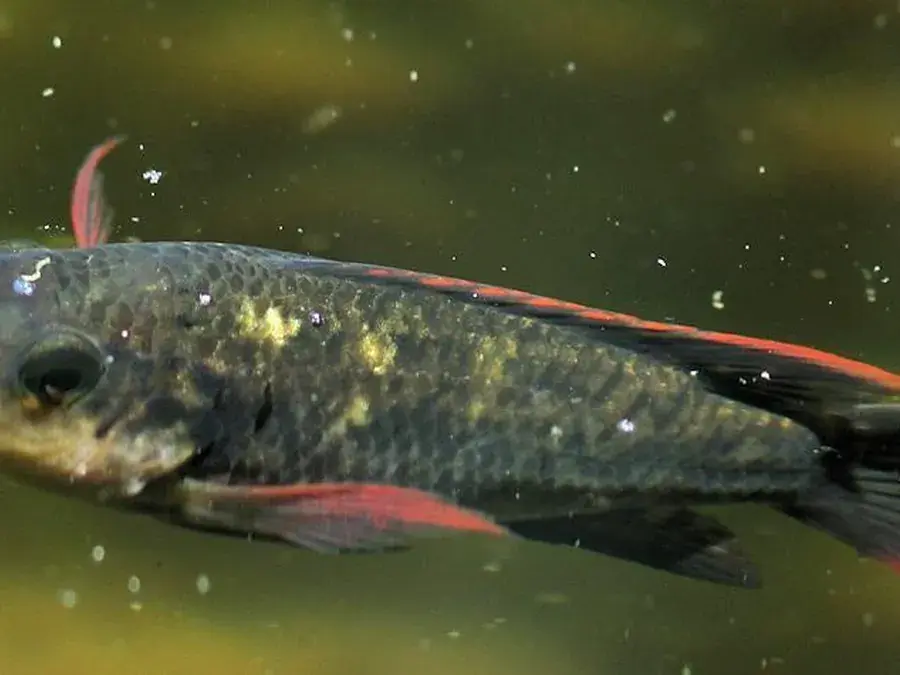
Mozambique tilapia (blue kurper)
Oreochromis mossambicus
Deep-bodied and dull silvery-olive with a few dark blotches along the side and no regular stripes on the tail. Breeding males turn black with a white throat, red-edged fins and a pointed, duck-bill snout.
Where and how to catch it →Photo: Wynand Uys · CC BY 4.0