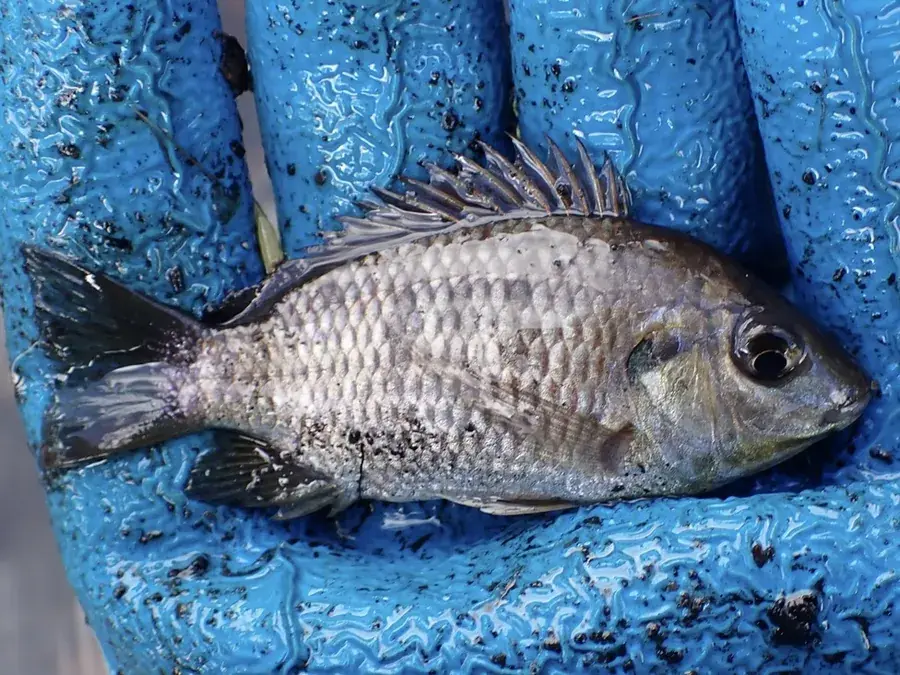
Photo by Thomas Irvine on iNaturalist · CC BY 4.0
Blackchin tilapia
Sarotherodon melanotheron
- When
- Active all year; habitat and behaviour shift with the season.
- Habitat
- Shallow, sheltered water in brackish lagoons, mangrove creeks and estuaries from Senegal to Cameroon — the Lagos Lagoon, Lake Nokoué and the Porto-Novo lagoon in Benin, the Ébrié lagoon at Abidjan and the Keta lagoon in Ghana — around mangrove roots, jetties and the brush parks (acadjas) of the Benin lagoons.
- Identification
- A small, deep-bodied tilapia, silvery with blue, gold or orange tints, with dark blotches on the chin and throat of adults, a dark rear edge to the gill cover, dark tips to the soft rays of the dorsal fin and irregular spots or faint bars along the sides.
- Notes
- The tilapia of West Africa’s coastal lagoons, and one of the few in which the male, not the female, broods the eggs in his mouth. It breeds all year in the warm lagoons, grazes mostly at night on algae, detritus and tiny animals, and lives in anything from fresh water to lagoons saltier than the sea.
- Method
- A small hook with bread, dough or a scrap of worm under a light float, fished close to mangrove roots, jetties and brush parks; loose-feed a little bread to draw the shoal.
- Caution
- Never move live tilapia between waters: introduced blackchin tilapia have overrun ponds and lagoons in Florida, Hawaii, the Philippines and Thailand. West African rules vary — ask locally.
Seasons, size limits and catch limits change every year and differ by water body. Check the current regulations for the country and the water before fishing.
Blackchin tilapia facts
- Also called
- Black-chinned tilapia, blackchin mouthbrooder or silvery tilapia; ‘saltwater tilapia’ in Hawaii; gloria or tilapiang arroyo in the Philippines. Formerly Tilapia melanotheron, T. heudelotii and T. leonensis.
- Family
- Cichlidae, the cichlids.
- Native range
- Brackish lagoons and estuaries of West Africa, from Mauritania to Cameroon.
- Introduced to
- Established in Florida — in the Tampa Bay system and the Indian River lagoon — and on Oʻahu, Hawaii, and invasive in the Philippines, including Manila Bay, and in Thailand, where it was found spreading in 2012 after an import for farming trials in 2010 and became a national priority in 2024.
- Habitat
- Shallow, sheltered water less than about 3 m (10 ft) deep in lagoons, estuaries and mangroves. It survives anything from fresh water to lagoons far saltier than the sea, but in West Africa it keeps to brackish water.
- Water temperature
- Warm water only. The Gulf of Guinea lagoons it lives in stay roughly 25–31°C (77–88°F) all year. In laboratory tests it stopped moving at 10–12°C and died at about 7°C (45°F).
- Size
- Most adults 12–20 cm (5–8 in); the largest measured about 28 cm (11 in).
- Record
- IGFA keeps no category for blackchin tilapia.
- Lifespan
- Not well documented.
- What it eats
- Algae and the film of life on submerged surfaces, detritus, small bivalves and zooplankton, picked up in bites, mostly at night.
- Spawning
- All year round in the warm West African lagoons. Unusually, the female leads the courtship and digs the nest pit; once the eggs are fertilised, the male picks them up and carries them in his mouth. They hatch after about five days, and the young stay in his mouth for a little over a week more. Fish mature at about 12–13 cm.
- Young fish
- Released from the father’s mouth as free-swimming fry about two weeks after spawning.
- Teeth and mouth
- Small, with up to a few hundred tiny teeth set in three to six rows.
- Look-alikes
- Guinean tilapia (Coptodon guineensis), the other lagoon tilapia of the coast, has a strongly arched head and a tail that is grey above and yellow below, and no black chin. Nile tilapia, in fresh water upstream, has regular dark bars across its tail fin.
- Eating
- A popular food fish in West Africa’s lagoon fisheries, fried, grilled or smoked, and also farmed.
- Status
- Least Concern on the IUCN Red List (2019) in its native range; a damaging invasive species where it has been introduced.
Interactive
Blackchin tilapia: size range
Move the slider from a typical adult to the largest recorded specimen, shown against objects of known size.
Most adults you'll catch: 12–20 cm (5–8 in).
This blackchin tilapia: 16 cm. Shorter than a hand.
The record
IGFA keeps no category for blackchin tilapia.
Questions people ask about blackchin tilapia
Why is it called the blackchin tilapia?
For the dark patches on the chin and throat of adult fish. In the Philippines the mark earned it the nickname gloria, after former president Gloria Macapagal-Arroyo and the mole on her cheek.
Which parent carries the eggs?
The father. In most mouthbrooding tilapias the female broods the eggs, but in the blackchin the male picks up the fertilised eggs and keeps them and the newly hatched young in his mouth for about two weeks.
Is blackchin tilapia invasive?
Outside West Africa, yes. It is established in Florida and Hawaii and spreading in the Philippines and Thailand, where it has damaged shrimp and fish farms and coastal wetlands; Thailand made its control a national priority in 2024. Never move live tilapia from one water to another.
Found in these regions
Checked against these sources ·
- FishBase — Sarotherodon melanotheron
- FishBase — Coptodon guineensis
- US Fish and Wildlife Service — Blackchin tilapia, Ecological Risk Screening Summary (2026)
- Wikipedia — Blackchin tilapia
Sizes, records and ranges are for the species as a whole; local populations and rules vary. Records change; the record-keeper named above holds the current one.
Local activity
This week's guide for a place
Enter a town, postal code or ZIP for this week's conditions there, based on the local climate, this week's weather and the ecological region.
Also active in October
 FishYear-round
Nile perch
Lates niloticus
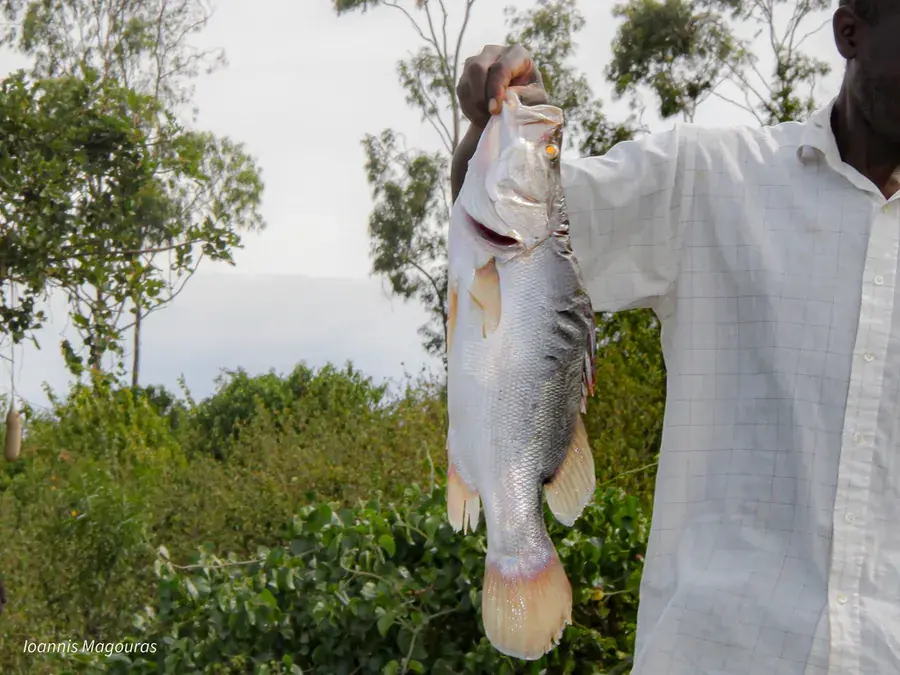
A huge silver perch with a blue sheen, a dorsal fin cut deeply into spiny and soft halves, a rounded tail, and a dark eye ringed in bright yellow.
Habitat and methods →Photo: Ioannis Magouras · CC BY 4.0
 FishYear-round
Nile tilapia
Oreochromis niloticus
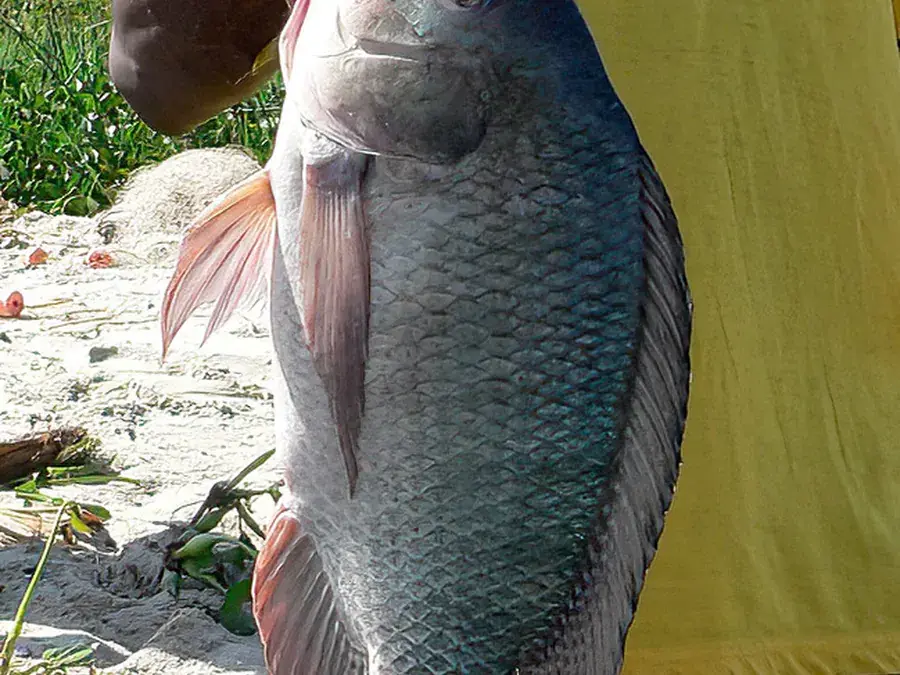
Deep-bodied and grey-brown with faint bars, and the tell: regular dark vertical stripes right across the tail fin. Breeding males turn reddish, especially on the fins.
Habitat and methods →Photo: Pål A. Olsvik · CC BY 4.0
 FishSep–Apr
Mozambique tilapia (blue kurper)
Oreochromis mossambicus
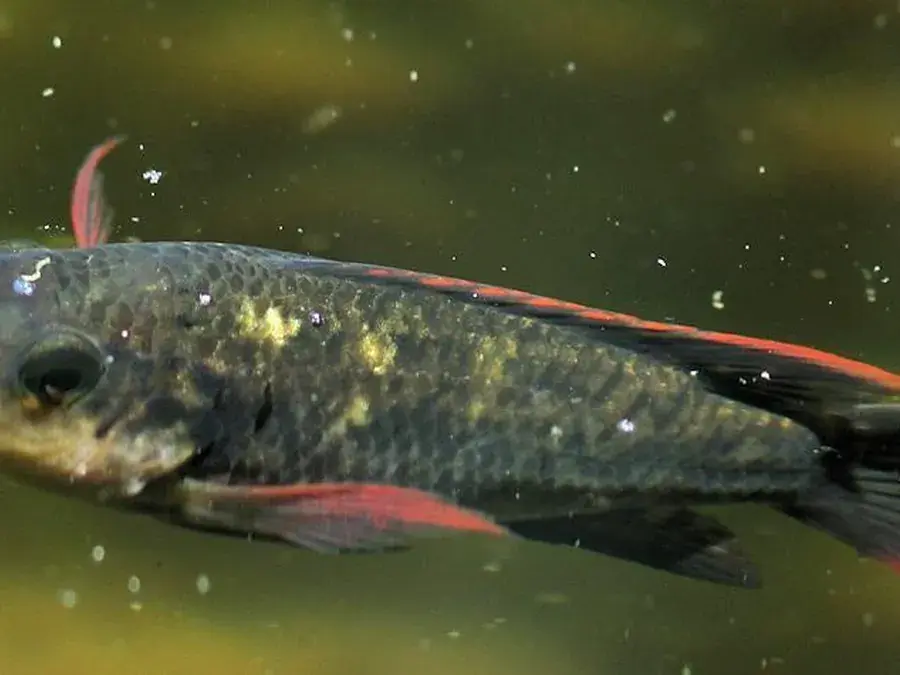
Deep-bodied and dull silvery-olive with a few dark blotches along the side and no regular stripes on the tail. Breeding males turn black with a white throat, red-edged fins and a pointed, duck-bill snout.
Habitat and methods →Photo: Wynand Uys · CC BY 4.0