Photo by Karim Haddad on iNaturalist · CC BY 4.0
Cassava croaker
Pseudotolithus senegalensis
- When
- Active all year; habitat and behaviour shift with the season.
- Habitat
- Mud, sand and broken ground from the beach out to about 70 m along the coast from Senegal to Angola — off surf beaches near river mouths, and on the inshore grounds fished from canoes and boats. Smaller fish come into shallow water, but it seldom enters lagoons or estuaries.
- Identification
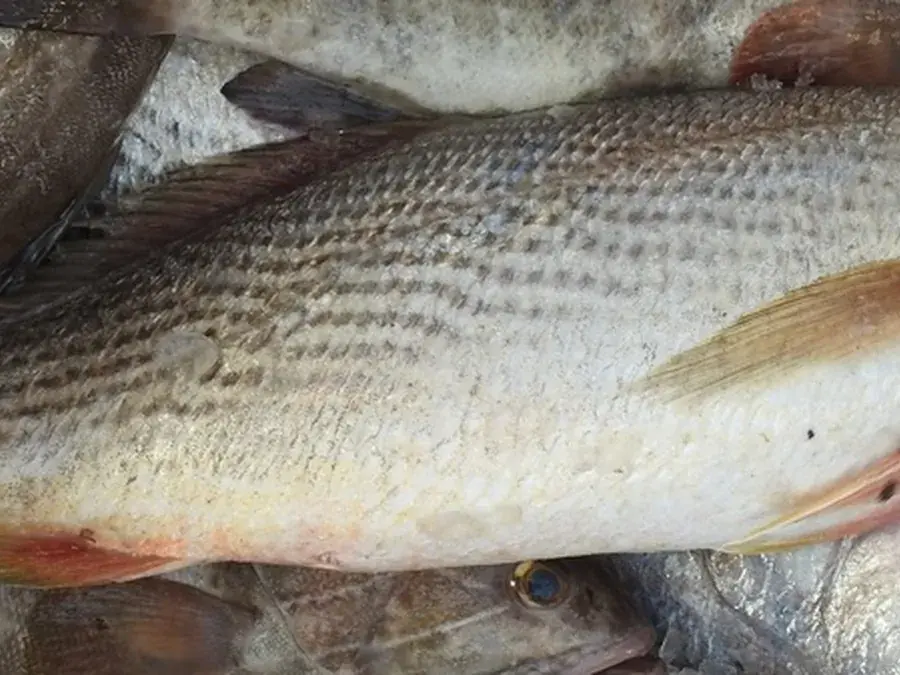
- A long, silvery-grey croaker with a big, oblique mouth, a slightly jutting lower jaw and a pair of large canine teeth at the front of the upper jaw. Rows of small dark spots follow the scale rows, the spiny dorsal fin has a black tip, the tail is pointed and the inside of the gill cover is black.
- Notes
- West Africa’s most valuable bottom fish and a staple of every coastal market. It hunts small fish, prawns and crabs over soft ground and spawns from November to March in the Gulf of Guinea. Heavy trawl and canoe fishing have made it Endangered.
- Method
- Cut fish, squid or a whole prawn on a running ledger, fished on the bottom from the beach or from a boat over mud; a jig or soft plastic bounced slowly along the bottom.
- Caution
- Listed as Endangered by the IUCN: keep only what you need and return fish under about 35 cm, the size at which they mature. West African rules vary — ask locally.
Seasons, size limits and catch limits change every year and differ by water body. Check the current regulations for the country and the water before fishing.
Cassava croaker facts
- Also called
- Cassava drum, croaker or simply cassava in English-speaking West Africa; bar and otolithe sénégalais in French; corvina and rainha in Portuguese.
- Family
- Sciaenidae, the drums and croakers.
- Native range
- The West African coast from Morocco to Angola, but rare north of Senegal; also reported from Namibia.
- Habitat
- Coastal water over mud, sand and rock from the shore to about 70 m (230 ft). Smaller fish live in shallow water, but rarely enter estuaries.
- Water temperature
- Tropical. AquaMaps puts its preferred surface water at about 24–28°C (76–82°F); it is seldom found in water cooler than 16°C (61°F).
- Size
- Most adults 35–60 cm (14–24 in); the largest measured about 114 cm (45 in).
- Record
- IGFA all-tackle world record: 14.2 kg (31 lb 4 oz), Michel Delaunay, Bubaque Island, Guinea-Bissau, 4 August 2009.
- Lifespan
- At least 8 years — the oldest recorded, from the mouth of the Congo River (FishBase).
- What it eats
- Small fish — FishBase records the fry of the long-finned herring — with prawns, shrimps and crabs.
- Spawning
- November to March in the Gulf of Guinea, in water of 22–25°C (72–77°F). Fish mature at about 35 cm.
- Young fish
- Small fish live in shallow coastal water.
- Teeth and mouth
- Large and oblique, with a slightly jutting lower jaw, bands of fine teeth and a pair of large canines at the front of the upper jaw. The inside of the gill cover is black.
- Look-alikes
- Longneck croaker (Pseudotolithus typus) grows larger, has an even smaller eye and an upper jaw that reaches past the eye, and its young enter estuaries and rivers. Bobo croaker (Pseudotolithus elongatus) is smaller, with a larger eye and a very strong second anal spine, and lives close inshore and in lagoons.
- Eating
- Excellent, with white, flaky flesh; West Africa’s most important bottom fish for food and a mainstay of coastal markets.
- Status
- Endangered on the IUCN Red List (2020), for a decline inferred from catch rates and the weight of fishing along the coast.
Interactive
Cassava croaker: size range
Move the slider from a typical adult to the largest recorded specimen, shown against objects of known size.
Most adults you'll catch: 35–60 cm (14–24 in).
This cassava croaker: 48 cm. Longer than a loaf of bread, shorter than a four-year-old.
The record
IGFA all-tackle world record: 14.2 kg (31 lb 4 oz), Michel Delaunay, Bubaque Island, Guinea-Bissau, 4 August 2009.
Questions people ask about cassava croaker
Why is it called a croaker?
Croakers and drums make a loud drumming or croaking sound by vibrating muscles against the swim bladder, and you can often hear it when one is landed.
Is the cassava croaker endangered?
Yes. The IUCN listed it as Endangered in 2020 because heavy trawl and canoe fishing along the West African coast have sharply reduced it. Keep only what you need and return fish under about 35 cm, the size at which they mature.
How big do cassava croakers get?
Most are 35–60 cm (14–24 in), and the species reaches 114 cm (45 in). The IGFA world record is 14.2 kg (31 lb 4 oz), from Bubaque Island in Guinea-Bissau’s Bijagós archipelago, in 2009.
Found in these regions
Checked against these sources ·
- FishBase — Pseudotolithus senegalensis
- FishBase — Pseudotolithus typus
- FishBase — Pseudotolithus elongatus
- Wikipedia — Pseudotolithus senegalensis
- IGFA — World Records search
Sizes, records and ranges are for the species as a whole; local populations and rules vary. Records change; the record-keeper named above holds the current one.
Local activity
This week's guide for a place
Enter a town, postal code or ZIP for this week's conditions there, based on the local climate, this week's weather and the ecological region.
Also active in October
 FishYear-round
Nile perch
Lates niloticus
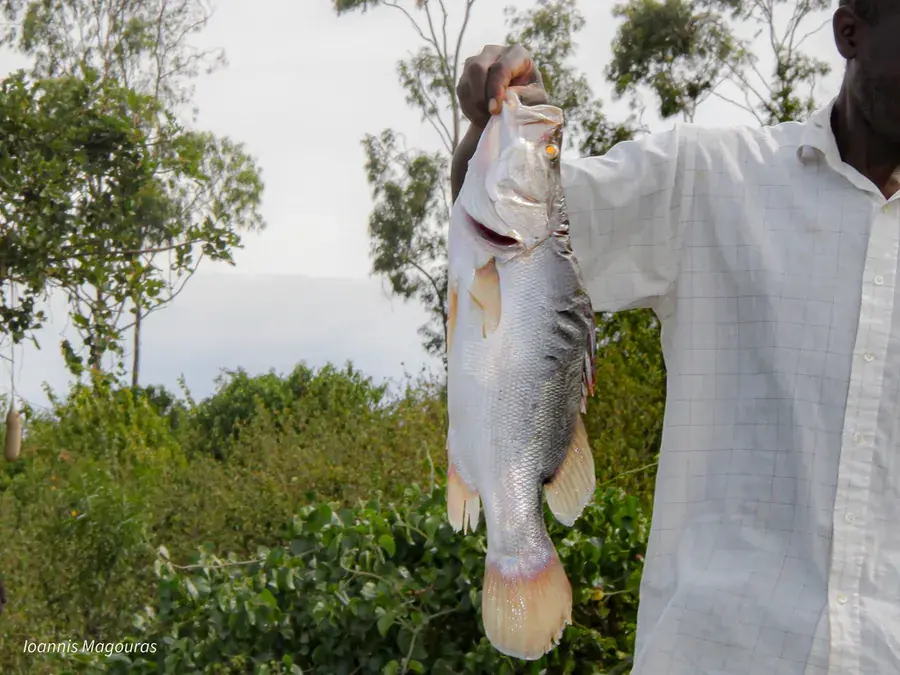
A huge silver perch with a blue sheen, a dorsal fin cut deeply into spiny and soft halves, a rounded tail, and a dark eye ringed in bright yellow.
Habitat and methods →Photo: Ioannis Magouras · CC BY 4.0
 FishYear-round
Nile tilapia
Oreochromis niloticus
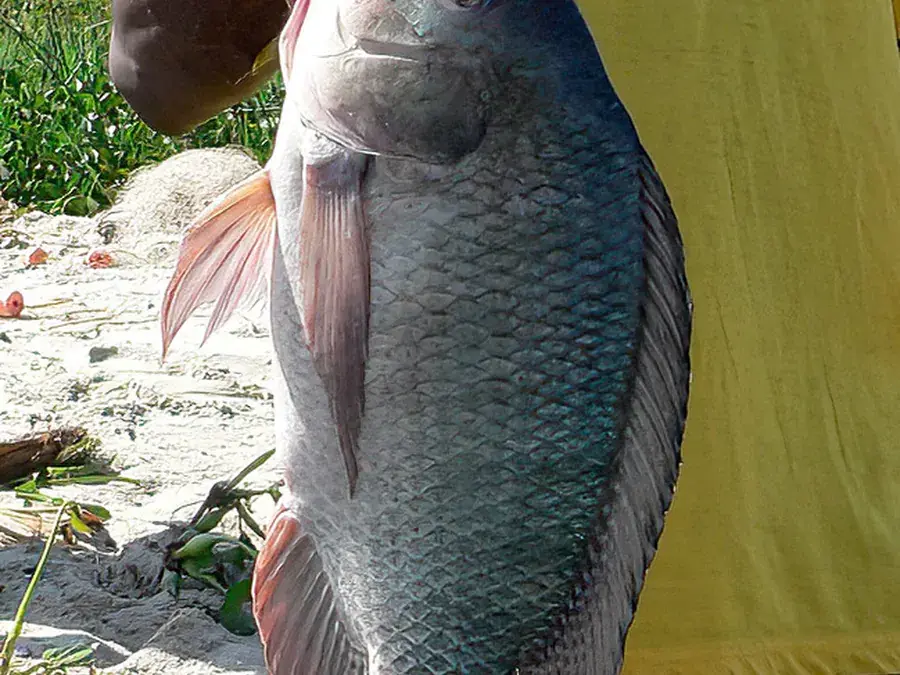
Deep-bodied and grey-brown with faint bars, and the tell: regular dark vertical stripes right across the tail fin. Breeding males turn reddish, especially on the fins.
Habitat and methods →Photo: Pål A. Olsvik · CC BY 4.0
 FishSep–Apr
Mozambique tilapia (blue kurper)
Oreochromis mossambicus
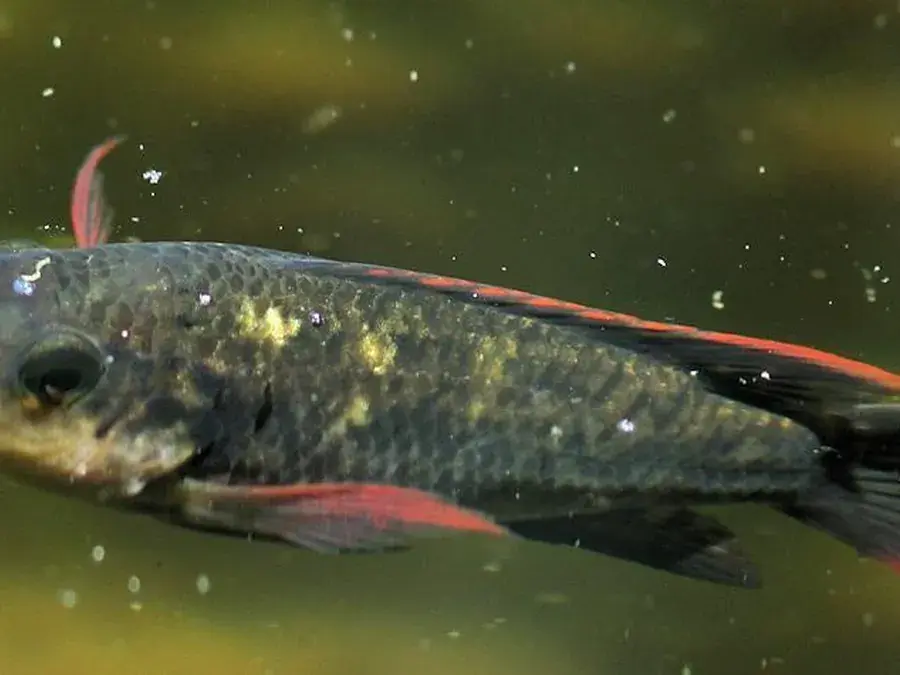
Deep-bodied and dull silvery-olive with a few dark blotches along the side and no regular stripes on the tail. Breeding males turn black with a white throat, red-edged fins and a pointed, duck-bill snout.
Habitat and methods →Photo: Wynand Uys · CC BY 4.0