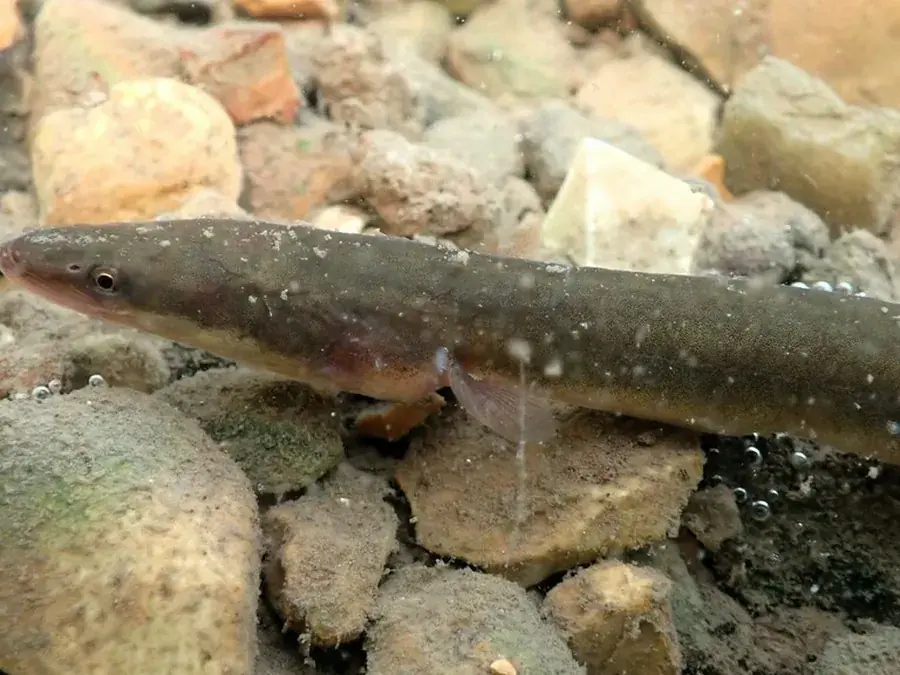
Photo by Nicola Crockford on iNaturalist · CC BY 4.0
European eel
Anguilla anguilla
- When
- Jun–Sep — June, July, August, September. Earlier where the water warms first.
- Where it holds
- Any water connected to the sea — rivers, lakes, canals, ditches, estuaries and coasts — hidden in mud, stones and weed by day.
- How to know it
- Snake-like and slimy with tiny buried scales, one long fin running round the tail, and a lower jaw that juts past the upper.
- What to know
- Critically endangered. Every European eel hatched in the Sargasso Sea and drifted to Europe as a larva, and the numbers arriving have fallen by about 90% since the 1970s. Don't fish for them.
- The tactic
- Don't target eels. If one takes a bait meant for something else, unhook it quickly in the water — or cut the line close if the hook is deep — and let it go.
- Caution
- Closed or protected across much of its range: Ireland's eel fishery has been closed since 2009, anglers in England must return every eel, and recreational eel fishing is banned in EU waters of the Mediterranean and Black Sea. Never keep one.
Seasons, size limits and catch limits change every year and differ by water body. Check the current regulations for the country and the water before you fish.
European eel facts
- Also called
- Eel; glass eels and elvers when young, yellow eels while growing, silver eels when they head back to sea. Anguille in French, anguila in Spanish, Aal in German, paling in Dutch, ål in Swedish and Danish.
- Family
- Anguillidae, the freshwater eels.
- Native range
- The Atlantic coast from Scandinavia to Morocco, and the Baltic, Mediterranean and Black seas, with the rivers and lakes that drain to them. It spawns far away, in the Sargasso Sea in the western Atlantic.
- Habitat
- Every kind of water connected to the sea — streams, big rivers, lakes, ponds, canals, estuaries and coasts — living on the bottom, hidden under stones, in mud or in crevices. Some never leave estuaries and coastal water.
- Water temperature
- Temperate; FishBase gives about 4–20°C (39–68°F). It feeds most in warm summer months and goes quiet in winter.
- Size
- Most adults 35–80 cm (14–31 in); the largest measured about 133 cm (52 in).
- Record
- IGFA all-tackle world record: 3.6 kg (7 lb 14 oz), Christoph Lave, River Aare at Büren, Switzerland, 1992, tied with a 3.59 kg fish from Sweden's Lyckebyån (1988). The British record is 5.074 kg (11 lb 3 oz), from a southern stillwater in 2024. In England every eel must now be returned.
- Lifespan
- Eels spend 6–12 years (males) or 9–20 years (females) growing in fresh water before they migrate; FishBase gives 23 years as the oldest reported. They spawn once, far out at sea, and die.
- What it eats
- Almost any small animal on the bottom: insect larvae, worms, snails, crustaceans and small fish, and carrion. Mostly active at night.
- Spawning
- Silver eels swim thousands of kilometres to the Sargasso Sea to spawn and die there. In 2022 scientists followed satellite-tagged eels from the Azores towards the Sargasso — the first direct evidence of the journey. No one has yet watched them spawn.
- Young fish
- Transparent, leaf-shaped larvae drift to Europe on the Gulf Stream over about 7–11 months, turn into glass eels 6–8 cm long, and swim up estuaries and rivers. They darken into elvers, then grow on as yellow eels.
- Teeth and mouth
- A wide mouth with small teeth; the lower jaw juts beyond the upper.
- Look-alikes
- American eel: almost identical, told apart by vertebra counts or DNA; both spawn in the Sargasso Sea. Conger eel: a sea fish whose upper jaw overhangs the lower, with the dorsal fin starting just behind the pectoral fins. Lampreys have no jaws and no paired fins.
- Eating
- Once a staple — smoked, jellied or stewed — but the species is critically endangered, and eel cannot yet be bred in captivity, so every farmed eel began as a wild-caught glass eel.
- Status
- Critically Endangered on the IUCN Red List. Numbers arriving in Europe have fallen by around 90% (possibly 98%) since the 1970s. Listed on CITES Appendix II; the EU eel regulation (2007) requires national recovery plans, and ICES advises zero catches of all life stages.
Try it
How big does a european eel get?
Slide it from an ordinary adult to the biggest one ever measured, next to things you know the size of.
Most adults you'll catch: 35–80 cm (14–31 in).
This european eel: 58 cm. Longer than a loaf of bread, shorter than a four-year-old.
The record
IGFA all-tackle world record: 3.6 kg (7 lb 14 oz), Christoph Lave, River Aare at Büren, Switzerland, 1992, tied with a 3.59 kg fish from Sweden's Lyckebyån (1988). The British record is 5.074 kg (11 lb 3 oz), from a southern stillwater in 2024. In England every eel must now be returned.
Questions people ask about european eel
Is it legal to fish for eels?
It depends where, and in many places, no. Ireland has closed its eel fishery since 2009; in England anglers must return every eel they catch, including in coastal waters; and recreational eel fishing is banned in EU waters of the Mediterranean and Black Sea. Elsewhere there are closed seasons and licences. The kindest rule: never keep one.
Why are European eels endangered?
Because far fewer young eels are reaching Europe — roughly 90% fewer than in the 1970s. Dams and weirs block their way upriver, hydroelectric turbines kill migrating silver eels, parasites and pollution weaken them, and glass eels have been heavily fished and smuggled for the farming trade.
Where do eels breed?
In the Sargasso Sea, in the western Atlantic, thousands of kilometres from Europe. The larvae drift back on the Gulf Stream. In 2022, satellite-tagged eels released from the Azores were tracked heading into the Sargasso — the first direct evidence — but no one has yet seen them spawn.
What should I do if I catch an eel by accident?
Unhook it quickly and gently, ideally without lifting it from the water, and let it go. If the hook is deep, cut the line as close to the mouth as you can rather than tearing it out.
Found in these regions
Checked against these sources ·
- FishBase — Anguilla anguilla
- European Commission — European eel
- Wright et al. (2022), First direct evidence of adult European eels migrating to their breeding place in the Sargasso Sea — Scientific Reports
- GOV.UK — Environment Agency rod fishing byelaws: national byelaws for England
Sizes, records and ranges are for the species as a whole; local fish, and local rules, vary. Records change — the record-keeper named above has the current one.
Is it active near you?
Get this week's guide for your area
Enter a town, postal code or ZIP and we'll tell you what's happening right there this week — from your local climate, this week's weather and your ecological region.
Also active in October
 FishJun–Mar
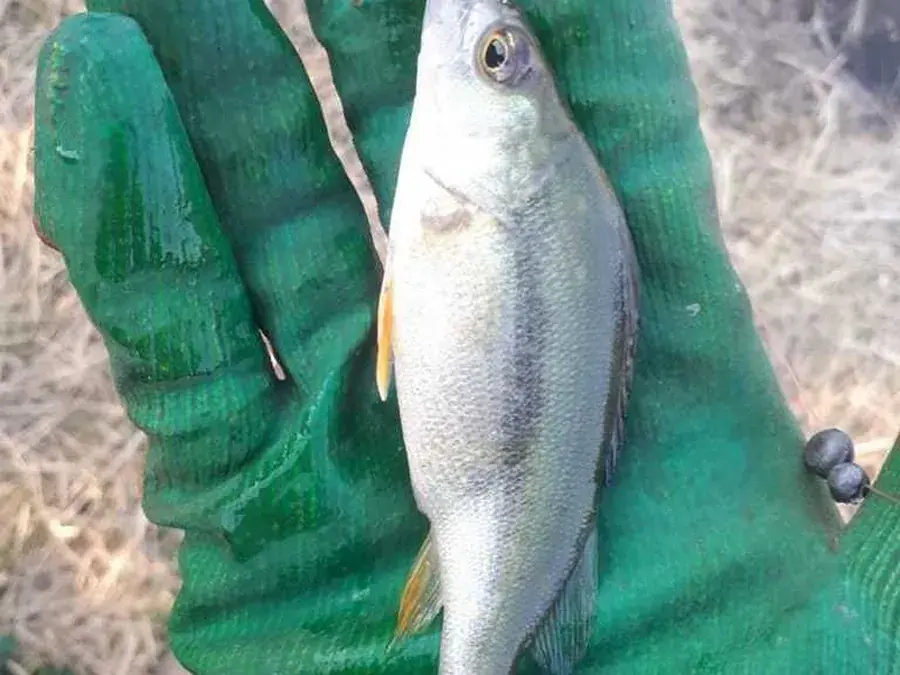
European perch
Perca fluviatilis
Five to eight dark bars on a greenish flank, bright red-orange lower fins, and a spiny first dorsal fin with a black blotch at the back.
Where and how to catch it →Photo: Дауд Арсанукаев · CC BY 4.0
 FishJun–Mar
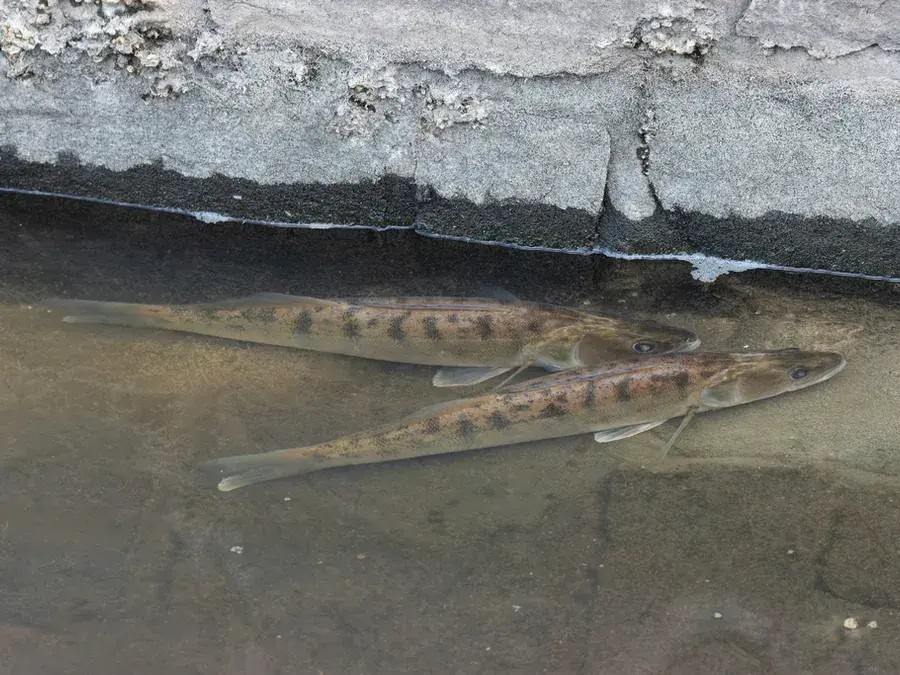
Zander
Sander lucioperca
Slim and glassy-eyed, with grey-brown saddles, rows of black spots on the spiny dorsal fin, and long fang-like canine teeth.
Where and how to catch it →Photo: Tomas Broucek · CC BY 4.0
 FishApr–Oct
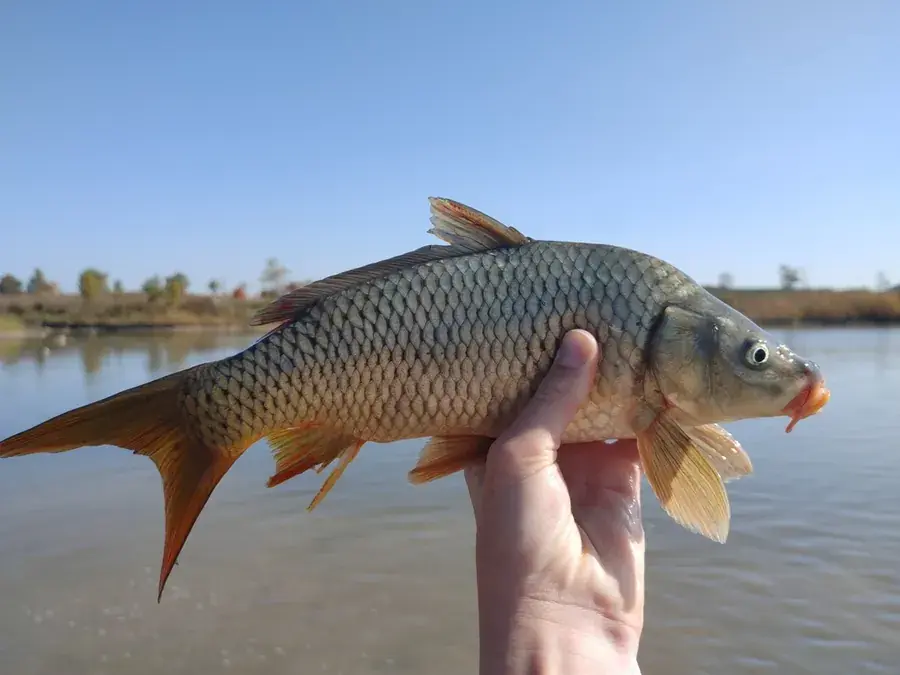
Common carp
Cyprinus carpio
Big bronze scales (or the scattered big scales of a mirror carp), a long dorsal fin, and two pairs of barbels at a rubbery, tube-like mouth.
Where and how to catch it →