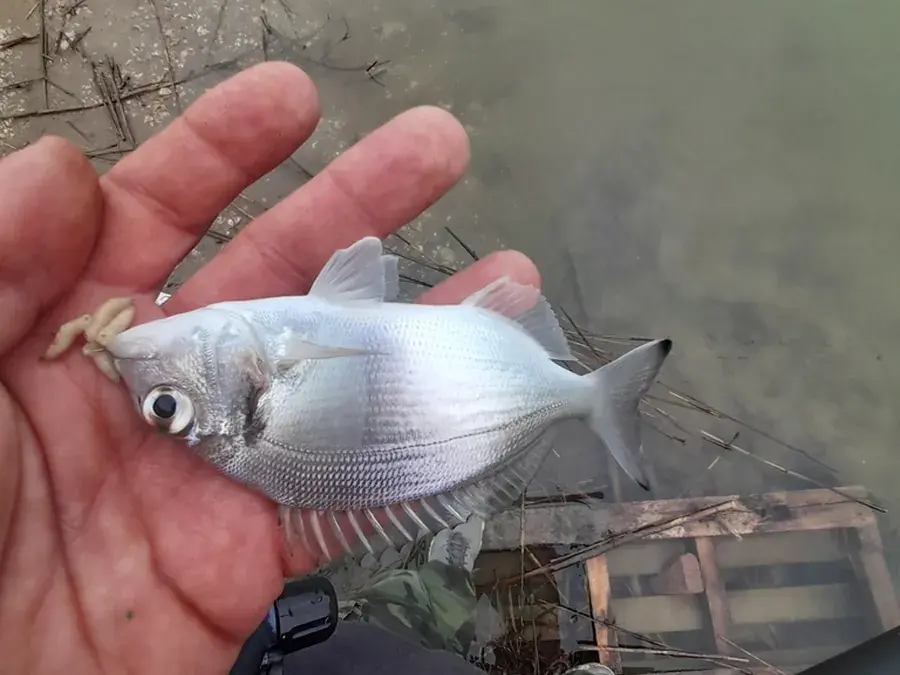
Gilthead seabream
Sparus aurata
- When
- May–Nov — May, June, July, August, September, October, November. Earlier where the water warms first.
- Where it holds
- Sand and seagrass, harbours, mussel beds and estuaries; brackish lagoons and river mouths through spring and summer.
- How to know it
- A deep, oval, silver body with a golden bar between the eyes, a dark spot high on the gill cover, and a red edge to the gill cover.
- What to know
- The dorade of French menus and the dorada of Spanish ones. It cracks mussels and crabs with heavy crushing teeth, and reaches north to southwest England and Ireland.
- The tactic
- Crab, mussel or prawn on a light bottom rig close to rocks and mussel beds; wait for a firm pull before striking.
- Caution
- Minimum sizes apply in most countries. Keep fingers away from the mouth — those teeth crush shells.
Seasons, size limits and catch limits change every year and differ by water body. Check the current regulations for the country and the water before you fish.
Gilthead seabream facts
- Also called
- Gilt-head bream, gilthead; dorade royale in French, dorada in Spanish, dourada in Portuguese, orata in Italian, tsipoura in Greek.
- Family
- Sparidae, the sea breams and porgies.
- Native range
- The Mediterranean and the eastern Atlantic from Britain and Ireland south to Senegal and the Canary Islands; rare in the Black Sea.
- Habitat
- Seagrass beds, sandy bottoms and the surf zone, usually shallower than 30 m though adults go down to 150 m. In spring it moves into brackish lagoons and estuaries. Mostly solitary or in small groups.
- Water temperature
- Warm water: best growth at about 18–26°C (64–79°F), and very sensitive to cold — the FAO gives 4°C (39°F) as its lower lethal limit.
- Size
- Most adults 25–50 cm (10–20 in); the largest measured about 70 cm (28 in).
- Record
- IGFA all-tackle world record: 7.36 kg (16 lb 3 oz), Jean Serra, an estuary near Brest, France, 2000. The British shore record is 5.499 kg (12 lb 2 oz), Kingsbridge Estuary, Devon, 2017.
- Lifespan
- Up to about 14 years.
- What it eats
- Mainly shellfish — mussels, oysters and clams — plus crabs and other crustaceans, and some plant matter.
- Spawning
- From October to December in open water; the eggs float. Gilthead change sex: they mature as males at about 2 years (20–30 cm), and many become females at 2–3 years (33–40 cm).
- Young fish
- The larvae drift for roughly six to seven weeks before settling; young fish move into lagoons and estuaries in spring.
- Teeth and mouth
- Strong jaws with four to six pointed, canine-like teeth at the front and rows of blunt, rounded crushing teeth behind — made for cracking mussels.
- Look-alikes
- Black sea bream is grey with faint lines and no gold bar. Two-banded and sharpsnout seabreams have dark bands across the body. The gold bar between the eyes and the dark spot on the gill cover make a gilthead.
- Eating
- Excellent, and a Mediterranean favourite grilled whole or baked in salt. Most sold is farmed — it is one of the Mediterranean's main farmed fish.
- Status
- IUCN Least Concern.
Try it
How big does a gilthead seabream get?
Slide it from an ordinary adult to the biggest one ever measured, next to things you know the size of.
Most adults you'll catch: 25–50 cm (10–20 in).
This gilthead seabream: 38 cm. Longer than a loaf of bread, shorter than a four-year-old.
The record
IGFA all-tackle world record: 7.36 kg (16 lb 3 oz), Jean Serra, an estuary near Brest, France, 2000. The British shore record is 5.499 kg (12 lb 2 oz), Kingsbridge Estuary, Devon, 2017.
Questions people ask about gilthead seabream
Why is it called gilthead?
For the gold bar across its forehead between the eyes — the 'gilt head'. The French dorade and Spanish dorada both mean 'golden' too.
Do gilthead bream change sex?
Yes. Gilthead are protandrous: every fish starts life as a male, maturing at about two years, and many become females at two to three. In farmed fish, the presence of older females can hold younger ones back from changing.
Are there gilthead bream in the UK?
Yes, in small numbers, mostly in the estuaries of Devon and Cornwall, and in Ireland. Britain's shore record of 5.499 kg (12 lb 2 oz) came from the Kingsbridge Estuary in 2017. Its heartland is the Mediterranean and the Atlantic coasts of Iberia and France.
What do gilthead bream eat?
Mostly shellfish — mussels, oysters, clams — and crabs, crushed with rows of strong, rounded back teeth. That is why crab, mussel and prawn are the baits to use.
Found in these regions
Checked against these sources ·
- FishBase — Sparus aurata
- FAO Cultured Aquatic Species — Gilthead seabream
- IGFA world records — Seabream, gilthead
- British Record (Rod Caught) Fish Committee — sea fish records, June 2026
Sizes, records and ranges are for the species as a whole; local fish, and local rules, vary. Records change — the record-keeper named above has the current one.
Is it active near you?
Get this week's guide for your area
Enter a town, postal code or ZIP and we'll tell you what's happening right there this week — from your local climate, this week's weather and your ecological region.
Also active in October
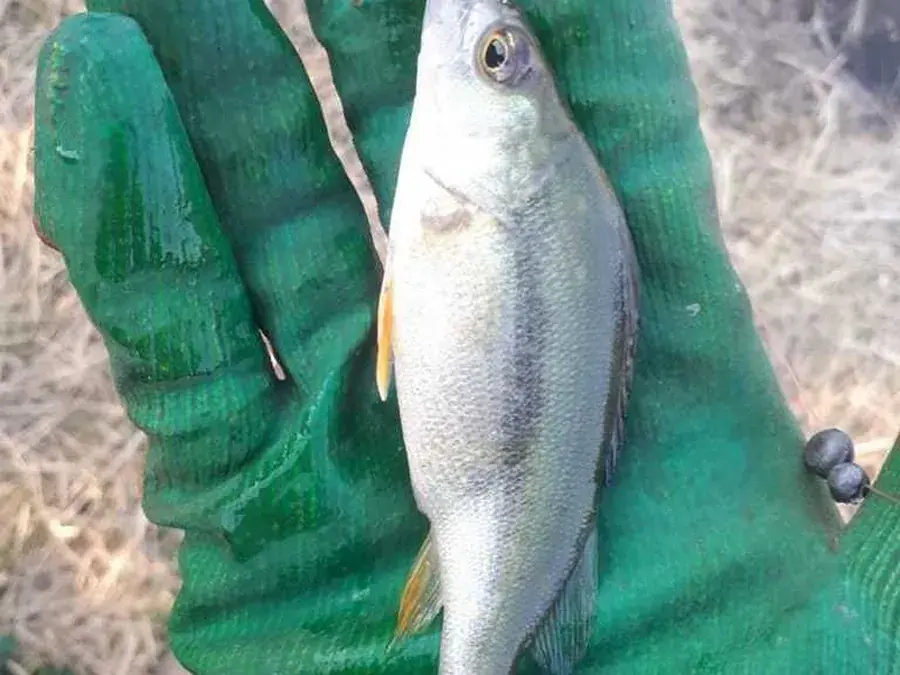 FishJun–Mar
European perch
Perca fluviatilis
Five to eight dark bars on a greenish flank, bright red-orange lower fins, and a spiny first dorsal fin with a black blotch at the back.
Where and how to catch it →Photo: Дауд Арсанукаев · CC BY 4.0
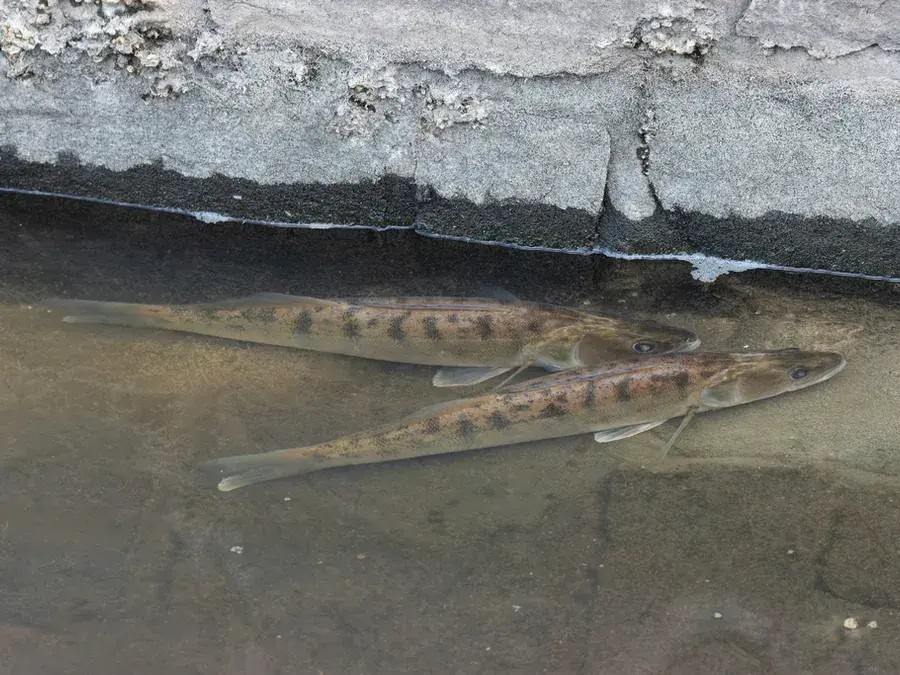 FishJun–Mar
Zander
Sander lucioperca
Slim and glassy-eyed, with grey-brown saddles, rows of black spots on the spiny dorsal fin, and long fang-like canine teeth.
Where and how to catch it →Photo: Tomas Broucek · CC BY 4.0
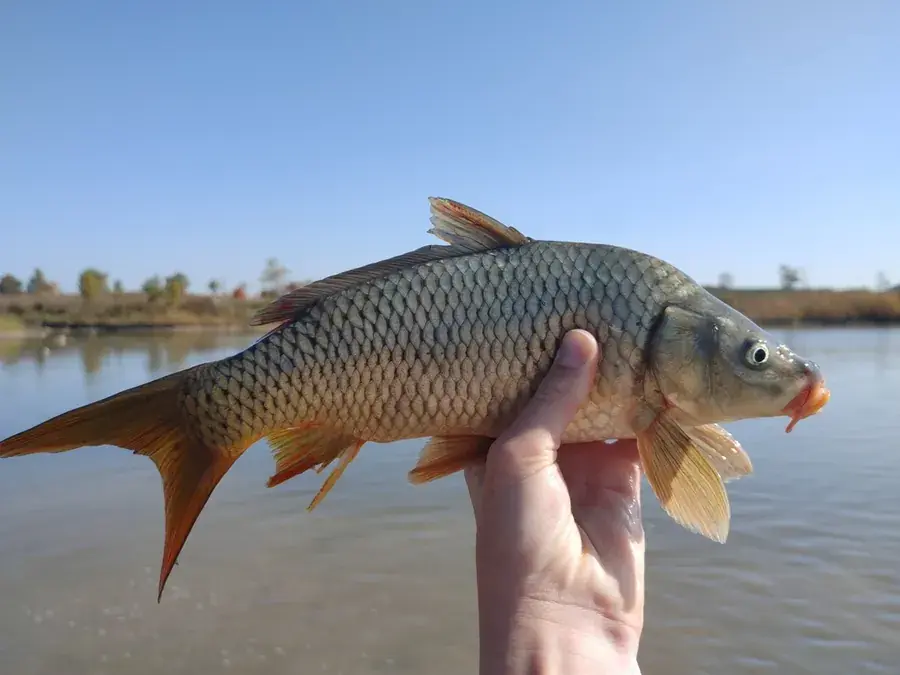 FishApr–Oct
Common carp
Cyprinus carpio
Big bronze scales (or the scattered big scales of a mirror carp), a long dorsal fin, and two pairs of barbels at a rubbery, tube-like mouth.
Where and how to catch it →