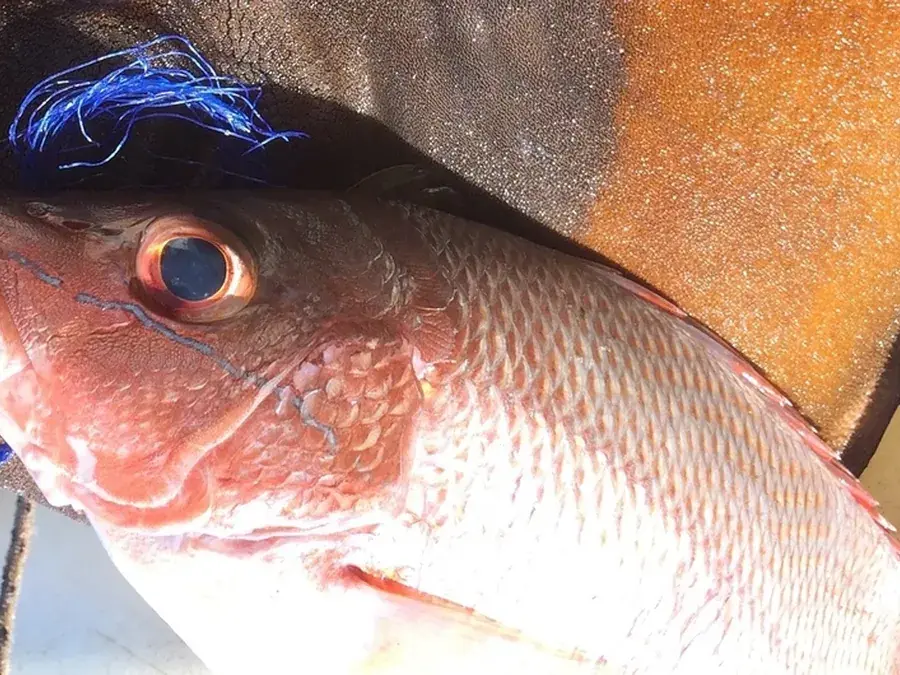
Gorean snapper
Lutjanus goreensis
- When
- Active all year; habitat and behaviour shift with the season.
- Habitat
- Rocky ground, reefs, wrecks and harbour breakwaters down to about 50 m from Senegal to Congo, chiefly in the Gulf of Guinea and around the Cape Verde Islands. Young fish live in estuaries, lagoon mouths and the lower reaches of rivers.
- Identification
- A stocky red snapper with a pointed head, a steep forehead and big eyes: vermilion on the back, pink in large fish, fading to white below, with a thin blue line — whole or broken into spots — from the upper jaw under the eye to the corner of the gill cover. Young fish are plain brownish.
- Notes
- A voracious predator of fish, crabs and other bottom animals, named after Gorée Island off Dakar. Little is known of its life history; off Lagos, fish sampled in 2008–2010 reached about 56 cm and 3 kg.
- Method
- Live or cut bait — sardine, a strip of mullet, crab or squid — on a short, strong trace fished hard against rocks and wrecks, or a jig worked through the structure. Lean on it at once to keep it out of the rocks.
- Caution
- Snapper teeth cut: unhook with pliers. West African rules vary — ask locally.
Seasons, size limits and catch limits change every year and differ by water body. Check the current regulations for the country and the water before fishing.
Gorean snapper facts
- Also called
- Gorean lagoon snapper or pink snapper; vivaneau de Gorée in French; luciano da Goreia in Portuguese.
- Family
- Lutjanidae, the snappers.
- Native range
- The West African coast from Senegal to Congo, mostly in the Gulf of Guinea and around the Cape Verde Islands.
- Habitat
- Rocky bottoms and coral reefs from the shore to about 50 m (165 ft). Young fish are common in coastal water, particularly in estuaries, and sometimes in the lower reaches of rivers.
- Water temperature
- Tropical. AquaMaps puts its preferred surface water at about 25–28°C (76–82°F).
- Size
- Most adults 30–50 cm (12–20 in); the largest measured about 80 cm (31 in).
- Record
- IGFA all-tackle world record: 7.26 kg (16 lb 0 oz), Leon Mark Weeks, Port-Gentil, Gabon, 11 April 2022.
- Lifespan
- Not well documented.
- What it eats
- Fish and bottom-living invertebrates such as crabs and shrimps.
- Spawning
- Little studied. Like other snappers it spawns at sea, and its young settle in estuaries and coastal shallows.
- Young fish
- Juveniles are plain brownish and live in estuaries and coastal shallows; studies have measured them at about 8–20 cm.
- Teeth and mouth
- A pointed head with a broad bone below the eye; the upper jaw reaches to about the middle of the eye, and both jaws carry canine teeth.
- Look-alikes
- African red snapper (Lutjanus agennes) has no blue line on the cheek and very dark tips to the pelvic fins; African brown snapper (Lutjanus dentatus) is smoky grey, with scale rows that rise obliquely above the lateral line. The Gorean snapper’s scale rows on the back run parallel to the lateral line, and the blue line under its eye is the best tell.
- Eating
- A good table fish, marketed fresh.
- Status
- Data Deficient on the IUCN Red List (2013).
Interactive
Gorean snapper: size range
Move the slider from a typical adult to the largest recorded specimen, shown against objects of known size.
Most adults you'll catch: 30–50 cm (12–20 in).
This gorean snapper: 40 cm. Longer than a loaf of bread, shorter than a four-year-old.
The record
IGFA all-tackle world record: 7.26 kg (16 lb 0 oz), Leon Mark Weeks, Port-Gentil, Gabon, 11 April 2022.
Questions people ask about gorean snapper
Where does the name Gorean snapper come from?
From Gorée, the small island off Dakar in Senegal, after which the species was named.
How big do Gorean snappers get?
Most are 30–50 cm (12–20 in), and the species reaches about 80 cm (31 in). Off Lagos, fish sampled in 2008–2010 reached 56 cm and 3 kg; the IGFA world record is 7.26 kg (16 lb 0 oz), from Port-Gentil, Gabon, in 2022.
How do I tell a Gorean snapper from an African red snapper?
Look under the eye: the Gorean snapper has a thin blue line, whole or broken, from the upper jaw to the corner of the gill cover. The African red snapper has none, has very dark tips to its pelvic fins and grows much larger — its IGFA record is 60 kg.
Found in these regions
Checked against these sources ·
- FishBase — Lutjanus goreensis
- FishBase — Lutjanus goreensis population characteristics
- FishBase — Lutjanus agennes
- FishBase — Lutjanus dentatus
- IGFA — World Records search
Sizes, records and ranges are for the species as a whole; local populations and rules vary. Records change; the record-keeper named above holds the current one.
Local activity
This week's guide for a place
Enter a town, postal code or ZIP for this week's conditions there, based on the local climate, this week's weather and the ecological region.
Also active in October
 FishYear-round
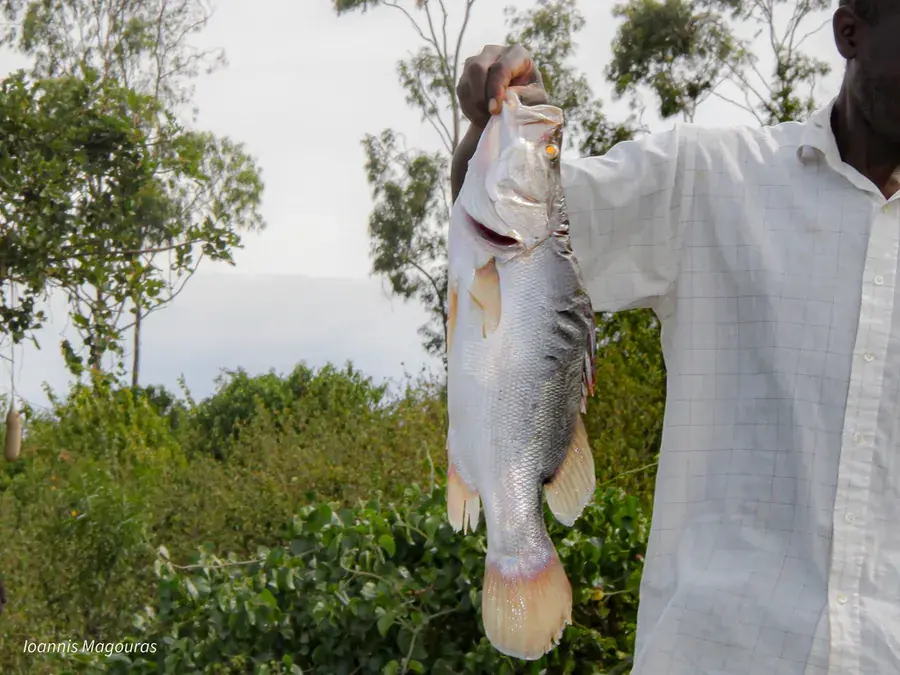
Nile perch
Lates niloticus
A huge silver perch with a blue sheen, a dorsal fin cut deeply into spiny and soft halves, a rounded tail, and a dark eye ringed in bright yellow.
Habitat and methods →Photo: Ioannis Magouras · CC BY 4.0
 FishYear-round
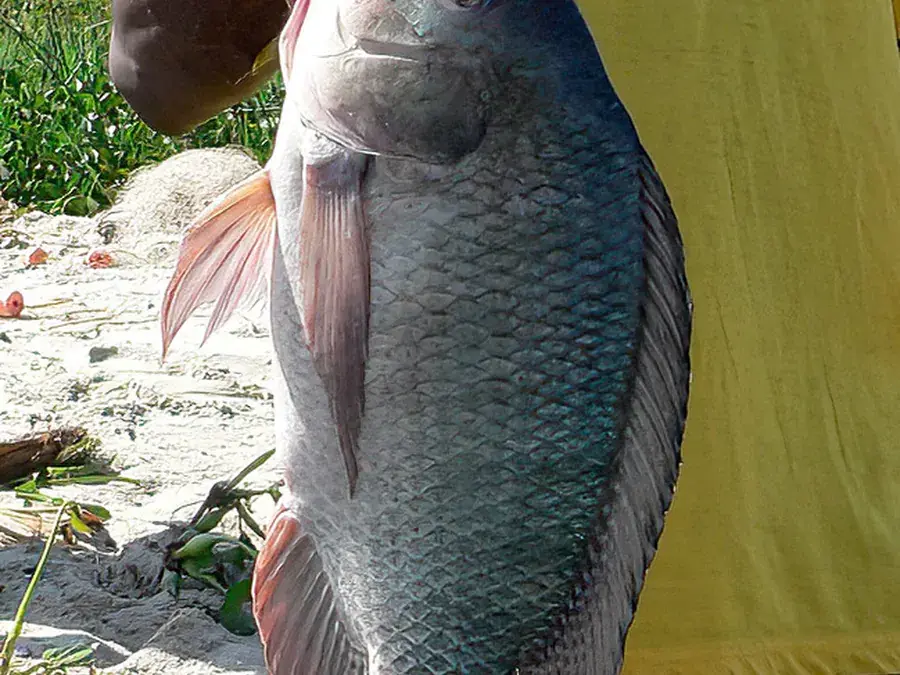
Nile tilapia
Oreochromis niloticus
Deep-bodied and grey-brown with faint bars, and the tell: regular dark vertical stripes right across the tail fin. Breeding males turn reddish, especially on the fins.
Habitat and methods →Photo: Pål A. Olsvik · CC BY 4.0
 FishSep–Apr
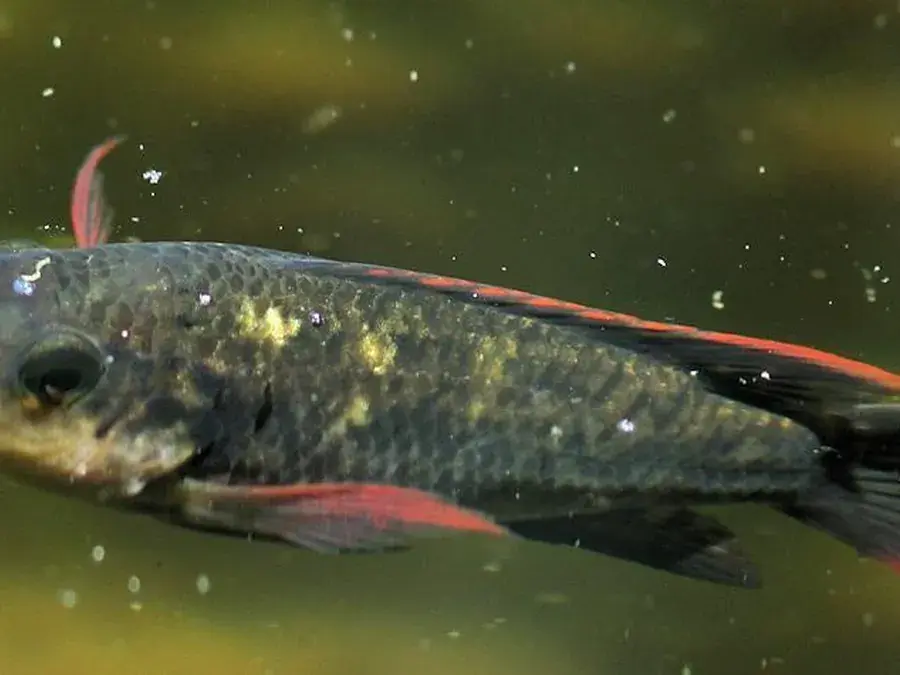
Mozambique tilapia (blue kurper)
Oreochromis mossambicus
Deep-bodied and dull silvery-olive with a few dark blotches along the side and no regular stripes on the tail. Breeding males turn black with a white throat, red-edged fins and a pointed, duck-bill snout.
Habitat and methods →Photo: Wynand Uys · CC BY 4.0