Silver catfish (bagrid catfish)
Chrysichthys nigrodigitatus
- When
- Active all year; habitat and behaviour shift with the season.
- Habitat
- Soft mud and sand bottoms of coastal lagoons, creeks, rivers and reservoirs from Senegal to Angola, from brackish lagoon water far up into fresh water — the Lagos, Lekki and Badagry lagoons, the Ébrié lagoon at Abidjan, and the Niger and its reservoirs, such as Lake Kainji.
- Identification
- A grey to silvery catfish with a pointed snout, four pairs of barbels, a stiff, sharp spine at the front of the dorsal fin and of each pectoral fin, a small fleshy fin before the tail and a forked tail whose upper lobe is longer than the lower.
- Notes
- The mâchoiron of French-speaking West Africa and one of the most valued lagoon fish of the coast. It feeds on the bottom on insects, seeds, small clams and detritus, taking more prawns and fish as it grows. In Nigeria it spawns once a year, in December and January, in pairs in dark hollows on the bottom.
- Method
- A running ledger with worm, prawn or a strip of fish, fished on the bottom in lagoon channels, creek mouths and deep river bends.
- Caution
- Mind the dorsal and pectoral spines, which can give a painful wound — hold the fish firmly behind the head. West African rules vary — ask locally.
Seasons, size limits and catch limits change every year and differ by water body. Check the current regulations for the country and the water before fishing.
Silver catfish (bagrid catfish) facts
- Also called
- Silver catfish or bagrid catfish in Nigeria, and obokun in Yoruba; mâchoiron in French-speaking West Africa, a name it shares with its relatives.
- Family
- Claroteidae, the claroteid catfishes; long placed with the bagrid catfishes, hence ‘bagrid catfish’.
- Native range
- West and west-central Africa from Senegal to Cabinda in Angola, reported north to Mauritania and south to the lower Congo River and the coastal rivers of Angola.
- Habitat
- Rivers, lakes, reservoirs and brackish coastal lagoons; adults keep to shallow water less than about 4 m (13 ft) deep over mud and fine sand.
- Water temperature
- Warm water: FishBase gives 22–28°C (72–82°F).
- Size
- Most adults 25–45 cm (10–18 in); the largest measured about 65 cm (26 in).
- Record
- IGFA keeps no category for it. The largest recorded fish measured 65 cm to the base of the tail (FishBase).
- Lifespan
- Not well documented.
- What it eats
- Omnivorous on the bottom: seeds, insects, small clams and detritus; larger fish take more prawns, crabs and small fish.
- Spawning
- Once a year. In Nigeria’s Badagry lagoon the fish ripen from October and spawn in December and January, in pairs, in dark hollows over sand or mud. Females mature at about 29–32 cm and males at 30–35 cm total length.
- Teeth and mouth
- A rather small mouth under a pointed snout, with a broad band of teeth in the upper jaw and four pairs of barbels.
- Look-alikes
- Its smaller relative Chrysichthys auratus usually has the first branched dorsal ray drawn out into a long filament. Sea catfishes, which share the lagoons, have no barbels at the nostrils; sharptooth catfish has a long dorsal fin with no spine and no small fleshy fin before the tail.
- Eating
- Highly valued fresh or smoked in Nigeria and Côte d’Ivoire, where it is also farmed.
- Status
- Least Concern on the IUCN Red List (2019).
Interactive
Silver catfish: size range
Move the slider from a typical adult to the largest recorded specimen, shown against objects of known size.
Most adults you'll catch: 25–45 cm (10–18 in).
This silver catfish (bagrid catfish): 35 cm. Longer than a loaf of bread, shorter than a four-year-old.
The record
IGFA keeps no category for it. The largest recorded fish measured 65 cm to the base of the tail (FishBase).
Questions people ask about silver catfish
What is the silver catfish of Lagos?
Chrysichthys nigrodigitatus, a claroteid catfish of rivers, lakes and brackish lagoons from Senegal to Angola. In the Lagos, Lekki and Badagry lagoons it is one of the most valued food fish, and it is farmed in Nigeria.
When does the silver catfish spawn?
Once a year. A study in Badagry lagoon found the fish ripening from October and spawning in December and January, in pairs, in dark hollows on the bottom.
Is the silver catfish dangerous to handle?
Its dorsal fin and each pectoral fin carry a stiff, sharp spine that can give a painful wound. Hold the fish firmly behind the head and keep your fingers clear of the spines.
Found in these regions
Checked against these sources ·
- FishBase — Chrysichthys nigrodigitatus
- FishBase — Chrysichthys auratus
- Ezenwa, A study of the reproductive biology of the catfish Chrysichthys nigrodigitatus in Nigeria — University of Lagos thesis (1981)
Sizes, records and ranges are for the species as a whole; local populations and rules vary. Records change; the record-keeper named above holds the current one.
Local activity
This week's guide for a place
Enter a town, postal code or ZIP for this week's conditions there, based on the local climate, this week's weather and the ecological region.
Also active in October
 FishYear-round
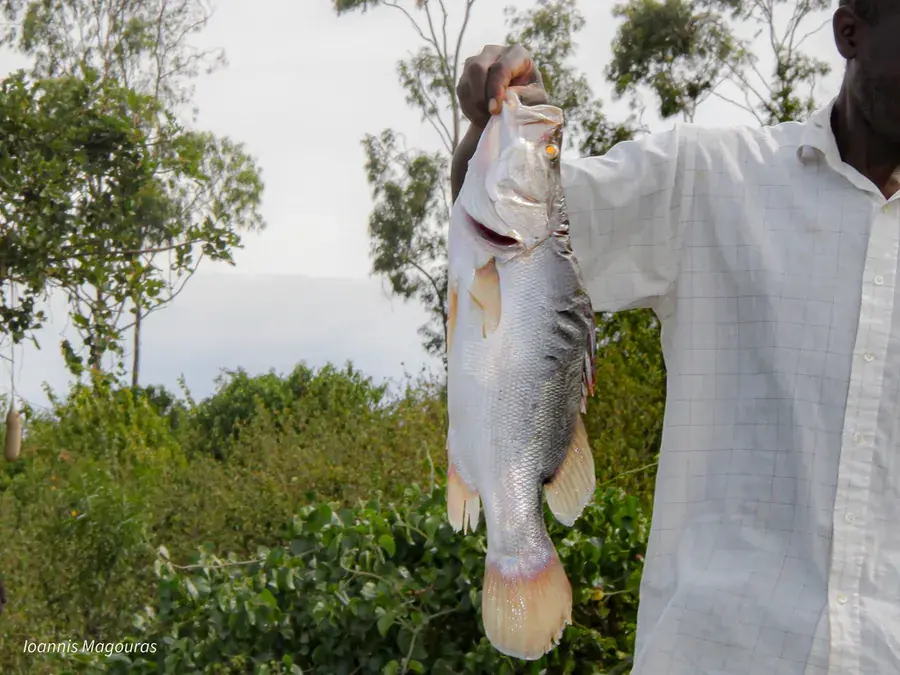
Nile perch
Lates niloticus
A huge silver perch with a blue sheen, a dorsal fin cut deeply into spiny and soft halves, a rounded tail, and a dark eye ringed in bright yellow.
Habitat and methods →Photo: Ioannis Magouras · CC BY 4.0
 FishYear-round
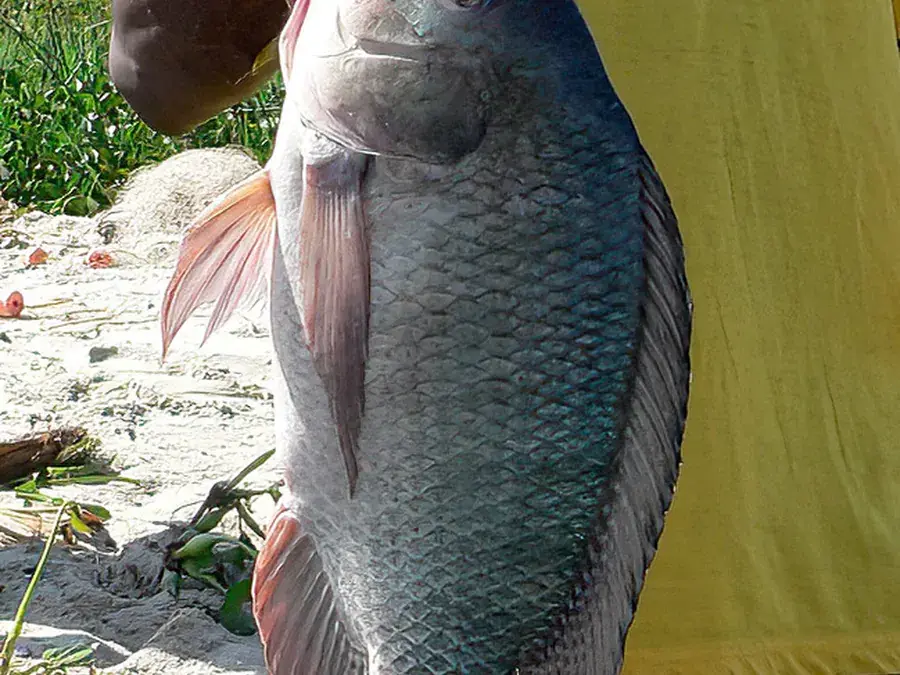
Nile tilapia
Oreochromis niloticus
Deep-bodied and grey-brown with faint bars, and the tell: regular dark vertical stripes right across the tail fin. Breeding males turn reddish, especially on the fins.
Habitat and methods →Photo: Pål A. Olsvik · CC BY 4.0
 FishSep–Apr
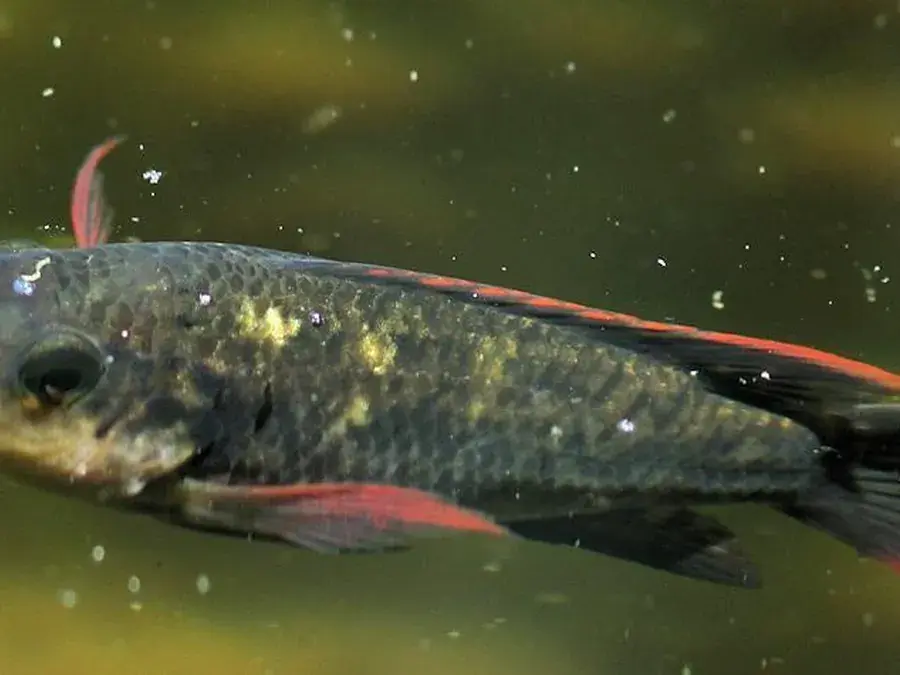
Mozambique tilapia (blue kurper)
Oreochromis mossambicus
Deep-bodied and dull silvery-olive with a few dark blotches along the side and no regular stripes on the tail. Breeding males turn black with a white throat, red-edged fins and a pointed, duck-bill snout.
Habitat and methods →Photo: Wynand Uys · CC BY 4.0