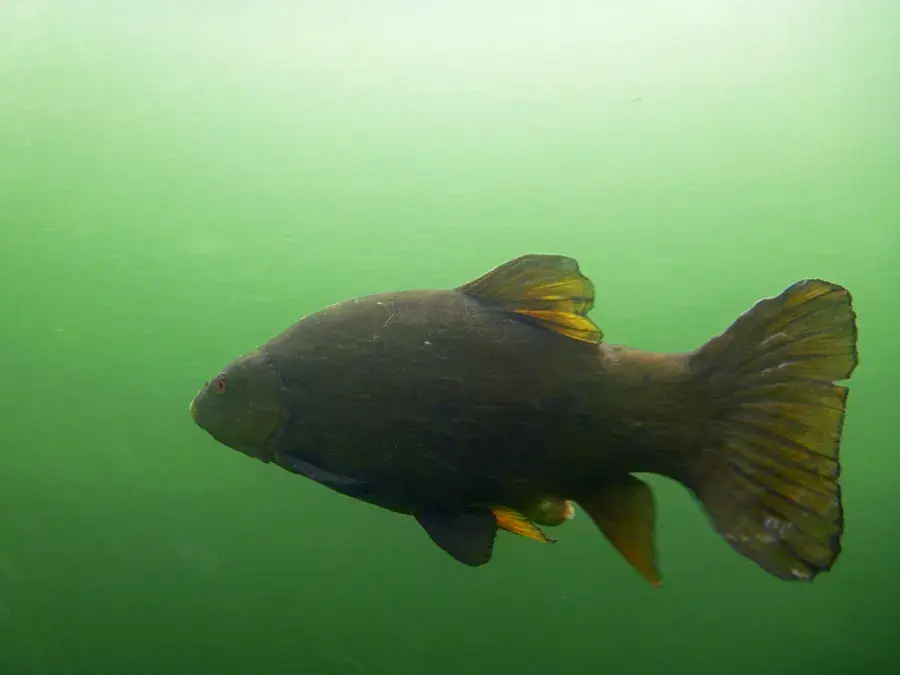
Photo by Ewout Knoester on iNaturalist · CC BY-SA 4.0
Tench
Tinca tinca
- When
- May–Sep — May, June, July, August, September. Earlier where the water warms first.
- Where it holds
- Still, weedy, muddy lakes, ponds, gravel pits and canals; look for tiny bubbles fizzing up beside the lilies at first light.
- How to know it
- Olive-green and very slimy, with tiny scales, small red-orange eyes, rounded fins, and one small barbel at each corner of the mouth.
- What to know
- The fish of misty summer dawns. It grubs on the bottom among the weed and fights far harder than it looks.
- The tactic
- Sweetcorn, maggots or a worm on a float or a small feeder, right on the bottom close to the weed.
- Caution
- Invasive in Quebec, Lake Champlain and British Columbia — report it and never move it; Ontario prohibits possessing or transporting live tench.
Seasons, size limits and catch limits change every year and differ by water body. Check the current regulations for the country and the water before you fish.
Tench facts
- Also called
- Doctor fish, from an old belief that its slime healed other fish. The golden tench is an ornamental pond strain. Tanche in French, Schleie in German, tenca in Spanish and Italian.
- Family
- Tincidae — long placed in the carp family, but recent genetic studies give it a family of its own.
- Native range
- Most of Europe and western Asia, east to the Yenisei. Naturally absent from Ireland, Scandinavia north of about 61°N, the eastern Adriatic basin, and western and southern Greece.
- Introduced to
- Ireland, North America, Chile, Australia, South Africa, Zimbabwe and Morocco. In Quebec it was brought illegally to a fish farm in 1986 and escaped through the Richelieu River into the St. Lawrence; it is now dense in the Richelieu, Lake Champlain and Lac Saint-Pierre, and has been seen as far as the Bay of Quinte on Lake Ontario. It is also established in British Columbia's Columbia and Okanagan systems and in parts of the western United States.
- Habitat
- Still or slow, warm water with mud or clay bottoms and lots of weed: lakes, ponds, gravel pits, canals and backwaters. It survives low oxygen better than almost any other fish — even where carp cannot — and often spends the winter half-buried in the mud.
- Water temperature
- Warm water; FishBase gives about 4–24°C (39–75°F). It spawns in early summer, once the shallows reach around 19–20°C (66–68°F).
- Size
- Most adults 20–45 cm (8–18 in); the largest measured about 70 cm (28 in).
- Record
- IGFA all-tackle world record: 4.64 kg (10 lb 3 oz), Dan Dellerfjord, Ljungbyån, Sweden, 1985. The British record is heavier: 6.899 kg (15 lb 3 oz), from a private fishery at Staines, Surrey, in 2001.
- Lifespan
- Long-lived for its size: tench up to 18 years old have been aged in a Norwegian lake.
- What it eats
- Bottom food, mostly taken at night: midge larvae, snails, pea mussels and other small animals, plus detritus and plant matter. Big adults often live mainly on molluscs.
- Spawning
- In summer, among dense weed in shallow still water. Each female lays batch after batch of small, sticky green eggs on the plants, every couple of weeks for about two months — up to 300,000 eggs in a season. The larvae hang on the plants until their yolk is used up.
- Young fish
- Fry stay hidden in thick weed and can grow fast. Males mature at 2–3 years and females at 3–7. A male has much larger, spoon-shaped pelvic fins that reach past the vent — the easy way to sex an adult tench.
- Teeth and mouth
- A small, fleshy mouth with one tiny barbel at each corner, and no teeth in the jaws.
- Look-alikes
- Carp has a long dorsal fin and big scales. Crucian carp is deep, bronze and has no barbels. Nothing else in fresh water combines olive-green colour, thick slime, tiny scales and small red eyes.
- Eating
- Edible, and once valued — it can be cooked like carp — but rarely eaten today; anglers almost always return tench.
- Status
- IUCN Least Concern; it has declined locally where rivers were engineered and backwaters lost.
Try it
How big does a tench get?
Slide it from an ordinary adult to the biggest one ever measured, next to things you know the size of.
Most adults you'll catch: 20–45 cm (8–18 in).
This tench: 33 cm. Longer than a loaf of bread, shorter than a four-year-old.
The record
IGFA all-tackle world record: 4.64 kg (10 lb 3 oz), Dan Dellerfjord, Ljungbyån, Sweden, 1985. The British record is heavier: 6.899 kg (15 lb 3 oz), from a private fishery at Staines, Surrey, in 2001.
Questions people ask about tench
Why is the tench called the doctor fish?
Because of an old belief that sick fish healed by rubbing against its thick slime. There is nothing in it, but the name stuck — and the tench really is unusually slimy, with tiny scales sunk in a thick skin.
Are there tench in Canada?
Yes, in Quebec and British Columbia. In Quebec they escaped from an illegal fish farm into the Richelieu River after 1986 and now live at high density in the Richelieu, Lake Champlain and Lac Saint-Pierre; they have been seen in Lake Ontario's Bay of Quinte. They are invasive: Ontario prohibits possessing or moving them, and sightings should be reported.
How do you catch tench?
Fish the bottom close to weed at dawn in early summer, with sweetcorn, maggots, worms or small pellets on a float or a small feeder. Patches of tiny bubbles rising near the lilies often mark feeding tench.
How big do tench get?
Most are 20–45 cm (8–18 in) and under 2 kg. The IGFA world record is 4.64 kg (10 lb 3 oz), from Sweden in 1985; Britain's record is 6.899 kg (15 lb 3 oz), from Surrey in 2001.
Found in these regions
Checked against these sources ·
- FishBase — Tinca tinca
- USGS Nonindigenous Aquatic Species — Tench
- Invasive Species Centre — Tench
- British Record (Rod Caught) Fish Committee — coarse fish records, January 2026
Sizes, records and ranges are for the species as a whole; local fish, and local rules, vary. Records change — the record-keeper named above has the current one.
Is it active near you?
Get this week's guide for your area
Enter a town, postal code or ZIP and we'll tell you what's happening right there this week — from your local climate, this week's weather and your ecological region.
Also active in October
 FishJun–Mar
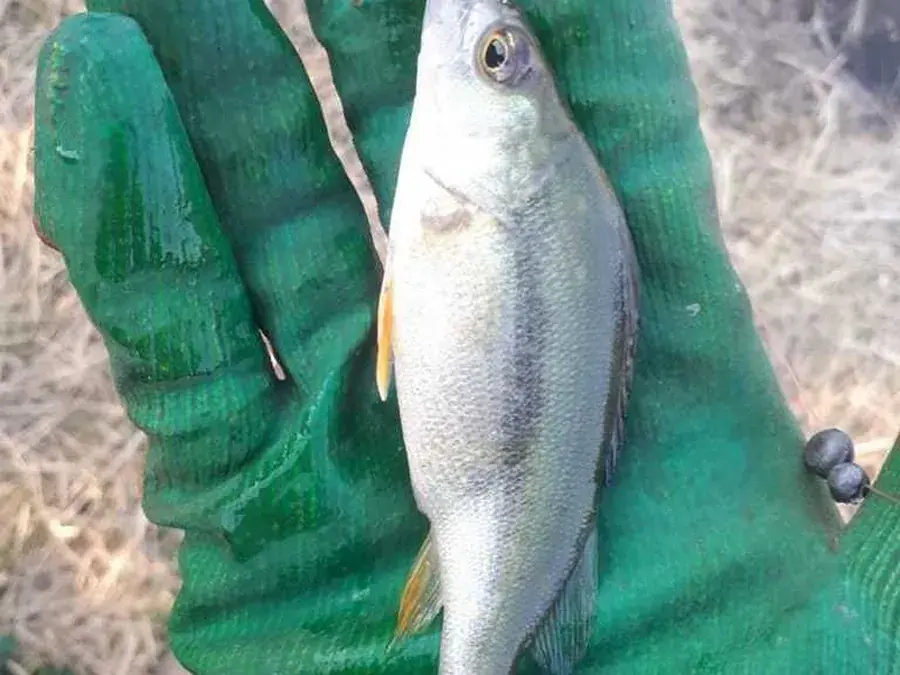
European perch
Perca fluviatilis
Five to eight dark bars on a greenish flank, bright red-orange lower fins, and a spiny first dorsal fin with a black blotch at the back.
Where and how to catch it →Photo: Дауд Арсанукаев · CC BY 4.0
 FishJun–Mar
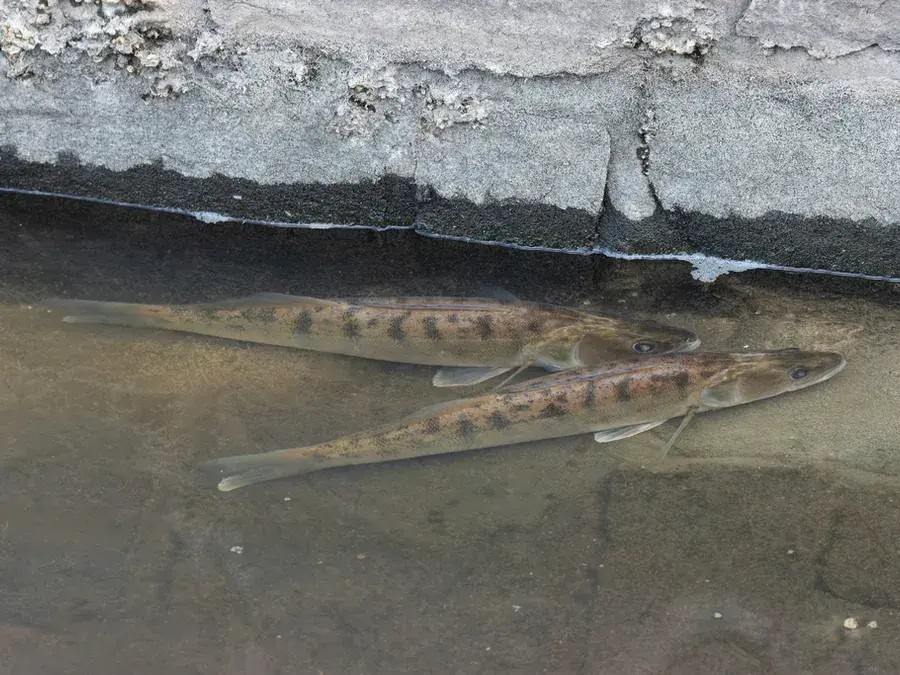
Zander
Sander lucioperca
Slim and glassy-eyed, with grey-brown saddles, rows of black spots on the spiny dorsal fin, and long fang-like canine teeth.
Where and how to catch it →Photo: Tomas Broucek · CC BY 4.0
 FishApr–Oct
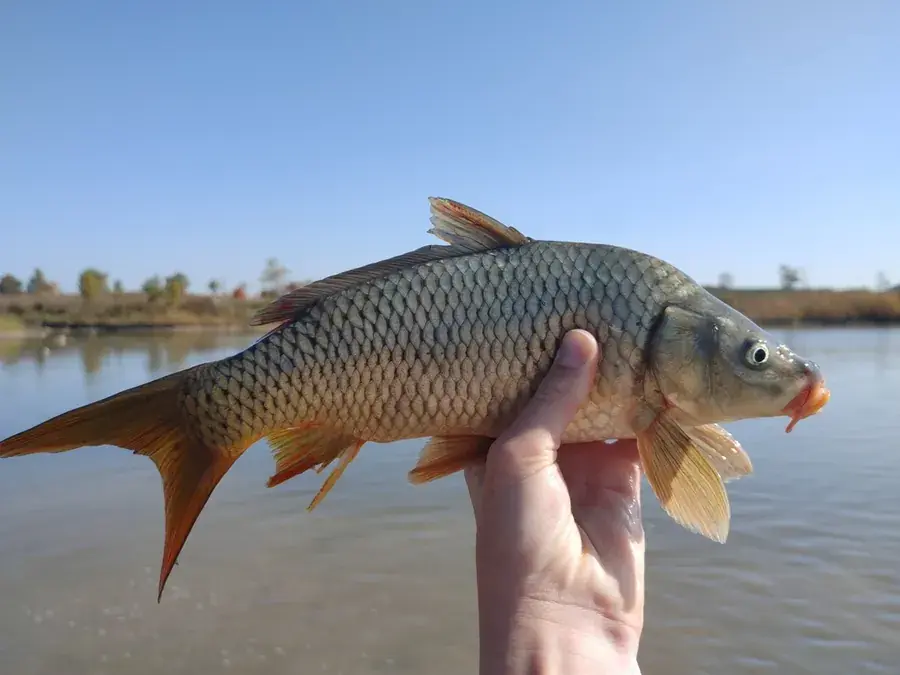
Common carp
Cyprinus carpio
Big bronze scales (or the scattered big scales of a mirror carp), a long dorsal fin, and two pairs of barbels at a rubbery, tube-like mouth.
Where and how to catch it →