West African ladyfish
Elops lacerta
- When
- Active all year; habitat and behaviour shift with the season.
- Habitat
- Lagoons, estuaries, tidal creeks and shallow sandy or muddy shores along the West African coast — the Lagos Lagoon, the Ébrié lagoon at Abidjan and the Cross River among them — running some way up tidal rivers. Schools work the channels and the bars at lagoon mouths.
- Identification
- A slim, round-bodied, bright silver fish with a large mouth, a bony plate between the arms of the lower jaw, a single dorsal fin in the middle of the back and a deeply forked tail. The scales are small — 72 to 83 along the lateral line — and there is no long trailing ray on the dorsal fin.
- Notes
- A fast, leaping, schooling predator of sardines and other small fish, shrimps and molluscs. A cousin of the tarpon, it starts life at sea as a see-through, ribbon-like larva. It is easily confused with the Senegalese ladyfish, which shares the coast and is told apart only by its scale and gill-raker counts.
- Method
- Small silver spoons, spinners, shallow-running plugs or a baitfish fly on light tackle, worked through lagoon channels and river mouths on a moving tide; a strip of fish under a float also takes them.
- Caution
- West African rules vary — ask locally.
Seasons, size limits and catch limits change every year and differ by water body. Check the current regulations for the country and the water before fishing.
West African ladyfish facts
- Also called
- Ladyfish or tenpounder; guinée in French. FishBase and FAO call it the West African ladyfish, and it is often confused with the Senegalese ladyfish (Elops senegalensis), which shares its coast.
- Family
- Elopidae, the ladyfishes — close cousins of the tarpons.
- Native range
- The eastern Atlantic coast of West Africa, from Mauritania to Angola and perhaps Namibia.
- Habitat
- Shallow coastal water over sand and mud, from the shore and some way up tidal rivers to the edge of the shelf at about 50 m (165 ft). It enters lagoons and estuaries, and sometimes fresh water, as in the Cross River in Nigeria and the Kouilou in Congo.
- Water temperature
- Tropical. AquaMaps puts its preferred surface water at about 25–28°C (77–82°F).
- Size
- Most adults 30–60 cm (12–24 in); the largest measured about 100 cm (39 in).
- Record
- IGFA keeps no separate category for the West African ladyfish. Its record for the Senegalese ladyfish, which is easily confused with it, is 5.9 kg (13 lb 0 oz), Gerard Cittadini, Bijagós Archipelago, Guinea-Bissau, 12 April 1994.
- Lifespan
- Not well documented.
- What it eats
- Small fish — sardines and other herrings above all — with crustaceans and molluscs; big ones also take insects.
- Spawning
- At sea. Like tarpon, ladyfish hatch as transparent, ribbon-like leptocephalus larvae that drift inshore and shrink as they change into small fish.
- Teeth and mouth
- A large, terminal mouth with bands of fine teeth and a bony plate (the gular plate) between the arms of the lower jaw.
- Look-alikes
- Senegalese ladyfish has smaller scales — 92 to 100 along the lateral line against 72 to 83 — and fewer gill rakers, so the two are hard to tell apart in the hand. Atlantic tarpon has huge scales, an upturned mouth and a long trailing ray on the dorsal fin.
- Eating
- Bony, like all ladyfish, but landed commercially and eaten along the West African coast.
- Status
- Least Concern on the IUCN Red List (2020).
Interactive
West African ladyfish: size range
Move the slider from a typical adult to the largest recorded specimen, shown against objects of known size.
Most adults you'll catch: 30–60 cm (12–24 in).
This west african ladyfish: 45 cm. Longer than a loaf of bread, shorter than a four-year-old.
The record
IGFA keeps no separate category for the West African ladyfish. Its record for the Senegalese ladyfish, which is easily confused with it, is 5.9 kg (13 lb 0 oz), Gerard Cittadini, Bijagós Archipelago, Guinea-Bissau, 12 April 1994.
Questions people ask about west african ladyfish
Is a ladyfish a kind of tarpon?
A close cousin. Ladyfish and tarpon belong to the same order and both start life as see-through, ribbon-like larvae. The ladyfish is slim, with small scales and no long trailing dorsal ray, and rarely tops a metre; the tarpon is deep-bodied, with huge scales, and grows to over 2 m.
How do you catch ladyfish?
On light tackle, with small spoons, spinners, shallow plugs or flies worked through lagoon channels and river mouths on a moving tide, or a strip of fish under a float. They leap hard and often throw the hook.
How big do West African ladyfish get?
Most are 30–60 cm (12–24 in); the largest recorded reach about 1 m (39 in).
Found in these regions
Checked against these sources ·
Sizes, records and ranges are for the species as a whole; local populations and rules vary. Records change; the record-keeper named above holds the current one.
Local activity
This week's guide for a place
Enter a town, postal code or ZIP for this week's conditions there, based on the local climate, this week's weather and the ecological region.
Also active in October
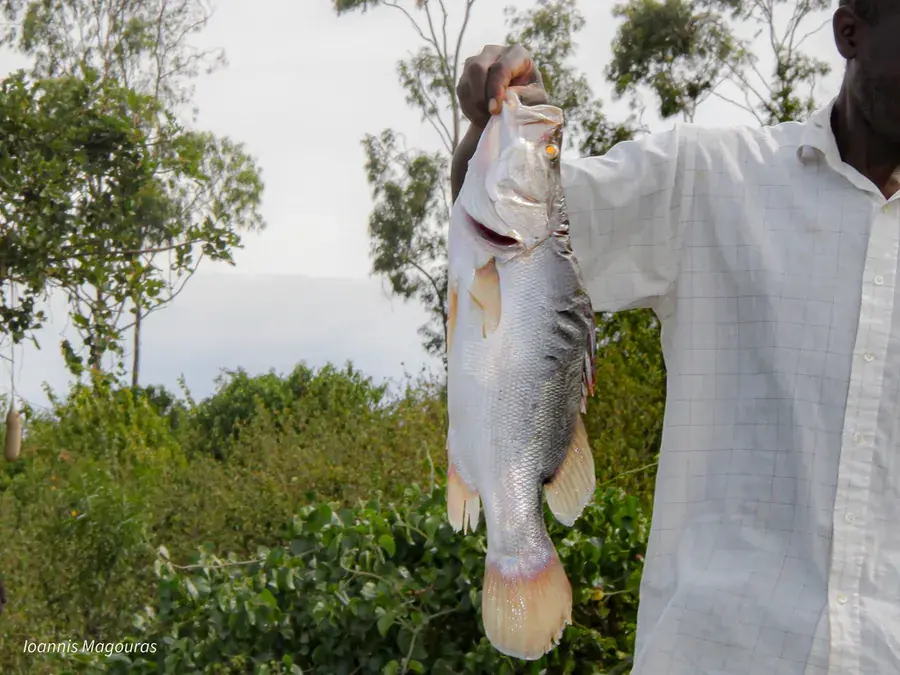 FishYear-round
Nile perch
Lates niloticus
A huge silver perch with a blue sheen, a dorsal fin cut deeply into spiny and soft halves, a rounded tail, and a dark eye ringed in bright yellow.
Habitat and methods →Photo: Ioannis Magouras · CC BY 4.0
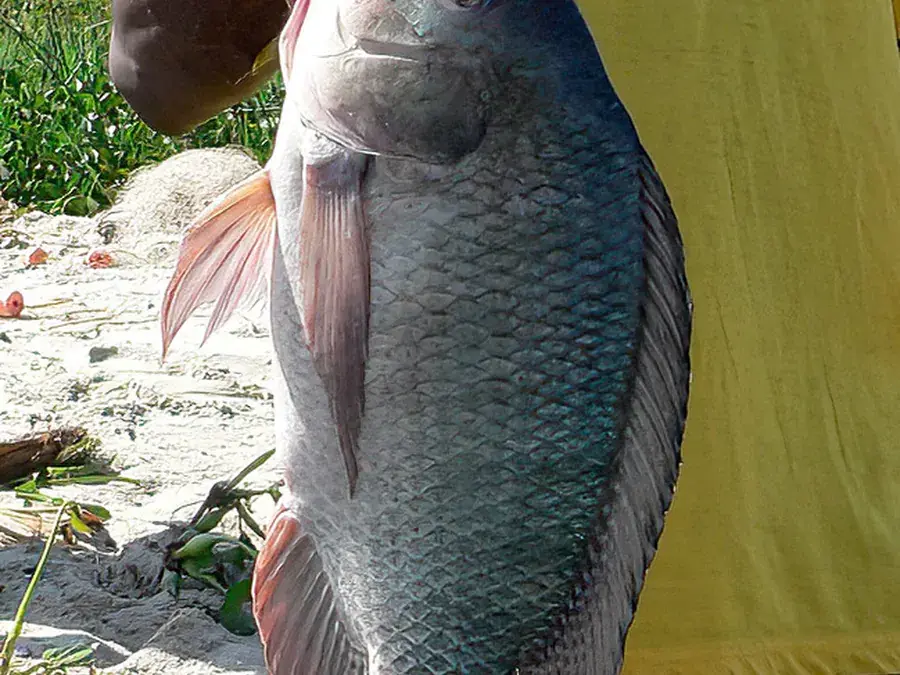 FishYear-round
Nile tilapia
Oreochromis niloticus
Deep-bodied and grey-brown with faint bars, and the tell: regular dark vertical stripes right across the tail fin. Breeding males turn reddish, especially on the fins.
Habitat and methods →Photo: Pål A. Olsvik · CC BY 4.0
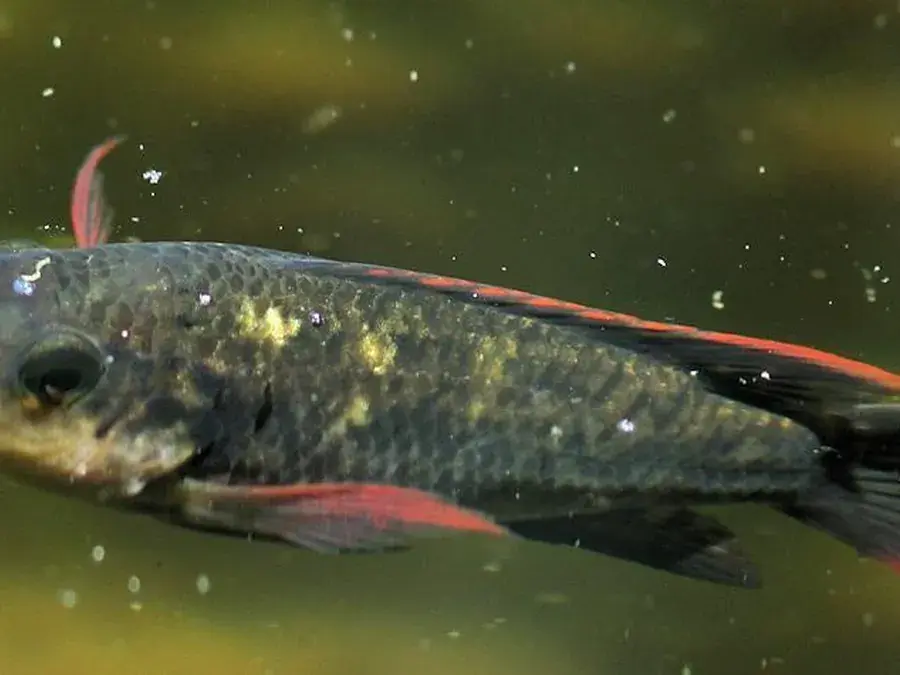 FishSep–Apr
Mozambique tilapia (blue kurper)
Oreochromis mossambicus
Deep-bodied and dull silvery-olive with a few dark blotches along the side and no regular stripes on the tail. Breeding males turn black with a white throat, red-edged fins and a pointed, duck-bill snout.
Habitat and methods →Photo: Wynand Uys · CC BY 4.0