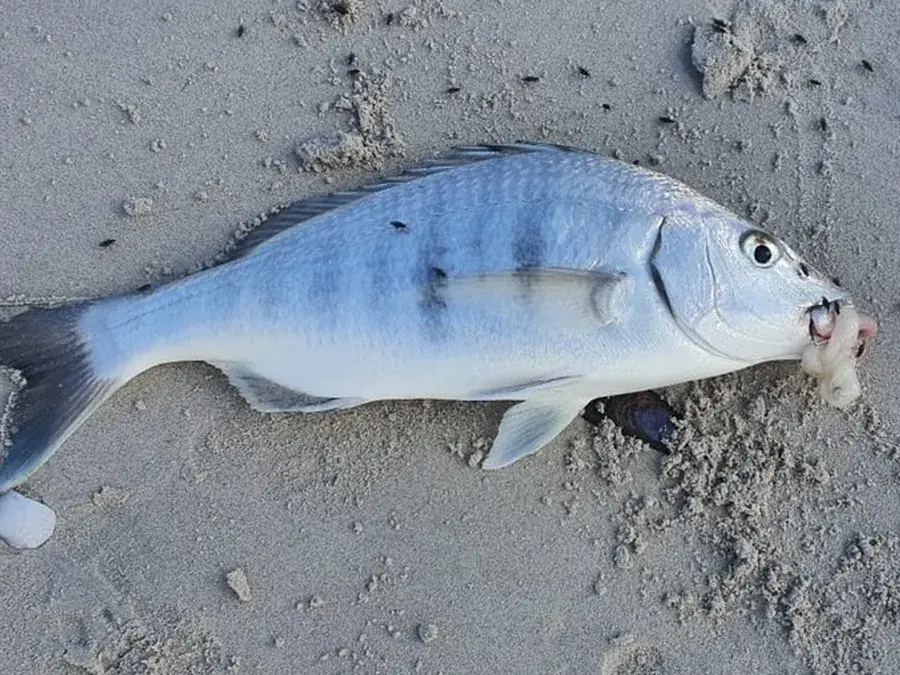
Photo by Dave Richardson on iNaturalist · CC BY 4.0
White steenbras (pignose grunter)
Lithognathus lithognathus
- When
- Oct–Apr — January, February, March, April, October, November, December. Earlier where the water warms first.
- Habitat
- Sandy beaches and mixed sand-and-rock shorelines in the surf zone, and the lower, sandy reaches of estuaries such as the Berg, Heuningnes, Knysna and Swartkops. Young fish spend their first two or three years in estuaries.
- Identification
- A big, silvery seabream with a mother-of-pearl sheen, a pointed nose and a small mouth — tiny teeth at the front, crushing molars behind. Young fish carry dark crossbars that fade with age.
- Notes
- Once the backbone of Cape shore angling, now Endangered after decades of over-fishing. It feeds on sandbanks by blowing a jet of water into prawn and worm burrows. Spring to autumn is the time; it is scarce in Cape surf and estuaries in winter, when adults are thought to move east to spawn off the Transkei.
- Method
- Live sand or mud prawn, or a bloodworm, on a light running trace in the surf gutters and estuary channels on a rising tide.
- Caution
- One a day at 60 cm or more, on a DFFE recreational permit (online or at the Post Office), and it may never be sold. Most are not mature until about 65 cm, so WWF-SASSI asks anglers to tag and release every white steenbras. No fishing at all in no-take marine protected areas, including the restricted zones of the Table Mountain MPA around the Cape Peninsula.
Seasons, size limits and catch limits change every year and differ by water body. Check the current regulations for the country and the water before fishing.
White steenbras (pignose grunter) facts
- Also called
- Pignose grunter; witsteenbras or wit steenbras in Afrikaans.
- Family
- Sparidae, the seabreams and porgies.
- Native range
- Endemic to South Africa, from the Orange River mouth to KwaZulu-Natal. The main stock lives along the Western and Eastern Cape coasts; it is rare in KwaZulu-Natal and scarce on the Northern Cape coast.
- Habitat
- Sandy and mixed sand-and-rock shores from the surf zone to about 25 m (80 ft). Juveniles depend on estuaries — mainly from the Berg to the Eastern Cape — for their first two or three years, then live in the surf zone before ranging more widely as adults.
- Water temperature
- Warm-temperate coastal water. AquaMaps puts its preferred surface water at about 14–24°C (57–75°F).
- Size
- Most adults 40–80 cm (16–31 in); the largest measured about 138 cm (54 in).
- Record
- No IGFA all-tackle category. The South African shore-angling record is 26.3 kg (58 lb), kept by the South African Shore Angling Association; the longest fish measured was 137.6 cm.
- Lifespan
- 25–30 years.
- What it eats
- Worms, crabs and other crustaceans, sand-dwelling clams, mysid shrimps and sea urchins. It blows a strong jet of water into a burrow to flush out the animal inside.
- Spawning
- Late winter, July and August, close inshore off a few river mouths on the former Transkei coast of the Eastern Cape. The larvae drift south and west and enter estuaries at 18–50 mm. Fish mature at about six years and 65 cm.
- Young fish
- Young fish live in the lower, sandy reaches of estuaries, feed on the banks at night and keep to a small home range.
- Teeth and mouth
- A small mouth under a pointed snout, with tiny teeth at the front of the jaws and crushing molars further back.
- Look-alikes
- Its relatives the West Coast steenbras (Lithognathus aureti), of Namibia and the Northern Cape, and the sand steenbras (Lithognathus mormyrus) are easily confused with it. Spotted grunter shares its estuaries and its prawn-blowing habit but is covered in small brown spots.
- Eating
- A no-sale species in South Africa: only recreational anglers with a permit may take it, and WWF-SASSI asks them to release it.
- Status
- Endangered on the IUCN Red List (2024). The stock collapsed after decades of beach-seine, purse-seine and shore-angling catches; commercial catches were banned in 2001, and numbers have since risen inside protected areas such as De Hoop.
Interactive
White steenbras: size range
Move the slider from a typical adult to the largest recorded specimen, shown against objects of known size.
Most adults you'll catch: 40–80 cm (16–31 in).
This white steenbras (pignose grunter): 60 cm. Longer than a loaf of bread, shorter than a four-year-old.
The record
No IGFA all-tackle category. The South African shore-angling record is 26.3 kg (58 lb), kept by the South African Shore Angling Association; the longest fish measured was 137.6 cm.
Questions people ask about white steenbras
What is the bag limit for white steenbras?
One fish per person a day, at least 60 cm long, on a DFFE recreational permit. It is a no-sale species. Because most white steenbras only mature at about 65 cm, WWF-SASSI asks anglers to tag and release every one.
Why is it called the pignose grunter?
For its pointed nose and its habit of rooting on sandbanks: it blows jets of water into the burrows of prawns and worms to flush them out, often in water barely deep enough to cover it.
Is the white steenbras endangered?
Yes. It is listed as Endangered by the IUCN. Shore-angler catch rates fell by about 90% between the 1970s and the 1990s, and the stock was assessed as collapsed. It lives 25–30 years and needs about six years to breed, so recovery is slow.
Where do white steenbras breed?
Off a handful of river mouths on the former Transkei coast in July and August. The young drift with the currents and settle in estuaries all the way west to the Berg River, where they live for their first two or three years.
Found in these regions
Checked against these sources ·
- FishBase — Lithognathus lithognathus
- Mann (ed.), Southern African Marine Linefish Species Profiles — ORI Special Publication 9 (2013)
- WWF-SASSI — White steenbras
- SANParks — Protecting South Africa’s endangered white steenbras: lessons from two estuaries (2024)
- Two Oceans Aquarium — White steenbras
- FOSAF — Saltwater fly-fishing report, Garden Route
Sizes, records and ranges are for the species as a whole; local populations and rules vary. Records change; the record-keeper named above holds the current one.
Local activity
This week's guide for a place
Enter a town, postal code or ZIP for this week's conditions there, based on the local climate, this week's weather and the ecological region.
Also active in October
 FishYear-round
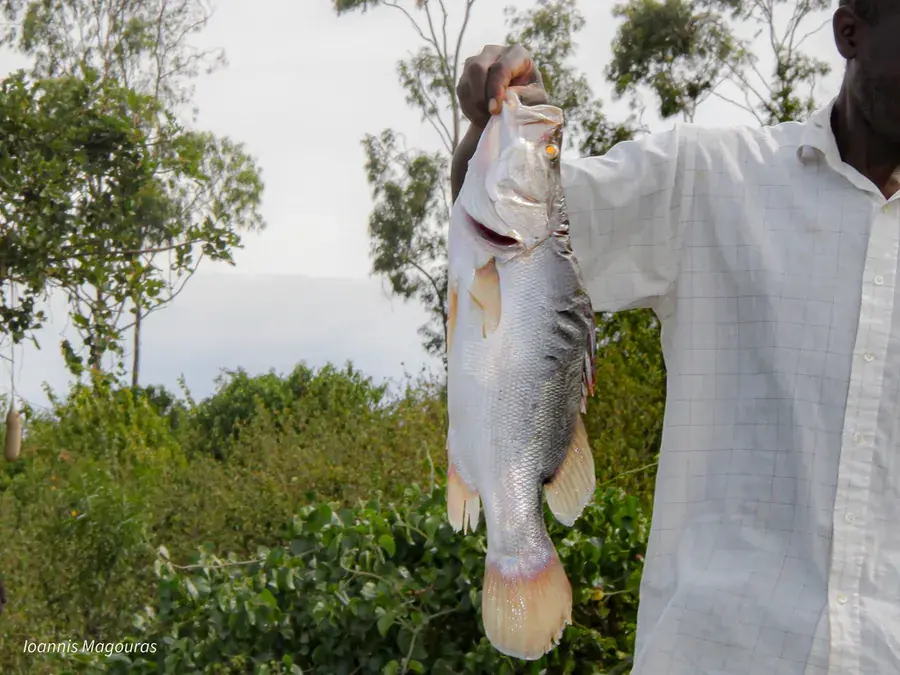
Nile perch
Lates niloticus
A huge silver perch with a blue sheen, a dorsal fin cut deeply into spiny and soft halves, a rounded tail, and a dark eye ringed in bright yellow.
Habitat and methods →Photo: Ioannis Magouras · CC BY 4.0
 FishYear-round
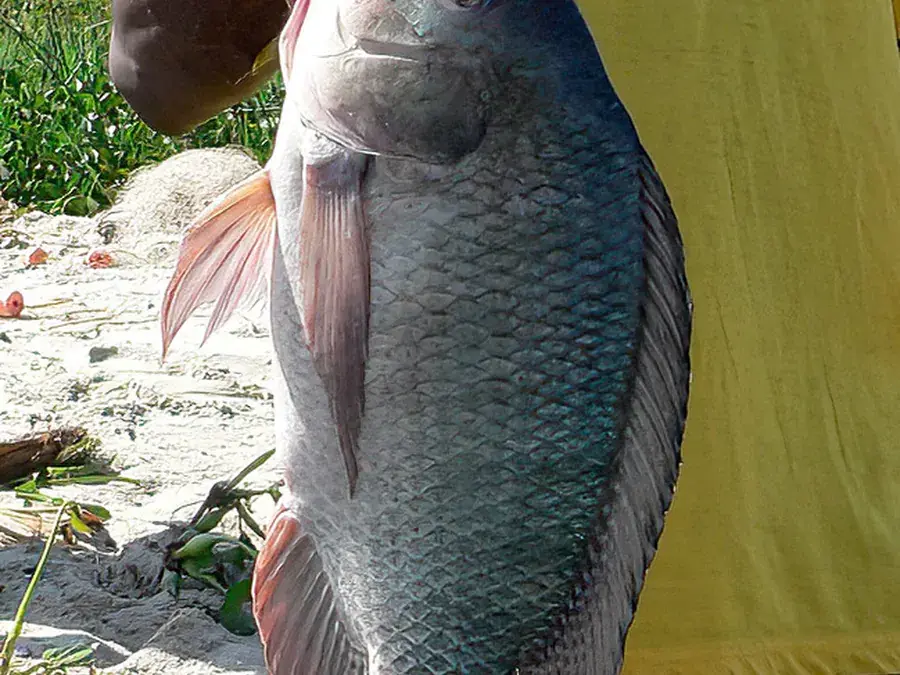
Nile tilapia
Oreochromis niloticus
Deep-bodied and grey-brown with faint bars, and the tell: regular dark vertical stripes right across the tail fin. Breeding males turn reddish, especially on the fins.
Habitat and methods →Photo: Pål A. Olsvik · CC BY 4.0
 FishSep–Apr
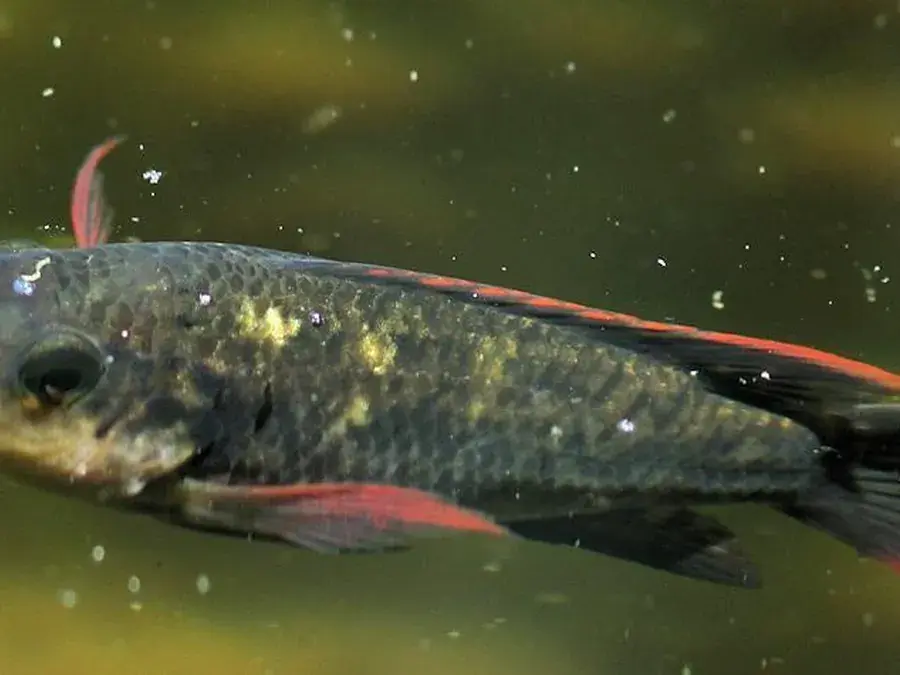
Mozambique tilapia (blue kurper)
Oreochromis mossambicus
Deep-bodied and dull silvery-olive with a few dark blotches along the side and no regular stripes on the tail. Breeding males turn black with a white throat, red-edged fins and a pointed, duck-bill snout.
Habitat and methods →Photo: Wynand Uys · CC BY 4.0