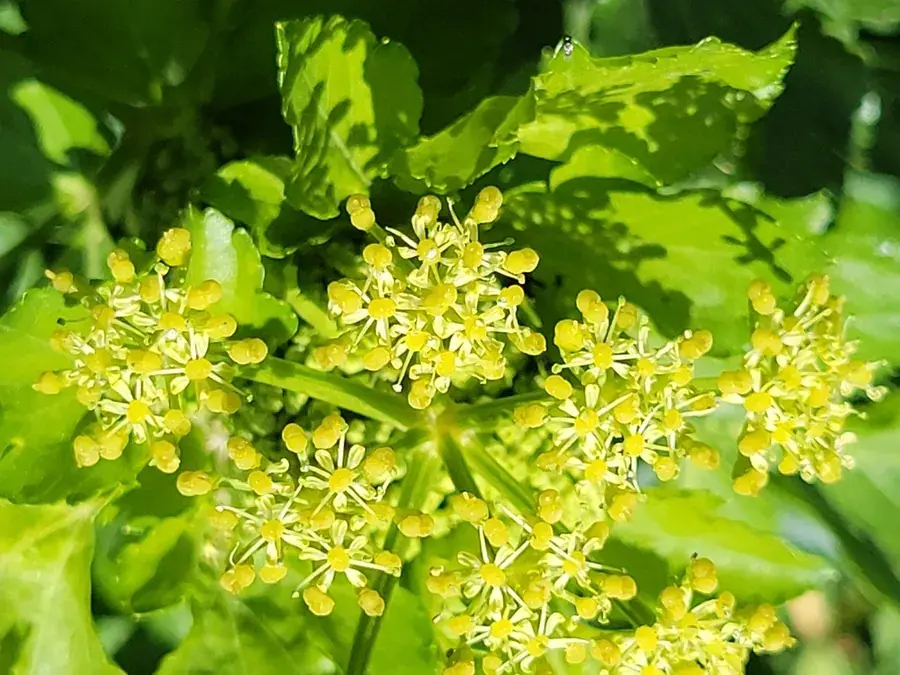
Photo by Matt Pelikan on iNaturalist · CC BY 4.0
Green·Season: February – May
Alexanders
Smyrnium olusatrum
Poisonous look-alike
Hemlock water-dropwort shares its family and can grow nearby; in Britain most recorded poisonings by it have been fatal. It has white flowers, finely divided, flat leaves that smell deceptively of parsley or celery, and grows in wet ground. Hemlock, also white-flowered, has ferny leaves and purple-blotched stems. Alexanders' flowers are yellow-green; before they open, learn the plant with someone who knows it.
- When
- Typically February – May — February, March, April, May. Earlier in warm, low country; later in the hills.
- Where it grows
- Road verges, hedge banks, cliff tops and cliff paths, field margins, scrub and waste ground, most of all near the sea in Britain and Ireland, where it was probably brought by the Romans; common through central and southern Europe and around the Mediterranean, its home.
- Identification
- A stout, hairless biennial up to 1.5 m (5 ft). The glossy, yellowish- to dark green leaves are divided into broad, bluntly toothed leaflets, and the stems are solid when young, becoming hollow and grooved with age. From April to June it carries dense, rounded umbels of yellow-green flowers with no sepals, followed by seeds that turn from green to black in July and August.
- Harvest and use
- Cut the succulent stems from February; they are at their best as the first flower buds appear in late March and April. Peel and steam or boil them like asparagus and toss in butter. Leaves and flowers go into salads, and every part is edible — the fleshy roots were once dug in winter. It was a common pot-herb until celery displaced it in the 18th century.
- Caution
- The danger is in the identification, above all in late winter and early spring, when the stems are picked before the flowers open. Never dig roots to eat unless the plant is unmistakable — hemlock water-dropwort's roots, mistaken for parsnips, cause the worst poisonings.
Alexanders at a glance
- Also called
- Alisander, horse celery, black lovage, wild celery, wild parsley, Macedonian parsley
- Family
- Apiaceae (the carrot family — the family of hemlock and hemlock water-dropwort)
- Where it grows
- Native around the Mediterranean, from Macaronesia and Iberia to Turkey and North Africa. In Britain and Ireland it is an old introduction, probably Roman, common on most coasts and inland in the south, and spreading along salted roads; in the north it keeps to sheltered coasts.
- When to pick
- Stems can be cut from February and are best as the first flower buds appear in late March and April. It flowers from April to June, and the seeds turn black in July and August.
- Parts used
- Young stems and leaf stalks (peeled and cooked), leaves, flowers, and roots dug in winter — every part is edible.
- More look-alikes to know
- Hemlock water-dropwort (Oenanthe crocata) grows in damp grassland, wet woods and along streams, rivers and canals throughout Britain and Ireland and down the Atlantic coast to Portugal: white flowers in June and July, flat, divided leaves, and pale, fleshy root tubers called dead man's fingers. See the hazard entries for hemlock water-dropwort and poison hemlock.
Questions people ask about alexanders
Is alexanders edible?
Yes, every part. Young stems are peeled and cooked like asparagus, young leaves go into salads and soups, and the roots were once dug in winter. It was a familiar pot-herb until celery replaced it in the 18th century.
How do you tell alexanders from hemlock water-dropwort?
By the flowers and leaves: alexanders has yellow-green flowers and glossy leaves divided into broad, blunt-toothed leaflets; hemlock water-dropwort has white flowers, flat, finely divided leaves and grows in wet ground. Hemlock water-dropwort is deadly, so if it isn't in yellow-green flower and you aren't certain, leave it.
When is alexanders in season?
From February to April. The stems can be cut from February and are at their best as the first flower buds appear in late March and April; the plant flowers from April to June.
Why is alexanders so common by the sea in Britain?
It is a Mediterranean plant, probably brought by the Romans, and too tender for hard frost, so in the north it survives mainly on the milder coasts. Road salting has helped it spread inland.
Found in these regions
Local season
This week's foraging guide for a place
Enter a town, postal code or ZIP for what is in season there this week, based on the local climate, this week's weather and the ecological region.
Also in season in October
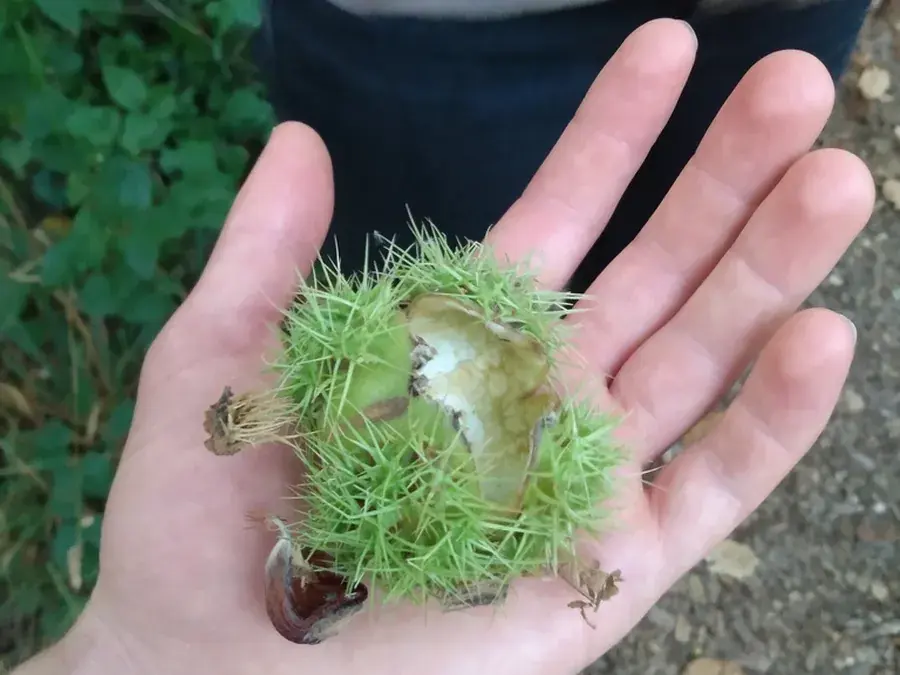 NutOctober – November
Sweet chestnut
Castanea sativa
A big tree with long, glossy leaves edged with sharp, regular teeth, and bark that twists in spiralling ridges on old trunks. The nuts come in twos and threes inside a husk covered in dense, needle-sharp spines; each is glossy brown, flat on one side, with a pointed tuft at the tip.
Identification and look-alikes →Photo: John Powers · CC BY 4.0
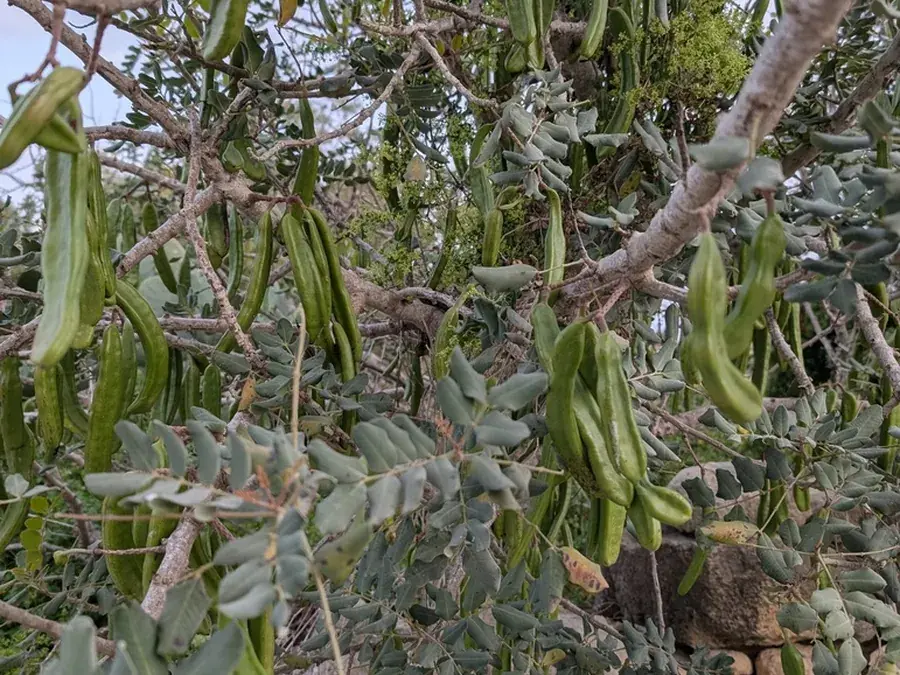 FruitAugust – October
Carob (St John's bread)
Ceratonia siliqua
A broad, round-crowned evergreen tree up to 15 m (50 ft) with leaves 10–20 cm (4–8 in) long, divided into pairs of leaflets. Small flowers grow straight from the trunk and old branches in autumn. The pods are flat, leathery and slightly curved, 10–30 cm (4–12 in) long, ripening from green to dark brown, sweet-smelling, with 10–13 very hard seeds. Most trees are male or female, and only females bear pods.
Identification and look-alikes →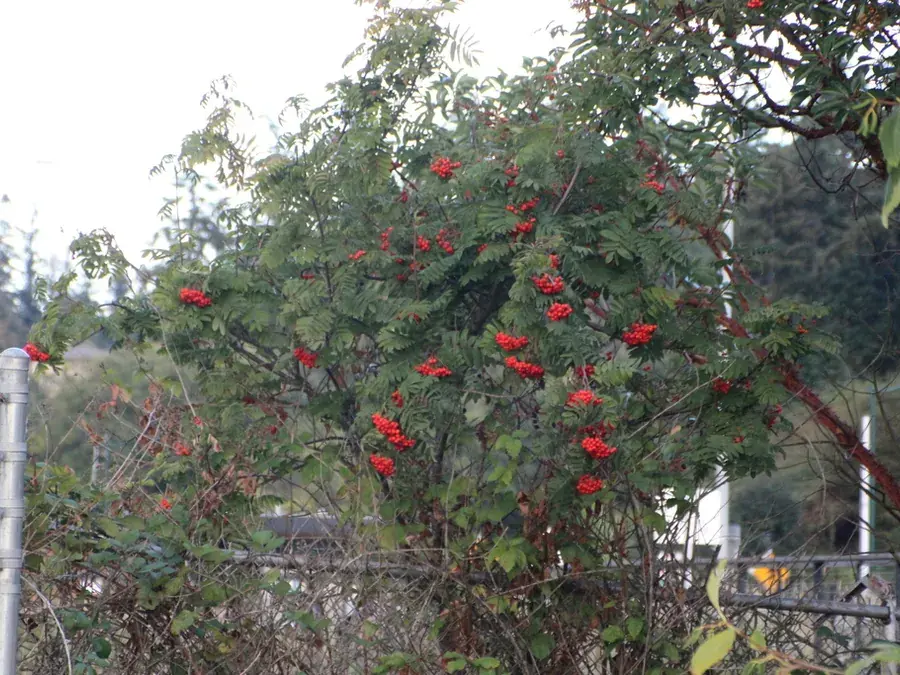 BerryAugust – October
Rowan berries
Sorbus aucuparia
A slim tree with smooth silvery-grey bark and feathery leaves of many toothed leaflets in pairs; big flat clusters of scarlet-orange berries, each about 1 cm (⅜ in) across with a tiny black five-pointed star at the tip.
Identification and look-alikes →Photo: Therese Phillips · CC BY 4.0
Checked against these sources ·
- Wikipedia — Smyrnium olusatrum
- First Nature — Smyrnium olusatrum, Alexanders
- BSBI — Smyrnium (archaeophyte in Britain and Ireland)
- Woodland Trust — Foraging in February (alexanders)
- Wild Bristol — Alexanders
- Wikipedia — Oenanthe crocata (hemlock water-dropwort)
- Canal & River Trust — Hemlock water dropwort
Seasons are typical for the middle of the range and move by weeks north and south, and up and down hills.
Educational information only. Never eat a wild plant or mushroom identified from a single photograph or description — confirm with a regional field guide or an experienced forager, and know the poisonous species in your area first.