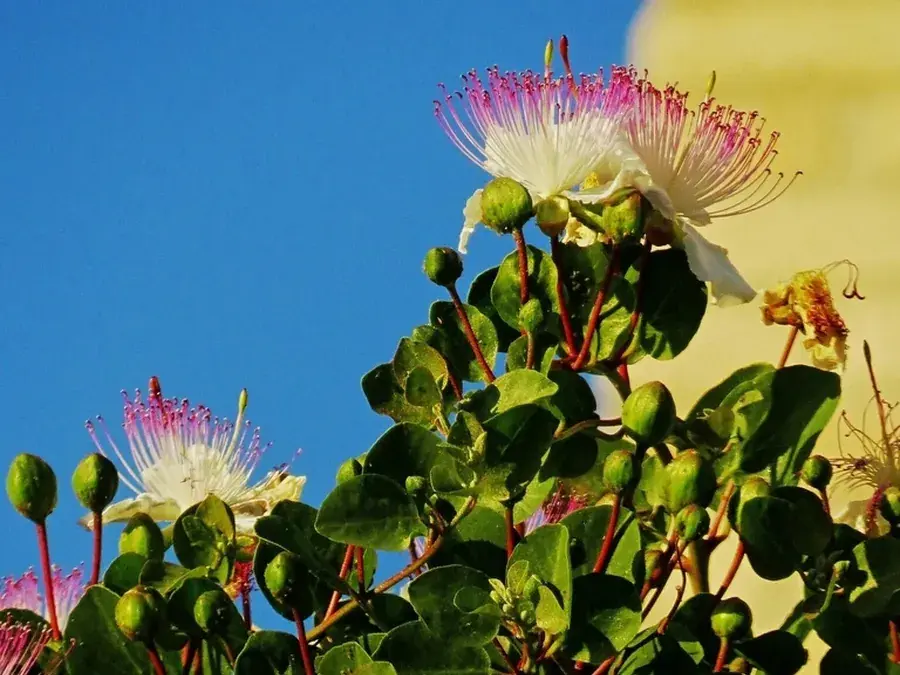
Photo by Gianni Del Bufalo bygdb on iNaturalist · CC BY 4.0
Green·Season: May – September
Caper
Capparis spinosa
- When
- Typically May – September — May, June, July, August, September. Earlier in warm, low country; later in the hills.
- Where it grows
- Old stone walls, rock crevices, cliffs and dry, stony slopes, often by the sea, all round the Mediterranean.
- Identification
- A sprawling shrub with long, trailing stems, thick, shiny, round to oval leaves and usually small curved thorns. The showy flowers last a single day: four white to pinkish petals and a burst of long violet stamens. Before they open they are small, round green buds — the capers. Left on the plant, they become plump green fruit on long stalks, the caper berries.
- Look-alikes
- A few poisonous species of Capparis elsewhere in the world look similar, so pick only a plant you know as Capparis spinosa.
- Harvest and use
- Pick unopened buds in the morning, the smaller the better, and come back to the same bush often. Raw buds are not eaten: dry them in the sun, then cure them in brine, coarse salt, or salt and vinegar, which releases their mustard flavour. Caper berries are pickled the same way.
- Caution
- Don't damage old walls and monuments, where the plant often roots. Many coastal cliffs and islands are protected: in Italy's national parks, for example, collecting wild plants is forbidden outside farmed land unless the park's own rules allow it.
Caper at a glance
- Also called
- Caper bush, Flinders rose
- Family
- Capparaceae
- Where it grows
- Native to almost every country round the Mediterranean — Spain, Portugal, France, Italy and its islands, the Balkans, Greece, Turkey and North Africa from Morocco to Egypt — and on into western and central Asia.
- When to pick
- Buds form from about April to September, most heavily in the hottest months; each flower lasts a day, so pick bushes every morning or two. Caper berries follow in summer.
- Parts used
- Flower buds (capers) and fruit (caper berries), cured. Dried leaves have been used in place of rennet in cheese-making.
Questions people ask about caper
Are capers flower buds?
Yes. Capers are the unopened flower buds of Capparis spinosa, picked by hand each morning; the smallest buds are the most prized.
Can you eat capers raw?
Not as a rule. Fresh buds are sun-dried and cured in brine, salt, or salt and vinegar, which lets an enzyme release their mustard-oil flavour (from glucocapparin).
What are caper berries?
The fruit that forms if a bud is left to flower: much larger, on a long stalk, and pickled to eat like olives.
Can I pick wild capers?
Where it is allowed and the plant is not on a protected monument. In Italy's national parks, for example, collecting wild plants is forbidden outside farmed land unless the park's rules allow it.
Found in these regions
Local season
This week's foraging guide for a place
Enter a town, postal code or ZIP for what is in season there this week, based on the local climate, this week's weather and the ecological region.
Also in season in October
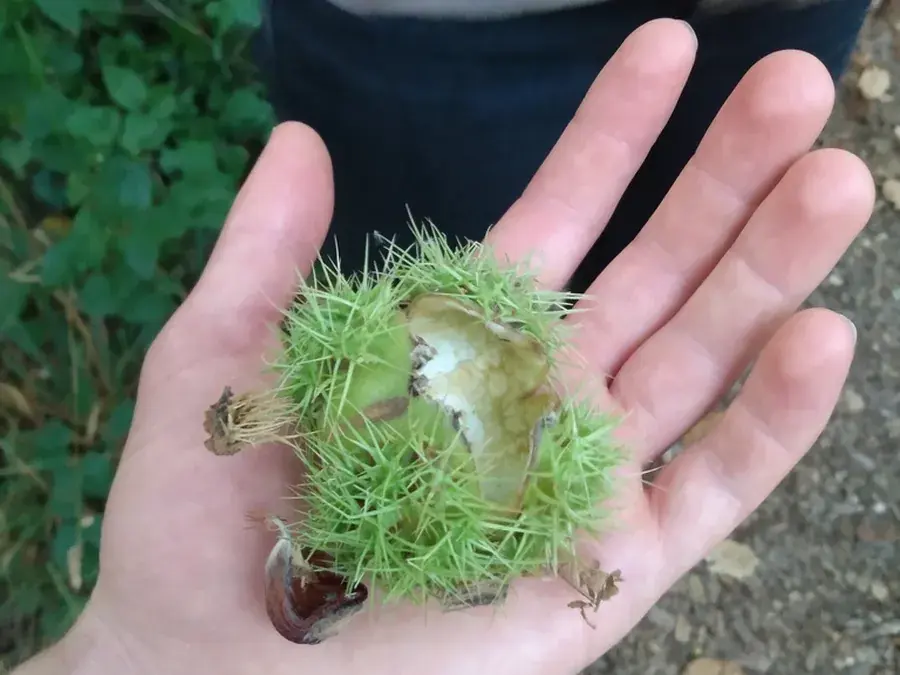 NutOctober – November
Sweet chestnut
Castanea sativa
A big tree with long, glossy leaves edged with sharp, regular teeth, and bark that twists in spiralling ridges on old trunks. The nuts come in twos and threes inside a husk covered in dense, needle-sharp spines; each is glossy brown, flat on one side, with a pointed tuft at the tip.
Identification and look-alikes →Photo: John Powers · CC BY 4.0
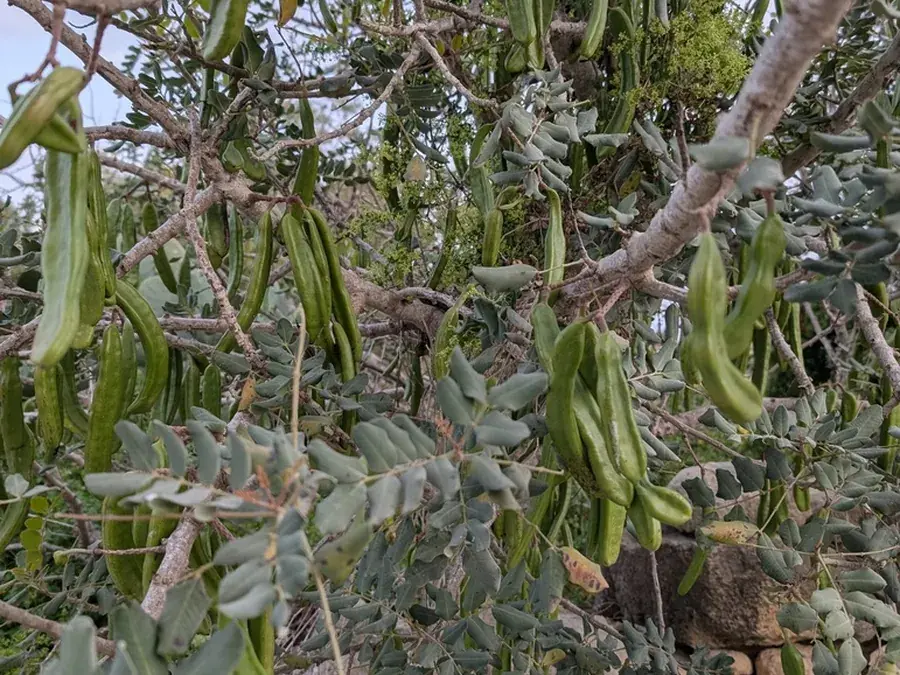 FruitAugust – October
Carob (St John's bread)
Ceratonia siliqua
A broad, round-crowned evergreen tree up to 15 m (50 ft) with leaves 10–20 cm (4–8 in) long, divided into pairs of leaflets. Small flowers grow straight from the trunk and old branches in autumn. The pods are flat, leathery and slightly curved, 10–30 cm (4–12 in) long, ripening from green to dark brown, sweet-smelling, with 10–13 very hard seeds. Most trees are male or female, and only females bear pods.
Identification and look-alikes →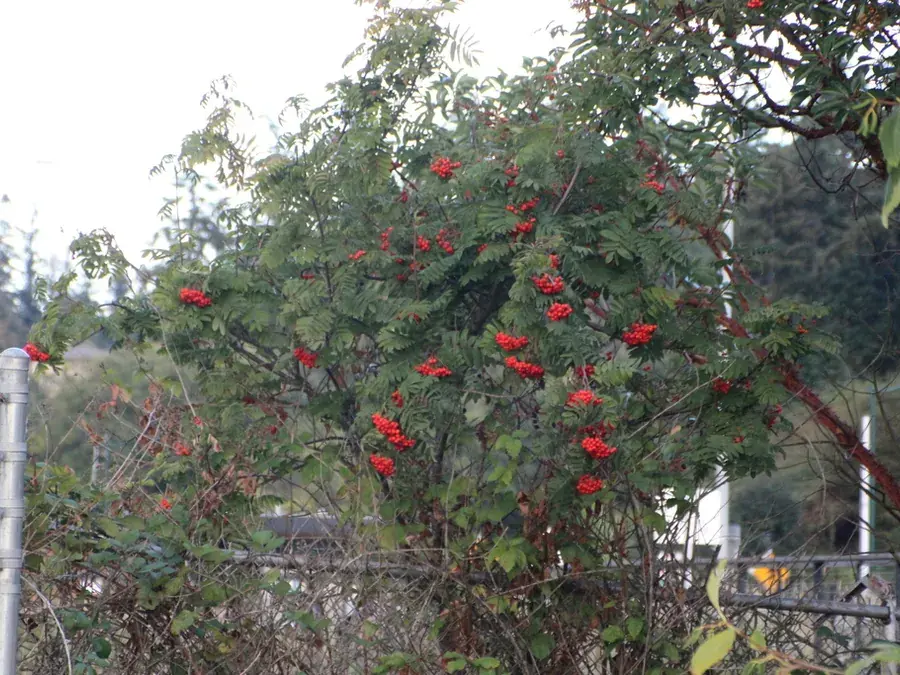 BerryAugust – October
Rowan berries
Sorbus aucuparia
A slim tree with smooth silvery-grey bark and feathery leaves of many toothed leaflets in pairs; big flat clusters of scarlet-orange berries, each about 1 cm (⅜ in) across with a tiny black five-pointed star at the tip.
Identification and look-alikes →Photo: Therese Phillips · CC BY 4.0
Checked against these sources ·
- Wikipedia — Capparis spinosa
- Kew, Plants of the World Online — Capparis spinosa
- University of Wisconsin–Madison Extension — Capers, Capparis spinosa
- Università di Palermo (IRIS) — Diversity and conservation of Capparis
- Legge 6 dicembre 1991 n. 394, framework law on protected areas (ISPRA)
Seasons are typical for the middle of the range and move by weeks north and south, and up and down hills.
Educational information only. Never eat a wild plant or mushroom identified from a single photograph or description — confirm with a regional field guide or an experienced forager, and know the poisonous species in your area first.